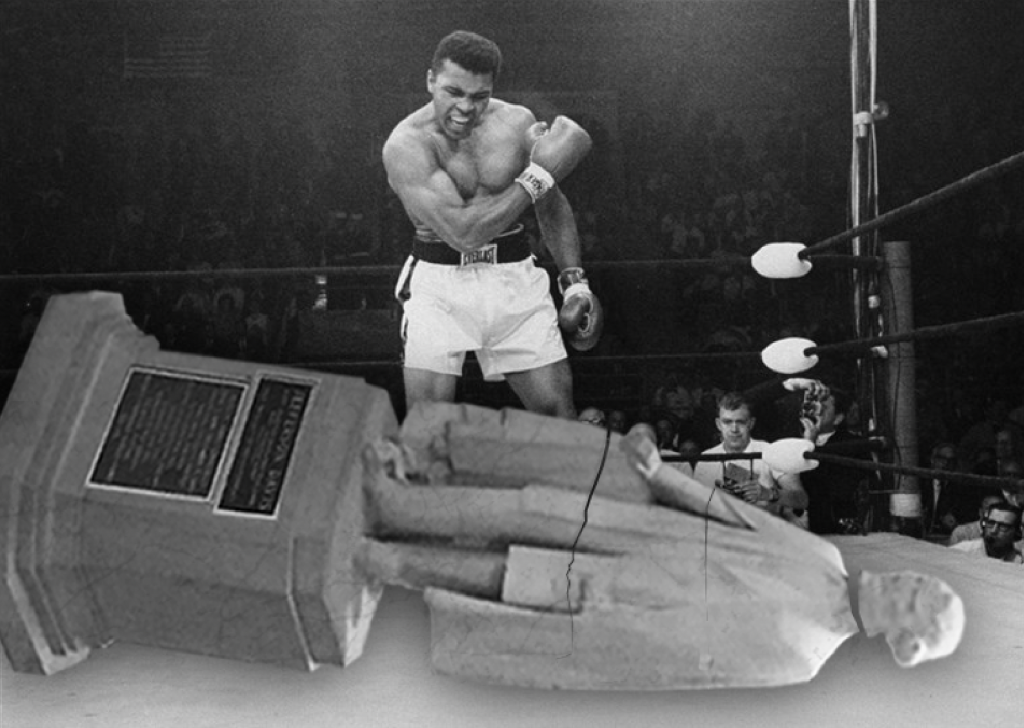
Please sign the petition below to remove the statue of Jefferson Davis currently in Kentucky’s Capitol Rotunda, and replace it with a tribute to Muhammad Ali, “the Louisville Lip” and “the Greatest of All Time.”
I just heard from the Ali family: It is the Champ’s belief that Islam prohibits three-dimensional representations of living Muslims. Accordingly, I have adjusted the petition to call for a two-dimensional representation of Ali (a portrait, picture or mural) in lieu of a statue.
UPDATE (Tuesday, December 2, 2014)
In this interview with WHAS-TV’s Joe Arnold, Governor Steve Beshear endorses the idea of honoring Muhammad Ali in the State Capitol (although he disagrees with removing Davis). Arnold explores the idea further on his weekly show, “The Powers that Be.”
Click here to check out WDRB-TV’s Lawrence Smith’s coverage of the story.
And here’s my op-ed in Ali’s hometown paper, the Louisville Courier-Journal.
UPDATE (Saturday, June 4, 2016)
In the wake of the 2015 Charlestown tragedy, in which a Confederate flag-waving murderer united the nation against racism, all of the most powerful Kentucky policymakers — U.S. Senator Mitch McConnell, Governor Matt Bevin, Senate President Robert Stivers and House Speaker Greg Stumbo — called for the removal of the Davis statue from the Rotunda. Today, as we commemorate last night’s passing of Muhammad Ali, there is no better moment to replace the symbol of Kentucky’s worst era with a tribute to The Greatest of All Time.
UPDATE (Wednesday, June 8, 2016):
Great piece by Lawrence Smith of WDRB-TV in Louisville on the petition drive to replace Jefferson Davis’ statue in the Capitol Rotunda with a tribute to Muhammad Ali.
UPDATE (Thursday, June 9, 2016):
Excellent piece on the petition drive by Jack Brammer that was featured on the front page of the Lexington Herald-Leader.
Highlight of the article:
Miller said he has received a few “angry comments” on his call to honor Ali.
“One of them encouraged me to kill myself,” he said. “You can quote me that I have decided not to take their advice.”
UPDATE (Friday, June 10, 2016)
The petition drives continues to show the Big Mo(hammed): check out these stories from WKYU-FM public radio in Bowling Green and WKYT-TV, Channel 27 in Lexington:
UPDATE (Saturday, June 11, 2016):
Still not convinced? Check out this excerpt from today’s New York Times:
By Nancy Slotnick, on Tue Oct 22, 2013 at 8:30 AM ET
“The only way you could meet my crazy was by doing something crazy yourself. Thank you. I love you. I knew it the minute I met you. I’m sorry it took so long for me to catch up. I just got stuck. Pat.”
We all bring our crazy to a relationship. Silver Linings does a beautiful job of writing a relationship where both participants are crazy but they take turns. They meet each other where they’re at. They end sentences with a preposition. They scream and throw dishes in public. They hug people whom they have a restraining order against or from. They end sentences with a preposition again. Did I mention that people call me crazy? They think I’m dreaming my life away, just like John Lennon wrote.
I struggle with how to let people into my life without letting them take over. How to embrace my crazy without getting caught up in it. How to recognize someone else’s crazy when they’re telling you it’s you. And when it’s also you. So complicated.
Spoiler alert- I’m going to talk about Silver Linings some more- I just loved it so much. It is rare for a romantic comedy (nay, romantic comedy/drama) to get it right without being trite. One of my favorite scenes was at the diner. Tiffany (Jennifer Lawrence) opens up about herself and seems to be having a moment with Pat. She offers to help her out and then he insults her by not wanting to be associated with her in the context of his ex-wife.
Rather than crying and running out of the restaurant (at first, at least), which I would have done, she balks. That’s the best word for her face. She looks at him, condescendingly, and says; “You actually think I’m crazier than you.” Not in the form of a question, but as a statement of disbelief. It’s great. I admire that. I wish that in the midst of a heating argument I could have the composure to do that. It was awesome. And then she smashes all the dishes off the table in one fell swoop and runs out of the restaurant, crying. I kind of wish I could do that too.
The beauty of it is that Pat realizes in that moment that he’s crossed a line and then he comes to the rescue on her crazy. They go back and forth on this as their relationship blooms. And that gives new meaning to the phrase the “dance of intimacy.”
Read the rest of… Nancy Slotnick: People Think I’m Crazy…
By Erica and Matt Chua, on Mon Oct 21, 2013 at 1:30 PM ET
For every story on LivingIF, there is a backstory. Here are two unforgettable experiences we had due to Couchsurfing, both of which led to trip highlights. Let us know in the comments if there are any stories you’ve read here that you wanted to know more about how they happened…
HE SAID…
I wonder what our trip would have been without Couchsurfing. Staying with strangers, all around the world, was one of the most memorable experiences of the trip. The problem with Couchsurfing though is that it is a logistical challenge. Instead of heading to a central area to find a hotel, you have to head to residential areas, then find a person. Arriving in a new country, without a phone, trying to find someone inevitably leads to memorable situations. Nothing was quite like getting from Japan to South Korea.
Getting to South Korea meant exiting Japan, leaving Japan meant a last night out on the town that went from bar to bar to karaoke to sunrise. Taking a quick nap we had some takeout sushi for breakfast and headed to Tokyo’s Narita Airport. Narita is a city about an hour away from Tokyo, so we gave ourselves plenty of time, and casually switched trains from the metro to the suburban rail lines. Simple enough, just go to Narita, right? WRONG, never go to Narita…go to Narita Airport! They are very different destinations.
Arriving in Narita we realized our mistake and had burned our extra time. We ran out of the train station and asked a taxi driver how much to get to the airport. Translating on his phone he estimated it would be $120 and take over an hour…he recommended we take the train. Running back into the station, I saw a person who looked about 18 and asked him, “do you have an iPhone?” He responded, “hai” and handed it to me. Think about this for a second, on a train platform he just handed a complete stranger his iPhone…that’s Japan for you.
By John Y. Brown III, on Mon Oct 21, 2013 at 12:00 PM ET
I have found that, as a general rule of thumb, people usually have to “feel the heat” before “they see the light.”
Nothing seems more conducive to the attainment of wisdom than the receipt (or threat of receipt) of a painfully humiliating lesson.
Which means that, as a general rule of thumb, the wisest among us are also the ones among us who have accumulated the highest number of painfully humiliating lessons in the course of their lives.
So, if you want to be a wise person, ask yourself What painfully humiliating lesson am I pursuing today?
Or perhaps experiencing right now without even knowing it?
By Artur Davis, on Mon Oct 21, 2013 at 10:00 AM ET
Count me as skeptical that for all of the damage Republicans have incurred from the failed shutdown, the lesson has genuinely been learned. Not when there is an emerging narrative that the House GOP simply picked the wrong fight (allegedly, either draconian cuts to income support programs , or perhaps, a balanced budget amendment would have been more costly for Barack Obama to reject); not when a majority of the House GOP caucus still voted to perpetuate the shut-down; not when critics inside the party are framing the scope of the party’s dilemma almost entirely in terms of one specific faction, and therefore limiting their solutions to well funded primary interventions against the Tea Partiers.
Some of the “what if” shadow dancing mimics the misreading of public opinion that has haunted the right since the successes of the 2010 midterms: conservatives have consistently confused swing voter angst over Obamacare with a broad based rejection of a government “power grab” over healthcare as opposed to a notably specific distaste for aspects of the law: from scaled back coverage dictated by the “Cadillac tax” on high value policies; to diminished consumer autonomy to enroll spouses in employer plans; to the pressure on small businesses to pare their full-time workforce to avoid mandates. And the shift from declaring the Affordable Care Act so toxic that it would validate the shutdown strategy to suggestions that a softer political target like low income groups or a “support that is a mile wide and an inch deep” variation like the balanced budget amendment would have paid Republicans more dividends? The haziness of wishful thinking, overshadowed by a deeper failure to appreciate that shutdown itself validates the obstructionist label, the impression of being too inflexible to govern, that so threatens the party nationally and is even starting to creep into red states like Georgia and Louisiana.
There is a different kind of miscalculation driving the…take your pick..more responsible, more establishment, more centrist…wing of the party (which, as the one silver lining of this fortnight, seems finally emboldened). It is the assumption that mobilizing to downsize the Tea Party is an endgame by itself. The 144 Republican no notes that emerged in the House may be minimized as “throwaways” who were trying to forestall primary contests and could do so with the knowledge that their votes were not essential: but that misses the reality that such a sizable portion of the party’s elected representatives, well more than the 40 to 50 members of the Tea Party Caucus, felt so constrained politically, and evidence that the sensibilities behind the shutdown have much greater currency in the party than Republicans are comfortable acknowledging.
I was amused to learn that the show ‘Who Wants to Be a Millionaire’ is doing away with the phone-a-friend lifeline. There was Meredith Vieira with her big smile and syrupy voice explaining that the time had come to take away the lifeline that has been a staple since the beginning of the show because too many friends were using the internet (doing Google searches) to help the contestants. No kidding. Did the show’s producers just figure that out? It was plain to see the progression from the early years of the show when contestants would call wicked smart people to today when they just call people that are really fast at doing on-line searches. What’s next, “ask the audience” to check their iPhones at the door of the studio? Let’s face it lifelines are enabled by the web. Should we just get used to it or is there something more important than a game show going on here reflecting on the state of human interaction.
This comes as no surprise to anyone with a teenage daughter. When is the last time you shouted to your teenager, Get off of that phone you have been talking for an hour? It is far more likely that you have said, get off of that computer and do your homework or no text messages during dinner. It is obvious that phone-a-friend has been replaced with text messaging and Facebook walls. Phone conversations have been replaced with an always-on lifeline connecting friends in real time. Answers, information, advice, entertainment, and connections are all available 24/7. Conversations are now just fragments, short poorly spelled text messages, or 140 character epithets.
Is the loss of phone-a-friend necessarily a bad thing? Maybe new web-enabled lifelines are expanding our universe of possible friends and opening up new opportunities for deep engagement. I think that may be true but there are serious questions that need to be asked about real human engagement. I worry that the web and social media platforms have become the driver more than the enabler. Are we “friending” people because they are web-savy, spending a lot of time on social media sites, and quick to return our text messages? Or are we “friending” smart, interesting, caring people that leverage the web to enable connections and who will be there when you need them the most? Will these connections stand up to the crises that we all will face when personal engagement and support is critical? Is “friending” even the same thing as being a friend? I wonder if we have become so focused on our follower or friend counts on-line that we are forgetting what true friendship is really about.
Seems to me that lifelines are more about the people at the other end of the line than about a connection to the web. Technology is a great enabler that can help us to be better friends but it is not a replacement for the hard work of being a good friend. There will be times in all of our lives when we will need to say, I would like to use a lifeline. If it is all right with you I would like to hold on to my phone-a-friend.
The RP’s column this week for The Daily Beast was his most popular ever, blowing up the Internets. Here’s an excerpt:
Politics in my old Kentucky home has, for centuries, been awash in irreconcilable contradictions.
We stuck with the Union in favor of our favorite son, Lincoln, but then joined in common cause with the Confederacy after the Civil War had ended. A century later, we boasted some of the nation’s most progressive civil rights laws; yet, to this date, we still feature many of America’s most segregated societies. And while Kentucky’s been one of the largest beneficiaries of the New Deal/Great Society welfare state, the dominant strain in our politics remains a fierce anti-government, anti-tax worldview.
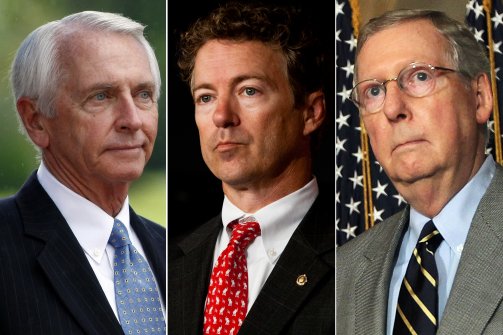
Kentucky’s perplexing and hypocritical aversion to big government has been exploited brilliantly by our senior senator Mitch McConnell, who’s capitalized on our cultural resentment of elite interference to transform the Bluegrass State into a deep-red citadel in federal elections. More recently, our junior senator Rand Paul catapulted McConnell’s vision much further than Mitch intended, placing Kentucky in the crosshairs of the Tea Party revolution. But while these two political icons and their surrogates clash over the depth of government slashing, they’ve been steadfastly united behind one common vision: the defeat, and, more recently, the repeal of the Affordable Care Act.
It’s no coincidence then that Obamacare is beginning to expose the political fault line that divides the two Kentuckys. The GOP’s effective—and quite misleading—messaging plays into the anti-establishment populace’s greatest fears about out-of-control outside interference: the myth of a government-run-health-care system, engineered by a President with socialist tendencies (and whose skin pigmentation and exotic name frankly heighten popular anxiety in some of the nation’s least educated counties). And yet, when you wade through the propaganda and understand the law’s true impact, Kentucky needs the Affordable Care Act…desperately. It’s a state consistently ranked near the bottom of nearly every national health survey, where one out of every six citizens remains uninsured.
With our long-standing tradition of timid politicians fearful of incurring the wrath of the anti-government mobs, it wouldn’t have been surprising to see Kentucky join much of Red America and reject both Obamacare’s Medicaid expansion to the working poor, as well as its option of establishing a state-run health benefit exchange to provide affordable health care to the remaining uninsured.
But in a delicious irony, Mitch McConnell and Rand Paul’s home state may ultimately serve as the proving ground of Obamacare’s success. That’s due to the political chutzpah of one man: Kentucky Governor Steve Beshear.
By John Y. Brown III, on Fri Oct 18, 2013 at 1:30 PM ET
I joke a lot about being 50. But that isn’t the only age I consider myself.
A few hours ago, it was 2:30am on October 18th which is about the exact time I had my last drink of alcohol 28 years ago.
We each, if we are lucky, have our actual birth date and another birth date when we are, some would say, “re-born.” Not necessarily in the religious sense…although it often is.
A line I love which captures this truth well comes from the movie The Natural with Robert Redford playing an aging and ailing baseball superstar. “We live two lives. The life we learn from and the life we live after that.”
I believe that. It’s not a perfect demarcation but it is a profound one. Maybe more crudely put it is the “life we tried to lead” and failed at and the “life we built up from those ashes.” It isn’t really a failure as much as a right of passage.
Most young people are full of vim and vigor and have a limited and self-absorbed view of the the world. Sometimes they crash and burn early, as I did. Sometimes the crash and burn later after having tremendous success. Sometimes they smolder for years until they careen off the road and into a ditch. This is our first life. The war years. The wild years when anything was possible.
Then there is the next life. The reality years. You don’t sell out but integrate and find your place and hopefully a place where you can be and do what you are meant to be and do. Until a person has hit their own self-imposed wall, they may be fun but aren’t terribly useful. Being useful is not a priority during this first life anyway, not really.
The “wall” introduces a person to him or herself. And soon after that a new life, based on the realm of the possible begins. It is a better and more useful life. Not less passionate or less fun or less exciting. But a grown-up (in the best sense of the word) has joined your “road trip” and turned it into a lifelong metaphorical journey. My wall. My old and sated life ending. My new and more useful life beginning all started about this time 28 years ago.
Here’s the post from last year describing the night. Hope it helps someone else in some small way. New lives are like that.


 Blog this!