By Artur Davis, on Mon Nov 28, 2011 at 8:30 AM ET  Occupy Wall Street is, in its current state, visible, noisy, and not terribly relevant. How can you stay relevant when the first major policy item on your agenda – student loan forgiveness for the unemployed and the low-income – is already law, and the second–substantial tax hikes for the wealthy – has already been claimed by one of the major political parties? Occupy Wall Street is, in its current state, visible, noisy, and not terribly relevant. How can you stay relevant when the first major policy item on your agenda – student loan forgiveness for the unemployed and the low-income – is already law, and the second–substantial tax hikes for the wealthy – has already been claimed by one of the major political parties?
Two other gripes with OWS: first, every modern progressive movement has derived its moral authority from its efforts to elevate some marginalized class of Americans. This is the first left leaning movement whose rhetorical goal is to pull one class of Americans down to size. It is self-consciously divisive in a way that blacks, women and gays never were.
Finally, while the 99 percent is a glib, clever phrase, it literally links the interest of a hungry child in the Mississippi Delta to those of a six figure accountant whose mortgage is underwater. If you are going to mimic the symbols of Dr. King’s Poor Peoples Campaign, at least have the depth to say something specific about poor people.
(Cross-posted, with permission of the author, from Politico’s Arena)
By Zack Adams, RP Staff, on Tue Nov 22, 2011 at 8:30 AM ET 
This is just the tip of an oppo iceberg that would make Herman Cain’s look like a pebble.
With the prospects of a vulnerable president and a Senate that’s clearly within reach, I just can’t imagine Republicans nominating someone so noxious among independents, someone with so much baggage. But Newt’s boomlet is yet another sign of the fact that this was really Rick Perry’s nomination to lose – something Perry’s worked diligently to do almost since the day he entered.
Every day this media-manufactured boomlet persists is another day that some enterprising journalist will dig a little deeper into Newt’s past. Like Cain, he’ll claim that the liberal media is trying to bring him down, when in reality, it will be his own pattern of reckless personal, political, and profit-seeking behavior that will do the trick.
(Cross-posted, with author’s permission, from Politico’s Arena)
By Jeff Smith, on Fri Nov 18, 2011 at 8:30 AM ET 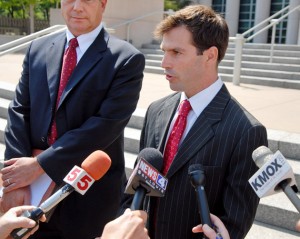 The 51 percent approval is definitely problematic. But remember that while the president’s struggles have been dissected in every way possible for the past three years, the inept Republican presidential field has yet to lay a glove on Mitt Romney. Democrats are likely to ensure that he is unrecognizable a year from now. The 51 percent approval is definitely problematic. But remember that while the president’s struggles have been dissected in every way possible for the past three years, the inept Republican presidential field has yet to lay a glove on Mitt Romney. Democrats are likely to ensure that he is unrecognizable a year from now.
There are a lot of angry unemployed people in the country who blame the president for their plight, but it may be hard for Republicans to rally swing voters around that sentiment, given the fact that the economy wasn’t exactly humming along when the president took office.
Conversely, there are thousands more who, after being laid off by the profit-hungry Bain Capital machine, blame Mitt Romney. Their sentiments are, I think, more likely to move voters; I suspect that many of their heartbreaking stories will emerge.
By Artur Davis, on Thu Nov 17, 2011 at 8:30 AM ET
When approval of Congress barely crosses the 10% Mendoza line–an old baseball slang named after a journeyman player who consistently batted .100–it’s safe to say that improving their stock portfolio should not be a major fixation for senators and representatives. Recent press reports regarding stock trading by congressmen has touched one more nerve for a public that already believes politicians operate in their own gilded, privileged world.
I am still, however, a bit torn here–not because I did the same thing (for what its worth, I never owned stocks during the time I served in Congress) and not because I think it’s a good thing to use an elected office to further personal profit. The problem I have is that the controversy, in all its unseemliness, spares us some needed introspection: about how narrow some of our financial laws are, and about what some ill-timed trades say about a larger culture that virtually all us aided and abetted.
First, the laws and their relatively limited state. The misconceptions around insider trading are extensive, even in informed circles. Its not well known, for example, that you can search the whole federal criminal code and never find the term “insider trading”; the concept is a creation of how judges and regulators have interpreted the securities fraud laws (which were written in the thirties, before E-Trade, before money markets flourished, before stocks became a middle class instrument to fund colleges and cushion retirements).
 The prevailing myth is that “insider trading” means you can’t buy or sell stocks based on “confidential information”. That’s actually wrong–the courts and regulators have focused on only one class of violations–hinging on individuals who have a specific legal or fiduciary duty to the source of the information. It’s true that you can be on the hook for criminal liability if you get information from someone that you know breached their fiduciary responsibilities–but it can be tough to prove what a trader knows about the ties between his source and the company whose confidences are being breached. The prevailing myth is that “insider trading” means you can’t buy or sell stocks based on “confidential information”. That’s actually wrong–the courts and regulators have focused on only one class of violations–hinging on individuals who have a specific legal or fiduciary duty to the source of the information. It’s true that you can be on the hook for criminal liability if you get information from someone that you know breached their fiduciary responsibilities–but it can be tough to prove what a trader knows about the ties between his source and the company whose confidences are being breached.
Read the rest of…
Artur Davis: On Congressional Insider Trading
By RP Staff, on Wed Nov 16, 2011 at 8:30 AM ET Our own contributing RP, Jeff Smith, once again is hitting the international public airwaves, the subject of a lengthy interview on National Public Radio on his jail experience and recovery.
Click here to listen.
By Patrick Derocher, on Tue Nov 15, 2011 at 12:00 PM ET 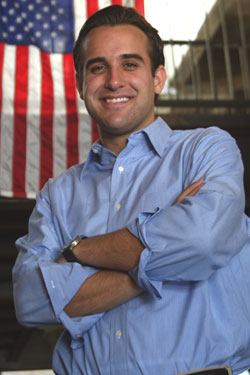 Rick Perry’s debate performance up until that point was not horrible. Every candidate has lapses at some point, its human. However, the fact that Perry has been bad in earlier debates and the fact that he forgot the Department of Energy puts his White House viability on life support. Throughout the campaign the governor has championed what he has done with energy issues in Texas. This is why the lapse is even more troubling. At this point of the primary race, Perry needs to put most of his emphasis and resources on Iowa. He has the money and organization to stay in the race for the time-being, but this misstep could and probably will prove to be the knockout punch for Perry 2012. Rick Perry’s debate performance up until that point was not horrible. Every candidate has lapses at some point, its human. However, the fact that Perry has been bad in earlier debates and the fact that he forgot the Department of Energy puts his White House viability on life support. Throughout the campaign the governor has championed what he has done with energy issues in Texas. This is why the lapse is even more troubling. At this point of the primary race, Perry needs to put most of his emphasis and resources on Iowa. He has the money and organization to stay in the race for the time-being, but this misstep could and probably will prove to be the knockout punch for Perry 2012.
(Cross-posted, with author’s permission, from Politico’s Arena)
By Artur Davis, on Fri Nov 11, 2011 at 8:30 AM ET
We never stop fretting over race and politics, largely because neither side of the political divide will let the subject go. Most Democrats I know are convinced that Barack Obama’s struggles are related partly to his race and anxieties over the rise of a multi-cultural power base. The accusations that Herman Cain harassed or aggressively propositioned at least four white women have stirred a new tempest, with conservative defenders of Cain suspecting race is at the bottom of the uproar, and liberals assuming that in the words of one pundit, “the layer of black sexuality” is what will kill off Cain with Republicans
Powerful stuff in a climate that was supposed to be “post-racial”. It’s a vexing enough subject that absurdities are flourishing on both sides: attributing Obama’s slide to race rather than the economy ignores the color-blindness descendants of Confederate soldiers displayed In Virginia and North Carolina in voting for Obama in 2008, or for that matter, the 50% plus approval ratings Obama enjoyed in Alabama and Mississippi in the spring of 09. Is the theory that they just didn’t look hard enough at Obama’s photos? Similarly, asserting that Cain is in a predicament because of race assumes Mitt Romney would get a pass if it was discovered that multiple women at Bain Capital had accused him of harassment and that Bain had paid money to resolve the claims.
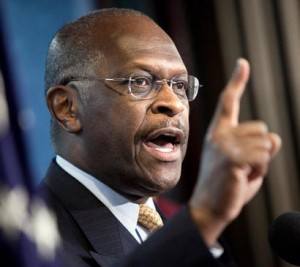
There are obvious straw-men at work here who are pretty easy to knock down. I generally agree with Ross Douthat of the New York Times, a smart, thoughtful center right columnist, who writes this week that in politics, “race matters, but ideology matters much, much more.” But I do find myself agreeing with one argument in circulation and it is worth addressing because it will matter long after Cain is done and collecting lecture fees.
Yes, Cain does inspire a special kind of loathing on the left for reasons that have something to do with his skin color. Full disclosure: I’ve been through a few of these fires, as the only black congressman who opposed Obamacare, as the rare African American politician who supports voter ID laws. I’ve seen it up close–there is a predisposition in some liberal circles to think that a black politician who deviates from the liberal line is “inauthentic” and dishonest, that he is deceptively trying to curry favor with white conservatives at the expense of his own. There is also a perverse kind of resentment that the “strategy” may work, that a black who can win conservative support can cut in line and therefore advance more quickly, that such a candidate will be spared the need to court certain power-brokers.
Read the rest of…
Artur Davis: What the Cain Scandal Reveals About Race & Politics
By Lisa Borders, on Thu Nov 10, 2011 at 8:30 AM ET This column, written by contributing RP Lisa Borders and former Comptroller General David Walker, appeared in yesterday’s Washington Examiner. We re-print with Ms. Borders’ permission.
This summer, the country was issued a warning. When Congress failed to deal with our growing national debt in a comprehensive and responsible manner, our debt was downgraded. We were lucky to get the warning.
The country was told to come to terms with its spending habits, escalating deficits, and growing debt burdens or risk a debt crisis that would do serious harm to our already tottering economy.
We were given a second chance. Our second chance comes in the form of a so-called “supercommittee” of 12 members of Congress who must recommend at least $1.2 trillion in deficit reduction by Thanksgiving, and then sell its plan to the full Congress.
Given that a debt crisis will push up interest rates and make our weak economy and high unemployment and under employment levels even worse, you might think Americans would be thankful for the opportunity to make a few sacrifices to avoid it. But no.
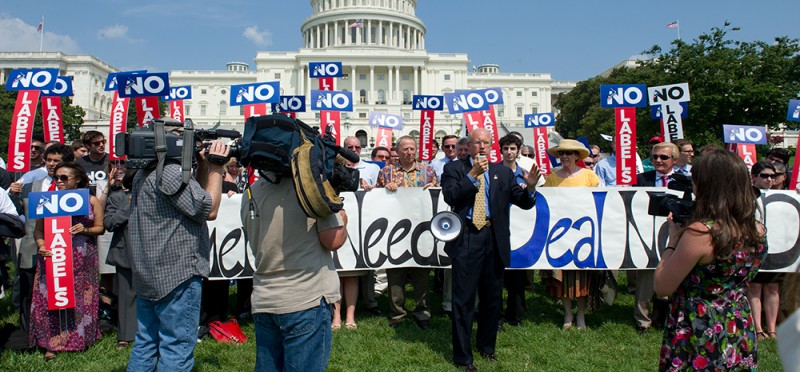
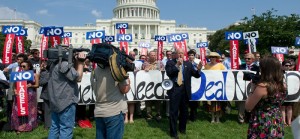 Dave Walker leading a No Labels rally Two hundred lobbying groups and special interests are reportedly trying to reach the supercommittee with essentially the same message: “cut everyone else but me; it’s all about me.”
The special interests don’t seem to care that every serious bipartisan group that’s studied ways to reduce our growing debt burden has come up with the same conclusions: 1) We need way more than $1.2 trillion in deficit reduction to prevent a crisis; 2) we need to cut costs and raise revenues to restore fiscal sanity, and 3) sky rocketing health care costs are the primary driver of our imbalance. We simply can’t fix our economy without reigning in our national health care programs, including Medicare.
Read the rest of…
Lisa Borders: Budget Battle is Not All About Me
By Krystal Ball, on Tue Nov 8, 2011 at 8:30 AM ET I have never held political office.
Like most young women of my generation, running for office was something I never pictured myself doing. I tended to think of politicians as coming from two different-and unappealing groups-extreme partisans and opportunists.
But when I decided to run for US Congress in early 2009, shortly after my daughter was born and in the throws of the idealism and hope that President Obama’s inauguration represented, I realized that things are the way they are in this country in large part because people like me, young mothers, young women struggling to make careers and find their way in the world, don’t participate very much in the political process.
We tend not to run for office. We feel in fact virtually excluded from the national political conversation. And I felt, and still feel, that the absence of the voices of women generally, and young women in particular, was hurting us as a country.
So, even though I felt absolutely 100% terrified about the whole process, I threw my hat in the ring and ran for US Congress. I thought that if I could overcome my shyness and insecurities and run for office, perhaps that would serve as an example for a few more young women to run and that those few more could serve as an example for more still until eventually thousands of young women, from all over the country, decided to participate in the political process and run for office at every level, and the higher the better. There’s no question in my mind that if this were to happen things in this country would really change.
Read the rest of…
Krystal Ball: Why We Need More Young Women in Politics
By Zack Adams, RP Staff, on Mon Nov 7, 2011 at 12:00 PM ET So, this turns some commonly used forms of birth control into murder. What a great idea!
Given everything else on the nation’s plate right now, a focus on this seems so 90s. It will inevitably result in many years of costly litigation.
(Cross-posted, with author’s permission, from Politico’s Arena)
|
|