By John Y. Brown III, on Fri May 11, 2012 at 12:00 PM ET  “Don’t be frontin'” “Don’t be frontin'”
I heard this phrase a few days ago and looked it up and like what it means. Basically, don’t put on airs to impress or deceive people.
That’s an important message and one I echo and would like to share with others.
I try to keep up with hip new lingo…and even occasionally use it, if I can get away with it.
But it’s been three days now since I’ve been looking for an opening to use the phrase “Don’t be frontin'” and I haven’t found the right opportunity yet….and am starting to think there may never be a way for me to get away with using this phrase without people cracking up….as I crack up with them.
That’s unfortunate. In other words, that’s neither “fly” nor “dope.”
By the way, I’ve been looking for an even longer time to use the terms “fly” and “dope.”
And this post probably wasn’t ideal. Just doesn’t work. Oh well.
Sometimes it’s better to just be who you are than something your not. Otherwise, you’re just frontin’
Hey! I did it!!!
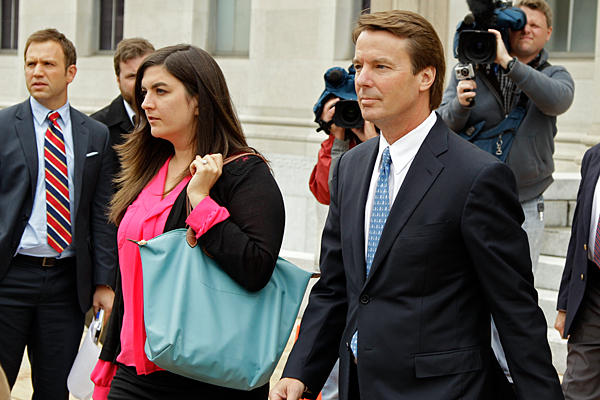
By Jeff Smith, on Fri May 11, 2012 at 8:30 AM ET  As a former state senator who served prison time for lying about a campaign finance violation involving approximately $10,000, I unfortunately have a unique perspective on the imbroglio surrounding former Sen. John Edwards, D-N.C. — a case in which campaign finance law, selective prosecution, and budget priorities in a time of scarcity happen to intersect. As a former state senator who served prison time for lying about a campaign finance violation involving approximately $10,000, I unfortunately have a unique perspective on the imbroglio surrounding former Sen. John Edwards, D-N.C. — a case in which campaign finance law, selective prosecution, and budget priorities in a time of scarcity happen to intersect.
The media attention surrounding my own guilty plea, resignation and prison sentence was extremely painful. Yet it was nothing compared with the widespread ridicule Edwards has received. His public image is ruined, and he faces a real possibility of prison. Even so, prison is not an appropriate punishment for someone who conceals an affair.
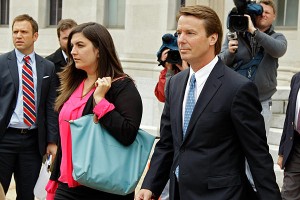 Edwards is now being prosecuted in federal court because one of his campaign backers pitched in to support his mistress and their love child, at a time when the public was unaware he had either. To the layman’s eye, such payments may not look like campaign contributions at all, let alone illegal ones. But according to prosecutors, they helped Edwards’ 2008 presidential campaign by concealing his infidelity and preserving his public image as a devoted family man. Edwards is now being prosecuted in federal court because one of his campaign backers pitched in to support his mistress and their love child, at a time when the public was unaware he had either. To the layman’s eye, such payments may not look like campaign contributions at all, let alone illegal ones. But according to prosecutors, they helped Edwards’ 2008 presidential campaign by concealing his infidelity and preserving his public image as a devoted family man.
Read the rest of…
Jeff Smith: The Wasteful, Adrenaline-filled Case against John Edwards
By John Y. Brown III, on Thu May 10, 2012 at 12:00 PM ET I know some people swear by the value of “Product Replacement Plans.” (PRPs)
You know those 15-20% of the sale price insurance policies that if the product breaks shortly after you buy i you get it replaced easily?
I don’t care for them, personally.
They suggest to me either that somebody is layering in another layer profit margin (since products sold new are supposed to work) or are we are making products so poorly that customers need to buy insurance against the product breaking in the first few months. Neither seems an appealing conclusion.
Do other countries push PRPs like we in the US?
It seems more a sign of clever sales gimmickry, in my view. But subconsciously sends the message that “We don’t make things well.”
Imagine if McDonald’s tried to sell us a PRP at 20% of each meal to protect against food poisoning? And people bought it!
Or the next time I bought a watch paying an extra 15% for PRP against the watch not telling time?
I just left office supply shop and was asked about a PRP for a technology item. I asked, “Why? Is something wrong with it? Should I expect it to break in a few months?”
The salesperson laughed and so did I….but I was sort of serious, too.
Although I didn’t say anything more I wanted to add “If you don’t have more confidence than that in this product, I don’t want to buy it. Is there another product that works well enough that it doesn’t need insurance against breaking right away?”
Maybe I will add that the next time. Or tell them I’ll come back when they are selling products that won’t break so easily.
By Artur Davis, on Thu May 10, 2012 at 8:30 AM ET Quin Hilyer of the Center for Individual Freedom published an article about Artur Davis’ rise as a proponent for ballot integrity:
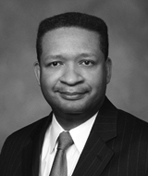 A new right-leaning star was born last weekend at the True the Vote summit in Houston, while the dynamo who heads True the Vote simultaneously achieved multiple goals related to ballot integrity. For a single 24-hour conference to achieve so much is remarkable, and deserves more attention than one meager column, alas, can give it. But let’s try. A new right-leaning star was born last weekend at the True the Vote summit in Houston, while the dynamo who heads True the Vote simultaneously achieved multiple goals related to ballot integrity. For a single 24-hour conference to achieve so much is remarkable, and deserves more attention than one meager column, alas, can give it. But let’s try.
First, what is True the Vote? Despite leftist propaganda to the effect that it is some sort of partisan (or even racial) attempt at vote suppression, True the Vote is a growing, bipartisan, multi-racial, national movement to ensure that elections are conducted with integrity and without polling-place antagonism. The idea is to place and train poll watchers, as per existing law, in every precinct in the country – so they will know exactly what they can and can’t do to stop and report voting irregularities without causing a stir that could in any way intimidate, much less suppress, legitimate voters….
But the surprising star of the show, according to many observers including this one, was former Rep. Artur Davis, the Alabama Democrat who gave one of the key nominating speeches for Barack Obama at the 2008 Democratic National Convention. In recent months, Davis has written numerous times for the conservative National Review, and he strenuously opposed ObamaCare while in Congress, so it was already clear that on at least some issues he leans right of center. It was already known that he supported voter-ID laws: Last October 17 he wrote a column in the Montgomery Advertiser saying as much. Of fraudulently manufactured votes, he wrote then, “If you doubt it exists, I don’t; I’ve heard the peddlers of these ballots brag about it, I’ve been asked to provide the funds for it, and I am confident it has changed at least a few close local election results.”
But that was child’s play compared to the tour de force of a speech he made last weekend. Holding up a photo-ID, he ridiculed those who say it is too great a burden to require one – especially those who have said such a requirement is a violation of civil rights and human dignity.
“This is not a billy club,” he said, recalling violent civil rights battles of the past. “This is not a fire hose…. This is not Jim Crow…. My parents and my grandparents can tell you what a colored-only water fountain tasted like. They could tell you what a colored-only bathroom smelled like.” It certainly, he said, was nothing like his ID card: “this tiny little thing that doesn’t wound, that has no sharp edges.” And: “To call photo ID a degradation of human rights is not only something that is so fundamentally wrong, but is something my parents would not even recognize…. That [claim that ID requirements violate human rights] is the old tactic of telling us the very opposite of what it true.”
Also blasting the establishment media for waking up in tony enclaves and driving to offices in prime real estate while telling the rest of us that we are out of touch with America, Davis lumped those media folks together with the political ruling class that willingly looks away from (or tacitly condones) vote fraud. “You cannot let the insiders run this game,” he thundered.
Click here to read the full piece.
By John Y. Brown III, on Wed May 9, 2012 at 12:00 PM ET Just in case anybody out there has pull within the clothing industry, I would like to put in a request for a tuxedo that doesn’t take an engineering degree to put on.
I don’t understand how clip-ons got such a bad name. What’s not to like?
And those cufflinks and studs? I’m sure whoever came up with the idea was doing the best they could within the time period they lived in.
But we have since invented buttons, zippers and Velcro. Even button fly jeans. Cufflinks and studs should have faded about the same time knickers went out of style.
I would support a new line of male clothing that is all about ease of use and functionality. Men today should be able to dress for “black tie” without needing two or more people involved.
I might even go for a reversible tuxedo. As long as the reversed side isn’t powder blue.
By Jeff Smith, on Wed May 9, 2012 at 8:30 AM ET I think it’s probably a wash.
For every wing-nut who would’ve stayed home in November without Bachmann’s endorsement, or simply voted for Romney without volunteering for him, there is at least one swing voter who is turned off by her.
But these effects are so marginal.
Endorsements mean precious little in general elections, and endorsements from failed presidential candidates who are forced to drop out the night of the caucus they were originally supposed to win mean even less.
(Cross-posted, with permission of the author, from Politico’s Arena)
By RP Staff, on Tue May 8, 2012 at 1:30 PM ET From The Examiner:
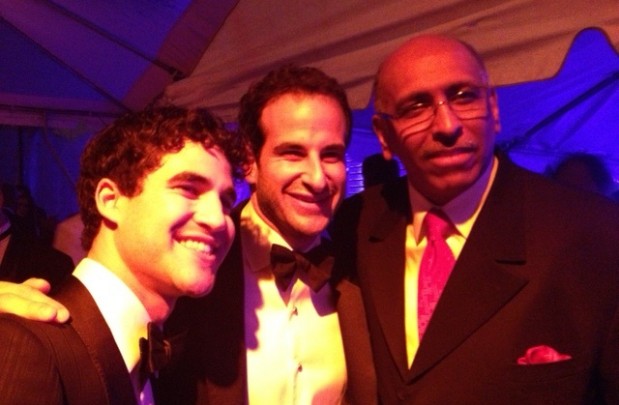
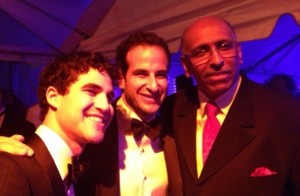 Former RNC Chairman and MSNBC contributor Michael Steele didn’t mean to intrude, but when he saw “Glee’s” Darren Criss and Matthew Morrison at Saturday night’s MSNBC after-party at the Italian Embassy, he needed to get a picture. Former RNC Chairman and MSNBC contributor Michael Steele didn’t mean to intrude, but when he saw “Glee’s” Darren Criss and Matthew Morrison at Saturday night’s MSNBC after-party at the Italian Embassy, he needed to get a picture.
“I love ‘Glee’ because it takes me back to a time when I was in Glee club,” Steele explained to Yeas & Nays after the quick photo session and chat had wrapped up. “And it opened a lot of doors for me and introduced me to musical theater, which I love.” Steele played Harold Hill in “The Music Man” in college. He was also in “Anything Goes,” and performed Shakespeare’s Macbeth “cowboy style.” “With boots and everything,” he laughed.
These days he identifies himself as a “Gleek.” “Yeah, I do, I do, I’ll admit it, I’ll admit it and, of course, seeing a lot of the stars here tonight from the show is kind of cool,” he said. “I record it every it every Tuesday cause usually I’m out doing stuff so I usually get to watch it over the weekend — I love it.”
Click here to read the full story.
By John Y. Brown III, on Tue May 8, 2012 at 12:00 PM ET
Sometimes there’s no substitute for the hackneyed phrase, “Only in America”
Tough economic times have led to long discussions with friends and colleagues about how best we to cope as they navigate a painfully tight job market.
My favorite resolution came from a fella I didn’t know well but was related to a dear friend. This person had gone through some tough times personally and vocationally recently and deserved a break. Although I couldn’t help him, he helped me by giving me inspiration and teaching me a thing or two about persistence, self-confidence and, most of all, good old American pluck!
After losing his job and enduring a messy divorce he tried and failed starting his own business. After that he went through seemingly endless rounds of interviews in multiple industries and repeatedly came up empty handed. But then he had a brilliant idea.
He became a life coach.
And for all I know, is doing well.
By Artur Davis, on Tue May 8, 2012 at 8:30 AM ET It is Lyndon Baines Johnson’s fate that as much as he was venerated during his career for his raw skills, he is remembered today largely as a colossal blunderer, by the right as a prototype of excess who spent taxpayers’ money profligately, and by the left as an adventurer who made a catastrophe out of a molehill called Vietnam. His own party, while framing the signature achievements in his domestic record–Medicare, the Voting Rights Act–as a secular temple that Republicans must be kept from dismantling, simultaneously avoids awarding Johnson much of the credit. His image is as grainy as the black and white television reels of his era, as harsh and remote as the perpetual grimace on his face in the footage from those reels.
Robert Caro’s latest entry in his opus on LBJ, “Passage to Power”, will do something to revive the 36th president’s reputation. It spans from Johnson’s inept, misconceived effort to win the presidency in 1960—a race which he never embraced and never seemed to think he should, much less would, win—to the stretch in the wilderness as John Kennedy’s vice president; to Johnson’s frenetic succession to power after November 22, 1963. Unexpectedly, the narrative stops in the spring of 1964, short of the demolition of Barry Goldwater, and well short of the 1965 legislative season that was Johnson’s epic moment. Caro’s readers will recognize that he has rarely felt bound by the precision of a conventional biographical framework and has stopped and started these volumes based on his own sense of rhythm and his perspective on which details best illuminate his much misunderstood subject.
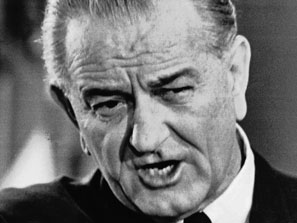 So, the last and next edition is the one that will take on the well worn tale of Johnson going up and down Mt. Olympus between the 64 election and the fall from grace in 1968. This narrative dwells on the less familiar struggles of a politician who was unsuited to the changes that television and the atrophy of the establishment were effecting during the 1960 election; and to the almost as forgotten description of a president seeking to convert an unprecedented public moment, the assassination of a leader with an unfulfilled and active agenda, into a legislative program on Capitol Hill, in a political climate that was decidedly more right-leaning and resistant to change than is currently appreciated. So, the last and next edition is the one that will take on the well worn tale of Johnson going up and down Mt. Olympus between the 64 election and the fall from grace in 1968. This narrative dwells on the less familiar struggles of a politician who was unsuited to the changes that television and the atrophy of the establishment were effecting during the 1960 election; and to the almost as forgotten description of a president seeking to convert an unprecedented public moment, the assassination of a leader with an unfulfilled and active agenda, into a legislative program on Capitol Hill, in a political climate that was decidedly more right-leaning and resistant to change than is currently appreciated.
Read the rest of…
Artur Davis: The No Longer Practiced Politics of LBJ
By John Y. Brown III, on Mon May 7, 2012 at 12:00 PM ET
Favorite horse racing story.
When my son was in kindergarten his school had a tradition of a stick horse derby race. Parents take it seriously. There were rumors of moms and dads advising their children on tricks and techniques for winning…and I didn’t want our son to be at a disadvantage.
So I took him out to our backyard to show him some stick horse racing tricks of my own–which I was making up as I go.
The key, I said, was staying focused on running hard no matter what. I demonstrated. Tucking the stick part of the stick horse between my legs and running back and forth as fast as I could. Until I stepped into a hole in the yard and tripped.
At that point I was jarred from my “hyper-competitive parent” mode and looked up and around me. I realized there was at least on neighbor watching me racing on a stick horse in my back yard. And injuring myself.
She was courteous enough to pretend she was looking in another direction in that way that says, “I’m so embarrassed for you that I’m going to do you the favor of pretending I didn’t see that. But I did. And, yes, you looked that ridiculous.”
I went inside and put ice on my ankle.
And didn’t go outside to the backyard again for several weeks. Until I had some dignified and serious reason to be there.
Still, the stick horse race went well. My son finished “in the money” so to speak. I was proud. And I like to think I may have helped contribute to his successful run.
It was a proud moment that made me think to myself in that loving way, “Like father, like son.” Sort of.
|
|