As the dog days of August trudge onward, there’s one universal truth:
We are all sick to death of politics.
So, beginning next week, and proceeding the week after, like any good politico, The Recovering Politician will temporarily change its format to reflect the prevailing public mood. But unlike too many politicians these days, we are also soliciting your help.
Next week — the week of August 15 — we will be celebrating Politics-Free Week at The Recovering Politician. There will be no talk of anything policy or politics oriented, as we focus on everything else under the sun.
And you, the RP Nation, are invited to join us. If you are game, please send us your best Top 5 pop culture list by Saturday night, August 13 to Staff@TheRecoveringPolitician.com.
Then the following week, the week of August 22, we will dedicate the site every day to what’s wrong with politics and how it can be fixed.
Of course, we want to hear from you as well. Please send us your essays on how to fix the American political system — one specific part, or the whole darn thing (1500 words or less) — by Saturday night, August 20 to Staff@RecoveringPolitician.com.
August may be dull, hot, and humid. But with your help, The Recovering Politician will experience a cool breeze of fun dialogue and fresh ideas for the nation’s future.
From Noon EDT to 1:00 PM EDT, the RP will be talking the debt ceiling and No Labels on Jefferson Public Radio, which covers Oregon and Northern California.
By Jonathan Miller, on Mon Aug 1, 2011 at 9:30 AM ET
My latest column for The Huffington Post reflects one of my great frustrations about today’s politics: The absence too often of rational, civil dialogue. I try to explain why so many disaffected Americans — particularly those in the Tea Party — don’t accept many incontrovertible facts at the center of policy debates, and how the rest of us can become more engaged to dilute the influence of extremism and misguided politics.
Here’s an excerpt:
One of the critical lessons from the debt ceiling debacle is not to underestimate the Tea Party’s influence on Washington policymakers.
But perhaps even more alarming was the strikingly willful disdain many Tea Party activists demonstrated towards some of the rationally indisputable facts at the center of the policy debate.
I saw this phenomenon firsthand on the virtual pages of this very website. Last week, frustrated by my failure to find my teenage daughter a simple explanation of the budget crisis online, I decided to pen one myself. My column, Debt Ceiling for Dummies, was an attempt to provide a dispassionate, non-partisan guide to the sometimes archaic, and often complex, subject matter associated with the credit default debate. As a former state Treasurer and CFO, I hoped to share what I’ve learned from a myriad of experiences dealing with concepts like debt limits and credit ratings.
But as is far too typical in today’s blogosphere, my article provoked an avalanche of bitter invective in the comments section of this site, my own blog, and even my personal Facebook page. I was called a “liar,” a “fraud,” even an intimate of the international conspiracy to fool real Americans and rob them of their hard-earned savings.
My more than two decades of politics taught me not to take any of the criticism personally. But it’s hard not to be flustered when a not-so-insignificant segment of the body politic refuses to accept the incontrovertible fact that lifting the debt ceiling honors the debts we’ve already incurred through our prior spending, and does not require higher levels of future spending or borrowing. Or that the inevitable U.S. credit downgrade that would result from a failure to lift the ceiling would inarguably worsen our national debt problems by dramatically increasing the cost of borrowing.
As a former Member of Congress, I am no longer asked how I will vote; instead, the question I get almost every day is how did Congress become so dysfunctional? The second, less interesting question: Aren’t you glad you’re not there?
The generalized anger at “Washington” is misplaced. Not all parties are equally at fault. While political posturing is apparent, it’s not all about politics. Ideas matter more than most commentators will acknowledge, and ideas that morph into convictions impervious to evidence are the root of our distemper.
Tax cuts pay for themselves. We’ll be welcomed as liberators. Climate science is a hoax—or at least not “proven.” None of these claims was or is true; the evidence against them is overwhelming. But they remain for most congressional Republicans absolute convictions. Why? I believe they are rooted in a profound aversion to collective action by Americans through our governments.
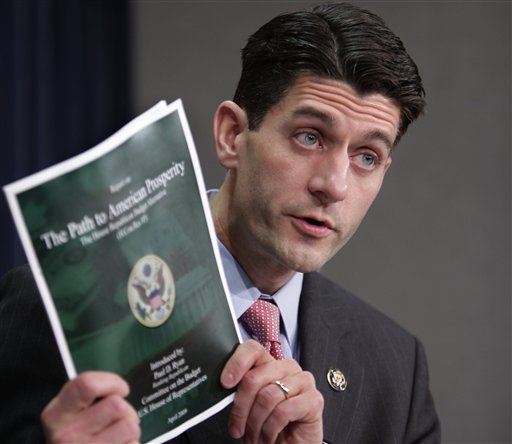
Rep. Paul Ryan
I served on the House Budget Committee for four years listening to Paul Ryan, Jeb Hensarling and my other Republican colleagues rail against “spending” (in the abstract) and promote the idea that tax cuts—in all times and circumstances—drive economic growth. The economists who testified at our hearings took a different view; they emphasized the importance in the long run of keeping revenues and expenditures in some sort of balance. Those were views not well received during the tax cutting frenzy of the Bush Administration.
The Tea Party Republicans are not promoting different ideas than their more senior Republican colleagues. They both disdain government, but the Tea Partiers reject political compromise as well.
How did we get here? George W. Bush’s signature line for his massive 2001 tax cut was just one step in the promotion of self-interest over common purpose that is weakening America economically and politically. “It’s not the Government’s money, it’s your money.” Right wing Republicans argue that federal taxes “diminish human freedom.” That world view, promoted with increasing intensity and success for over 30 years, leaves little room for a pragmatic debate about how governments can improve the well-being of the people.
Read the rest of… Tom Allen: Debt Dysfunction Has Deep Roots
By Jason Atkinson, on Fri Jul 29, 2011 at 8:30 AM ET
I took part in the Aspen Institute’s Global Leader Network bi-annual gathering, and once again I felt like the bellhop to these accomplished people.
Just over 200 fellows from 27 counties all with the same ‘virus’ to change the world. For the seminar “why I stepped up,” I was asked to be a presenter, and like everyone there, my phony meter had long ago broke. I look at the self-help genre through the same Vaurnets as the guy with the Madonna microphone selling the slap-jack.
The seminar was all honesty, and the answer to why people step up and put themselves forward for public service is not linear. It’s very hard to put into words. Some people are hard-wired to mix their personal confidence with their convictions, look past the personal sacrifices and pitfalls, and try to do their best knowing they might never be recognized for it.
As I wrote that sentence, it dawns the need for recognition could be the difference between states-people and politicians.
Mark Hatfield
A few concerns on modern service were articulated I think need to be discussed at the intellectual temple of the The Recovering Politician: First, is service today accepting the values of the party over the values of the person? I know firsthand the stinging backlash from ones own party for being too independent. Caucus politics can be small, petty and very effective. In my state, I’ve never seen a pro-life Democrat go anywhere and neither do pro-conservation Republicans. In my experience, the behind the door caucus politics and the perceived party policies are entirely different. I wonder if Mark Hatfield could get elected today?
The second concern about modern service is process. We have created a system of governance in which process (committees, task-forces, blue ribbon panels) are hallowed. Every state in America has plenty of process; because the process is suppose to provide a voice to everyone, right?
Not so fast. I think process protects the status quo in modern service and makes the role of the elected harder. In my state, task-force members are all bureaucrats and paid lobbyists-both with kingdoms to protect. Why are elected servants not part of process? Simple- they can’t afford it. Most states do not even pay public servants minimum wage. So does everyone have a seat at the process table?
Channing
Before I leave you with the impression that I am a Debbie Downer, let me leave you with a quote from one of her contemporaries–William Ellery Channing who wrote “The office of government is not to confer happiness, but to give men opportunity to work out happiness for themselves.” Yep, that’s my kind of stepping up. It’s a complicated calling.
For as long as I can remember, complaints about “dysfunctional” government have permeated the public dialogue about Washington.
I was swept into congress in 2006 on a tide of “change” and swept out in 2011 as the pendulum swung the other way. During my time as a candidate and as a member I was enmeshed in a system that prized raising money above all as the key to credibility, power and effectiveness.
I was good at raising money. I set fundraising records in my small home state both as a candidate for the House and during my Senate run. I loved my work and my colleagues. I worked with high-minded people who wanted to do the best they could for the American people.
I also saw that or campaign financing system had developed into a system which was often at odds with the best interests of the people who we served. “Money talks, nobody walks” was an advertisement from my youth. In our system, money talks and those with it ride comfortably while those without walk behind. The power of money gives disproportionate power to those who have it and threatens the fabric of our democracy.
I felt first hand the deleterious effects of the abhorrent Supreme Court decision in the Citizens United case as unnamed corporate interests barraged my state’s airwaves with millions of dollars in ads tearing me down. The money and the pursuit of it subtly corrode even the most principaled representative. The first time a member thinks to him or herself “If I vote this way, I’ll lose X”, that subtle corrosion is at work.
I was privileged the other day to sit on a panel with former Republican Senator Larry Pressler at the screening of a film titled “Priceless”. Go see the film. Think about how much easier it would be to get things done with a change in our campaign finance system.
Visit the website of Americans for Campaign Reform. I believe changing the way we finance elections is at the core of ensuring the future of our representative democracy.
This morning, the RP appeared as the featured guest on “Wilshire & Washington,” a radio talk show focused on the intersection between politics, entertainment and technology. The RP is questioned about No Labels, and the role it is playing to influence the debate in Washington in favor of a bipartisan deal to solve the current debt ceiling crisis.