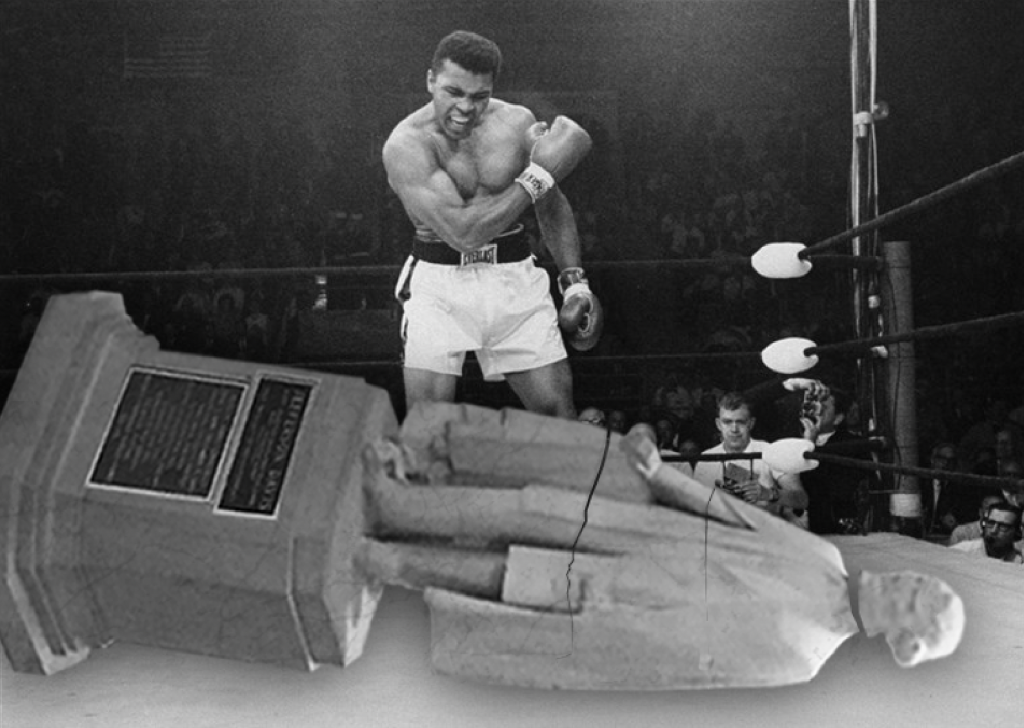
Please sign the petition below to remove the statue of Jefferson Davis currently in Kentucky’s Capitol Rotunda, and replace it with a tribute to Muhammad Ali, “the Louisville Lip” and “the Greatest of All Time.”
I just heard from the Ali family: It is the Champ’s belief that Islam prohibits three-dimensional representations of living Muslims. Accordingly, I have adjusted the petition to call for a two-dimensional representation of Ali (a portrait, picture or mural) in lieu of a statue.
UPDATE (Tuesday, December 2, 2014)
In this interview with WHAS-TV’s Joe Arnold, Governor Steve Beshear endorses the idea of honoring Muhammad Ali in the State Capitol (although he disagrees with removing Davis). Arnold explores the idea further on his weekly show, “The Powers that Be.”
Click here to check out WDRB-TV’s Lawrence Smith’s coverage of the story.
And here’s my op-ed in Ali’s hometown paper, the Louisville Courier-Journal.
UPDATE (Saturday, June 4, 2016)
In the wake of the 2015 Charlestown tragedy, in which a Confederate flag-waving murderer united the nation against racism, all of the most powerful Kentucky policymakers — U.S. Senator Mitch McConnell, Governor Matt Bevin, Senate President Robert Stivers and House Speaker Greg Stumbo — called for the removal of the Davis statue from the Rotunda. Today, as we commemorate last night’s passing of Muhammad Ali, there is no better moment to replace the symbol of Kentucky’s worst era with a tribute to The Greatest of All Time.
UPDATE (Wednesday, June 8, 2016):
Great piece by Lawrence Smith of WDRB-TV in Louisville on the petition drive to replace Jefferson Davis’ statue in the Capitol Rotunda with a tribute to Muhammad Ali.
UPDATE (Thursday, June 9, 2016):
Excellent piece on the petition drive by Jack Brammer that was featured on the front page of the Lexington Herald-Leader.
Highlight of the article:
Miller said he has received a few “angry comments” on his call to honor Ali.
“One of them encouraged me to kill myself,” he said. “You can quote me that I have decided not to take their advice.”
UPDATE (Friday, June 10, 2016)
The petition drives continues to show the Big Mo(hammed): check out these stories from WKYU-FM public radio in Bowling Green and WKYT-TV, Channel 27 in Lexington:
UPDATE (Saturday, June 11, 2016):
Still not convinced? Check out this excerpt from today’s New York Times:
By Jonathan Miller, on Thu Apr 14, 2011 at 12:30 PM ET
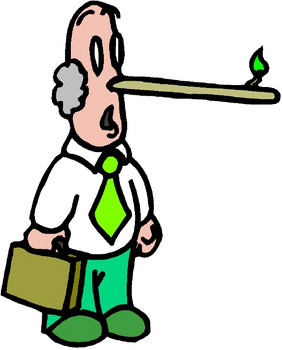
The one thing that I miss least about leaving the political arena is the lying.
If there’s one quality that unites Democrats and Republicans, politicians and the press corps; it is their mutual propensity for, and expectation of, fabrication.
Often, it’s the small lies that wise and wary observers can sniff out before they do harm: Sure I’ll raise $10,000 for your campaign. You can count on me to support your cause in the legislature. My, you look way too young to be a grandmother! Don’t worry, I’ve had a vasectomy.
Most common is “political spin” which, all too regularly, is simply a euphemism for lying: Barack Obama is a Socialist. The Republicans want to hurt poor people.
Every now and then, you encounter stone-cold, pathological liars in the business. They’re rarer than the profession’s reputation, but I’ve run into too many elected officials, reporters, and political operatives whose every utterance I’ve learned to disbelieve or suffer the consequences. And I despise it.
But should we put all of these liars into jail? Of course not.
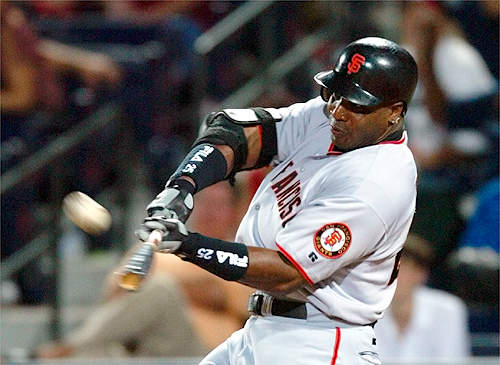
Yesterday, Barry Bonds was convicted for obstructing justice by lying to a grand jury about his personal steroid use. (Which begs the question — asked by Dashiell Bennett — how could Bonds be guilty of obstructing justice for lying when the perjury charges against him were rejected by the same jury?)
Note that Bonds was not convicted of — or even charged with — illegal use of steroids. His entire prosecution was based on his lying about his use, in an ultimately unsuccessful effort to protect his professional reputation.
Bonds is not the cleanest case because steroid use is illegal, and Bonds is such an unlikeable narcissist.
The most famous example of this controversy is even more polarizing. Like Bonds, President Bill Clinton lied to the American people and gave controversial answers to a grand jury in order to protect his public reputation. But here, the underlying misbehavior was not illegal. As Republicans like Newt Gingrich have been quick to assert, the 1998 impeachment was not about the sexual affair — which is not a crime in the District of Columbia — but rather about the President’s lying about it before a grand jury. While Clinton’s verbal parsing may have technically immunized himself against a perjury conviction, it is clear that he was impeached by the House for lying about underlying behavior that wasn’t a crime.
As a former member of the Clinton Administration, I’m biased; but I am comfortable saying that, without any partisan considerations, lying about a perfectly legal action should not be the basis of removal from office. And so did most Americans.
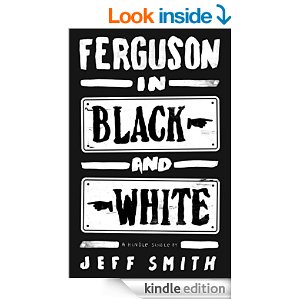
Let’s take an even cleaner case: that of contributing RP Jeff Smith. (Again, I admit bias: Jeff is my friend.) If you’ve read his stunningly candid story on this Web site, you know that Jeff was convicted of lying to federal investigators about whether he had knowledge of a scheme to distribute negative fliers about his campaign opponent. The underlying behavior may have violated campaign finance rules, but surely did not merit a jail sentence. And I argue, neither should his lying about it.
Did Jeff deserve to be punished? Absolutely. Stripped of his public office? Perhaps. But sentenced to serve a one-year term in a jail filled with violent offenders? I believe the punishment overwhelmingly exceeded the crime.
Of course, I am not arguing in any way that perjury and/or obstruction of justice should be considered misdemeanors or civil violations in every instance. Of course, lying to an authority about illegal activity, particularly of a violent nature, must be punished severely.
Nor am I arguing that there should be no punishment whatsoever in these circumstances. Lying to an authority is wrong; and the offender must be held accountable for his or her actions.
But someone who lies about a non-violent, non-criminal activity, in order to protect his reputation and family — a very natural, human instinct — should not be treated akin to a violent criminal.
I will soon be interviewing Jeff for RPTV to discuss this issue. But I’d like to know your opinion first: Does lying to a grand jury or an investigator about a legal activity merit a jail sentence? What are your suggestions for reform? Or do you like system the way it is?
It’s extremely difficult to accurately estimate the number of people that cross into the United States each year from our southern neighbor. Most estimates are based on apprehension numbers from the border patrol. Clearly, it’s hard to extrapolate from those unlucky enough to have been caught and sent back over la frontera. The solution, it turns out, may be as simple as picking through the garbage. [Nature]
British Prime Minister David Cameron again makes controversial statements regarding immigrants in Great Britain. Apparently, immigrants in the UK have created a “kind of discomfort and disjointedness” in British communities. Whatever your political feelings about immigration are, only a British PM would classify animosity towards immigrants as “discomfort”—that’s what happens when you let your knickers down! [The Guardian]
In case you missed it, France formally banned on Monday the wearing of full veils (niqabs) in public. Although very few Muslim women actually wear full veils (erroneously called burqas by the French) in France, the French government under President Sarkozy (L’Americain) has determined that they are a threat to public safety. A safety issue? Caving to anti-immigrant extremists? Anti-Islam politics at its most cynical? Or a necessary safeguard against the loss of French identity? What do you think? [New York Times]
Hey, do you like Latino music, but get sick of eating chips and salsa to recycled Mariachi songs at your favorite taco stand? There’s mucho más música available from Latin America. Check out [Alt.Latino] ahora!
What I know for sure — now in my mid forties — is that my life doesn’t have to be an uphill climb.
I also know that my happiness — the enduring sort — is right here, all the time, just waiting for me to have it completely; and that it’s all about today, right now.
A mentor of mine named David, at the Chopra Center for Wellbeing in Carlsbad posted this on his Facebook page last week, and pretty much sums it up:
Accept this moment exactly as it is because every moment leading up to this very moment is exactly as it is. This can be a toughie but whether you like it or not, the past is carved in stone…however, this moment—this precious moment right now has infinite possibilities. What do you want to choose—the past or the now?
Because we live in a culture fed by the notion that we have to work, work, work, for what we “deserve,” we find ourselves conditioned to believe that we don’t deserve anything without the intellectual sweat, sweat, sweat and tears.
I have to include a quote from the Dahli Lama. When asked what surprised him most about humanity, he answered:
Man. Because he sacrifices his health in order to make money. Then he sacrifices his money in order to recuperate his health. And then he is so anxious about the future that he does not enjoy the present; the result being that he does not enjoy the present or the future; he lives as if he is never going to die; and then dies having never really lived.
It seems this notion of work has spilled over into our beliefs about happiness as well. But the truth is that this Western-culture approach is incomplete, isn’t it? It doesn’t acknowledge the truth that there is a deeper, more pervasive aspect of the human experience that is fed by the powerful natural inclination toward happiness.
When we are happy with our undertakings, they are a lot less like work and a lot more like fulfillment. We’ve all heard the adage, “Love your work and you’ll never work a day in your life.” And, as I think about this I can’t help but ask the question of how. Dr. Chopra puts it best in one of his recent new books, The Ultimate Happiness Prescription:
The purpose of life is the expansion of happiness. Happiness is the goal of every other goal. Most people are under the impression that happiness comes from becoming successful, accumulating wealth, being healthy, and having good relationships. There is certainly enormous social pressure to believe that these accomplishments are the same as achieving happiness. However, this is a mistake. Success, wealth, good health, and nurturing relationships are by-products of happiness, not the cause.
Not the cause!
I’ve actually found this to be true: The more time I spend engaged in creative, fulfilling tasks, the more I seem to attract into my life opportunities that keep allowing me to feel creative and fulfilled.
Teaching is a good example of this. I love teaching and have a life long history of it in various ways: from teaching my 5 year old sister to read when I was just 9, to my Sunday School duties with the kindergarten class at 14, to arts camp directorships, to creating mom/daughter workshops as an adult.
The more I’ve engaged in teacher training opportunities just because they feel great, the more opportunities have landed in my lap that feel great. I’m now teaching yoga and mediation to adults and kids; and I’ve gotta say, I didn’t plan it, but it keeps me yoga-ing and meditating myself, which brings the by-product of happiness in general. Ask my family.
And frankly, the better I feel about the bits of time here and there (I’ve been mothering daughters for 17 years; and have been married to a recovering politician for five more than that) that are creative and fun, the more everything else feels fine, including cleaning out the garage and cooking dinner.
Louise Hay puts it beautifuly in You Can Heal Your Life:
Click on the book cover to sample.
The Universe totally supports us in every thought we choose to think and believe. Put another way, our subconscious mind accepts whatever we choose to believe and so what I believe about myself and my lifew becomes true for me. What you choose to think about yourself and about life becomes true for you. And we have unlimited choices about what we can think.
Doesn’t it make sense then to think about enduring happiness?
And like my favorite medicine woman and teacher, Rosalyn Bruyere always says:
“Releasing negative feelings never works, you have to flush them out with good ones.”
Try it! What makes your heart sing? What do you yearn to do, play with, seek? When you think about waking up in the morning, which activities would make you excited to get up and go? In which experiences do you lose track of time?
The answers are the seeds of enduring happiness, and they are as natural to us as breathing, so why not, eh?
It wasn’t too long ago that I was working really hard for happiness–it was an uphill climb and I could never fully appreciate the view along the way. Funny, I’m kinda craving a little mountaineering now if you must know. The real thing. But how’s this for life; I’m planning to climb a a few mountains because it seems like fun (a nice one, with a hiking trail!), and because the air will smell great, and because I’ll enjoy it.
How are you enjoying the mountain, the air, the view, your life? Share your answers here so that others can be inspired.
By Jonathan Miller, on Wed Apr 13, 2011 at 5:00 PM ET
Thursday means a new Friend of RP, and this one turns out to be the RP’s closest friend. In fact she’s been married to the RP for more than 21 years. Tune in for all the juicy scoop. Or maybe some profound lessons from a recovering political wife.
We’ll also, of course, have some Weekly Web Gems, and some other great surprises.
By Stephanie Doctrow, RP Staff, on Wed Apr 13, 2011 at 1:30 PM ET
The Politics of Recovery
Can’t kick that morning coffee habit, no matter how hard you try? According to research, caffeine dependency might be in your genes. [Time]
Talk about a comeback. After losing his job as a salesman, Andy Lunsford discovered his true calling: being an opera star. [CNN]
Got some thoughts on how to turn America around? These 20 success stories have some ideas of their own. [Newsweek]
The average American watches 143 hours of television per year– not surprising, but still scary. Good Magazine gives us eight more meaningful things we could do with our time. [Good Magazine]
By Jonathan Miller, on Wed Apr 13, 2011 at 12:00 PM ET
I’m a passionate professional golf fan…about 4-5 weekends a year. I half-pay attention to the ups and downs of the PGA schedule during the season when SportsCenter’s on, but I’m glued to the screen only those Saturdays and Sundays when a “Major Tournament” is being played — the Masters, U.S. Open, British Open, and the PGA champtionship — or every other year when the Ryder Cup stirs up my latent gingoism.
C'mon...You cried too, didn't you?
For the past decade, I’ve been a proud, card-carrying member of Team Lefty. Phil “Lefty” Mickelson was known for many years as The Best Golfer in the World Never to Win a Major; and then having shooed the Majors’ Monkey off his back at the 2004 Masters, transformed into The Best Golfer in the World Not Named Tiger Woods. As the son of a cancer victim, my heart broke in 2009 when his mother and his wife, Amy, were diagnosed with breast cancer, and I literally cried when he grabbed Amy for a long embrace after capturing the 2010 Masters.
And what a contrast it was to Lefty’s nemesis, who was going through…OK, if I need to explain Tiger Woods’ annus horribilis to you, then you need to watch television at least once in a while.
But as the 2011 season started to get into gear, I found myself rooting for Tiger, and yes, feeling sorry for a guy whose net worth exceeds many developing nations, and whose reputation for legendary narcissism preceded the recent scandal by many years.
Last Sunday, when he put together an incredible string of birdies during the first nine holes of the Masters’ final round, I was yelling at the screen doing my part to help urge his ball to fall into the hole. And I was disappointed when ultimately he fell just a few strokes short of the championship.
I guess I’m victim of the human instinct to root for the underdog. But, just as this web site’s focus is on the second acts of recovering politicians, I think the love of a good redemption story is built into our DNA.
I’m interested in hearing from you — Tiger fans and Tiger haters: What did Sunday’s round mean to you? Can someone redeem himself through athletic accomplishment? Or does Tiger even need redemption: Is it our business in the first place to judge Tiger for his actions?
By Robert Kahne, RP Staff, on Wed Apr 13, 2011 at 8:30 AM ET
Politics of the Diamond
What a terrible day for George W. Bush–Josh Hamilton, brightest star on the Texas Rangers, slid into home and broke his arm. He’s out six to eight weeks. If you don’t know much about Hamilton, he has one of the most amazing stories in baseball. I’ve linked an old interview with HBO’s Real Sports that you ought to watch. [Lone Star Ball] [Real Sports]
Barry Bonds’ perjury trial is almost finished, as the jury is currently deliberating about charges of him lying to a grand jury and obstructing justice. I am actually very torn about Barry Bonds. On one hand, I know he cheated and that is obviously bad. On the other, lots of people cheated, so why are they coming after Bonds so hard? More than one person has alleged racism here. What do you think? [New York Times]
Here is a heartbreaking story about opening day for baseball in Japan. I remember after 9/11 when Keith Olbermann spoke about the healing power of baseball. I don’t remember what he said exactly, but it was something along the lines of baseball being something that keeps us all connected and allows us a respite from sorrow. Here’s hoping that works at least a little bit in Japan too. [ESPN]
Have you heard about Brian Stow, the Giants fan who was almost beaten to death outside of Dodger Stadium? It’s a tragic story–he remains in a medically induced coma. The Giants have stepped up, raising almost $70,000 for his medical expenses. It makes me happy to see people being generous. I won’t lie, though, it makes me kind of sad that we live in a country where baseball teams have to raise money to pay for needed medical care. [USA Today]
“Manny being Manny” is one of my favorite sayings in all of baseball. Unfortunately, we’ve said it for what will likely be the last time, as Manny Ramirez hung up his cleats for the last time less than a week into the season. Few players in any sports elicit such strong emotions as Manny Ramirez. I’ve linked to extremely different articles for you to peruse. (I think Manny is awesome, but I’m glad he never played for my Cardinals). [Manny Sucks] [Manny Rules]
This is the picture I wanted to use for Politics of the Diamond [LOL]
Political novels are a dying breed, and the death has been a long, slow one. But into the void steps Jeff Greenfield with a smart, well conceived set of political short stories called “Then Everything Changed“. In less than 400 pages, Greenfield, one of Robert Kennedy’s best speechwriters and an accomplished journalist, pulls off what is arguably the best political fiction in the last generation: it will and should endure for its skill and its contribution to our imagination. The book is built on three novellas: the premise of each is that a particular historical fact happened a fraction of an inch differently, and that the political world was realigned accordingly. The first supposes that a would be assassin lurking outside John Kennedy’s Florida getaway in December 1960 carried out his plot to steer a car loaded with explosives into the President elect’s path; and that the tragedy thrusts Lyndon Johnson into power three years early, and makes LBJ the leader who faces Soviet aggression in Berlin and Cuba. If the actual fact that JFK was stalked by an potential assassin during his transition is so obscure today that some of Kennedy’s own biographers don’t know it, the second “what if” has been fodder for speculation for two generations: Greenfield’s version is that Sirhan Sirhan‘s hastily improvised shooting of RFK is thwarted and that Kennedy lives to face off against Hubert Humphrey in a thrilling Democratic convention and Richard Nixon in a close run fall campaign. His prize is a country with outsized expectations of a second Camelot, which he must navigate as he tries to pursue a tough-minded liberalism that stirs up dust from the left and right.
The final premise is not built around life and death, but around the power of words never
How would these changed events have affected Chevy Chase's career?
spoken. It imagines that Gerald Ford managed to averted a still inexplicable gaffe on foreign policy in a presidential debate with Jimmy Carter, and ended up passing Carter to win a narrow electoral college victory. (It is largely forgotten now that Carter’s win would have been reversed by a shift of less than 15,000 votes in Ohio and Mississippi). It is Ford who governs during the stagflation and drift of the late seventies, and when Ronald Reagan emerges as the nominee four years later, he bears the burden of a decade of failed Republican rule. His opponent, a charismatic one term Colorado Senator named Gary Hart, whose New Democrat aura is the right antidote to more conventional candidacies by Edward Kennedy and Reagan. Anyone engaged (or addled) enough by politics to be reading this blog could spin a nice set of counter- factuals around presidential elections. Where Greenfield surpasses the guessing game is his exceedingly deft injection of real life variables into his fiction. Greenfield’s LBJ remains determined to surpass Kennedy’s martyred luster by a prioritization of voting rights in the South; at the same time, his well documented insecurities make a catastrophic mix with Kruschev’s adventurism in the early sixties. Similarly, the same Bobby Kennedy who bravely exposed himself to a grieving black crowd in Indianapolis the night of Martin Luther King’s death is instantly familiar in the fictional account of RFK facing down a mob of student demonstrators in Chicago at a critical moment at the convention. Greenfield just as credibly suggests that a presidential campaign by Ted Kennedy would have floundered in any timeline under the weight of innuendo and doubts about his character, and that Ronald Reagan’s penchant for tactical boldness (think: the real life near selection of Ford as a running mate in 1980) might have led to a historic choice of a running mate in the fictional version of 1980.
Read the rest of… Artur Davis: “Then Everything Changed”


 Blog this!