Please sign the petition below to remove the statue of Jefferson Davis currently in Kentucky’s Capitol Rotunda, and replace it with a tribute to Muhammad Ali, “the Louisville Lip” and “the Greatest of All Time.”
I just heard from the Ali family: It is the Champ’s belief that Islam prohibits three-dimensional representations of living Muslims. Accordingly, I have adjusted the petition to call for a two-dimensional representation of Ali (a portrait, picture or mural) in lieu of a statue.
UPDATE (Tuesday, December 2, 2014)
In this interview with WHAS-TV’s Joe Arnold, Governor Steve Beshear endorses the idea of honoring Muhammad Ali in the State Capitol (although he disagrees with removing Davis). Arnold explores the idea further on his weekly show, “The Powers that Be.”
Click here to check out WDRB-TV’s Lawrence Smith’s coverage of the story.
And here’s my op-ed in Ali’s hometown paper, the Louisville Courier-Journal.
UPDATE (Saturday, June 4, 2016)
In the wake of the 2015 Charlestown tragedy, in which a Confederate flag-waving murderer united the nation against racism, all of the most powerful Kentucky policymakers — U.S. Senator Mitch McConnell, Governor Matt Bevin, Senate President Robert Stivers and House Speaker Greg Stumbo — called for the removal of the Davis statue from the Rotunda. Today, as we commemorate last night’s passing of Muhammad Ali, there is no better moment to replace the symbol of Kentucky’s worst era with a tribute to The Greatest of All Time.
UPDATE (Wednesday, June 8, 2016):
Great piece by Lawrence Smith of WDRB-TV in Louisville on the petition drive to replace Jefferson Davis’ statue in the Capitol Rotunda with a tribute to Muhammad Ali.
UPDATE (Thursday, June 9, 2016):
Excellent piece on the petition drive by Jack Brammer that was featured on the front page of the Lexington Herald-Leader.
Highlight of the article:
Miller said he has received a few “angry comments” on his call to honor Ali.
“One of them encouraged me to kill myself,” he said. “You can quote me that I have decided not to take their advice.”
UPDATE (Friday, June 10, 2016)
The petition drives continues to show the Big Mo(hammed): check out these stories from WKYU-FM public radio in Bowling Green and WKYT-TV, Channel 27 in Lexington:
UPDATE (Saturday, June 11, 2016):
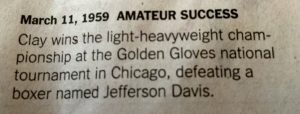
Still not convinced? Check out this excerpt from today’s New York Times:
Wow..another huge day at The Recovering Politician.
We’ve already surpassed Friday’s readership totals (the biggest since Opening Week in April) by more than 40%.
But we are not resting on our laurels.
Tomorrow, the RP interviews Rod Jetton for RPTV, giving you a chance to hear more of his fascinating personal story.
We will have more, of course, on the debt ceiling debate.
And since we all could use a little levity in these ultra-serious times, the RP will offer his latest “Top 5” pop-culture list. If you are new to the RP Nation, here is a taste of what that exactly means.
So get some rest tonight, because we will have a busy Tuesday.
By Patrick Derocher, on Mon Jul 25, 2011 at 4:00 PM ET
President Obama endorsed Harry Reid's $2.7 trillion budget plan over John Boehner's today.
It’s been a busy day for debt and budget negotiations in Washington, enough to justify a second round of budget crisis updates from The Recovering Politician:
President Obama has endorsed Harry Reid’s plan to cut $2.7 trillion from the budget without raising revenues, a major departure from his earlier insistence that any debt deal include significant revenue increases, though the Reid plan does fulfill his desire to have the debt ceiling raised enough to get the US through the 2012 election cycle. White House Press Secretary Jay Carney praised the plan for cutting responsibly and removing default-related uncertainty from the coming year. [Politico]
Speaker Boehner has released the details of his debt-reduction plan to House Republicans. The proposal includes a two-step process that will cut spending by $3 trillion over the next ten years without raising taxes. It also includes the temporary debt ceiling increase that President Obama and Congressional Democrats have balked at in the past. [The National Review]
The International Monetary Fund has weighed in on the United States debt crisis, echoing the sentiment that getting spending under control, and more immediately, raising the debt ceiling, are necessary for the continued economic health of the US and the rest of the world. The IMF supported proposals that include spending cut and revenue increase triggers should Congress fail to act in a timely manner. [The Hill]
In spite of extensive testimony to the contrary, Representative and candidate for President Ron Paul has said that a default is the best thing that could happen to the United States. He cites past credit defaults as evidence that a default in 2011, though harmful to the US economy, would not be calamitous. [National Journal]
The Boehner budget proposal is being referred to as a victory for the Tea Party, since it includes no revenue increases, a two-tier raising of the debt ceiling, and a vote on a balanced budget amendment. Though not a complete rehash of the Cut, Cap, and Balance bill, this budget would require a vote on a Constitutional amendment during 2012. [Huffington Post]
Massachusetts Democratic Representative Edward Markey has accused House Republicans, and Speaker Boehner in particular, of trying to harm the US economy in hopes of pinning the blame on President Obama. [The Hill]
Democratic sources have confirmed that Harry Reid’s $2.7 trillion deficit reduction plan does not touch entitlement benefits in any way. This further differentiates his plan from Speaker Boehner’s and is likely to shore up support among Democrats who were unhappy that President Obama had expressed a willingness to put entitlement programs on the table as part of a debt deal. [Huffington Post]
By Zack Adams, RP Staff, on Mon Jul 25, 2011 at 3:00 PM ET
The Politics of Tech
Here is a simply amazing video of a super-lightweight robot imitating a bird’s flight by flapping its own wings. A must-see. [TED]
A recent study claims that internet movie pirates are actually better consumers for the movie industry than non-pirates. the pirates typically buy more DVDs and visit movie theaters more often. [Geek.com]
A fantastic editorial on the unfortunately common practice of data-capping. “Caps should not just be a way for Internet providers to extract monopoly rents.” I couldn’t have said it better myself. [NY Times]
Here is another interesting article that explains how wider WiFi ranges (up to 45 miles) are possible using lower power consumption. [Clean Technica]
By Robert Kahne, RP Staff, on Mon Jul 25, 2011 at 2:00 PM ET
This is how it all began.
To me, Harry Potter and the Deathly Hallows was on one hand impossible to make while simultaneously extremely easy to make. It was easy to make because in JK Rowling’s book, she tossed up several action sequences which begged to be made into incredibly suspenseful and intense action sequences in a hugely-budgeted film. On the other hand, this movie was impossible to make because given the source material, the film makers were hard pressed to give this series the ending it deserved. What I mean by that is this: JK Rowling’s final book roundly failed to deliver the closure for which fans of the series begged. She randomly and emotionlessly killed off major characters and failed to provide the “big 3” with the large scale resolution wanted, and at no point provided a satisfactory conclusion to the story of Albus Dumbledore. Given this, the film makers had to create something that was satisfying in a filmographical sense which failed on a literary level.
Wait, THAT GUY used to be the dorky guy from the first movie?
As far as the good moments went, I felt like the film did a fantastic job. When I read the book, I thought four scenes were developed especially for the film adaptation: Malfoy Manor, the robbery of Gringotts, the sacking of Hogwarts, and the scene at King’s Cross. The only scene of these which took place in Part I was Malfoy Manor, and I thought that scene was far and away the best in the film. The remaining scenes, which took place in Part II, were riveting, and provided more satisfaction (due entirely to visuals: the book was a template for a film rather than a true literary experience, IMO) than the book. I don’t want to give anything away, but suffice it to say that Neville Longbottom seemed far more heroic in the film than in the book.
As far as the difficult pieces, the film did a decent job. The ending of the book was laughable, if not down-right aggravating. I can remember reading the book and trying to muster up some tears for the ending of this series, which had spanned my entire childhood, and failing to do so. The film was not heart-wrenching, but given the source material, I felt relatively invested in the ending–more so than I did in the book. It is a shame that Ms. Rowling failed to adequately develop characters such as Ginny Weasley and Tonks, it is too bad that she killed off major characters without much fanfare, and it is too bad that she felt it necessary to murder the comic relief (seriously, if JRR Tolkien had murdered Pippin, we would have skewered him too). In parts, the film seems to mock the book’s ridiculous twists by giving slight references to major deaths.
In the end, if you are a fan of the series, seeing this film is necessary. Ms. Rowling and her compatriots at Warner Bros. have woven an amazing portrait of characters and situations which yearns for closure. It is a shame that the resolution they provide is so lacking–but it is what we have. If you, however, have not read the books or seen any of the films to this point, avoid this film. It is “Part II” of film which is the 7th part in a 7th part series. If you are unfamiliar with it, you will be entirely lost. And in addition, it isn’t all that great.
There is no way that those pictures are of the same person.
I wish I could chalk all this pessimism up to the fact that I am a 24 year old man watching a film made for children–but I can’t. Rowling’s work has been praised for its accessibility to audiences of all ages. The most tragic part of the conclusions to this series is that we know–down in the depth of our souls–that Rowling had the story-telling talents to give us an incredible conclusion to an amazing series, and failed to do so. It was my great hope in 2007 that she would write us another novel from the perspective of Neville Longbottom about this time period. However, as it becomes less and less likely that Ms. Rowling will ever write another novel, and that the resolution we have is the only one we will ever get, it makes me a little sad.
This has been cross posted from my personal blog, which you can find here.
By Sandra Moon, RP Staff, on Mon Jul 25, 2011 at 12:00 PM ET
The Politics of Faith
The Bible as Myth–one writer explains why reading the Bible in this light has been helpful to his understanding of biblical stories. He explains that myths are not false stories, as the term is commonly understood, but that they are “a form of literature that expresses fundamental truths in a way that ordinary discourse is inadequate to describe.” [Huffington Post]
The cooperative effort between two denominations in one of the largest social service networks in the U.S., Lutheran Services in America, may come to an end over a difference in views on homosexuality and the authority of scripture. [Washington Post]
As the budget deadline approaches, faith leaders meet with Obama and ask, “What Would Jesus Cut?” [God’s Politics Blog]
Will the LGBT fight for equal standing under the law play a significant role in decriminalizing Morman polygamy? [Religion Dispatches]
By Patrick Derocher, on Mon Jul 25, 2011 at 11:00 AM ET
Senate Majority Leader Harry Reid has created the most recent effort at a budget deal that can pass both Houses of Congress and be signed by the President.
In a Sunday afternoon conference call with House Republicans, Speaker Boehner urged his caucus to stand firm in budget negotiations while acknowledging that compromise and a bill that can pass both houses of Congress will be necessary. For their part, Democrats including President Obama, Senate Majority Leader Harry Reid, and Treasury Secretary Tim Geithner still refuse to accept a deal that includes only a short-term debt ceiling increase, which House Republicans continue to push. [National Journal]
Mark Warner has called for the Senate to vote on the budget reduction plan put forth by the Gang of Six, a bipartisan coalition of which he is a member. Since its release a week ago, the plan has largely fallen by the wayside in favor of dueling plans by House Republicans and Senate Democrats. The Gang’s plan, through cutting defense spending, reforming entitlements and closing tax loopholes, would reduce the deficit by $9 trillion over the next decade. [The Hill]
Facing a Republican Party that is unwilling to share its debt-reduction plan or get behind any existing plans, Harry Reid is drafting a plan that will cut the deficit by $2.7 trillion dollars. While the plan includes raising the debt ceiling through 2013, as President Obama and other Democrats have demanded, it trims the deficit without raising revenues, as Republicans have demanded. [Politico]
President Obama is refocusing his administration on bridging the gaps between Democrats and Republicans, a major theme of his 2008 campaign that may be used to boost his appeal to independent voters in the 2012 election. In particular, he is working to break the partisan logjam surrounding debt ceiling and deficit negotiations, a goal which, if achieved, would likely improve the President’s image as far as the economy is concerned. [Washington Post]
According to a poll by The Hill, US voters are highly skeptical about the ability of Congress and the President to reach a deal on the debt ceiling: 71% say that they have little or no confidence in the government’s ability to do as much. Among Democrats, 47% have some level of confidence that a deal will be reached, while only 11% of Republicans agree. A slim majority (51%) believe Congress is too unwilling to compromise, while 35% believe it is too willing to do so, with Republicans being more likely than Democrats and independents to believe that Congress is too willing to compromise. [The Hill]
Speaking on MSNBC this morning, New York Democratic Senator Chuck Schumer referred to Majority Leader Harry Reid’s plan as something that House Republicans should be able to get behind and end the stalemate over debt reduction plans. He lauded its extension of the debt ceiling through 2013 while noting that it meets the major Republican criteria of not raising revenues and having a 1:1 spending cuts to debt ceiling increase ratio. [Huffington Post]
The Dow Jones Industrial Average opened about 125 points (one percent) lower on Monday, reflecting skepticism about the ability of Congress and President Obama to reach a deal on the debt ceiling before August 2. This drop is in line with similar declines in Asian markets Monday, includingJapan’s Nikkei, which fell be 0.81 percent, and the Shanghai Composite, which closed down about three percent on Monday. As a result of the declines, economists in Asian countries have been calling on the United States to effect swift action on the debt question. Drops in European markets have been less marked; as of Monday morning on the East Coast, the SIX Swiss Exchange was down 0.25 percentage points while the FTSE in England had barely dropped, by about 0.01 percent. [Politico]
Speaking in the economic powerhouse city of Shenzhen, Secretary of State Hillary Clinton reassure Chinese officials that the American economy is sound and in no real danger of defaulting on its loans. In doing so, she stressed that the United States will not give up on its role as a major power in the Asian political and economic affairs. [Huffington Post]
Then, the Washington Post, via its popular political columnist, Chris Cillizza (aka, “the Fix”) name-dropped the RP when discussing the rapid rise of No Labels, the new grassroots movement uniting Democrats, Republicans, and Independents who believe that on occasion we need to put aside our labels to do what’s right for the country:
Given all of the above, advocates of a third party — or at the very least another viable option in the 2012 presidential race — seem to be sprouting up all over.
The two most prominent are Americans Elect, a group aimed at winning ballot access for an eventual third-party candidate, and No Labels, an organization filled with high-profile names — including former George W. Bush media consultant Mark McKinnon and former Kentucky state treasurer Jonathan Miller — designed as an online home for the politically disaffected. “If you build it (ballot access), they (candidates and voters) will come,” McKinnon said in an e-mail.
No Labels says it advocates for bipartisan solutions to problems and not a third-party presidential candidate.
Please note that the RP — like the No Labels movement in general — is not an advocate of a third party or a third-party presidential candidate. He was an early supporter of Barack Obama in 2008 and remains a strong supporter of his reelection. Other No Labels members support one or another of the GOP presidential candidates. They all agree, however, that particularly in light of today’s extraordinary debt ceiling crisis, it is important that we come together in times of national import to arrive at bipartisan compromise in the country’s interest.
By Jonathan Miller, on Mon Jul 25, 2011 at 9:00 AM ET
With the debt ceiling crisis in the headlines for weeks (and perhaps weeks to come), the RP has written a column (cross-posted at The Huffington Post) that tries, in plain-English terms, to explain what all the fuss is about, and why it is so critical for each of us to make our voices heard to our representatives in Washington:
As we approach August 2, the deadline for Congress to lift the debt ceiling before the nation begins to default on its credit, there’s still considerable public confusion about what it all means.
While nearly every economic expert declares that default would be a disaster, and a bipartisan consensus of politicians not aligned with the Tea Party agree, the country is still sharply divided. The most recent Pew Research Center poll found that only 40 percent of the public felt it was “essential” to raise the debt limit, while 39 percent of Americans (including 53% of Republicans) felt that we could go past the August 2 deadline without major economic problems.
Why the disconnect?
Part can be attributed to the continuing and growing distrust of Washington politicians, particularly by those disaffected on the far right.
Much is also due to the esoteric, bewildering, and sometimes coma-inducing nature of the financial jargon and labyrinthine subject matter associated with the debt ceiling debate.
As a Democrat and a former state Treasurer and CFO, I’m probably not the right guy to convince the partisan-blinder-wearing Ceiling Deniers.
But for the rest of us, I offer the following straightforward, plain-English summary to hopefully help better explain the real-life impact of American credit default:
This concluding post will complete the story of how I finally got my life back on track.
I don’t know if you believe in God or not, but I DO! In December of 2009, God finally had enough of my wayward ways and allowed my choices to get me into a situation that only he could help me through.
After spending the night with a lady I had reconnected with on Facebook, I was charged with felony assault. The press, along with my enemies, had a heyday, and I immediately shut my consulting business down.
Soon after that, I was notified that I was a target of a federal grand jury investigation surrounding my handling of a bill in the 2005 legislative session.
Needless to say I started 2010 broke, with no job, very few friends and lots of time on my hands. As bad as my troubles were at the time, looking back now, I’m thankful for them. Life passes by so quickly, and very few of us get the chance to sit down and contemplate what is important. My troubles gave me a chance to analyze my bad choices and personal weaknesses.
With my pride stripped away, I was able to honestly evaluate my past actions. I saw how foolish I had been to put my family on the back burner. I learned how bitterness toward my enemies had made me a bitter person to everyone around me. The hardest thing for me to admit was that I wasn’t the same friendly and caring guy who had gone to Jefferson City in 2000.
Read the rest of… Rod Jetton: Success, Scandal & Change, Part 3-Downfall and Renewal



 Blog this!