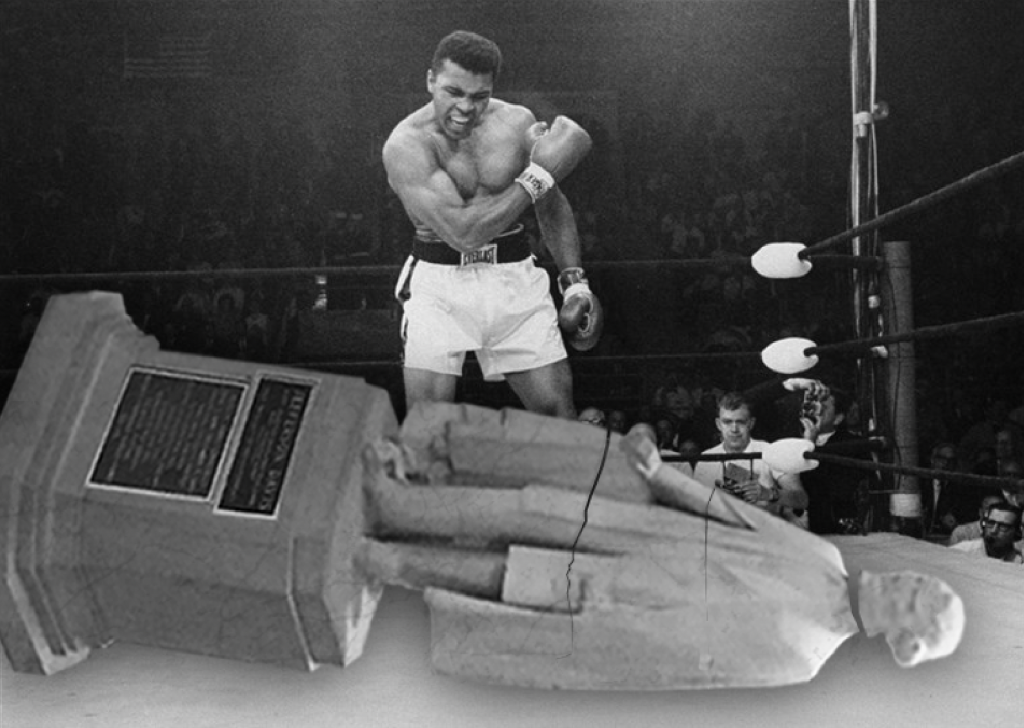
Please sign the petition below to remove the statue of Jefferson Davis currently in Kentucky’s Capitol Rotunda, and replace it with a tribute to Muhammad Ali, “the Louisville Lip” and “the Greatest of All Time.”
I just heard from the Ali family: It is the Champ’s belief that Islam prohibits three-dimensional representations of living Muslims. Accordingly, I have adjusted the petition to call for a two-dimensional representation of Ali (a portrait, picture or mural) in lieu of a statue.
UPDATE (Tuesday, December 2, 2014)
In this interview with WHAS-TV’s Joe Arnold, Governor Steve Beshear endorses the idea of honoring Muhammad Ali in the State Capitol (although he disagrees with removing Davis). Arnold explores the idea further on his weekly show, “The Powers that Be.”
Click here to check out WDRB-TV’s Lawrence Smith’s coverage of the story.
And here’s my op-ed in Ali’s hometown paper, the Louisville Courier-Journal.
UPDATE (Saturday, June 4, 2016)
In the wake of the 2015 Charlestown tragedy, in which a Confederate flag-waving murderer united the nation against racism, all of the most powerful Kentucky policymakers — U.S. Senator Mitch McConnell, Governor Matt Bevin, Senate President Robert Stivers and House Speaker Greg Stumbo — called for the removal of the Davis statue from the Rotunda. Today, as we commemorate last night’s passing of Muhammad Ali, there is no better moment to replace the symbol of Kentucky’s worst era with a tribute to The Greatest of All Time.
UPDATE (Wednesday, June 8, 2016):
Great piece by Lawrence Smith of WDRB-TV in Louisville on the petition drive to replace Jefferson Davis’ statue in the Capitol Rotunda with a tribute to Muhammad Ali.
UPDATE (Thursday, June 9, 2016):
Excellent piece on the petition drive by Jack Brammer that was featured on the front page of the Lexington Herald-Leader.
Highlight of the article:
Miller said he has received a few “angry comments” on his call to honor Ali.
“One of them encouraged me to kill myself,” he said. “You can quote me that I have decided not to take their advice.”
UPDATE (Friday, June 10, 2016)
The petition drives continues to show the Big Mo(hammed): check out these stories from WKYU-FM public radio in Bowling Green and WKYT-TV, Channel 27 in Lexington:
UPDATE (Saturday, June 11, 2016):
Still not convinced? Check out this excerpt from today’s New York Times:
The author is the CEO of Host Strategic Resources, LLC, a firm specializing in strategic and crisis communications, speechwriting, web development and open source software implementation. He was the former Communications Director for Congresswoman Katherine Harris (R-FL)
A very thoughtful piece, Jonathan. I have become more open to the case for legalization in recent years, though I’m far from convinced.
First, the notion that pot is “harmless” is far from proven. Perhaps the best characterization of the evidence I have seen is that – like tobacco – the cumulative impact varies from person to person. For example, George Burns smoked cigars and lived to be 100. Likewise, there are plenty of “casual” pot users who don’t experience significant health effects.
Yet, according to a Scientific American article detailing the same peer review study you cited, “[c]hronic marijuana use has been associated with anxiety, schizophrenia, bipolar disorders and depression.” Given the role of such mental disorders in violent crime, I respectfully disagree with how you dismiss the potential links between marijuana abuse and violent crime – not to mention the risks associated with impaired driving, heavy equipment operation, etc. Moreover, while marijuana may not have the addictive characteristics of cocaine, there is plenty of evidence that it can be addictive, at least for some individuals.
Thus, it appears as though one’s understanding of one’s own physiology, family health history (particularly instances of addiction) might be the most important consideration in deciding whether pot use is safe (just as it is in the case of alcohol and tobacco). This decision relies upon the judgment that comes with age. So, as part of a legalization regime, would we establish minimum age requirements – a “pot smoking age”?
Under this scenario, won’t we have the same problem all over again – kids grasping for the “forbidden fruit” – and won’t the same criminal elements hang around to meet this demand? For me, the “gateway drug” argument retains particular salience in this case. Kids will find it easier to deal with pushers than trying to obtain the drug through legal channels via a fake ID or other means. The legal availability of marijuana will certainly depress the “street price” – but pushers will still deal the drug in order to continue developing their market for harder drugs.
Read the rest of… The RPs Debate Marijuana Legalization: David Host Rebuts
Some interesting points from Jonathan and Artur, and some fancy philosophy as well.
And I grant Artur’s point – having represented some of the nation’s poorest and violent census tracts I agree that people just want the dealers off the streets.
And when our nation has the political will to make that happen instead of spending a trillion dollars in the Middle East this past decade, then I’m prepared to entertain arguments about reforming the criminal justice system.
Read the rest of… The RPs Debate Legalizing Marijuana: Jeff Smith Responds
Two thoughts regarding Jeff’s position on wholesale legalization of narcotics, which as my earlier comments suggest, I fundamentally reject.
First, it illustrates very conveniently a common flaw in libertarian arguments, the notion that unrestrained liberty is a social good in its own right. Without lapsing too much into philosophical mumbo-jumbo, any social good actually ought to convey a value we all might enjoy, one that might somehow lift the condition of the community. The libertarian goal that we are all free to take on more risk not only fails that standard, it essentially kicks it aside.
(OK, OK, if you are too old or too young to get the reference, click here.)
As always, Jeff’s writing is lucid, compelling, entertaining, and reliant on first-hand knowledge due to his unique experiences.
But I strongly disagree. In fact, you help illustrate to me why marijuana legislation is such a moral issue, in stark contrast to the “harder” drugs you mention.
Part of having freedom is having the freedom to do harm to yourself.
First of all, I disagree with the premise: My communitarian philosophy, in contrast to your libertarian views, recognizes the moral dimensions of public policy, and sometimes requires members of the community to sacrifice certain freedoms for the common good. [Sorry for the big words and over-thinking, but if you’d like an excellent summary of the philosophical distinctions, click here, and if you want to read an incredible, very readable book on the subject, click here.]
Read the rest of… The RPs Debate Legalizing Marijuana: The RP Defends
I think drug legalization is a little like campaign finance reform, or Lay’s potato chips: You can’t do it halfway (or, you can’t eat just one).
That’s why I think Jonathan’s wrong. We shouldn’t legalize marijuana. We should decriminalize all drugs.
Prohibition has accomplished a few things. It has driven up the price of drugs dramatically given the risks that market players take every day. It has increased the potency of drugs and made them more dangerous than they would be if legal and regulated; every year thousands die from taking drugs that are laced with toxic substances. It has helped lead to the imprisonment of a generation of mostly minority young males, many of whom have substantial talents and aptitude for capitalism (and took advantage of their skills in the only thriving industry in their neighborhoods). And of course, because of the outsized profits available to those willing to risk their liberty and indeed, their life, prohibition helped give rise to an epidemic of violence that plagued inner cities for decades and has to a lesser extent hit rural America via meth.
I have avoided getting into this talk because, amusingly enough, I really do not have a clear opinion.
Like the RP, I have never really smoked weed, but know plenty of people who have and who have not turned into the giggling dope fiends of Reefer Madness. I appreciate the arguments about enforcing existing law, and also the dangers of gateway drugs, but I can also see the argument that decriminalizing small amounts for personal use and regulating the trade would actually be a net plus for the treasury (combining a new tax revenue stream and lower police costs).
I do think, however, that the debate tends to gloss over the important point of social costs. Legalizing weed will require plenty of regulation, and the need for such regulations tends to get lost in all the talk about how awesome it will be to smoke ’em if you got ’em. Proponents of legalization love to point out all the damage that is done by alcohol, and they have a point.
I think that Jonathan’s argument regarding medical marijuana–versus social use of marijuana– is a tougher one to resolve, but I’m still inclined toward the view that legalizing marijuana for medicinal purposes is easy to do in theory, hard to do in fact. Jason Atkinson is dead-on, in my view, about the abuses and subterfuges that will spring up if the door to legalization is opened at all.
As for Jonathan’s observations regarding the resources spent on minor drug prosecutions, it’s a quite serious point. I would repeat my earlier sentiments that marijuana prosecutions remain an area of disparity and uneven unforcement. I would even go so far as to endorse the experiment in some jurisdictions of considering drug possession cases in special drug courts, where the focus is treatment and avoiding recidivism rather than incarceration.
I disagree with Artur’s balancing of the equities when it comes to marijuana legalization, but it certainly is a reasonable conclusion (one that I used to share), and there simply isn’t the data yet to demonstrate the relative health benefits versus the relative health risks.
That’s one reason that the California Medical Association had called for legalization, to provide the wider clinical analysis to once and for all determine whether marijuana use is more good than bad, or vice versa.
But the equally compelling reason that I support legalization is the impact on our system of corrections and criminal justice, and as a former federal prosecutor, Artur, I’d love to hear your perspective.
Read the rest of… The RPs Debate Legalizing Marijuana: The RP Defends
The arguments for legalizing marijuana turn on the idea that the risks are limited, or on a libertarian notion that individuals should have the license to weigh the risk for themselves.
I’ve yet to hear a case that an explosion of social marijuana use will improve public health, strengthen families or communities, or add to the public good in any measurable way. I’m dubious about ending a whole class of criminal laws with nothing positive to show for it.
There is certainly room to evaluate the defects in how marijuana laws are enforced; many judges and state level defense lawyers are convinced that minorities are more likely to face felony charges for marijuana related crimes, and that the system is replete with inconsistencies in how marijuana offenders are treated, for reasons rooted in class, race, geography, etc. That conversation ought to happen, but there is ample room to reform the disparities without throwing up our hands altogether.
Alright, pour me a white russian and level with me Dude or your Dudeness, or uh, Duder, or El Duderino for whomever is not into the whole brevity thing.
The issue is should citizens smoke pot? The answer is no. It’s bad for you. So are alcohol, potato chips and too much tv, but what we are talking about is a drug for pain relief. Should pain drugs be made? Yes, and I’m open to the herb being part of that mix if treated like a drug.
The criminal element will not evaporate because it’s legal. Perfectly healthy people will not stop trying to get it because its legal.
Many states are trying to stop kids from using Meth. One of the main ingredients of Meth is cold medication. Making that medication hard to get, drastically put a dent into meth production, increasing the street cost, and frankly making it too expensive to be a recreational drug.
On the west coast, the cartels are now making and transporting Meth (see my early post). Crime is crime. If it’s legal for the hurting, the healthy will be jones’n for it.
As a public leader can I support a policy that I know will hurt people? That’s a big question.


 Blog this!