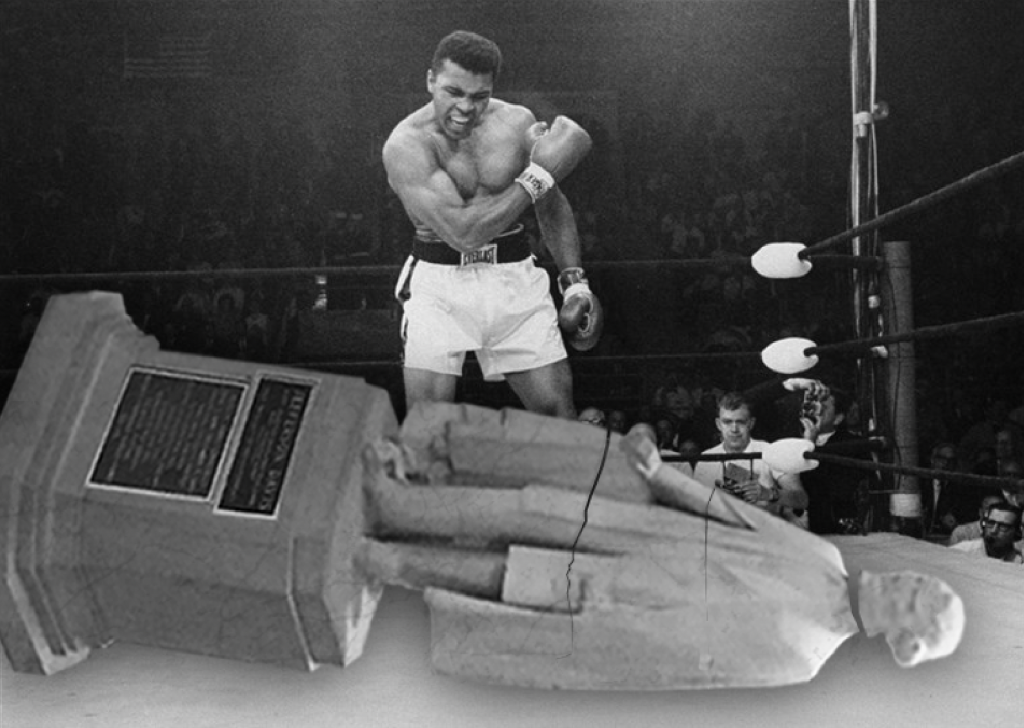
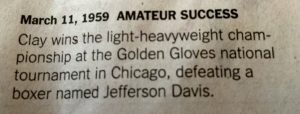
Please sign the petition below to remove the statue of Jefferson Davis currently in Kentucky’s Capitol Rotunda, and replace it with a tribute to Muhammad Ali, “the Louisville Lip” and “the Greatest of All Time.”
I just heard from the Ali family: It is the Champ’s belief that Islam prohibits three-dimensional representations of living Muslims. Accordingly, I have adjusted the petition to call for a two-dimensional representation of Ali (a portrait, picture or mural) in lieu of a statue.
UPDATE (Tuesday, December 2, 2014)
In this interview with WHAS-TV’s Joe Arnold, Governor Steve Beshear endorses the idea of honoring Muhammad Ali in the State Capitol (although he disagrees with removing Davis). Arnold explores the idea further on his weekly show, “The Powers that Be.”
Click here to check out WDRB-TV’s Lawrence Smith’s coverage of the story.
And here’s my op-ed in Ali’s hometown paper, the Louisville Courier-Journal.
UPDATE (Saturday, June 4, 2016)
In the wake of the 2015 Charlestown tragedy, in which a Confederate flag-waving murderer united the nation against racism, all of the most powerful Kentucky policymakers — U.S. Senator Mitch McConnell, Governor Matt Bevin, Senate President Robert Stivers and House Speaker Greg Stumbo — called for the removal of the Davis statue from the Rotunda. Today, as we commemorate last night’s passing of Muhammad Ali, there is no better moment to replace the symbol of Kentucky’s worst era with a tribute to The Greatest of All Time.
UPDATE (Wednesday, June 8, 2016):
Great piece by Lawrence Smith of WDRB-TV in Louisville on the petition drive to replace Jefferson Davis’ statue in the Capitol Rotunda with a tribute to Muhammad Ali.
UPDATE (Thursday, June 9, 2016):
Excellent piece on the petition drive by Jack Brammer that was featured on the front page of the Lexington Herald-Leader.
Highlight of the article:
Miller said he has received a few “angry comments” on his call to honor Ali.
“One of them encouraged me to kill myself,” he said. “You can quote me that I have decided not to take their advice.”
UPDATE (Friday, June 10, 2016)
The petition drives continues to show the Big Mo(hammed): check out these stories from WKYU-FM public radio in Bowling Green and WKYT-TV, Channel 27 in Lexington:
UPDATE (Saturday, June 11, 2016):
Still not convinced? Check out this excerpt from today’s New York Times:
In some alternate universe, President Obama follows up on his reform of healthcare and financial regulations by pivoting to an overhaul of public education in the United States. Instead of spending 2011 on the predictable, partisan ground of raising upper income taxes while growth is weak, Obama might have spent the year making a case that a vibrant economy demands a skilled, advanced workforce and that our outdated method of educating our children is inadequate to the challenge.
Alas, that is not the reality we live in. Obama’s signature plan of incentivizing states to embrace their own reforms, The Race to The Top, is being nibbled to irrelevance; rather than spending political capital to revamp No Child Left Behind, the administration is following the easy course of killing it softly with waivers; charter schools have gone two straight State of the Union addresses without being mentioned; and if the president believes that the stratification in the quality of our schools from one zip code to another is a major contributor to income inequality, he has scarcely said so.
Had Obama adopted education reform as an agenda item, he would have profited from the Republican inertia on the subject. Whether it was Rick Perry on the days he remembered his pledge to abolish the Department of Education, or Newt Gingrich promising to downsize the department to a clipping service for inventorying data, or Mitt Romney trotting out old rhetoric about “local control”, the GOP presidential field has been one long yawn on the notion of education as a public priority.
It’s a bipartisan omission that signifies the power of each party’s political base. For Obama, bold action on educational accountability seems to be a casualty of a post debt-ceiling reelection strategy that is base reinforcement all the time. On the right, denigrating the public sector is easier work than laying out a foundation to make its elements, including education, more productive.
Read the rest of… Artur Davis: Obama’s Education Downfall
People who don’t realize they are reading a satirical news story from the Onion – classic. This story got a lot of play from people with poor observational skills. [Facebook screenshot]
By Stephanie Doctrow, RP Staff, on Wed Feb 8, 2012 at 1:30 PM ET
Why the Obama administration’s contraception ruling might mean more to the 2012 election than you think: [Time]
Karen Handel, one of the top officials of the Susan G. Komen for the Cure foundation, stepped down Tuesday after the organization’s controversial decision to cut off funding to Planned Parenthood was reversed. [NY Times]
Online dating might make it easier to meet people, but does it make it harder to find The One? [CNN]
Good news, frequent flyers. New evidence shows there’s not a greater risk of blood clots when flying economy class versus first class (but it’s still a good idea to walk around mid-flight). [USA Today]
Double dipping might be a germaphobe’s biggest party nightmare, but how bad is it for you really? [Wall Street Journal]
Race has played an underlying role in most national elections since former President Martin Van Buren ran on the Free-Soil ticket in 1848, splitting Democratic candidate Lewis Cass’s vote in New York State and helping facilitate the victory of pro-states rights Whig General Zachary Taylor.
The role of race receded briefly in the post-Reconstruction era, as the Democratic Party snubbed blacks and the Republicans essentially ignored them for decades, in the wake of the Compromise of 1877.
FDR had an interest in suppressing Democratic divisions on race throughout the 1930s in order to push his New Deal agenda. But race came roaring back in the 1940s, as Strom Thurmond’s Dixiecrats split from incumbent Democrat Harry Truman in 1948 to form a third (actually, fourth) party that year. Since then, racial issues have been salient in nearly every election.
In 1960, JFK’s call to Coretta Scott King helped him win approximately two-thirds of the black vote, despite that fact that there was no real difference between his position and Nixon’s on civil rights. In 1964, civil rights was perhaps the primary issue cleavage, as Goldwater was staunchly opposed to the 1964 CRA pushed by LBJ, and consequently carried only his home state + the Deep South. In 1968 and 1972, Nixon’s “Southern Strategy” was premised on the white backlash against the civil rights movement. In 1980, Reagan went to Philadelphia, Miss., where three civil rights workers were brutally murdered in 1963, to kick off his 1980 general election bid and proclaimed that “the spirit of Jefferson Davis lives in this year’s Republican Party platform.” In 1988, Wille Horton became a household name. In 1992, Clinton successfully walked the racial tightrope: he signaled that he would not be co-opted by Jesse Jackson and, by proxy, the party’s African-American base by dissing Jackson via Sister Souljah at the Rainbow Coalition convention, but reassured blacks that he would “mend, not end” affirmative action. In 2000, Bush deftly alluded to race in his bid for suburban women (and perhaps a sprinkling of blacks) by decrying the “soft bigotry of low expectations that plagued urban schools. And in 2008…well, you know.
Read the rest of… Jeff Smith: Race Has Always Been An Election Issue
By John Y. Brown III, on Tue Feb 7, 2012 at 12:00 PM ET
I love big ideas and the one I’m about to share may be the biggest idea of 2011!
What if I told you I had devised a way that would reduce personal debt by 8-9% each year (yet there would be zero loss to our quality of life or reduction in things we want to purchase)?
In addition to personal debt reduction, we could eat away at the international trade imbalance by an equivalent annual amount.
And finally, the “generalized frustration” each American feels daily would be moderately and noticeably reduced.
Would you be interested?
Of course, you would.
Here’s my idea. Ban all “up-selling”–the annoying practice of enticing Americans, a group who already can’t shop responsibly, to buy stuff we neither need nor want with money we don’t have!
The only thing we would miss is the stuff we bring home that we neither want nor need….and keep it available for those who truly need these items (yet another economic efficiency).
But–and here’s the brilliant part–only ban upselling domestically. For all international sales we will “require” companies to up-sell. This means every time we transact for a major export—e.g. sell aircraft, soybeans, semi-conductors, etc to a foreign country– we require that the US company ask if they’d like fries, an extra muffin, stamps, batteries, or to open a new bank account (in the US).
Of course, individually no single upsell will make much of a dent. But over time the US trade imbalance will be rectified, we won’t need another bailout from DC, we’ll walk around less antsy becuase we’ll feel competent to shop for ourselves, and for the first time in a long time we’ll be a model of personal fiscal restraint for the rest of the world.
By Jonathan Miller, on Tue Feb 7, 2012 at 8:30 AM ET
While the RP has recently been stirring the pot with pieces on highly controversial issues such as legalizing marijuana, expanded gaming, and Tim Tebow, he now addresses an idea that should have nearly-universal support: Cutting Congressional pay when they fail to pass a budget. Read this except from his piece today in The Huffington Post:
A thousand days.
In our gazelle-paced, über-networked society, so many remarkable, epochal events have taken place during the last thousand days:
Both the Tea Party and Occupy Wall Street emerged as powerful rebuttals to the status quo in American politics…
The Arab Spring ushered in a domino effect that toppled vicious dictators across the Middle East…
A handful of European democracies teetered on the brink of collapse, while world powers rushed to preserve the global economy…
And most significant of all…Two Kardahsian weddings were followed by one Kardashian divorce.
But one critical thing has not occured:
It’s been more than one thousand days since the U.S. Congress passed a budget resolution.
And in the meantime, the congressional appropriations process – the means by which all federal spending is authorized and allocated – has simply broken down. During the current fiscal year, only 3 of the 12 regular appropriations bills have been passed.
Sound like a lot of inside the Beltway jargon?
Here’s what it means:
When Congress acts without a budget, it essentially is spending taxpayer money without first evaluating and prioritizing its services. A budget, in essence, is a blueprint that allows us as a nation to make deliberate decisions on how to allocate our scarce resources. Without one, taxpayers are forced to pick up the tab for the waste and inefficiencies.
When Congress fails to pass spending bills on time, it relies instead on temporary spending measures. In the past fiscal year, there were eight such temporary “continuing resolutions.” This start-and-stop spending process causes havoc for federal agencies that provide for our national defense, transportation financing, education support, environmental protection, and product and food safety. Government is forced to operate in a fog of financial uncertainty, resulting sometimes in delays of critical national services.
But guess who’s been paid right on time, like a Swiss clock, during this entire thousand day period?
No need for a spoiler alert: It’s just too delicious an irony…the U.S. Congress.
Click here to read the entire piece, “No Budget? No Pay!” at The Huffington Post.


 Blog this!