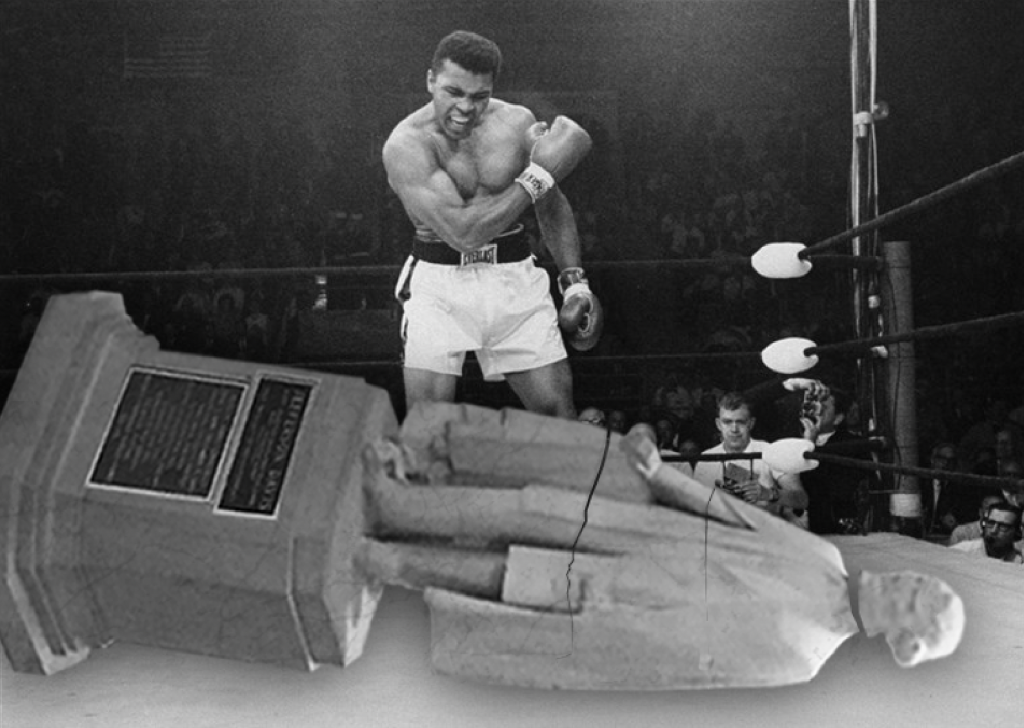
Please sign the petition below to remove the statue of Jefferson Davis currently in Kentucky’s Capitol Rotunda, and replace it with a tribute to Muhammad Ali, “the Louisville Lip” and “the Greatest of All Time.”
I just heard from the Ali family: It is the Champ’s belief that Islam prohibits three-dimensional representations of living Muslims. Accordingly, I have adjusted the petition to call for a two-dimensional representation of Ali (a portrait, picture or mural) in lieu of a statue.
UPDATE (Tuesday, December 2, 2014)
In this interview with WHAS-TV’s Joe Arnold, Governor Steve Beshear endorses the idea of honoring Muhammad Ali in the State Capitol (although he disagrees with removing Davis). Arnold explores the idea further on his weekly show, “The Powers that Be.”
Click here to check out WDRB-TV’s Lawrence Smith’s coverage of the story.
And here’s my op-ed in Ali’s hometown paper, the Louisville Courier-Journal.
UPDATE (Saturday, June 4, 2016)
In the wake of the 2015 Charlestown tragedy, in which a Confederate flag-waving murderer united the nation against racism, all of the most powerful Kentucky policymakers — U.S. Senator Mitch McConnell, Governor Matt Bevin, Senate President Robert Stivers and House Speaker Greg Stumbo — called for the removal of the Davis statue from the Rotunda. Today, as we commemorate last night’s passing of Muhammad Ali, there is no better moment to replace the symbol of Kentucky’s worst era with a tribute to The Greatest of All Time.
UPDATE (Wednesday, June 8, 2016):
Great piece by Lawrence Smith of WDRB-TV in Louisville on the petition drive to replace Jefferson Davis’ statue in the Capitol Rotunda with a tribute to Muhammad Ali.
UPDATE (Thursday, June 9, 2016):
Excellent piece on the petition drive by Jack Brammer that was featured on the front page of the Lexington Herald-Leader.
Highlight of the article:
Miller said he has received a few “angry comments” on his call to honor Ali.
“One of them encouraged me to kill myself,” he said. “You can quote me that I have decided not to take their advice.”
UPDATE (Friday, June 10, 2016)
The petition drives continues to show the Big Mo(hammed): check out these stories from WKYU-FM public radio in Bowling Green and WKYT-TV, Channel 27 in Lexington:
UPDATE (Saturday, June 11, 2016):
Still not convinced? Check out this excerpt from today’s New York Times:
Congressmen Kurt Schrader (D-OR), Scott Rigell (R-VA), Jim Cooper (D-TN), and Reid Ribble (R-WI) today appeared together in front of the U.S. Capitol to send a clear message to America: Congress is broken, and we’re ready to fix it.
“The American people recognize that Washington is broken,” said Congressman Scott Rigell, a Republican from Virginia Beach. “This is underscored by the fact that the 112th Congress has an underwhelming 12 percent approval rating. It is a sobering reality that Congress is, indeed, in need of reform, and it’s time we do something about it.”
At a press conference Wednesday, Rigell, Schrader, Ribble, and Cooper formally launched the Fix Congress Now Caucus, a small but committed body of like-minded, reform-driven Members — seasoned and new to Congress. Their mission is simple: “We will identify, agree upon, and move forward legislation and rule changes that will fix this institution to such a degree that we are able to fully meet our deep obligation to our fellow Americans — and to our children and grandchildren. And we will be bold in our efforts to truly make a difference.”
The top priorities of the Caucus are reforming the benefits of Congress, addressing the inefficient and unaccountable budgeting process that leaves the country without a budget year after year, and finally, elevating the debate from the bitter partisanship now rampant in Washington.
As the first practical expression of that goal, the founders, flanked by other Members who have signed on to support their efforts, announced their unanimous support for HR 3643, ‘No Budget, No Pay,’ a bill introduced in the House by Cooper and in the Senate by former House Member Dean Heller of Nevada.
The bill essentially establishes ‘pay for performance’ in Congress. It prohibits payment to any Member of Congress if both houses of Congress have not approved a concurrent resolution on the budget for a fiscal year before October 1 of that fiscal year and have not passed all the regular appropriations bills for the next fiscal year by the same date.
Schrader, a Democrat from Oregon agreed: “One of the fundamental responsibilities of Congress is to designate a fiscally responsible budget for which the Federal government has to operate. If we cannot perform this most basic task, we have no right to be collecting a paycheck from hardworking American taxpayers who rely on us to do so.”
“Diagnosis is the first step to treatment,” said Cooper, a Democrat from Tennessee who has long advocated for Congressional reform. “So I’m glad my colleagues are recognizing that Congress is broken. By tackling reform, this caucus will push for medicine – like No Budget, No Pay – that Congress could actually swallow.”
Ribble, a Wisconsin freshman who sits on the House Budget Committee, said: “I ran for office for the same reason that I helped start the Fix Congress Now Caucus. I want to ensure that my children and grandchildren can experience America as it should be: the land of opportunity.
“We want the Fix Congress Now Caucus to be a vehicle to correct the systemic dysfunction that has plagued Washington – regardless of party affiliation,” Ribble continued. “If our colleagues on both sides of the aisle stand with us and work toward commonsense solutions, then we can make sure that generations to come have a chance at the American dream.”
Rigell also stressed the importance of elevating the tone of the debate in Washington from partisanship rhetoric to a more civil debate.
“We must strive for a civil tone in Washington. In all debates we have here, we must seek the true facts and not question each other’s motives,” Rigell said. “But do not mistake civility for weakness. Each of us is firmly rooted in our principles, but we are also committed to seeking the common ground that Americans expect us to find to address this nation’s great challenges.”
By John Y. Brown III, on Wed May 16, 2012 at 12:00 PM ET
Children’s books matter.
I love–LOVE–trying to take perceived problem and turning it into an unforeseen solution. Creating a new situation that is “better” than the condition before the problem.
I was wondering what my first exposure to this concept was and think I remember–at least in part.
A favorite book of mine as a very young boy involved a family of bears. The playful young boy bear was picking blackberries (so the story goes) and got blackberry juice stain on his plain-colored shirt. The mother bear–tempted to get angry and scold her son—had a better idea. She took blackberry juice and dyed the entire shirt a pretty blue-purple color. The “new” shirt was not only not stained– but better than before.
I can’t remember the name of the book…but I sure remember the story. I can’t imagine that I was over 5 years old when I read and re-read it.
And to this day when I’m surprised by a disappointment, I almost always quickly ask myself, can we make blackberry dye –figuratively speaking–to solve the problem
So, yes, children’s stories matter. That one either gave me an idea for a life philosophy or reinforced it. Or both.
But it started with a kids book about imaginary bears solving an ordinary problem. Differently and creatively. And successfully.
By Artur Davis, on Wed May 16, 2012 at 10:00 AM ET
Mark Schmitt has just written a solid critique in the New Republic of the failing political enterprise that is Americans Elect. On this site and elsewhere, I’ve echoed Schmitt’s point that the putatively grassroots organization has turned into little more than a society of well connected K Street/Wall Street donors and establishment types who are steering toward some amorphous “center.” I‘ve also argued that this center is a socially liberal, deficit conscious, selectively pro big business zone that reflects the worldview of any lobbyist-paid lunch table at the Palm or Bobby Vann’s. In other words, less a coherent middle ground than a hodgepodge of views that are already well represented in American discourse, especially at elite levels.
As Schmitt documents, the group has lagged in its audacious plan to elevate a third party presidential candidate. Its goal of securing ballot access in 50 states, which was supposed to have been accomplished last fall, has barely crossed the halfway point. The top contenders in their online virtual primary—Buddy Roemer and an unauthorized rump of Ron Paul diehards– are compiling embarrassingly low numbers that look like single precinct caucus totals. And the veil of indifference about the identity of an eventual candidate has been lifted in favor of a not so covert push for former Comptroller General David Walker, a serious man but one whose flirtations with running have yielded 360 online votes and an occasional Google alert.
The failure is not surprising: the two occasions in which a third party has genuinely broken through in our politics have involved either a national catastrophe—the Republicans who were born from the disintegration of the country over slavery in the antebellum era—or the galvanizing presence of a charismatic former president, Theodore Roosevelt, who was denied a comeback by his party’s retrograde machine. For all of the angst over our current partisanship, America circa 2012 is not remotely a nation in fundamental disarray, or one whose political institutions are unraveling. The Tea Party on the right has already realigned into what amounts to a populist wing within the Republican Party while Occupy Wall Street on the left has quickly faded into irrelevance and incoherence.
Read the rest of… Artur Davis: Americans Elect, Going, Going, Gone?
In his Pulitzer Prize-winning book, “Profiles in Courage,”John F. Kennedy wrote admiringly of U.S. senators who put the national interest ahead of partisanship, ideological purity and regional parochialism. Many sacrificed their careers because of their stands, but Kennedy held them aloft as examples to be emulated for their moral courage, intellectual independence and public candor.
Judging by Sen. Richard Lugar‘s defeat in the Indiana Republican primary last week, today’s most partisan voters would give the book an unfavorable review.
Lugar served the people of Indiana in the U.S. Senate for 36 years. My father was a colleague of his for four years, and I served with him for another 12. My father and I saw the world differently from Sen. Lugar in many respects, and we often voted differently. But Lugar is a statesman in the best sense of the word. He was thoughtful, civil and willing to find common ground when doing so served the best interests of our nation.
Those characteristics made him a great senator, but they also turned him into a soon-to-be ex-senator last Tuesday when he was soundly defeated in his Republican primary by the tea party-backed Indiana Treasurer Richard Mourdock. Lugar was undone by the antithesis of what Kennedy so admired.
Read the rest of… Evan Bayh: Profiles in Partisanship
By Jonathan Miller, on Tue May 15, 2012 at 5:00 PM ET
Thanks for joining us for what I believe was a very enlightening, and sometimes even entertaining debate on the relevance of Mitt Romney’s alleged bullying of a fellow prep school attendee nearly 50 years ago.
Some concluding observations:
I thought the colloquy between Jeff Smith and Artur Davis on marriage equality and gay rights was fascinating. While I agree with Jeff, I was impressed with Artur’s reasoning. Usually, the anti-equality side relies strictly on Bible verses or evades the fundamental issues. I’m pleased in how Artur enriches the civil dialogue even though I disagree with his conclusions.
While this site is primarily focused on the views of recovering politicians, I am really glad to involve the perspective of others as well. David Host and Ron Granieri both offered some very interesting takes from their perches in the private sector and academia, and I was especially pleased to hear the perspective of Gen Y’ers Robert Kahne, Zac Byer, and Jordan Stivers who aren’t too removed from their teen years. Gay marriage, rights, and bullying are issues that polarize us generationally, but it is the Y’ers views that will be around for a lot longer.
I deeply apologize about including Steven Schulman‘s lame insights in an otherwise fascinating debate. You have to understand, his mom sends me a batch of her incredible, world-famous brownies every time I publish one of Steve’s pieces.
I agree with my namesake, Jonathan, and spoke from that way from my pulpit in Alabama. In my experience, people change, and some people change radically and become their better selves. This was a shameful incident. But we do not elect 17 year olds to the office of President, thank God.
Further, I felt badly that Romney had to play dumb, that he couldn’t fess up or tell the world who he changed because of the gotcha political environment. The muted reaction to this event from the candidate and his minions was a result of trying to finesse the news cycles.
Says Linda Curry, Harrods Creek, KY:
I think he should definitely be held accountable. Romney was eighteen (18) years old. Legally he was an adult. Yes, it matters what he did fifty (50) years ago. He wants us to elect him President of the United States. From what I am hearing of his comments he will certainly “bully” the poor and helpless in favor of the ultra rich. He even tried to laugh the matter off as not remembering it. If he were honest with the American people he would not try to act like it didn’t happen.
Read the rest of… The RPs Debate Romney Bullying: The RP Nation Weighs In
Jeff Smith’s response to my position is a thoughtful clarification. It deserves the following clarification on my part: first, I do think there is room to criticize the termination of Grenell as a needless concession to anti-gay sentiment on the right; there is also as much room to view it as a legitimate reflex in a campaign that has had a consistent issue with staffers who draw too much attention to themselves (remember the debate coach who was sacked last fall after talking out of school about his role in Romney’s debate prep?). My point is simply that it is a fit subject for debate and not a closed, easy case, and I should have expended the time in making that clear.
Second, on the much broader observation that Jeff makes, I actually agree with his point that those of us who aren’t there on gay marriage have an obligation to ground those criticisms in themes that resonate beyond the evangelical community, and that don’t just reflect animus against one class of citizens. I have made that point in a posting on my own blog,officialarturdavis.com last week. I quote part of my observations below:
“The media-filtered reaction to President Obama’s endorsement of gay marriage has been predictable: an undercurrent of exaltation in the newsrooms that have long ceased to think of homosexuality as anything but another form of freedom; cherry-picked evangelical leaders who fit that same media’s expectations of what social conservatism looks and sounds like. To be sure, the networks and cable have brought forth their share of high profile African American ministers and Catholic bishops, but they aren’t the woman in that southern church running a youth group, trying to grapple with how social change shapes fatherless neighborhoods: the preachers and clerics are speaking in the accents of scripture and biblical text, which most Americans are in the custom of preaching not practicing.
It would be a healthy thing if more of the debate featured voices like the woman I described. It would be equally healthy if more conservatives (and frankly, conservatives disagree with each other on this issue, liberals are entirely of one mind) had weighed in not with jibes at Obama’s timing or the sincerity of his original, pre-”evolving” mindset, but with an honest declaration that the argument over gay marriage does not have the same contours today as it did ten years ago. The fight for most Americans going forward is whether the legal future of same sex marriage is determined state by state, with voters and democratic processes deciding this issue, and not by federal judges deploying an elastic construction of the equal protection clause; and secondly, whether sectarian institutions like Catholic adoption agencies will preserve their own freedom of conscience or lose it to public and elite opinion.
Had there been more pragmatic voices, more voices speaking the language of democratic choice and not absolutism, (see Ross Douthat for an insightful take on how the gay rights community has effectively wielded an absolutionist position to stigmatize opposition) this fundamental cultural argument might be one that clarified rather than deepened our division. Had President Obama gone one step further in his interview and defended the right of good people to differ, he could have actually strengthened his case: instead, he portrayed his own past skepticism as a weirdly disconnected thing that had little force or philosophy behind it, and the logic of his case is that to differ is to condone bigotry.”
While I don’t couch it as a character defect, just a blown tactical opoortunity, Romney did miss a moment last week to make the kind of statement of purpose that Jeff alludes to here, and that I touched on last week, but not in the context of the Washington Post’s hit job. He could have used his speech at a relligious college last weekend to make the point that principled Americans can differ on the definition of marriage; that his reading of the Constitution and his preference for states to decide their own social cultures leads him another way, but that he respects the voices of those who think the issue is a clear-cut matter of justice. He also might have added that conservatives should take comfort from the fact that after decades of marriage attracting some cultural derision in smart, chic circles, its a good thing that the institution is being embraced by a cultural left that was skeptical to say the least in the seventies, when Gallup showed all time lows in faithfulness and expectations of monogamy.
Had Romney gone that route, he would have been criticized on the left and the right for trimming on a moral point. But he would have evoked the tones around a lot of dinner tables last week, and he would have sounded like a leader whom the people at those dinner tables could get used to seeing on their screens for four years.
I do agree with many of you that this apparently isolated incident from many years ago should not by itself raise concerns about Mitt Romney’s ability to be a good President.
For me, there are several other legitimate reasons to believe that he is not the right person to lead this country, but this isn’t one of them.
I do, however, think that this was a missed opportunity for Mitt Romney to reveal his humanity, and his ability to admit mistakes and learn from them.
He should have acknowledged the incident, and then shifted the focus by talking about how he realized that he was wrong, and reiterate his respect for all people, etc.
Instead, in typical Romney fashion, he acted like he had no recollection of the event (which isn’t very believable.) He ended up acting flustered, like he does when he is asked an uncomfortable question about his record.
Whether he is or is not an honest and decent person I am sure I will never really know. As voters, all we have to go on is what we observe as the candidates undergo the often brutal scrutiny that comes with running for President. We need to know if the leader of the free world can be honest and reflective, and if they can handle criticism, even if it is unfair or irrelevant.
In summary, it is not the bullying as a teenager that concerns me, it is the response as an adult who is running for the highest office in the land that does.
What if the victim had been a girl, and he had ripped off her bra because she dressed like a beatnik? No groping, nothing sexual, just mean.
If that is different, why?
Also, the analogies to using alcohol and marijuana ring quite hollow. Those are personal experiments, not harassment of others.
This conduct is surely not disqualifying by any stretch – I don’t think anyone is saying that it is. But the contrary position — that it deserves no attention at all — is not realistic. This is one of the things that goes into the basket of judging character, and Romney’s recent behavior, his marriage, etc., that voters can and should look at to get a picture of the man who wants to be our president.
Artur writes that “if one’s perspective is that Mitt Romney’s opposition to gay marriage and his parting of ways with a staffer whose public position was at odds with his own both amount to homophobia or bigotry,” then there is no room left for civil debate.
A bit of sophistry there. I never said that Romney’s position or his pushing out of Grenell amounted to homophobia and bigotry. I said that it amounted to a weakness of character.
While out, loud, and proud, Grenell worked for eight years for George W. Bush, serving as spokesman to Ambassadors Bolton and Negroponte, as well as John Danforth and Zalmay Khalilzad. Bush, of course, also strongly opposed gay marriage and pushed a constitutional amendment to ban it. The point is that Grenell was at odds with Bush too but Bush understood that not every member of your administration will agree with every single one of the administration’s positions; it is, however, critical that employees agree with those positions in the realm in which they work.
But as Jonah Goldberg from Artur’s own NRO writes, Romney should understand that if you’re going to oppose gay marriage, you will have zero chance of convincing anyone your position isn’t driven by anti-gay animus if you’re also opposed to gays working in policy areas that have nothing to do with gay marriage.


 Blog this!