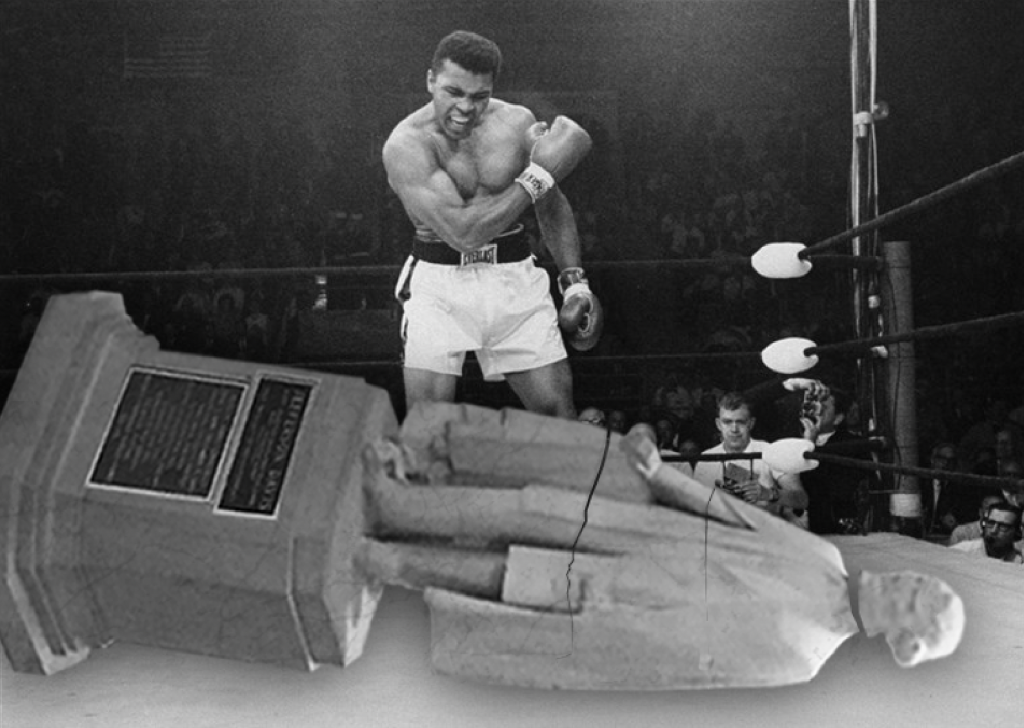
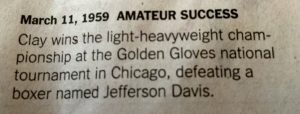
Please sign the petition below to remove the statue of Jefferson Davis currently in Kentucky’s Capitol Rotunda, and replace it with a tribute to Muhammad Ali, “the Louisville Lip” and “the Greatest of All Time.”
I just heard from the Ali family: It is the Champ’s belief that Islam prohibits three-dimensional representations of living Muslims. Accordingly, I have adjusted the petition to call for a two-dimensional representation of Ali (a portrait, picture or mural) in lieu of a statue.
UPDATE (Tuesday, December 2, 2014)
In this interview with WHAS-TV’s Joe Arnold, Governor Steve Beshear endorses the idea of honoring Muhammad Ali in the State Capitol (although he disagrees with removing Davis). Arnold explores the idea further on his weekly show, “The Powers that Be.”
Click here to check out WDRB-TV’s Lawrence Smith’s coverage of the story.
And here’s my op-ed in Ali’s hometown paper, the Louisville Courier-Journal.
UPDATE (Saturday, June 4, 2016)
In the wake of the 2015 Charlestown tragedy, in which a Confederate flag-waving murderer united the nation against racism, all of the most powerful Kentucky policymakers — U.S. Senator Mitch McConnell, Governor Matt Bevin, Senate President Robert Stivers and House Speaker Greg Stumbo — called for the removal of the Davis statue from the Rotunda. Today, as we commemorate last night’s passing of Muhammad Ali, there is no better moment to replace the symbol of Kentucky’s worst era with a tribute to The Greatest of All Time.
UPDATE (Wednesday, June 8, 2016):
Great piece by Lawrence Smith of WDRB-TV in Louisville on the petition drive to replace Jefferson Davis’ statue in the Capitol Rotunda with a tribute to Muhammad Ali.
UPDATE (Thursday, June 9, 2016):
Excellent piece on the petition drive by Jack Brammer that was featured on the front page of the Lexington Herald-Leader.
Highlight of the article:
Miller said he has received a few “angry comments” on his call to honor Ali.
“One of them encouraged me to kill myself,” he said. “You can quote me that I have decided not to take their advice.”
UPDATE (Friday, June 10, 2016)
The petition drives continues to show the Big Mo(hammed): check out these stories from WKYU-FM public radio in Bowling Green and WKYT-TV, Channel 27 in Lexington:
UPDATE (Saturday, June 11, 2016):
Still not convinced? Check out this excerpt from today’s New York Times:
I truly hope discussion about the Post piece doesn’t turn into debate about its timing versus substance.
Reporters are digging into Romney’s post, just as they dug into Obama’s (Rev. Wright, etc). In doing the digging, they came upon the recollections of grown, prosperous men about a bullying incident that haunted them through the years. A peer at their school was harassed, held down and sheared. The prosperous son of a Governor/Big 3 CEO committed the act. That’s pretty damn mean.
What concerns me all the more is that Romney seems to acknowledge the incident, though with faint memory. I think a human being should remember something like that–that is, unless they are wired differently.
Of course, this wouldn’t be as relevant if Romney’s policy positions didn’t reveal callous attitudes towards the GLBT community. Physically restraining a “different” student is one things; policy prescriptions that restrain an entire population from military service, the right to marriage or even civil unions, brings such dehumanization to scale.
I find this incident so insignificant to why – or why not – Mitt Romney should be our next president that I’ve been searching for some larger social significance.
A few years removed from college, I think back to all the pictures some of my friends and I didn’t take for fear of where and when they might resurface. It wasn’t worth putting ourselves in particular situations, we figured, no matter how typical they may be for twenty-somethings in college.
And though we were probably right, I found these experiences frustratingly calculated. Think about all that you have learned about yourself because of the variety of your experiences. Shameful or satisfying, angering or alleviating, it’s safe to say they were all educating in one way or another.
Do I wish Romney hadn’t mistreated that kid 50 years ago? Of course. And I’m sure Mitt wishes otherwise, too.
But until a slew of stories arise that reveal Romney was a pathological bully, I’m looking at this as a moment from which Romney learned right from wrong. He made a mistake – we all do – and he learned from it. Frankly, I’d be much more disappointed in him if I found out Romney stood on the sidelines while his friends picked on a classmate simply because Mitt was afraid it would come back to haunt his future political career.
Experience life and make some mistakes – it’ll be clear enough to your potential investors or voters whether or not you learned from them.
Great point about Romney’s response needing to be honest and opening inroads for an important dialogue.
Like so many instances of public discussion of a public figure’s heretofore private life incidences , it’s the response –not the act—that’s the thing. The teen behavior by Romney, if true, is reflective of a narrow and hurtful view of homosexuality while he as a teen. But if he deliberately deceived the public about the incident as a 65 year old candidate for president, that would bother me quite a bit more.
I believe that if a candidate is comfortable with themselves and their past, it allows the public (voters) to be comfortable with them—and their past. They trust the person who stands before them today that their prior mistakes were duly noted, reconciled, and learned from. But if the person has not made this peace with their past bad acts and integrated them into their present selves, they are merely managing a public image not reflective of who they really are. And will struggle to gain credibility with the voters who they seek to lead.
Having gotten lost in this thread long ago, I will re-enter only to make a few observations:
-If one’s perspective is that Mitt Romney’s opposition to gay marriage and his parting of ways with a staffer whose public position was at odds with his own both amount to homophobia or bigotry, there is not much room for civil debate. I would beg to differ, and would only urge that a topic on which the country seems almost evenly split deserves a less absolutist frame.
-On the larger question of relevance, I side with the Miller/Steele way of looking at this episode: too long ago, too hard to separate from the context of juvenile foolishness, too hard to invoke against Romney without setting a standard that would scorch too many others. I also found intriguing one line of comments to the effect that the whole business of background mining to determine character would have wreaked havoc with a lot of good presidencies. It’s not that character has nothing to tell us about the potential misuses of power, but that it requires much more depth of knowledge and much more texture than today’s weakly sourced media snapshots can generally provide. And surely there is some statute of limitations.
-As to the other nagging charge, that Romney’s handling of this episode is revealing of some lack of empathy, I plead confusion. Should he have really waxed eloquent about a thing that he likely barely remembers, and that he reasonably contends has not much to do with his current values? Should Barack Obama have shown more anguish in describing the costs of teenaged drug use, or George Bush more passion in describing the wages of alcoholism? I’ll side with whoever said that the passions of these candidates on where they plan to take the country are worth more than their passions about their life lessons.
-Final point: I’ll confess disappointment that no one has bothered to address the timing of the Washington Post story, especially on a blog where more than a few of us have been at the mercy of press selectiveness in our past political lives. Timing is a huge power in journalism and the choice to run this story the day it ran is hard to qualify as anything other than a hit job. It was a pretty-clear cut instance of a news organization trying hard to link a 48 year old account to a current position on an issue. That is advocacy, not balls and strikes journalism; fine for a Huffington Post blogger, not fine for the second political paper of record in the country.
I think the answer to Jonathan’s original question–whether or not the actions of youth should disqualify someone from office–is not really black or white. I think, probably, if somebody murders someone else in the first degree when they are 16 years old, that should disqualify them from being President, ever.
On the other hand, if someone, say, makes a really sick and inappropriate joke about killing people of the opposite party when they are 16 or 17, that probably shouldn’t disqualify them from ever holding office. The question then becomes–where on this spectrum does Mitt Romney’s actions fall?
Judging by the responses to this question by some of the folks in this debate, this story resonates more with people my age and younger to a much greater degree than those who are older than me. I think this is probably because attitudes about bullying of homosexuals are changing in a big way, and because my generation is grappling with a horrible plague of teenage homosexual suicides. I am by no means a swing voter–I even went so far as to say Barack Obama will be remembered by history as the greatest President of my lifetime–but during the GOP nomination fight, my attitude was “Lord help us if anyone beside Mitt Romney or John Huntsman comes out of this thing.” That is to say, I don’t dislike Mitt Romney, and actually think he wouldn’t be a bad President. However, this turn of events honestly makes me question that.
I strongly disagree with Jonathan when he said that clearly, the smartest move politically for Mitt Romney in this situation was to lie. His actions, 50 years ago though they were, presented a huge opportunity for inroads with the American public. I think if Mitt Romney had decided to offer an honest and heartfelt apology along the lines of Tony Campolo from the video earlier, it would have been a huge positive–not just for the Mitt Romney for President campaign, but for the campaign against anti-gay bigotry writ large. Instead, he chose to lie.
I also strongly disagree with Jonathan and others when they say this sort of behavior does not mesh with the popular opinion of Mitt Romney. The prevailing opinion of Mitt Romney through the eyes of his opponents is that he is an elitist, aloof, out-of-touch jerk who doesn’t understand anything about anyone who isn’t like himself. As evidence, his opponents point to the $10,000 bet he placed with Gov. Rick Perry, his joking about friends who own NASCAR teams, his quip about his wife “driving a few Cadillacs”, and his car elevator. The narrative up until now has been somewhat convincing, and this story really drives that point home.
Most of the actions of youth can be forgiven; but Mitt Romney’s choices both while he was young and dealing with his youthful indiscretions drive home a narrative about Mitt Romney that give me great pause about his character as a person and about what kind of President he would be.
For me, at least, the aftermath of this story changes the whole narrative of this campaign for me. Before, I really wanted Barack Obama to be given a second term, but I wouldn’t have been overly upset with President Romney. Now, however, I really don’t want this guy to be the President.
(A sentence I had not anticipated writing since joining the RP blog. But well put, sir.)
Some people like to drive slowly past an accident to see what happened. I hate to admit it, but I’m guilty of this more often than I wish I were. But I don’t want to be someone who drives by a fender bender and slows down to imagine an accident that I wish had happened but didn’t.
I can’t help but feel that’s an appropriate analogy for Mr Romney’s alleged anti-gay bullying behavior. Even if it happened as provocatively as some have reported, I don’t feel the behavior is much more than pubescent pseudo-masculine posing.
Embarrassing? Yes.
Regrettable? Sure.
Like a fender bender. But grounds for revocation of a license to be president, so to speak, 45 years later? I say we should take Michael Steele’s advice and keep driving.
Something to see and note, perhaps, but nothing worth staring at for very long.
It’s amazing what you miss when you turn off the TV or stop reading the newspaper. But, unfortunately, since that’s not what I did this week, I’m stuck like the rest of you trying to put some rational context to an almost fifty year story about a bunch of preppy high school boys in the 1960s doing what all preppy high school boys do—haze the hell out of each other.
And because one of those preppy high school boys is running for president we’re supposed to judge his actions to be more egregious, offensive and disqualifying because this happened in 1965?
If the Washington Post broke the story that five weeks ago Mitt Romney and a bunch of aides wrestled an Obama supporter to the ground and Romney sat on his chest and started cutting his hair off, now that would be something worth reading (and seeing). But since that’s not what happened, this story like the incident itself bears no relevance to the man, his campaign for the presidency or what people think or feel about him (except maybe for a few old preppy high school boys who may think he’s cool—but not quite like “The Fonz”).
Just like the most minor of fender benders that ties your life up in a knot of traffic because someone has to slow down and look—don’t look, don’t even pause. Just keep moving because there’s nothing going on here worth reading about or seeing.
I have read the RP debate with moderate interest for two reasons. First, I don’t care what Romney, Obama, or any other candidate did in high school or grade school. Let’s hope the world finds out less about all our lives in those years.
Secondly, this crazy story makes no sense. Look at Romney, listen to Romney and ask yourself if this guy could beat up or pick on anybody.
I have met Mr. Romney and even spent a small amount of time with him behind the spotlights. His friends would call him kind, gracious, well mannered, and curious. His enemies would call him a weak sissy who is afraid of his own shadow.
As a Marine I would not classify Mitt as a tough kick butt kind of person. I don’t think that is his style. That’s OK, we can’t all be John Wayne.
But seriously, does anyone think this guy ever picked on people? I could see him spreading gossip or something girly like that, but not to throw a punch or intimidate anyone.
The dog-on-the-roof-of-the-car story lost traction when the media discovered that the President had admitted to eating one. Thus, we now confront a story even more remote in time, which strives to raise implications which are certainly far more serious.
Yet, before we venture too far into the subject of how relevant the reported incidents are as a guide to Mitt Romney’s character today, should we not first revisit the threshold question of how deeply the political process should scrutinize a candidate’s personal history? Will those who have stood (often justifiably) aggrieved at attempts to dig into Barack Obama’s past perform an about-face, now that the shoe seems to be on the other foot? I hope not.
It seems as though the media launched this seemingly perpetual cycle back in 1988, when for the first time (at least in my recollection) a presidential campaign imploded under the weight of personal issues. Granted, Gary Hart foolishly challenged the media to “follow him around . . . it will be boring.” I can also recall how Hart’s opponents justified the whole exercise upon as relevant to Hart’s fitness for the presidency, as it supposedly reflected upon his “judgment.”
Fast-forward to the 1991 Clarence Thomas confirmation hearings. The poisonous atmosphere that pervades judicial nominations today dates back to the 1987 Bork nomination, which turned not upon personal revelations, but upon positions that Bork had previously articulated. One could argue that Bork’s past writings were drawn out of context and should not have disqualified him for the Supreme Court (to me, serving as the henchman who finally carried out Nixon’s orders to fire Archibald Cox was far more troubling) – but it was hard to argue that those writings were not relevant. In 1991, however – without any other means to stop Thomas’ confirmation – opponents turned to Anita Hill’s sexual harassment allegations. What followed, of course, was a drawn-out media spectacle which amounted to a public trial without discovery, rules of evidence, or any of the other protections which our system supposedly provides to ensure a dispassionate search for the truth.
This show trial even seemed to involve new “law.” While Thomas denied Hill’s accusations in full, some of his supporters suggested a defense of consent – based upon the indefensible notion that just because Hill remained in Thomas’ employment, she had somehow endorsed the alleged behavior. Hill’s supporters responded that an employee-employer situation constitutes a “power relationship” wherein sexual harassment must be implied, regardless of the particular facts and circumstances. Moreover, members of the Senate Judiciary Committee came under attack for showing “insensitivity” toward Professor Hill; this issue played a prominent role in the following year’s Senate campaigns.
Given this backdrop, is President Clinton’s ordeal later that decade surprising in any respect? If we must automatically imply sexual harassment from the mere existence of a “power relationship” between Thomas and Hill, should we not have drawn an even stronger inference from circumstances involving a president and a intern in her 20s? Yet – without any sense of irony regarding what they had unleashed – Thomas’ accusers immediately became Clinton’s defenders. Presumed harassment melted back into “personal indiscretion,” providing a particularly troubling display of the old adage, “where you stand is where you sit.” This time, of course, a public show trial cross-pollinated with actual legal proceedings (the Paula Jones case).
While Jonathan has articulated a very principled, even-handed argument with which I agree in most all respects, I do take exception to one aspect of his position. In our legal system, entire lives can turn upon the weight of false testimony. Accordingly, perjury is never appropriate or acceptable. One can argue very persuasively that President Clinton’s false deposition testimony should have been addressed – if at all – within the legal system instead of Congress (which would likely have required waiting until the end of his presidency), but re-defining his conduct as merely “lying about personal indiscretions” takes us down a dangerous path. For example, the assumption that people will “naturally lie” about personal matters has transformed domestic relations proceedings in some courts into lawless free-for-alls in which perjury is condoned, if not expected (on the basis that people will “naturally lie” about personal matters).
We seem to live in a society bent upon creating illusions of perfection – not only regarding ourselves, but in connection with the leaders we choose. Seeking to maintain such illusions, we rely upon hyper-technical distinctions and highly-nuanced arguments that have the practical effect of adjusting our standards. It would seem far better to set our standards high and exercise common sense, compassion, and mercy when people fall short. Within the legal context, prosecutorial and judicial discretion exist for this very reason.
Of course, the heat and passion of politics inevitably ensures that the slightest flaw will get wildly blown out of proportion. If we try hard enough, we will find a way to connect that flaw to a candidate’s potential performance in office (in 1992, Ross Perot memorably suggested that Bill Clinton’s alleged infidelity was relevant because if his wife could not trust him, how could we?). Yet, the preservation of “government by the people” – or government by human beings – requires us to accept leaders with all-too-human frailties. Could FDR have passed the medical scrutiny John McCain endured four years ago? What about JFK’s “judgment” in sharing a mistress with mob boss Sam Giancana? Would we elect Lincoln today if we knew about the pervasive depression with which he struggled for most of his adult life? How would today’s political inquisitors handle reports that at the age of twelve, Adlai Stevenson accidentally shot and killed a childhood friend?
The bottom line – we simply cannot know enough about an individual’s private life to place what we learn about the same in the proper perspective. The only reliable information we possess is the public record. Sticking with the latter as we assess potential candidates is therefore not only just; it is sensible and practical.


 Blog this!