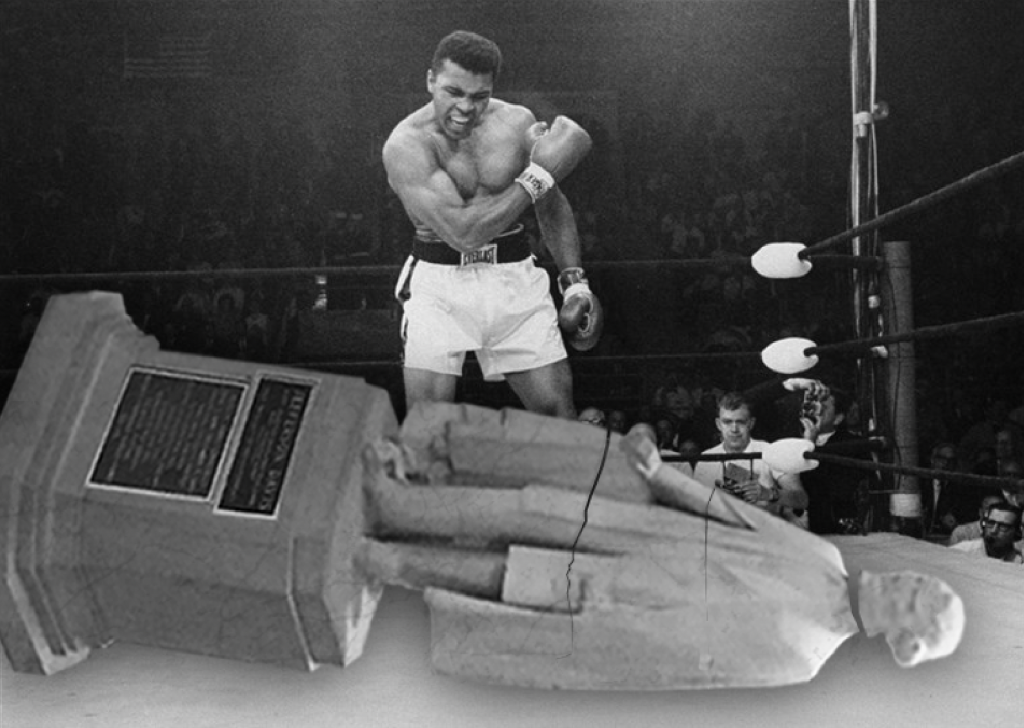
Please sign the petition below to remove the statue of Jefferson Davis currently in Kentucky’s Capitol Rotunda, and replace it with a tribute to Muhammad Ali, “the Louisville Lip” and “the Greatest of All Time.”
I just heard from the Ali family: It is the Champ’s belief that Islam prohibits three-dimensional representations of living Muslims. Accordingly, I have adjusted the petition to call for a two-dimensional representation of Ali (a portrait, picture or mural) in lieu of a statue.
UPDATE (Tuesday, December 2, 2014)
In this interview with WHAS-TV’s Joe Arnold, Governor Steve Beshear endorses the idea of honoring Muhammad Ali in the State Capitol (although he disagrees with removing Davis). Arnold explores the idea further on his weekly show, “The Powers that Be.”
Click here to check out WDRB-TV’s Lawrence Smith’s coverage of the story.
And here’s my op-ed in Ali’s hometown paper, the Louisville Courier-Journal.
UPDATE (Saturday, June 4, 2016)
In the wake of the 2015 Charlestown tragedy, in which a Confederate flag-waving murderer united the nation against racism, all of the most powerful Kentucky policymakers — U.S. Senator Mitch McConnell, Governor Matt Bevin, Senate President Robert Stivers and House Speaker Greg Stumbo — called for the removal of the Davis statue from the Rotunda. Today, as we commemorate last night’s passing of Muhammad Ali, there is no better moment to replace the symbol of Kentucky’s worst era with a tribute to The Greatest of All Time.
UPDATE (Wednesday, June 8, 2016):
Great piece by Lawrence Smith of WDRB-TV in Louisville on the petition drive to replace Jefferson Davis’ statue in the Capitol Rotunda with a tribute to Muhammad Ali.
UPDATE (Thursday, June 9, 2016):
Excellent piece on the petition drive by Jack Brammer that was featured on the front page of the Lexington Herald-Leader.
Highlight of the article:
Miller said he has received a few “angry comments” on his call to honor Ali.
“One of them encouraged me to kill myself,” he said. “You can quote me that I have decided not to take their advice.”
UPDATE (Friday, June 10, 2016)
The petition drives continues to show the Big Mo(hammed): check out these stories from WKYU-FM public radio in Bowling Green and WKYT-TV, Channel 27 in Lexington:
UPDATE (Saturday, June 11, 2016):
Still not convinced? Check out this excerpt from today’s New York Times:
By John Y. Brown III, on Mon Oct 27, 2014 at 12:00 PM ET
Smarty pants astrophysicist Stephen Hawking has joined Facebook and said in his first post “I have always wondered what makes the universe exist. Time and space may forever be a mystery, but that has not stopped my pursuit.”
Oh brother. Whatever.
Well, you know Mr Hawking, you may be the smartest man alive but a lot of us on Facebook have some pretty brilliant moments ourselves. I am upping my scientific and intellectual Facebook game. Be forewarned. And remember, it’s OK to hate the player but don’t hate the game? Feel me? You are no longer in the ivory tower on Facebook. You are now on the street. And it’s about to get real.
So, for starters, you aren’t the only one on Facebook who wonders about what makes the universe exist and about space and time and stuff like that. I think about them too. Not all at the same time. But I think about them sometimes. And think about many other complicated sciencey things too.
When I am on an airplane I like to look out the window at the clouds and think to myself, “Let’s see. There are three kinds of clouds. Stratus, cumulus, and one other.” See? You are probably already realizing we are a lot more alike than you originally thought. That’s OK. That will happen to you a lot on here. Keep an open mind on Facebook. Ok? That’s important for everybody — but especially for guys like us.
Oh…and after I think about the different types of clouds, I’m not done. I keep going. I saw this one recently (see below) I keep staring at the cloud formations until it comes to me, using my vast imagination (again like you) and I figure out what the cloud shape reminds me of. This one reminds me of a puppy dog.
I am interested, Mr Hawking, to find out if your mind works this way too and if you agree the cloud looks a lot like a little puppy dog? Cutie, huh?!
Anyway, congrats for joining Facebook. This may be the most exciting and surprising intellectual journey of your life. And I suspect — if you give it a chance–you will finally get some answers to all your questions about the universe.
This is the fourth of a series of conversations published on the Time website, authored by myself and Nicha Ratana, with transformational leaders who will be storytellers at the BIF10 Collaborative Innovation Summitin Providence, RI.
Ethan Zuckerman’s job is to see the Internet for what it is.
As the director of the MIT Center for Civic Media and the author of Rewire: Digital Cosmopolitans in the Age of Connection, Zuckerman studies civic engagement within digital infrastructures. He has made the case that we are not as connected as we appear to be.
Zuckerman’s research explodes what he calls the “myth of connectivity.” As he claims, “The world is more global. Our problems and economics are global. And though we are inundated with content, the media is getting less global.”
He believes it is important to expose and rectify this fallacy; after all, “this leads not only to shocking ignorance about the world, but also to missed opportunities for marketing and collaboration.”
As it turns out, Zuckerman says, “What you don’t know can hurt you.”
“Atoms are more accessible than bits in many occasions,” Zuckerman says. “Fijian water is easy to access, but Fijian culture is not.”
He attributes the myth of connectivity to a lack of demand rather than too much supply. With the explosion of personal publishing and the “read-write web,” the issue isn’t so much the lack of stories told from other parts of the world, but rather, that these stories have been filtered out by the American attention span.
One of the problems of “free market journalism,” Zuckerman says, is that it relies on user behavior to recommend content. This filtering mechanism is deeply susceptible to what he calls “homophily.” Meaning “love of the same,” the concept is also known by the truism “birds of a feather flock together.”
Homophily explains the tendency of news coverage to cater to the lowest common denominator, or, speaking within the realms of Zuckerman’s research, of the disappearance of international or investigative reporting.
“What we need are new systems to help us stumble over things, to jog us out of ordinary reality,” Zuckerman says.
Zuckerman claims the key to integrating international or hard-hitting perspectives into domestic discourse is to provide relevant context. Fundamentally, he says, “What’s most important to you, is ‘you’ and ‘yours.’ If we’re not giving people some way in which they can interact with content, we’ll be missing giant opportunities.”
He forecasts that content recommendations of the future will be able to determine an audience’s interest and the “information rut” that they’re stuck in, before bridging that gap by suggesting novel, yet unexpectedly useful content. For instance, “following your interest in US mobile phones, you might find yourself reading about Chinese phone technologies, or about how much disposable income the mobile market captures in East Africa,” he explains.
“I was never in love with the narrative of the Internet startup,” Zuckerman says.
“Dot com” entrepreneurism did not excite him as much as the question of the Internet’s potential to transform the world.
Yet, for all his reluctance to view enterprises as one-stop fix-its for society’s ills, Zuckerman looks forward to returning to speak at the Collaborative Innovation Summit hosted annually by the nonprofit Business Innovation Factory (BIF) in Providence, RI.
At the Summit, Zuckerman intends to engage the BIF community — which he knows to be composed of unconventional tinkerers and seasoned social entrepreneurs — with a critical question he has been wrestling with: how to innovate journalism.
The BIF Summit has been a site of meaningful connections for Zuckerman in the past. He recalls meeting his MIT colleague Neri Oxman there, and marveling, from her talk about her first encounter with snow, Oxman’s intuitive thought process as a materials scientist.
“What I value so much about BIF is this notion that you’re not there to give a presentation, but to tell a story,” Zuckerman says, “With stories, the interesting motivations are never completely rational. That irrationality, that underlying passion, is to me what’s fascinating about anybody who’s trying to change the world.”
He believes that in BIF’s passionate community, he will find a receptive audience. “Storytelling is hugely underrated as a form of human communication,” he says, “It’s really hard to make money while doing good, investigative journalism, but that doesn’t mean it’s not worth doing.”
“Ultimately, I think we need to be having a deeper conversation about what public goods we should be willing to pay for, that the market isn’t good at provisioning,” Zuckerman says. He recognizes, “Those tend to be fighting words in the United States, but I think this notion of having really high-quality information is something that we’re not talking seriously enough about.”
The BIF Collaborative Innovation Summit combines 30 brilliant storytellers with more than 400 innovation junkies in a two-day storytelling jam, featuring tales of personal discovery and transformation that spark real connection and “random collisions of unusual suspects.”
By John Y. Brown III, on Fri Oct 24, 2014 at 12:00 PM ET
What makes Fridays nice at age 51 is the vague but pleasant recollection that 15 or 20 years ago something really fun –maybe even edgy and exciting– used to happen on Friday nights.
Even though you can’t quite remember what it was.
You realize that was a long time ago and isn’t going to happen tonight. Because you are too tired and have to pick up the kids later.
But the fuzzy memory that something fun used to happen to you on Friday nights still sustains you.
And is enough to still make you “thank God it is Friday.”
In today’s edition of That’s What She Said, I interview recording artist Ms. Williams on men’s style.
Click here or on the image below to watch our interview. You’ll hear her take on the matter, including the ONE accessory that makes her run the other way when a guy wears it.
After you’re done watching the interview, make sure you take my style quiz to see how you rate on a scale of 1 to 10.
I have been traveling the last few days and have had several conversations with people on the planes I’ve been on about fitness. One in particular with my taxi cab driver who picked me up at the airport in Florida.
The lady must have been in here early 40’s and in decent shape but really wanted to be in better shape. After finding out what I did for a living she instantly started probing me for information. And as it is in many cases the person will ask questions or state beliefs only to validate their own beliefs regardless of my opinion on the subject matter.
15 minutes into our ride she had told me how diet X didn’t work for and neither did diet A-R but diet W and Z were the bomb.com. What?! She also referred to anything lifting related as the “man zone” and quickly wanted to tell me how doing an hour of cardio was great but was boring and she wasn’t sure she could tell a difference. You don’t say?
So, as only I can do, I referred her to my book 12 Steps to Fitness Freedom as a step in the right direction for her. Maybe the book could do a better job of explaining the components of fitness than I could do. Either way these random conversations with people boggle my mind. I still cannot understand why we have such a hard time understanding the core principles of fitness. We continually over diet, we look at food as either bad or good and we have no concept of what is too much or not enough.
Let’s set the trend here with the 3 Thoughts We Should Stop Having About Fitness:
Thought 1: Diets Work
If diets work then why is obesity and the number of diet books on sale at an all time? Diets don’t work. Have never worked. Will never work. They are often too stringent and restrict our favorite foods. They are also not nutrient driven and only focus on the amount of calories you eat, forgetting about the nutrient value of protein, carbs and fats.
Thought 2: More Exercise is Better
Using exercise to lose fat is like using a band aid to on a gun shot wound. Thinking you can go workout to eradicate that pizza you just ate or that bottle of wine you just drank is lunacy. The average person cannot eat what they want then go workout and expect to look the way they want. You also can workout TOO much. Your nervous system can only handle so much (this is where the value of rest comes into play) exercise thang it can become fried and will need a break. 3-4 days of vigorous exercise is usually enough for most people, anymore than that and the body will not be able to handle stress (unless nutrition, rest and genetics intervene).
Thought 3: Lifting Weights Makes Women Look Like Men
It doesn’t. Never has. Never will. There are outliers to everything, however those are few and far between. Want to be leaner? Want to have a defined waist, shoulders and back, pick up heavy things. With the help of great nutrition habits, lifting weights will make anyone look great naked. And that’s a great thing!
My hope is I can put these to bed and never have to discuss them again. But the majority of you reading this already know these so if you could forward to friends and family, it would help he education of the exercising public and maybe increase my subscribers! Until next time.
By John Y. Brown III, on Wed Oct 22, 2014 at 12:00 PM ET
The headline today in the Courier-Journal reports a sharp–even shocking –decline in law school applications for the three KY law schools: 60% at UL and 40% at UK and NKU over the past 3 years. And this decline follows national trends for law school applicants.
The verdict? A law school education and the debt incurred to complete it is no longer as good an investment as it once was given the current market crunch for new attorneys and the projected income for those who do find legal work.
That is simple math and, frankly, a bursting of the law school bubble, so to speak, has been long overdue.
But for someone who is a graduate of law school myself and works both inside and outside of a law firm, I would like to make a personal and emotional plea to those who are considering law school but for whom the math doesn’t quite add up.
First, it’s not just about the math. To paraphrase former President Clinton’s famous 1992 campaign slogan, “It’s the education, stupid.” I know that is easy to say for someone like me who went to law school over 20 years ago when tuition was a fraction of what it is today. But I contend a legal education shouldn’t be a decision like investing in a stock in a mutual fund. It is about something far more personal; more intangible; more defining. A law school education is stepping up and putting yourself on the line as you attempt to go through one of the most intellectually challenging, invigorating and gratifying rites of passage that exists in the world of higher education. (And, yes, you learn to write long-winded and dense run-on sentences like the one I just wrote.) But there are many other benefits, too.
When I was an undergraduate student I went to see a movie with a couple of older students and a newly minted attorney. After the movie I asked the attorney what law school was like and how he liked being a lawyer. He said practicing law wasn’t that enjoyable but “being a lawyer” was great. He added, “You just don’t get intimidated by others or put people on pedestals.” He pointed to a TV with President Reagan speaking and added, “I wouldn’t even be intimidated if I were in a small group of people talking to President Reagan.”
That conversation obviously left an impression on me. And it wasn’t from the comment about not enjoying practicing law. I wanted to be able to have a conversation with a President and not be reduced to mush. That happened to me 3 years after I graduated law school and I got to meet President Bill Clinton while he was campaigning in KY for re-election. He was still the President but he was also now–to me—just “a law school graduate.” Like me. And I stood confidently and initiated a short, pleasant and sensible exchange.
But these benefits are only some of the, shall we say, shallower benefits of going to law school. Law school, after tearing you down, does eventually build you back up and boost your confidence. Somewhere late in my first year of law school, I decided, “I had what it takes to be a lawyer.” I had completed a long and difficult assignment and was recognized with an award for my work. I felt catapulted to a whole new level. I went from being a successful college student with a liberal arts degree to someone who was capable of doing important things in the grown-up world.
The day I was offered my first summer internship at a top Kentucky law firm, I cheered alone in my apartment as wildly as I did when UK’s men’s basketball team nearly made the Final Four two years later. Except mine was a victory. A voice inside me —one quieted by the rejection letters from several top law firms earlier that week—roared, a little that day. Or maybe was born. And that inner voice has stayed with me and served me well in periods of self-doubt.
Still and all, attending law school is a very personal and tumultuous life decision. How does one know how to make this decision? I can’t offer a clear-cut guide. I suspect the decision is akin to the decision made by a mountain climber when staring at the highest mountain he or she has ever faced. In the end, they climb it because it is there and that’s what mountain climbers feel compelled to do. This statement, I suspect, will spark a good deal of disagreement. But I will stand by it in the broadest sense.
Put another way, if you are intellectually curious and interested in institutions like government, business, economics, and community and drawn to ideals like justice and fairness, truth and reason –then you are likely an intellectual mountain climber. And need a mountain to climb that’s worth climbing. And law school, I believe, is a worthy mountain to climb.
Legal education is a process that stretches all your intellectual faculties and then hones them in a forceful and focused manner. It may suffocate some creativity but when you are finished, you’ll feel the three years in the legal laboratory helped you be, intellectually, “All you can be.,” as the Army used to promise. Students get whipped into shape through a form of intellectual boot camp. And that process provides an intangible value that can’t be easily quantified or measured on a spreadsheet alongside an entry level banking or finance position that pays the same as the average attorney, including law school, over a 10 year period. Some things just aren’t made to fit into a spreadsheet cell. But they still matter. Maybe a lot. Possibly even a whole lot.
A legal education, I contend, is the best educational preparation for most any profession outside of a technical or scientific specialty. I also have an MBA and am grateful for that education. My business education, if I had to describe it quickly, was “informative” but my legal education was “transformative.” And legal training has been useful to me in all my different and varied occupations–from start up businesses to corporate executive to elected official to practicing attorney to consultant and lobbyist and to adjunct college professor and whatever else may lie ahead. Whatever I am doing in 20 years, if I am still alive, I will owe To some extent, to my legal education. Even if I am a professional fly fisherman. I will at least be an orderly and logical one who is trying to be better than the fly fisherman down river–who didn’t go to law school. (Yes, you will be forever competitive about even the most trivial things thanks to law school. But you were already wired up that way. Law school just ran the electricity through your wiring and lit up your competitiveness more than you ever wanted others to see.
And I believe that those who believe the intrinsic value of a legal education is actually quantifiable are the same people who believe everything is quantifiable (and probably would have been better off taking more liberal arts courses in college). The intrinsic value of a legal education isn’t something with clear contours and can’t even be articulated clearly. But this intrinsic value does become part of a completeness you feel about yourself when you are sitting alone and wonder if you have asked enough of yourself. Sound hokey? Perhaps a little. But “hokey” matters more than we want to admit when we are young–especially when we are trying to seem together but don’t quite feel it yet inside
And then there is the practical benefit of networking that law school provides. If you attend a Kentucky law school you will be in a class with many of Kentucky’s future leaders in their legal, business and political community. You are exposed not only to your class but the two classes ahead of you and behind you. And within 5-10 years you’ll find yourself with “friends” (former classmates) who are now serving as judges and law partners and heads of local organizations or corporate executives and business people as well as elected officials all across our 120 county state. The guy you sat next to in Torts I and wouldn’t dare ask to borrow notes from now has his own courtoom. And his older sister two years ahead of you in law school is now in the state legislature. And you all will belong to the same club they do: Law school graduate
The club or fraternity (or sorority), exists as the result of successfully enduring a common endeavor that at first seems like an overwhelming challenge. But proves not to be. And along the way, you learn your limits –and capabilities. You learn the extraordinary capabilities of others. You face yourself as you really are. And you surprise yourself with what you are capable of doing. I remember during my second year of law school asking a fellow law student I worked with the summer before, John Roach, “How can we possibly finish these assignments? There is no way we can complete all these projects in the short time we have!” I waited anxiously for John to provide a reassuring strategy as he always seemed to do. But this time he didn’t. He just shrugged and answered, “We have to do it. We don’t have any choice.” That is law school in a nutshell. And you somehow get it all done. Because you have to and don’t have a choice.
Finally, and perhaps most importantly, there are deep friendships that develop. My first summer internship I worked in a narrow corridor of carrels that was closed off to the rest of the law firm. We were a bunch of nervous and hard working ambitious young people whose private grandiose plans were counter balanced by our secret fear that we would eventually not amount to much of anything. But we were impressed enough with each other that we started to figure maybe we had more going for us than we thought. And the more we got to know each other the better it made each of us.
That summer I sat next to Robert Weir, who later was one of the best men in my wedding, and is now a U.S Magistrate Judge and finished first in our law school class. Behind me was John Roach, who was general counsel to a governor and served on Kentucky’s Supreme Court and who now has his own thriving private law practice. Next to Robert was Matt Nelson, who ranked among the top 5 in our class and seemed to plow through writing legal briefs like a champion swimmer swims through the water in a meet. Next to Matt was Will Montague, a trusted and long-time friend who has been a successful partner at several of the state’s top law firms and now has his own firm. And across from Will was John Butler, a lovable guy from Green Co, Kentucky who left the law to coach high school basketball instead, breaking the long family tradition of practicing law but boldly and bravely choosing the life he wanted instead —and with all of our blessings and full personal support. And there were other extraordinary people, classmates, who filled up those remaining nondescript but hallowed (to me anyway) carrels making up that narrow corridor of law school interns.
The next summer my closest friend was David Hale, who became Kentucky’s U.S Attorney and is now the nominee for US District Court Judge. And Ben Fultz, who now has his own thriving law firm starting with his last name. And I have had an interesting, rewarding and diverse career myself and have many of these individuals to thank for helping me along the way, personally and professionally. And each of these individuals are, I dare say, friends for life. Even if we go long periods without seeing or talking to one another. And the same can be said with most every other law student in our class who I sidled up next to as we slogged together through the arduous law school mountain climb.
This Sunday afternoon before last I was out driving with my family and got a call from an old and dear law school friend. The call was to tell me of the members or our “corridor group” from the summer of 1990, had taken his life. Although our group hadn’t spoken in weeks or months –or in some cases even years– we quickly lined up as though it were late August in 1990. With our spouses and graying and thinning hair and paunchier midsections, we stood together on a hillside in the rain and watched one of our dear friends be laid to rest.
I hadn’t seen Robert Wier since his investiture ceremony several years earlier. I patted him on the back and hugged him and he hugged me back. He was from Benham, Kentucky and told me shortly after we met, “I thought I wouldn’t like you at all, John. I assumed you’d be a spoiled entitled jerk. But you turned out to be just the opposite. After getting to know you, I now think of you as one of the very best people I’ve ever known.” I consider that passing comment from Robert many years ago, perhaps the highest compliment I’ve ever received in my life. But we were now back in the present and it was nice to be standing next to my friend again after far too many years. I whispered, “I figured they’d have a special seat for you today, Judge.” Robert’s eye’s gleamed as they always had as he smiled warmly, “I’m just hoping to stay balanced on the side of this hill like everybody else.”
After the funeral, many of those from our original summer group and many other former fellow law students, huddled together and talked, and laughed, and talked some more. it was never said, but clear that we were grateful to have each other.. We tried to put together an impromptu lunch but everyone seemed too busy to make it work on the spur of the moment. We promised to get together for lunch sometime soon but probably won’t. But in law school I was taught the perils of ever assuming anything. So maybe we will get together for lunch soon. I hope so.
I hugged John Roach goodbye and thanked him for always “stepping up” in our group. I told him, “If my car broke ever down at 3am and I had only one phone call to make, I would call you. Because I know you’d be there as quickly as you could. There would be a long lecture for me to endure and you would make some good points. But mostly, you would just be there. And I thank you for that.”
I hugged and shook hands with others and waived goodbye and within minutes I was on a conference call and whisked back into my old and own little world. But as I drove away I felt a familiar rush. But not the rush that I could do anything or was finally good enough. But the mature rush of feeling grateful to be part of a special group of special people and honored to call each of them my friend—22 years after law school.
Was that feeling –and all the experiences I just tried to relate— worth the tuition? Were they worth the time and toil? Were they worth all the debt incurred?
Hell yes they were! Every penny. Every moment. Everything.
Perhaps, you might think, this is my conclusion because I believe that the decision of whether to go to law school isn’t mostly about the math. And if you think it mostly a decision about the math, you probably shouldn’t go law school.
But if you see value in the law school experience beyond merely the questionable spreadsheet analysis of “investment dollars” versus “future projected income,” then pack your mountain climbing gear and head up to the base of the mountain. They will be holding a place for you. But sign in quickly so you don’t lose your place. And get ready for an experience of a lifetime that you will be glad you didn’t miss—and one day not be able to imagine your life without.
Am I an idealist? I suppose I am. At least a little bit. And I hope I always will have that small flickering flame of idealism. Idealists never let a little fuzzy math get in the way of a greater cause. And if I can look back on my life and feel that I have succeeded in keeping that flame alive, I will have my law school education, in large part, to thank.
By Lauren Mayer, on Wed Oct 22, 2014 at 8:30 AM ET
Whatever you thought of the live ‘Sound of Music’ starring Carrie Underwood, it was still commendable for a number of reasons, including exposing country fans to musical theatre, and showing people who’d only seen the movie the numbers & scenes that were cut from it. (Not that Julie Andrews wasn’t adorable, but in the movie the Captain dumps Baroness Schraeder just because of one dance with his employee, which is sort of creepy. In the actual musical, Schraeder turns out to be a Nazi appeaser, and possibly a sympathizer, which is a slightly better reason . . .)
I was reminded of this song by Louie Gohmert (and a few other wingnuts) remarking that the spreading tide of marriage equality was just like the spread of Nazism . . .
By John Y. Brown III, on Tue Oct 21, 2014 at 12:00 PM ET
Dear God,
When you invented shaving every morning for men, what were You thinking? I know it was a long time ago and there was a good reason for it at the time. Just help me to understand.
P.S. I have lost 29 lbs this year. Since you don’t follow me on Facebook, you probably hadn’t heard. Pretty good, huh?
Hope the shaving question didn’t make You mad. Not questioning you. I am just curious. I think losing weight has given me more confidence and allowed me to be more assertive. And ask questions I wouldn’t have asked last year when I was heavier.
Let me know on the shaving thing.
And good job on most everything else.
P.P.S. I noticed in pictures of you at church you are carrying a few extra pounds than you probably should at your age. Do you know your BMI? I know we are all very busy, especially You, but we still have to take time to take care of our health. And that goes for You too. Since you don’t shave, maybe you could take those 5 minutes every morning the rest of us guys spend shaving and try running in place. Or doing jumping jacks. You will notice a difference pretty quickly.
Not judging. Just notice others wieght issues more than I used to. A more slimming and darker colored robe might help too. Just a thought.


 Blog this!