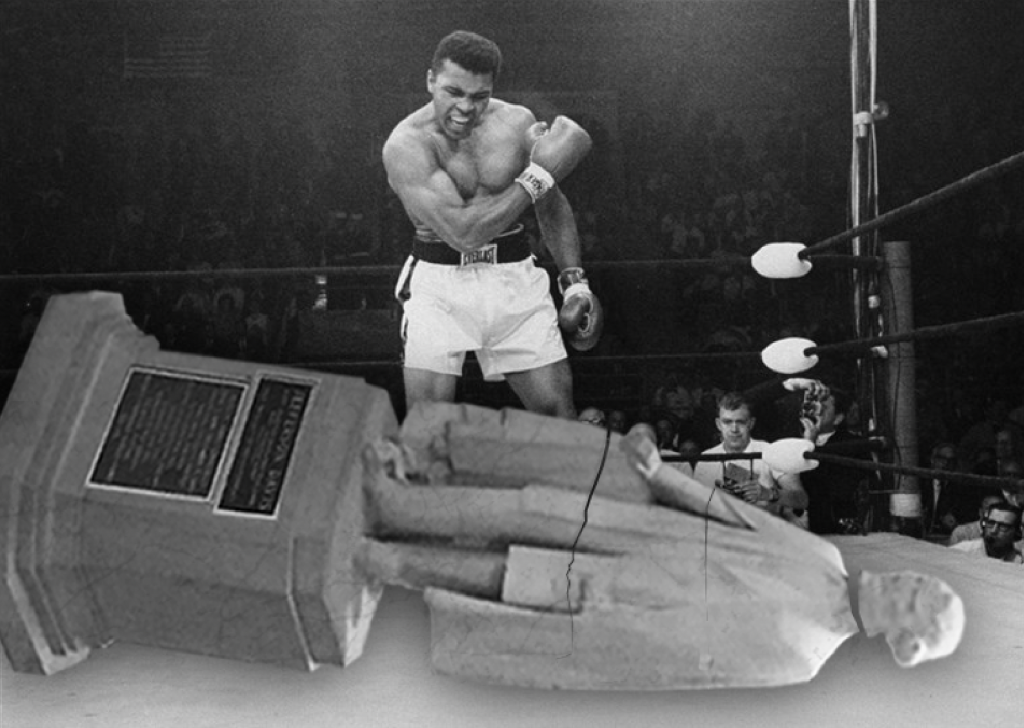
Please sign the petition below to remove the statue of Jefferson Davis currently in Kentucky’s Capitol Rotunda, and replace it with a tribute to Muhammad Ali, “the Louisville Lip” and “the Greatest of All Time.”
I just heard from the Ali family: It is the Champ’s belief that Islam prohibits three-dimensional representations of living Muslims. Accordingly, I have adjusted the petition to call for a two-dimensional representation of Ali (a portrait, picture or mural) in lieu of a statue.
UPDATE (Tuesday, December 2, 2014)
In this interview with WHAS-TV’s Joe Arnold, Governor Steve Beshear endorses the idea of honoring Muhammad Ali in the State Capitol (although he disagrees with removing Davis). Arnold explores the idea further on his weekly show, “The Powers that Be.”
Click here to check out WDRB-TV’s Lawrence Smith’s coverage of the story.
And here’s my op-ed in Ali’s hometown paper, the Louisville Courier-Journal.
UPDATE (Saturday, June 4, 2016)
In the wake of the 2015 Charlestown tragedy, in which a Confederate flag-waving murderer united the nation against racism, all of the most powerful Kentucky policymakers — U.S. Senator Mitch McConnell, Governor Matt Bevin, Senate President Robert Stivers and House Speaker Greg Stumbo — called for the removal of the Davis statue from the Rotunda. Today, as we commemorate last night’s passing of Muhammad Ali, there is no better moment to replace the symbol of Kentucky’s worst era with a tribute to The Greatest of All Time.
UPDATE (Wednesday, June 8, 2016):
Great piece by Lawrence Smith of WDRB-TV in Louisville on the petition drive to replace Jefferson Davis’ statue in the Capitol Rotunda with a tribute to Muhammad Ali.
UPDATE (Thursday, June 9, 2016):
Excellent piece on the petition drive by Jack Brammer that was featured on the front page of the Lexington Herald-Leader.
Highlight of the article:
Miller said he has received a few “angry comments” on his call to honor Ali.
“One of them encouraged me to kill myself,” he said. “You can quote me that I have decided not to take their advice.”
UPDATE (Friday, June 10, 2016)
The petition drives continues to show the Big Mo(hammed): check out these stories from WKYU-FM public radio in Bowling Green and WKYT-TV, Channel 27 in Lexington:
UPDATE (Saturday, June 11, 2016):
Still not convinced? Check out this excerpt from today’s New York Times:
By John Y. Brown III, on Tue Jun 12, 2012 at 12:00 PM ET
“Wassup esse, Juan Brown?”
I’ve wondered what it would feel like to hear that sentence said to me by one of my friends, assuming he was a Hispanic tough guy who was from the streets of East LA.
And I admit, there’s a good chance I’ll never hear it since I don’t live in East LA.
But I can be dangerous. I really can be.
Not like Ving Rhames “going medieval” dangerous….but dangerous in my own way…. I don’t carry a gun or anything like that, for example. But I do keep pepper spray in my glove compartment that my mother bought me years ago. And I still have it. And could conceivably use it under the right circumstances.
We all have a dark side–and a breaking point— that could cause us to break the law to make a point because it was the right thing to do and it was up to us to do it.
That’s right, Friendo.
A personal example came up today when I was pushed to the limits of exasperation and decided to take the law into my own hands. I was at a convenience station filing up my car with unleaded and went inside to get my usual, a small coffee with lots of cream and sugar and a cinnamon roll. I took my place in line behind a large and tough looking man who seemed a lot hungrier and frankly more dangerous than me. So there were two of us. Together. The woman with the cashier was asking for directions and buying lottery tickets. And was taking f-o-r-e-v-e-r (a really, really long time) to complete her purchase.
My friend in front of me looked at me twice and rolled his eyes in frustration. He was confused and frustrated. But I wasn’t. I knew what to do. I waited until the lady at the cash register caught my eye and I slowly raised the cinnamon roll to my mouth and took a small bite of it. Before I had paid for it! Sending the message, “We’re in a hurry back here and we’re not fooling around.”
And then I took a second bite. She wasn’t looking the second time. I just had been surprised at how fresh and delicious the cinnamon roll was the first bite. But I wasn’t finished toying with her yet. We continued to wait and this time I lifted my cup and took a slow pull off my small coffee as if to say, “I have about ….umm….I’m…please hurry. Please. I’m…I really hate lines.”
Another minute past and the sales lady looked at me once more, and I went a place I didn’t think I was capable. I took a large symbolic bite that left less than half the cinnamon roll.
And I didn’t flinch.
I was feeling that any second I might hear the words, “Wassup esse, Juan Brown.”
But instead the sales clerk smiled at someone behind me and I turned to see who. It was two police officers sitting at a table drinking coffee. I swallowed hard. I had really gone too far this time and was going to have to apologize once it was my turn to pay. “One small coffee and a cinnamon roll” I cheerfully chirped. “Haha….the cinnamon roll started off a lot bigger. I’m sorry. I was so hungry”
She never even looked me in the eye. I nodded as I walked by the police officers and breathed a sigh of relief nothing more happened. And I even threw away my pepper spray once I got to my car.
By Jonathan Miller, on Tue Jun 12, 2012 at 11:00 AM ET
One of the “Crazy Lies” that I have debunked in my new book, “The Liberal Case for Israel: Debunking Eight Crazy Lies About the Jewish State,” is the pernicious charge of “pinkwashing”: anti-Zionists perniciously claim that Israel’s extraordinary LGBT record is merely a pink smokescreen for its other failures. [Click here to read an excerpt from my book on “pinkwashing” charge.]
Fortunately, I am not the only one up and arms about the claim. Last week, a Trustee of the City University of New York lambasted that school’s decision to hold a conference on pinkwashing. As The Algemeiner reports:
The Center for Lesbian and Gay Studies at City University of New York plans to hold a conference on “Homonationalism and Pinkwashing” next year, which intends to accuse Israel of using their strong record on gay rights to detract from the “oppression of Palestinians”, while ignoring “the existence of Palestinian gay-rights organizations”, according to a release from CLAGS.
Jeffrey Wiesenfeld, who sits on the Board of CUNY Trustees calls the conference “disgusting” and plans to bring the issue to the Chancellor’s office, which he believes may be unaware of the issue.
“It’s just amazing to me that one of the few free societies in the world like the state of Israel should be a target for people so stupid that they can’t recognize what their fate would be in any other nation in the Middle East,” Wiesenfeld told The Algemeiner.
Ross Douthat has a striking observation on the futile Wisconsin recall: rather than echo the conventional Republican theme that the effort was an ill-conceived liberal putsch, aimed at overturning the fruits of both the electoral and legislative process, he compares the saga to 2009-10, when Barack Obama’s Democrats rammed through sweeping domestic legislation and the Right decisively counterattacked in the midterms. Provocatively, he calls them “mirror image exercises in reverse shock and awe, and…backlash.”
Fascinating stuff. Of course, it’s a message some conservatives will blanche at for the simple reason that a recall is an extremely unprecedented gesture—three governors in our history have fallen victim—while the 2010 off year races were obviously a regularly scheduled democratic exercise. But Douthat surely has the ultimate conclusion right: both sides have gotten well schooled in the gymnastics of cut and slash opposition; it’s just that Republicans are getting the better of it. And as Douthat allows, the outcome in a bluish state that Democrats are still favored to carry underscores the political pull of reeling in outsized spending and the relative weakness of the liberal alternative, when both are put to the test.
I would even go one major step further: in the post LBJ era, the public has arguably never validated a specific, identifiable liberal agenda at the ballot box. The winning Democrats in that time frame—Carter, Clinton and Obama—have won on a tightly crafted appeal that stressed economic anxiety and blurred ideological content. Even the one congressional landslide for Democrats in memory, the 2006 midterms, were linked primarily to fatigue with Iraq and Republican overreach on Social Security. If one reads the post Reagan era as a closely matched siege over time, the left owes its victories to negative referenda on incumbents and a couple of superstar performers. In other words, liberals have been cursed to plot a course identical to the one they dismissively suggested accounted for Ronald Reagan.
Read the rest of… Artur Davis: One Cautious Take on Wisconsin
By Jonathan Miller, on Mon Jun 11, 2012 at 3:00 PM ET
David Maraniss has some more incredible insight on the President in this weekend’s Washington Post:
To say that President Obama loves basketball understates the role of the sport in his life. He has been devoted to the game for 40 years now, ever since the father he did not know and never saw again gave him his first ball during a brief Christmastime visit. Basketball is central to his self identity. It is global yet American-born, much like him. It is where he found a place of comfort, a family, a mode of expression, a connection from his past to his future. With foundation roots in the Kansas of his white forebears, basketball was also the city game, helping him find his way toward blackness, his introduction to an African American culture that was distant to him when he was young yet his by birthright .
As a teenager growing up in Hawaii,he dreamed the big hoops dream. He had posters of the soaring Dr. J on his bedroom wall. A lefty, he practiced the spin moves of Tiny Archibald. And in the yearbook of an older high school classmate who wanted to be a lawyer, he wrote: “Anyway, been great knowing you and I hope we keep in touch. Good luck in everything you do, and get that law degree. Some day when I am an all-pro basketballer, and I want to sue my team for more money, I’ll call on you. Barry.”
It never happened, of course. But the adolescent known as Barry kept on playing, even after he took back his given name of Barack and went off to college at Occidental, Columbia and Harvard and went into community organizing, then politics in Illinois. He played whenever he could on playgrounds, in fancy sport clubs, at home, on the road. During his first trip back to Honolulu after being elected president, he rounded up a bunch of his old high school pals, got the key to the gym at Punahou School, and went at it. When the pickup game was over, Darryl Gabriel, who had been the star of their championship-winning team, found himself muttering to another former teammate, “Man, Barack is a lot better than Barry ever was!”
In his presidency, basketball has become a recurring theme, one of the visible ways that he has escaped the confines of the White House and the pressures of his job. He’s sat courtside at a Washington Wizards game, cheering on his team, the Chicago Bulls. He’s talked trash on the court behind the White House, taken in a game between North Carolina and Michigan State on the deck of the USS Carl Vinson, and invited ESPN into the Oval Office to watch him fill out his bracket for March Madness.
This is the story of the roots of his obsession, back in his days as a teenager, when Barry Obama played on one of the best high school teams in the country.
Click here to read the full story, “President Obama’s basketball love affair has roots in Hawaii high school team”
By John Y. Brown III, on Mon Jun 11, 2012 at 12:00 PM ET
Commit to goals ahead of time so you have no choice but to achieve them!
A short story by Flannery O’Conner has a scene where a character throws his hat over the high fence so he’ll have no choice but to climb over it as part of the story’s adventure.
I love that.
And try to replicate that in my life.
For example, this morning I put on and comfortably fastened a new pair of pants for the first time. The pants were purchased two sizes smaller than my usual waist size. Because I wanted to be sure I had no choice but to achieve my goal.
It was a great feeling of success for being so goal oriented.
Even though I bought the pants nearly 3 years ago.
Remember the RP’s highly critical take on Peter Beinart’s The Crisis of Zionism? Apparently, the RP is not alone…on either side of the issue.
Here’s a brilliant piece by New York‘s Jason Zengerle on Beinart and the controversy surrounding his book:
“I’m really not a radical.”
It is late April, a month after his new book about American Jews, Israel, and their tangled, often tortured relationship has hit the shelves, and Peter Beinart is on the defensive. He’s sitting in his office at the City University of New York. Although he’s now worked at CUNY for two years, the small, windowless cube—more befitting a research assistant than a tenured journalism and political-science professor—is filled with unpacked cardboard boxes and little else. But more square footage, or a view, or some family photographs would do little to lift the sense of siege that pervades the room. “I’m trying to live as a critic of Israel’s policies, from a moral perspective, inside the Jewish community,” Beinart says, “and inside the fairly mainstream Jewish community, which is where I feel most at home.”
Now that home has become something of a war zone. At his shul—“It’s an Orthodox synagogue on the Upper West Side,” he says, “but it’s probably better not to mention its name”—he is suddenly a controversial congregant. At the Jewish day school where he sends his young children, other parents now look at him askance. Even members of Beinart’s own family are furious at him. And yet it’s the impact his book has had on his professional home—namely the community of center-left American Jewish writer-intellectuals where Beinart has spent his career—that has been most painful.
From the moment it was published, The Crisis of Zionism has dominated the American Jewish political discourse. The book argues that Israeli policies—chief among them the occupation of Palestinian lands—threaten the democratic character of Israel and the Zionist project in general, and that it’s the responsibility of American Jews to help change those policies. Marc Tracy, who edits the Scroll, the blog of the Jewish online magazine Tablet, says, “There was definitely a period where the Scroll might as well have been renamed ‘the Peter Beinart Blog.’ Everything was about him.” Politically conservative Jews attacked the book—not unpredictably. “Why does [Beinart] hate Israel so?” Daniel Gordis asked in his review for the Jerusalem Post, before answering: “Beinart’s problem isn’t really with Israel. It’s with Judaism.” The Wall Street Journal’s Bret Stephens, writing for Tablet, branded The Crisis of Zionism “an act of moral solipsism.” But withering reviews have come from Beinart’s ideological allies on the Jewish center-left as well. Writing in The New York Times Book Review, Jonathan Rosen—a mild-mannered Jewish public intellectual whose most recent book was a meditation on bird-watching—savaged Beinart for his “Manichaean simplicities” and for “employ[ing] several formulations favored by anti-Semites.” Tablet editor Alana Newhouse panned the book in the Washington Post for introducing “its own repressive litmus test, this one to determine who can be considered both a liberal American and a Zionist.”
By Jimmy Dahroug, on Mon Jun 11, 2012 at 8:30 AM ET
You’ll have the rest of your life to be conventional graduates. Now is the time to chase your dreams, while you’re still young enough to start over if you fall.
“This is maybe your one shot when you come outta here, so don’t blow it by jumping at money, by doing the things that everybody thinks you should do because it seems successful, figure out where your heart is and try to go with that.”
Michael Lewis, author of Moneyball and The Blind Side, offered this advice to college graduates on Meet the Press when discussing guidance he has offered at commencement addresses. It may be the best advice for any college graduates that I have ever heard. Platitudes about “going for it” are easy to dismiss unless you consider that time is running out quicker than you realize. The first year or so after college may be your last, best shot to take risks to pursue to the job you love.
For most of you, this is the rare few years before family needs and the responsibilities of a stable career consume your daily lives. If there ever was a time to risk pursuing a dream career instead of taking the comfortable path, that time is now.
Earlier this year I was privileged to attend an event where Marty Rouse, National Field Director for the Human Rights Campaign, was honored for his significant work in helping pass marriage equality in New York State. With a career of stories to tell an audience hanging on his every word, Marty chose to share that pivotal choice he made shortly after college to leave a comfortable job and devote his life to the work he loved.
Shortly after college, Marty was moving up the ladder at a promising job in New York City. One day his boss pulled him aside and told Marty that while he was great at the day job, it was clear that Marty’s passion was in his work as an LGBT rights advocate. He advised Marty to quit and at least try to make a living doing the work he loved because in ten years Marty would likely be in his boss’s shoes: too comfortable and too risk-averse to leave that job to do what he loved.
Read the rest of… Jimmy Dahroug: Class of 2012 –This May Be Your Last Best Chance
By Chris Schulz, RP Staff, on Fri Jun 8, 2012 at 1:30 PM ET
If you are tired are living on this planet then you will shortly be able to begin the application process to be one of the first humans to live on Mars. [yahoo.com]
The infamous Exxon Valdez is causing controversy again as it is about to be dismantled for scrap. [latimes.com]
A look at the effort put forth to research Hawaiian songbirds. [nytimes.com]
Hopefully you got a look at Venus earlier this week. These astronomical movements are still teaching us much about the universe. [npr.org]


 Blog this!