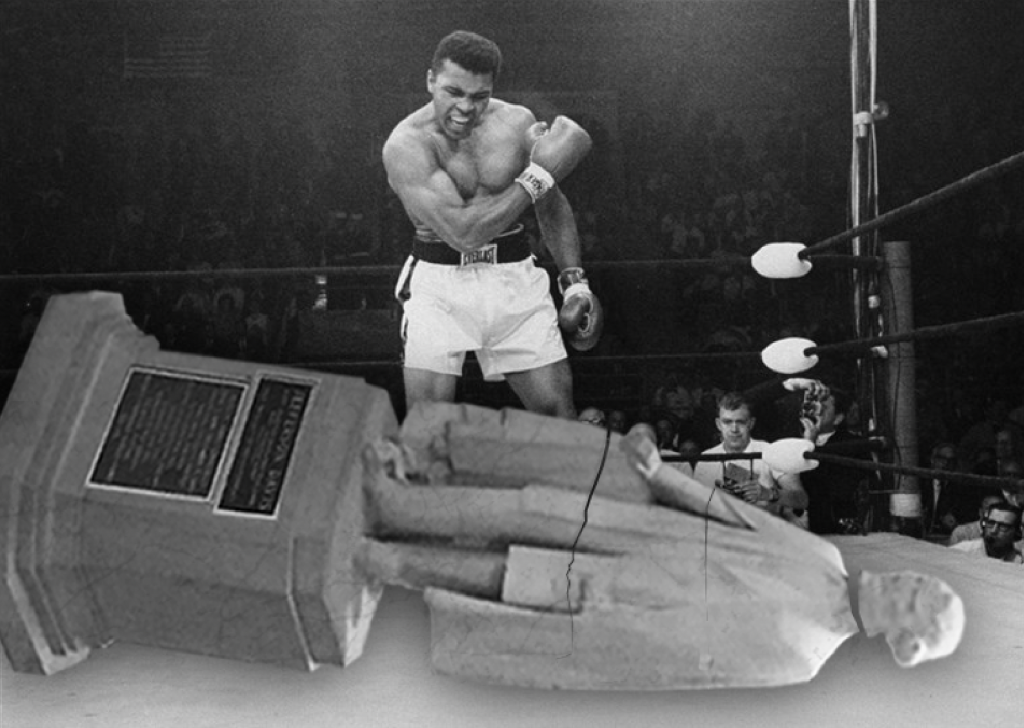
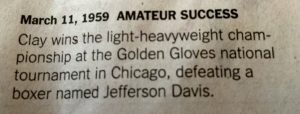
Please sign the petition below to remove the statue of Jefferson Davis currently in Kentucky’s Capitol Rotunda, and replace it with a tribute to Muhammad Ali, “the Louisville Lip” and “the Greatest of All Time.”
I just heard from the Ali family: It is the Champ’s belief that Islam prohibits three-dimensional representations of living Muslims. Accordingly, I have adjusted the petition to call for a two-dimensional representation of Ali (a portrait, picture or mural) in lieu of a statue.
UPDATE (Tuesday, December 2, 2014)
In this interview with WHAS-TV’s Joe Arnold, Governor Steve Beshear endorses the idea of honoring Muhammad Ali in the State Capitol (although he disagrees with removing Davis). Arnold explores the idea further on his weekly show, “The Powers that Be.”
Click here to check out WDRB-TV’s Lawrence Smith’s coverage of the story.
And here’s my op-ed in Ali’s hometown paper, the Louisville Courier-Journal.
UPDATE (Saturday, June 4, 2016)
In the wake of the 2015 Charlestown tragedy, in which a Confederate flag-waving murderer united the nation against racism, all of the most powerful Kentucky policymakers — U.S. Senator Mitch McConnell, Governor Matt Bevin, Senate President Robert Stivers and House Speaker Greg Stumbo — called for the removal of the Davis statue from the Rotunda. Today, as we commemorate last night’s passing of Muhammad Ali, there is no better moment to replace the symbol of Kentucky’s worst era with a tribute to The Greatest of All Time.
UPDATE (Wednesday, June 8, 2016):
Great piece by Lawrence Smith of WDRB-TV in Louisville on the petition drive to replace Jefferson Davis’ statue in the Capitol Rotunda with a tribute to Muhammad Ali.
UPDATE (Thursday, June 9, 2016):
Excellent piece on the petition drive by Jack Brammer that was featured on the front page of the Lexington Herald-Leader.
Highlight of the article:
Miller said he has received a few “angry comments” on his call to honor Ali.
“One of them encouraged me to kill myself,” he said. “You can quote me that I have decided not to take their advice.”
UPDATE (Friday, June 10, 2016)
The petition drives continues to show the Big Mo(hammed): check out these stories from WKYU-FM public radio in Bowling Green and WKYT-TV, Channel 27 in Lexington:
UPDATE (Saturday, June 11, 2016):
Still not convinced? Check out this excerpt from today’s New York Times:
Anytime you’ve got an R after your name, and you’re running in the most Republican state in the country with the best political name in the nation (from a Utahn perspective) topping your ticket, you have a chance.
But it’s just wishful thinking to say that she’ll garner more black GOP support. Allen West and Tim Scott haven’t done so; Michael Steele didn’t do so last cycle.
Mia Love
Data suggests that someone a lot higher profile (Rubio) has been unable to do so for Latinos.
Although, I’m sure the Republicans will have her onstage 12 hours a day in Tampa. Of course, that will be targeted at suburban white women more than at blacks; they’re smart enough to realize that Obama is going to get 90 percent of the black vote regardless.
And as long as there are state Republican parties hosting conventions where bullet-riddled outhouses decorated as Obama presidential libraries are seen as funny jokes, that will never change.
By Jonathan Miller, on Tue Jun 19, 2012 at 3:00 PM ET
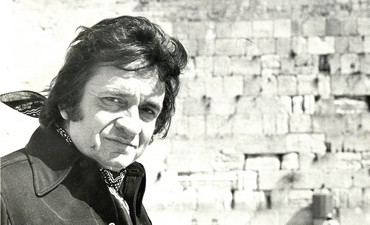
Is it possible that the Man in Black was America’s first Christian Zionist? So says Professor Shalom Goldman in this article from the Jerusalem Post excerpted below:
Way before the modern-day Christian Zionist movement became a bastion of American support for Israel, there was the Man in Black.
Johnny Cash, the all-American country music great whose career spanned six decades, carried on an ardent love affair with Israel for most of that time. Cash, a devout Christian who died in 2003 at the age of 71, visited the country five times from 1966 through the mid-1990s along with his wife June Carter Cash and their children. And it wasn’t only with his footsteps that he he demonstrated his connection to the country – he recorded complete albums of inspirational hymns about the holy land and made films about his journeys to Biblical sites.
Cash’s ties with Israel have long fascinated Shalom Goldman, a professor of religion at Duke University. The author of the book Zeal for Zion: Christians, Jews, and the Idea of the Promised Land, Goldman theorized that Cash symbolized American Christian enthusiasm for Israel before it became labeled as a far-Right movement.
For the last year, he’s been giving a presentation mostly on college campuses: In The Holy Land with Johnny Cash: Christian Zionism and American Popular Culture, a lecture about the religious aspects of Cash’s life and work – including his baptism in the Jordan River – augmented by slides of his pilgrimages to the holy land and live performances of a selection of his Zion-flavored gospel songs.
“Cash was a Christian Zionist for at least a decade before the Christian Right moved into a place of political power in the late 1970s,” said Goldman, speaking from a summer cabin in Georgia last week before heading to Israel, where he’ll give his Cash presentation on Tuesday evening at the Tmol Shilshom bookstore in Jerusalem, accompanied by local folk singer Hila Tam.
The Israel Project Conference Call: Jonathan Miller Wednesday, June 20, 2012 @ 12:00 P.M. EDT
Author, public servant and Huffington Post contributor Jonathan Miller spent nearly two decades in politics before joining the private sector last year.
A former two-term elected Kentucky State Treasurer, he is the author of the recently released book “The Liberal Case for Israel: Debunking Eight Crazy Lies about the Jewish State,” in which he highlights deep factual misunderstandings, media disinformation, and the perpetuation of “Eight Crazy Lies” by those who seek the Jewish State’s total destruction.
By John Y. Brown III, on Tue Jun 19, 2012 at 12:00 PM ET
What we do is only what we do. Not who we are. (Or why lawyers shouldn’t commit suicide)
As my teen kids get older I encourage them to find “their people”–the groups where they feel they belong and are most at home with. Their tribe, so …to speak. For me, one of the first such groups I found this kinship with was lawyers. I’m one myself, though non-practicing. I found that my interests, ways of thinking, sense of humor, social concerns and life aspirations lined up well with other lawyers–more so than say engineers, accountants, or medical professionals.
Lawyers are a quirky bunch. I joked the other day that one appeal of the profession is that it allows an individual to take his or her collective character defects and bill for them. It’s an exacting, hyper-competitive and idealized profession where each day you start off feeling like Perry Mason but finish the day feeling more like Melville’s Bartleby the Scrivener. And so it’s not a shock that attorney’s, as a group, suffer a notably higher than average rate of depression, addiction and suicide. It’s a profession that is both analytical and philosophical. Lawyers are trained to think more and feel less. And many eventually find themselves, on their bad days, on an intellectual precipice staring down, as Nietzsche observed, at the abyss. And the abyss can seem both all consuming and mocking. And since lawyers are not encouraged to ask for help themselves –since they aspire for the controlled hero role in their jobs– they are left alone to do as they are trained to do: To “think their way” out of a problem that was created, ironically, by over-thinking.
My mother tells me my favorite book as a young child was What People Do All Day by Richard Scarry. In the book it explains how everyone has a job to do during the day. Some are bakers, some are firemen, some our merchants, some are farmers, some are moms, some are repairmen, some are are doctors and some are lawyers. And so on. And each has some task or assignment for the day that makes everything kind of work together.
The reason I started this post was to link to this story —an eloquent reflection on on the legal profession by one of Kentucky’s wisest and most insightful practitioners, Supreme Court Justice Bill Cunningham, who recently lost yet another friend and colleague to suicide. Click here to read the story.
But I think I’d rather end this post on a more mundane note. Or rather a mundane hope. That lawyers, like the characters in Richard Scarry’s “What People Do All Day” realize they are only doing a job, completing a task, fulfilling a role that makes society somehow work. If it wasn’t being a lawyer they’d be doing some other job that makes society function. And that it’s just a job, like any other. And that they are just people too. Mostly just trying to stay busy all day.
And others in our busy little towns have jobs that can help those struggling with depression, addiction and thoughts of suicide. And that these people need to stay busy too–from people who need them and reach out for their help. Or our busy little towns won’t work so well.
By Jonathan Miller, on Tue Jun 19, 2012 at 10:00 AM ET
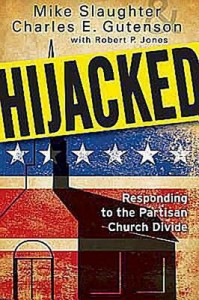
My friend, Chuck Gutenson, a Christian scholar at Asbury Seminary in Wilmore, Kentucky, has authored an outstanding new book on the political misuse of Jesus’ image and teachings. In Hijacked: Responding to the Partisan Church Divide, Gutenson argues that all Americans should join in efforts to stop the unhealthy alliance of religious faith and political partisanship.
Here’s an excerpt:
Click here to review/purchase
It really gets old, doesn’t it? Every election cycle, the story is the same. This Christian says that Christian is not really a Christian. And why is that? Is it because they differ on critical issues relating to the content of the Christian faith? Is it because of doctrinal or ecclesial disputes? No, the reason for this inability to recognize and respect each other as Christian sisters and brothers is because those Christians belong to a different political party and support different political candidates than we do. Oh, don’t get me wrong, they may have doctrinal or ecclesial disputes. We just don’t ever get to find out because the wedge issue that lies at the surface is our political differences.
One of the most common critiques of Christians in our contemporary culture is that we are “too political.” This has been borne out by study after study, and it’s a huge turnoff to younger folks. In fact, it is such a turnoff that in droves they are leaving churches that cannot properly distinguish their political positions from their Christian faith. And, frankly, who can blame them? Why continue to be a tarred by the rancorous debates over politics? Interestingly, it was Barry Goldwater who presciently said: “Frankly, these people frighten me. Politics and governing demand compromise. But these Christians believe they are acting in the name of God, so they can’t and won’t compromise.” And, therein lies the crux of the problem: because we are sure God is on our side, any attempt to compromise with those who disagree with us is judged to be a betrayal. The outcome? Rather than Christian faith being a thing that unites us, it becomes distorted and used for partisan gain. It seems that being political power brokers has become too seductive for us to resist.
But, you know what? Those who attempt to hijack religious faith for partisan gain do so because, well, because it works. And, as long as it works, they will continue to do it, election cycle after election cycle after election cycle. It will continue to divide, rather than unite, and with each cycle, more folks will throw up their hands in desperation and walk away. It can be stopped, though. In fact, we can stop it anytime we want. All we have to do is make it clear that we have had enough and will no longer tolerate it. And that’s exactly what we’d like to have you help us do. How? Join our campaign, pledge not to use religious faith for partisan gain and to do all you can to resist those who do.
Gutenson has also launched a Web site — DontLetThemHijackJesus.com — where citizens can share video messages with their friends.
For the same reasons that I didn’t apply the gaffe label to Barack Obama’s sanguine musings about the economy, or Bill Clinton’s rebelliousness on Democratic tax policy, I wouldn’t apply it to Jeb Bush’s recent pronouncements on the Republican Party. The former Florida governor, and the man who would have been elected president in 2000 if he had turned a couple of percentage points in his first Governor’s race, meant to put the force of his substantial appeal behind a warning about the erosion of a certain generational brand in the GOP. If not exactly a lament for Rockefeller type moderates, it was certainly a wishfulness for a strategic and political approach that coopted Democrats on themes like education and healthcare, and that sought active ownership of issues like immigration reform: in other words, the template that got two other members of the family elected president.
Conservative cynics will note that said template did not prevent one Bush from losing reelection, and another from a disastrous second term, and that the failings of both yielded the two most successful Democratic candidacies in the last three decades. But Bush is certainly right about the long view: a Romney presidency that wanted to make headway on entitlements, that wanted to make the authentically bold education reforms Romney is proposing a reality, and that wanted to end Obamacare without triggering a politically dangerous surge in the ranks of the uninsured, would need room to maneuver and navigate through implacable Democratic opposition. It is not heresy to envision a Romney term that breaks gridlock instead of perpetuating it.
As to the part of the Bush address that made headlines, the “Reagan couldn’t survive in today’s Republican Party”, there is a value in a history lesson, and no one has told it better than Craig Shirley’s two year old book on the 1980 campaign, “Rendezvous With Destiny“. Shirley reconstructs the late seventies as anything but a monolithically conservative climate and the Republican Party as a fractious group that was hardly reconciled to Reagan’s candidacy. Edward Kennedy was the country’s most charismatic political star and promised unabashedly to revive an assertive liberalism that did not intend to be constrained by the era’s inflationary threat. Reagan’s opposition was credible and experienced and moderate alternatives like George HW Bush and Howard Baker commanded the loyalties of a significant element of the Republican funding base. Gerald Ford sat on the sidelines, but ran close with Reagan in Republican preference polls as late as the winter of 1980.
That Reagan won so comfortably seems like historical inevitability now, the natural progression of a country shedding itself of sixties style excess. Shirley’s masterful re-telling of that cycle describes something infinitely more inspiring and complex: a brilliantly tenacious politician who survived through the force of his own personality and who re-imagined conservatism as freedom rather than austerity, as a source of confidence rather than reproach. It does Reagan little justice to shrink him to artificial proportions by suggesting that he was only the sum of the elements of his platform; it shortchanges the ideological instability of the times to interpret Reagan’s victory as a simple instance of a candidate meeting his party’s and a majority of the country’s moods. More than any American figure since JFK, Reagan prospered by shaping that mood himself.
And the notion that Reagan’s governing style was the hallmark of an ambidextrous Great Compromiser who couldn’t thrive in today’s hyper-partisan atmosphere? It would amuse the air traffic controllers union he rolled over, and the congressional Democrats he bludgeoned in his first budget fights, and the communists he confronted in Europe and Central America. The deals Reagan did cut, over Social Security financing, for example, were imperfect then and now, but they didn’t define Reagan or diminish him with movement conservative because the times he was unmovable were actually the moments that built the public’s confidence. And the rebuilding of that confidence in the aftermath of the disastrous seventies is what installed him as a bipartisan presidential icon, much more than the specifics of a legislative track record.
Read the rest of… Artur Davis: Reagan Would Still Win
We all say this almost weekly when describing to others what it’s like to live in Louisville.
“It’s a great place to live and raise a family” I’ve said over 3000 times. And meant it each time.
Sure, it’s not “edgiest… city”, or “fastest growing city” or “fastest dying city” or any of the other more thrilling adjectives that would be more conducive to a burst of adrenaline.
But Louisville isn’t where people move to for an adrenaline rush. It’s where people move to after the they’ve tried the “adrenaline rush” cities and found them wanting.
They’ve learned the hard way that a uniquely “livable city” was what they were really looking for all along…and just didn’t know it. At least that’s my story. And I know it’s a common one.
Louisville is not a city full of cheap external thrills. Rather it is a city that allows us to become our better selves internally.
Congrats Louisville. On being great –in fact, the best–at being a good place to live.
I’d put it this way: LA, NY, Chicago, Dallas, New Orleans, Philly, Cindy, Indy, Atlanta and Nashville are all fun cities to date. But Louisville is the city that you are going to want to marry.
By Jason Grill, on Mon Jun 18, 2012 at 10:00 AM ET
President Clinton and his New Democrat “DLC” policies of the 1990s are what President Obama’s team need to be embracing, not running from.
President Clinton is one of the most effective allies for President Obama and he should brush off the recent remarks.
Clinton is a huge net positive for Obama on anything economic or job creation related. President Obama should not make the same mistake Al Gore made in 2000.
The more Obama is seen with Clinton the better he will do in key swing states and overall in the 2012 election.
By John Y. Brown III, on Mon Jun 18, 2012 at 9:15 AM ET
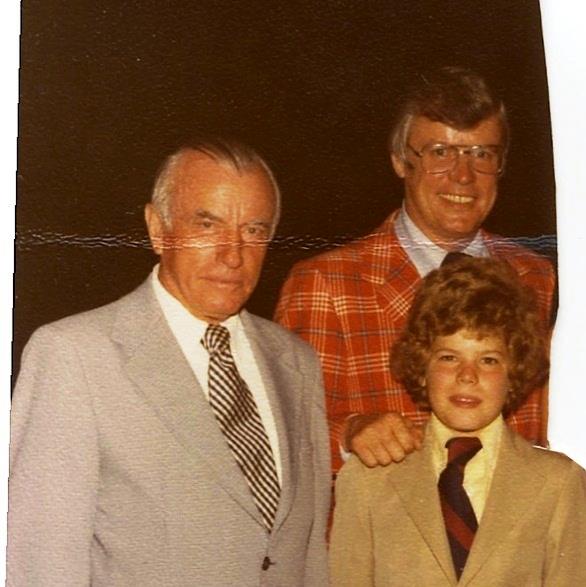
JYB Sr., JYB Jr. and JYB III circa 1972
This Father’s Day I received an unexpected almost magical gift at 11pm on the plane ride home from a family vacation. While clearing out old stored documents on my laptop I found a story written by my grandfather, John Y Brown Sr, whose name I carry, reflecting on the meaning of being a father to his youngest daughter, Pam Brown.
It is a sad and tragic story….but it is also a celebration of the love of a doting and devoted father for his endearing and adoring youngest daughter.
Pam died at the age of 28 trying –along with her newlywed husband and one other—to be the first persons to cross the Atlantic Ocean in a hot air balloon. It was a quixotic adventure that ended tragically and probably, more than any other single event, defined or redefined my father’s family.
Pam had a flair for the dramatic and in her short life had a distinguished career in theater and television. Actor’s Theatre in Louisville has a portrait of Pam on display (mentioned in my grandfather’s story) –just outside of the theatre that bears her name.
I remember when the balloon went down in the middle of the Atlantic Ocean. And when some two weeks later when the search parties gave up looking for the bodies. We never talked a lot about it as a family. I suppose it was too painful.
But in my grandfather’s case it appears it was so painful he had to write about it. My grandfather was a thoughtful, kind and thoroughly good man. But not a man who spoke easily about feelings. That all changed for me last night (as I’m sure it changed for other family members when they read or will read this story) as I stumbled across his heartfelt reflection of his relationship with his youngest daughter and her tragic death. It’s a photocopy of the booklet he created– typed out with pictures and some portions written in his own hand when he was about 80 years old.
My grandfather was a man I knew, respected and loved –but didn’t know as well as I wanted to. I’d never glimpsed his most human or fragile side. A side all fathers and grandfathers have. It was a wonderful Father’s Day gift.
From a man who died on Father’s Day 27 years ago yesterday.


 Blog this!