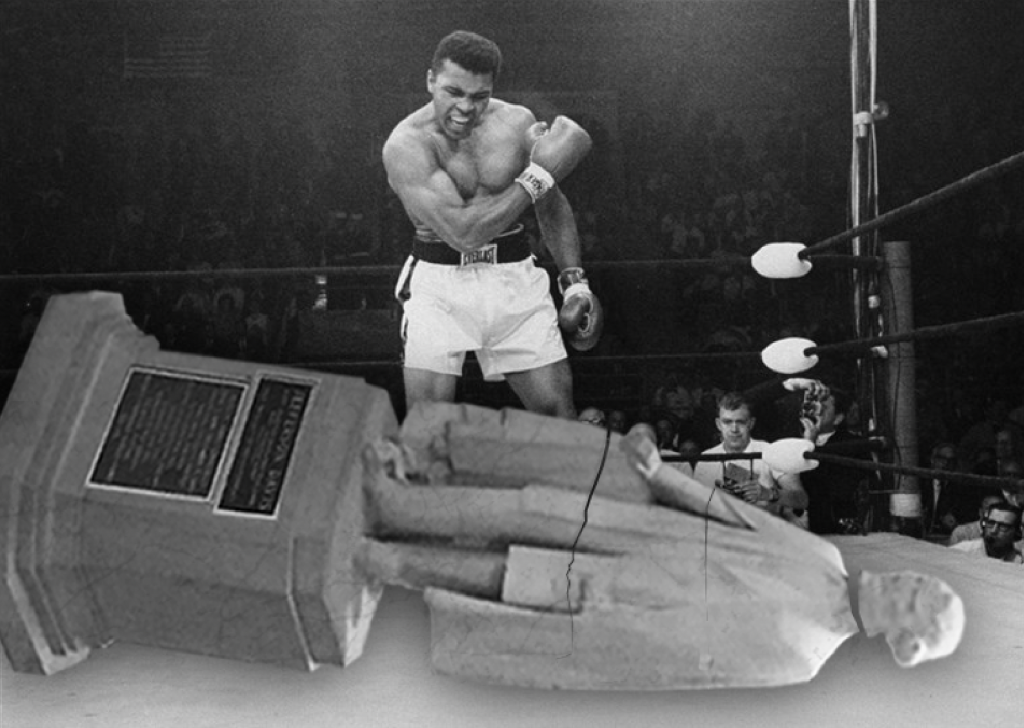
Please sign the petition below to remove the statue of Jefferson Davis currently in Kentucky’s Capitol Rotunda, and replace it with a tribute to Muhammad Ali, “the Louisville Lip” and “the Greatest of All Time.”
I just heard from the Ali family: It is the Champ’s belief that Islam prohibits three-dimensional representations of living Muslims. Accordingly, I have adjusted the petition to call for a two-dimensional representation of Ali (a portrait, picture or mural) in lieu of a statue.
UPDATE (Tuesday, December 2, 2014)
In this interview with WHAS-TV’s Joe Arnold, Governor Steve Beshear endorses the idea of honoring Muhammad Ali in the State Capitol (although he disagrees with removing Davis). Arnold explores the idea further on his weekly show, “The Powers that Be.”
Click here to check out WDRB-TV’s Lawrence Smith’s coverage of the story.
And here’s my op-ed in Ali’s hometown paper, the Louisville Courier-Journal.
UPDATE (Saturday, June 4, 2016)
In the wake of the 2015 Charlestown tragedy, in which a Confederate flag-waving murderer united the nation against racism, all of the most powerful Kentucky policymakers — U.S. Senator Mitch McConnell, Governor Matt Bevin, Senate President Robert Stivers and House Speaker Greg Stumbo — called for the removal of the Davis statue from the Rotunda. Today, as we commemorate last night’s passing of Muhammad Ali, there is no better moment to replace the symbol of Kentucky’s worst era with a tribute to The Greatest of All Time.
UPDATE (Wednesday, June 8, 2016):
Great piece by Lawrence Smith of WDRB-TV in Louisville on the petition drive to replace Jefferson Davis’ statue in the Capitol Rotunda with a tribute to Muhammad Ali.
UPDATE (Thursday, June 9, 2016):
Excellent piece on the petition drive by Jack Brammer that was featured on the front page of the Lexington Herald-Leader.
Highlight of the article:
Miller said he has received a few “angry comments” on his call to honor Ali.
“One of them encouraged me to kill myself,” he said. “You can quote me that I have decided not to take their advice.”
UPDATE (Friday, June 10, 2016)
The petition drives continues to show the Big Mo(hammed): check out these stories from WKYU-FM public radio in Bowling Green and WKYT-TV, Channel 27 in Lexington:
UPDATE (Saturday, June 11, 2016):
Still not convinced? Check out this excerpt from today’s New York Times:
By Jonathan Miller, on Mon Jul 16, 2012 at 1:30 PM ET
ESPN’s legendary columnist wrote an important column on Joe Paterno, the man he profiled for the Sports Illustrated‘s Sportsman of the Year issue in 1986. SPOILER ALERT: It’s devastating. [ESPN]
This weekend, the RP appeared on WKYT’s Kentucky Newsmakers, the oldest and most respected TV news interview program in the Commonwealth, hosted by The RP’s friend, local broadcasting legend Bill Bryant.
Enjoy their discussion (in two segments below) about poker, politics and a whole lot more:
By John Y. Brown III, on Mon Jul 16, 2012 at 12:00 PM ET
Crashing or coasting?
Depends on if you are on the outside looking in or the inside looking out.
Unfortunately, you see it a lot in business. It’s almost a predictable arc–rising, leveling and, like a star, eventually imploding.
It starts with breaking through initial barriers and onto the scene. Followed by rapid and dynamic growth for a sustained period until it becomes an institution of sorts. Then there is a plateauing. An uneasy period where management becomes more concerned about maintaining market share than growing it…because, frankly, it already has about all the market share it can ever get.
And then there is a disconnect. Slow at first and only noticeable to those looking for it. But then noticeable to a growing number of others. But not to management. Until the decline has begun. Sometimes management notices and faces the problem then and tries to reverse course. Other times a new management team is brought on because the current team is unable to see the problem clearly or navigate out of the crisis they inadvertently created. And if neither of these take place, there is the crash. Sometimes its soft; sometimes hard. Sometimes swift; sometimes slow. But the crash is inevitable.
In the final stage the company is no longer nimble. No longer responsive to customers. It takes them for granted. Instead of trying to see ahead and anticipate market demands and adjust early to them the company instead rests on its laurels and tries to prevent the natural changes from happening within the industry—ironically, the same changes this once great company used to break into a leadership position by being more responsive than their former complacent competitors. The former agent of change has become the agent for the status quo.
They resist change during this phase not because change will hurt better delivery of their products or services to customers but because change has become an inconvenience for management. The company is no longer “client centered” but “self centered.” And they have long forgotten the day when they counted on their once larger competitors to believe that self-importance was a successful long-term growth strategy in business. It never is.
They will eventually remember this truth. That is inevitable too. But sadly that is almost always “after” the inevitable crash–not before.
By Jonathan Miller, on Mon Jul 16, 2012 at 11:00 AM ET
And now from the other side of The New York Times, here’s CAMERA:
In the New York Times’ front page story today about a volunteer national service program in Israel, reporter Jodi Rudoren notes that “62 percent of the Arab public backed the program.”
It is curious, then, that 82 percent of the article’s quoted words from Arabs are spoken against national service. (This figure actually understates the disproportion. It includes everyone quoted except for two Israeli professors, both of whom highlight only Arab perspectives against national service. And it does not include the quoted words of posters that likewise argue against the program.)
The problem here is not that Rudoren provides fake quotes. Of course she doesn’t. It’s an issue of framing. Even though most Arabs in Israel support national service, the piece is written in a way that leaves readers with an overwhelming and predominant sense of Arab opposition to the program.
Readers hear from a single young Arab girl, Nagham Ma’abuk, who supports and participates in the national service program. But her voice gets lost in a staccato of quotes by opponents of integration and national service: Ehab Helo comes out against integration with the state. Radical Arab parliamentarian Hanin Zoabi jumps on the opportunity to level sharp words agaist national service, and against Israel as a whole. Four teenagers express that they are “against, against, against and against” the program. Rozeen Kanboura adds another “against.” And Ayan Abunasra makes her “articulate” case in opposition to the program.
This is analogous to a presidential debate in which viewers hear from one candidate, then from his opponent — and then from each member of the opponent’s senior campaign team. A stacked deck affects perception.
By Jonathan Miller, on Mon Jul 16, 2012 at 10:00 AM ET
Excellent piece in the weekend’s New York Times on No Labels’ latest initiative to Make the Presidency Work:
In all the discussion these days about how dysfunctional Washington has become, attention usually centers on a fractious Congress riven by partisanship and paralyzed at times by rules and obstruction. Often lost in that conversation is the possibility that the presidency itself may need fixing.
At least that is the conclusion of a bipartisan group of former advisers to presidents and would-be presidents who have drafted what they call a plan to make the presidency work better. With the help of several former White House chiefs of staff, the group, called No Labels, has fashioned a blueprint that would make whoever wins in November both more powerful and more accountable.
The idea is to cut through some of the institutional obstacles to decisive leadership that have challenged President Obama and his recent predecessors, while also erecting structures to foster more bipartisanship, transparency and responsiveness. If the proposals were enacted, the next president would have more latitude to reorganize the government, appoint his own team, reject special-interest measures and fast-track his own initiatives through Congress. But he would also be called on to interact more regularly with lawmakers, reporters and the public.
“There aren’t any magic answers to Washington’s problems,” said Dan Schnur, a former Republican strategist who worked on several presidential campaigns and now directs the Jesse M. Unruh Institute of Politics at the University of Southern California. “But what these reforms do is make it easier for elected officials who are serious about solving problems to do so.”
Nancy Jacobson, a longtime Democratic fund-raiser who, like Mr. Schnur, is a co-founder of No Labels, said the purpose of the plan was to find ways to make a difference, taking into account the current atmosphere. “We’re trying to make the presidency more effective,” she said.
Click here to read the full article, “Unshackling the Presidency to Fix the Government”
By Ronald J. Granieri, on Mon Jul 16, 2012 at 8:30 AM ET
“It must be great being a college professor. You get summers off!”
All professors have probably heard this sentiment, in one form or another. It is usually accompanied by a sigh, the commenter wishing that she had such a cushy life. Though as many times as I have heard it, I know that it is not necessarily intended as a slight or a criticism. Most often, it is expressed as a good-natured if ignorant observation about the unusual perks of a somewhat exotic job, rather like when people tell flight attendants, “Wow, you get to fly all over the place for free!”
What makes academic life seem so exotic is that being a professor is more like practicing a medieval craft than pursuing a modern profession. As befits a world of robes, elaborate ceremonies, and gothic quadrangles, universities maintain a system of unique rewards and demands that harkens back to pre-modern times.
Practically, this means that the work habits of academics are hard to reconcile with the patterns of most normal professions. Academics are supposed to do two things—produce knowledge and share that knowledge with the larger community. They are also, according to tradition, supposed to govern and police themselves. Although that does not mean what it used to, when universities had special laws and even their own jails (some of which are preserved as tourist sites in European university towns such as Heidelberg in Germany) it still means that universities pride themselves on being governed by their own—deans, directors, chairs, and presidents drawn from the faculty.[1]
Here we get at the root of the contrast between what people think professors do and what they actually do. For the things that are most visible to the outside world—teaching in the classroom, meeting with students in office hours, grading assignments—is also only a part of what academics are expected to do. When junior faculty sigh and say they “really need to find time to do my own work,” they are rarely referring to teaching. Indeed, even the most dedicated teacher who devotes time to developing and preparing new courses is going to need a lot of time alone to gather and develop new knowledge. That means everything from reading and reviewing the newest literature in their field to working on their own projects. None of these tasks lend themselves to punching a clock. Academics are paid to think and read and write, which means a lot of their time is unstructured, and they have freedom to organize it according to their own priorities. That is the positive view. The less positive view is to note that unstructured work means that it is never really over. There is always more to read, and those books and articles don’t write themselves.
So academics have to deal with less immediate but more constant pressures than people in other professions, all the year round. That is not a complaint, since I am sure that a lot of people in other types of jobs wish the pressures they felt were less tangible, but it is something to think about before claiming that because professors only teach a few classes a semester, or do not teach in the summer, they have a lot of “free time.”
If those outside academe have a hard time understanding what goes on there, that is also because the practical details of academic life can vary greatly depending on both the type of university or college and the field in which an academic operates (and of course upon whether one is on the tenure track). Schools can range from teaching-heavy colleges (which would include both small private institutions and satellite campuses of state universities, as well as community colleges) where the average professor is expected to offer four or five courses a semester (and do all of her own grading) to the elite research universities where the load is usually two courses a semester—perhaps less, if the faculty member has special administrative responsibilities such as chairing a department or directing an institute—and where most of the grading is done by graduate students, as part of their apprenticeship before beginning their own academic careers.[3]
Teaching and research exist in tight, inverse proportions: the lower the teaching load, the higher the research expectations.[4] What those research expectations may be depends on the field. In the natural sciences, successful academics are expected to manage a laboratory and conduct a range of experiments. That means hiring and supervising a small army of student assistants, and applying for and managing the large outside grants necessary to fund the operations. Natural scientists also publish several research reports and articles a year. Most of those publications will be multi-authored, which (to put it most charitably) allows scientists to leverage their work into more publications than they could have produced on their own. Humanities and social science professors publish fewer and longer pieces—journal articles and books, usually single-authored—and are less dependent on labs and grants, except when they need to travel to archives.
Critics ranging from undergraduates unable to get an appointment to complain about midterm grades to Wall Street Journal op-ed writers have attacked the attention faculty pay to what can appear to be unnecessarily esoteric research.[5] Imust admit to having mixed emotions about these criticisms. There is nothing wrong with demanding that faculty remember their responsibility to share their knowledge with non-specialists, and I am a firm believer in the importance of teaching. What such critics tend to miss, however, is the responsibility of professors not only to repeat old knowledge but to create new knowledge as well. At their best, such criticisms can serve to puncture the pomposity of over-specialized academics. At their worst, they sink to the level of the know-nothings who want to eliminate the library budget because no one has read all the books that are already in it.
Read the rest of… Ronald J. Granieri: A Glimpse Behind the Ivy Curtain
Joe Arnold of WHAS-TV (Louisville) put together a hilarious and fascinating TV news story on The RP’s impossible run through the World Series of Poker. It’s only four minutes long, and we highly recommend it. Click below:
By John Y. Brown III, on Fri Jul 13, 2012 at 12:00 PM ET
Found myself weirdly wondering what song I had heard the most times in my life.
Fittingly, it’s a weirdly wonderful song. One I still fail to understand and have never been very interested in figuring out. I just enjoy listening to the bluesy moody jazzy melody. And seem never to tire of it.
“The Low Spark of High Heeled Boys” by Traffic.
The song sustained me many nights, days and afternoons from my teens into my late 20s–when I finally got to see the band live in Tamarac, FL in 1992.
It was a small intimate theater in the retirement community of Tamarac, FL and the average audience age was about 40.
But if I had to pick out my favorite concert moment, it would be when Traffic played Low Spark. That moment, for me, just barely beat out the time I saw Steely Dan live (also in the early 90s in FL) play Aja. Which was a close second place for the song I’ve listened to the most times. And, again, a song I have no interest in understanding. I just enjoy the bluesy, moody, jazzy….
Co-Prodcuer Jennifer Miller and Lead Actor/Writer/Director Richey Nash accept the award for Best Dramatic Feature Film at the Manhattan Film Festival
Los Angeles, Calif.— Hitting the Cycle, an independently produced feature film shot entirely on location in Lexington, Ky., was named Best Dramatic Feature Film at the 2012 Manhattan Film Festival in New York City. Hitting the Cycle will next be featured during the Woods Hole Film Festival on the Cape Cod waterfront in Massachusetts.
The fictional story follows Jimmy “Rip” Ripley, a professional baseball player nearing the end of his career, who reluctantly revisits his long-forgotten hometown to face his estranged, dying father. While attempting to reconcile his fractured past with an uncertain future, Rip begins to gain insight into the choices, opportunities and sacrifices that people confront when they outlive the life of their dreams.
Lexington native J. Richey Nash portrays the lead character of Rip in Hitting the Cycle. Now based in Los Angeles, Nash also wrote, produced and co-directed the film (along with Darin Anthony). Oscar-nominated actor Bruce Dern plays Rip’s father.
Hitting the Cycle screened at the 10-day Manhattan Film Festival in late June, and won the Best Dramatic Feature Film award at a ceremony on July 1st. Hitting the Cycle previously won an award in May at the Tupelo Film Festival in Mississippi.
Nash said, “We are very excited and pleased by the reception the film is receiving on the festival circuit. A lot of people worked very hard to bring this movie to the big screen, so the awards recognition is gratifying for all of us.”
Though many of the film’s stars and primary crew members are Hollywood-based, Nash decided to bring the production to Lexington because of the diversity of available filming locations and the growing number of production and talent resources (Kentuckians comprise two-thirds of the cast and crew). The opening scenes from Hitting the Cycle take place at readily recognizable Lexington venues, most notably the ballpark of the Lexington Legends, the popular local Minor League Baseball team. The remainder of the story unfolds in “Sayreville,” Rip’s fictional hometown. Shooting locations included public parks, private homes, bars, restaurants, a high school, and several University of Kentucky hospital buildings.
“Lexington was the ideal place to shoot this film not only for its beautiful scenery and varied locations, but also for the tremendous support of the local community,” said Nash. “We had such a great experience. I wouldn’t hesitate to come back to Kentucky for another film project.”
Hitting the Cycle will next screen on Friday, August 3rd at the Woods Hole Film Festival. The film will return to Lexington in October for a run at the historic Kentucky Theatre.


 Blog this!