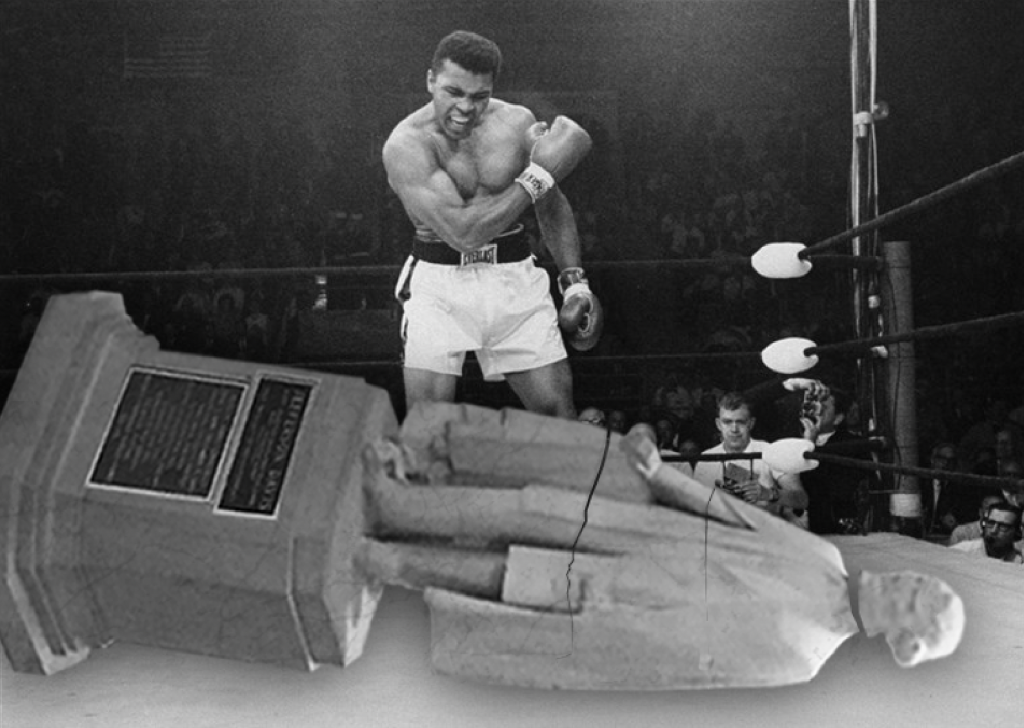
Please sign the petition below to remove the statue of Jefferson Davis currently in Kentucky’s Capitol Rotunda, and replace it with a tribute to Muhammad Ali, “the Louisville Lip” and “the Greatest of All Time.”
I just heard from the Ali family: It is the Champ’s belief that Islam prohibits three-dimensional representations of living Muslims. Accordingly, I have adjusted the petition to call for a two-dimensional representation of Ali (a portrait, picture or mural) in lieu of a statue.
UPDATE (Tuesday, December 2, 2014)
In this interview with WHAS-TV’s Joe Arnold, Governor Steve Beshear endorses the idea of honoring Muhammad Ali in the State Capitol (although he disagrees with removing Davis). Arnold explores the idea further on his weekly show, “The Powers that Be.”
Click here to check out WDRB-TV’s Lawrence Smith’s coverage of the story.
And here’s my op-ed in Ali’s hometown paper, the Louisville Courier-Journal.
UPDATE (Saturday, June 4, 2016)
In the wake of the 2015 Charlestown tragedy, in which a Confederate flag-waving murderer united the nation against racism, all of the most powerful Kentucky policymakers — U.S. Senator Mitch McConnell, Governor Matt Bevin, Senate President Robert Stivers and House Speaker Greg Stumbo — called for the removal of the Davis statue from the Rotunda. Today, as we commemorate last night’s passing of Muhammad Ali, there is no better moment to replace the symbol of Kentucky’s worst era with a tribute to The Greatest of All Time.
UPDATE (Wednesday, June 8, 2016):
Great piece by Lawrence Smith of WDRB-TV in Louisville on the petition drive to replace Jefferson Davis’ statue in the Capitol Rotunda with a tribute to Muhammad Ali.
UPDATE (Thursday, June 9, 2016):
Excellent piece on the petition drive by Jack Brammer that was featured on the front page of the Lexington Herald-Leader.
Highlight of the article:
Miller said he has received a few “angry comments” on his call to honor Ali.
“One of them encouraged me to kill myself,” he said. “You can quote me that I have decided not to take their advice.”
UPDATE (Friday, June 10, 2016)
The petition drives continues to show the Big Mo(hammed): check out these stories from WKYU-FM public radio in Bowling Green and WKYT-TV, Channel 27 in Lexington:
UPDATE (Saturday, June 11, 2016):
Still not convinced? Check out this excerpt from today’s New York Times:
When your leading fundraiser – and the guy who allegedly offered to raise Blago $1.5M in exchange for your appointment to a vacant U.S. Senate seat – faces a 19-count indictment, and has already shown in other cases (Blago’s two trials) a willingness to flip and testify for the Feds, I can understand how the stress might trigger serious physical problems.
Having had my own top fundraiser and best friend wear a wire on me for months as the Feds closed in, I am, regrettably, all too familiar with this plight.
I have no idea what’s going on with JJJ mentally or physically. But for me, when the feds started sniffing around, and you realize that they have unlimited resources at their disposal and tremendous leverage over your closest confidante, those were the most stressful days of my life.
The fact that even his family is saying little – and not strongly pushing back against various insinuations – suggests that there is more to this than meets the eye.
I first saw JJJ speak nearly a decade ago to an audience of rich white people at St. Louis Country Day School. Advocating policies that would raise their taxes significantly, he had them in the palm of his hand. It was shortly after I saw then-Senate candidate Barack Obama speak for the first time, and frankly, there was no comparison. JJJ was, hands down, the most impressive pol I’d ever heard.
Read the rest of… Jeff Smith: Where’s Jesse Jackson, Jr.?
By Patrick Derocher, on Thu Jul 12, 2012 at 3:00 PM ET
It’s the second most-discussed Supreme Court decision of last month – on June 25, the Court handed down a ruling on Arizona’s extraordinarily controversial SB 1070, one that was hailed as a win by court-watchers on both sides of the aisle. Supporters of the law celebrated that the Court upheld a section of the law allowing police officers to check people’s legal status during their course of duties – what Arizona Governor Jan Brewer referred to as “the heart of the law” – while opponents lauded the assertion of federal authority over immigration policy.
In any case, a few things are clear: the Court struck down the provisions in SB 1070 that overstepped state-federal boundaries (namely criminalizing working in the US illegally), upheld the letter of the law that allows law enforcement officials to check immigration status, and left the door open to challenges of that law once it has gone into effect.
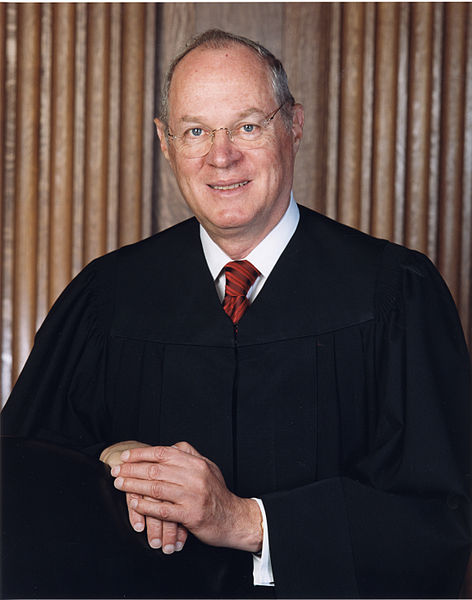
In what is probably the most-quoted line in the ruling, Associate Justice Anthony Kennedy writes for the majority:
“At this stage, without the benefit of a definitive interpretation from the state courts, it would be inappropriate to assume §2(B) will be construed in a way that creates a conflict with federal law […] This opinion does not foreclose other preemption and constitutional challenges to the law as interpreted and applied after it goes into effect.” [SupremeCourt.gov]
That Kennedy has sided with the majority in a case that sharply delimits state power is interesting enough (though perhaps not as interesting as the fact that Chief Justice John Roberts also sided with the majority). What is perhaps more important, though, is Kennedy’s implicit dare to the federal government and, to a lesser extent, the Arizona.
His dare to the state is obvious enough: Prove to us that you aren’t racially profiling, which this law makes it dangerously easy to do. This provision, of course, is what President Obama, Attorney General Holder, and countless activists were protesting when they challenged SB 1070, and yet the Court has not really spoken Section 2, waiting for a case regarding the law’s implementation to be brought forth. Less obvious is his dare to the Obama Administration (and indeed all subsequent administrations) to enforce the federal government’s immigration laws.
By reaffirming the supremacy of the federal government in such matters, Kennedy has made it incumbent upon the federal government to enforce immigration laws. The driving force behind SB 1070 was, of course, to compensate for lack of action on the feds’ part, and the frustration underlying that law isn’t going to disappear. Rather, it seems that Kennedy has put out a surreptitiously conservative ruling of his own – while states won’t be able to take immigration enforcement into their own hands as much as some might like, the opinion may well provide ammunition for Republicans looking to elect federal officials who will enforce immigration laws more strenuously than in the past.
By John Y. Brown III, on Thu Jul 12, 2012 at 12:00 PM ET
Relationships are hard and take work.
It was inevitable. No relationship that begins with love at first sight is able to remain in the “honeymoon” phase forever. There’s that initial irritation (maybe an offhand comment, the way they chew their food, a quirky habit not noticed before–but always something). And then there is the first disagreement (or fight).
Maybe you work through it; maybe you don’t. But there is disappointment. And then reality sets in and you move ahead with a more realistic assessment of expectations in the relationship.
That happened yesterday between me and my new iPhone, which I bought last week.
Several times last week (Thursday during a noon meeting and Friday for a 2pm conference call), at the peak of the work day, I went to my iPhone to find it lifeless. Dead.
I didn’t say anything at first. Just changed the subject and looked the other way while lovingly recharging.
But when it died again late afternoon Friday, I snapped and said some insulting things to my iPhone. “Come on! What is it with you? Do Apple people only work 4 hours a day and don’t make phones that last longer than that?” Ouch! I took that back. But later thought “You (my iPhone) remind me of that cute little Chihuahua that Paris Hilton carries in her purse —a cute but useless accoutrement.”
Fortunately, I didn’t say that out loud.
If was Friday night, so I let it go. And we had a good time. Took some pictures. Played with some apps. Watched a video clip of Modern Family.
But today I’m wondering if the iPhone and I are going to make it. Breaking up with the Blackberry wasn’t easy. And, yes, I’m on the rebound now and perhaps not thinking straight. But I was hoping for a second phone that was more like a solid second marriage….not a fun fling to get out of my system. I’m committed to making this work, if it can. And am buying a car charger for the iPhone this morning.
The initial thrill is wearing off and I worry about being stuck with a high maintenance smart phone. I’m not ready to explore legal options of breaking the two year service contract.
By Zack Adams, RP Staff, on Thu Jul 12, 2012 at 10:00 AM ET
The Politics of Tech
This may be news to you (it was to me) that Viacom and DirecTV are feuding over carriage fees. Now escalation has taken the form of Viacom blocking episodes of the Colbert Report and Daily Show from view by DirecTV customers by removing them from their websites. [GIGAom]
New York City is turning old pay phones into WiFi hotspots in a move that is genius in reducing waste and ingenuity. [GIGAom]
This is far from being current news, but it is interesting. You may or may not be familiar with the Soviet’s Tsar Bomba, the most powerful nuclear weapon ever detonated. Here is some info on the bomb itself. Check out the chart in the link that compares the expolsion of the Tsar Bomba to the bomb the US dropped on Hiroshima. Terrifying. [chart]
Amazon wants to offer same-day delivery. In an effort to make this possible they are building many more packaging centers. [Slate]
Why US wireless carriers are some of the biggest threats to innovation. [The Verge]
Firefox dev claims “everybody hates Firefox updates”; Mozilla has handled the rapid release process poorly, and that by pushing a “never-ending stream of updates on people who didn’t want them” people have been driven to Chrome with its simpler, no-fuss update process. [Neowin]
Imagine if it were revealed that Scott Pelley or Diane Sawyer had met with Chris Christie last year to implore him to enter the presidential race in order to save the country from political crisis, and had offered the platform of their evening newscast for the announcement. Then imagine the reaction if Brian Williams made a speech decrying extremism in the Republican Party and describing the Right as a threat to the national discourse. For good measure, consider the aftermath if the Romney campaign made back-channel inquiries to Sawyer about running for vice president and Sawyer failed to disclose the offer to her superiors, much less her audience.
Any single one of these scenarios would be explosive and would ignite a gusher of passion about the decline of objectivity in journalism. The specter of national news anchors venturing so blatantly into politics would be cited as toxic proof that their craft had been corrupted.
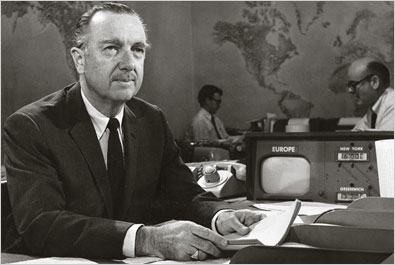
If you have waded through Douglas Brinkley’s thick, detailed book on Walter Cronkite’s life, you know that each one of these far-fetched sounding examples is borrowed from actual events. The venerable news legend exhorted Robert Kennedy to challenge Lyndon Johnson in 1968 and prodded him to announce his bid on the CBS Evening News. Cronkite publicly assailed the Nixon Administration for seeking to subvert the press specifically and political dissent broadly. On one occasion, in 1972 with George McGovern, and perhaps with an independent candidate in 1980, Cronkite entered discussions about taking a vice presidential slot, and kept the conflict of interest from his public and his bosses.
There is not much condemnation of Cronkite’s line crossing in Brinkley’s account; to the contrary, there is a tone of mourning for how much Cronkite’s stature is missed, and a lot of wide eyed admiration for the role he played as “America’s most trusted man” for a span of about 20 years. If Brinkley is at all discomfited by the times Cronkite crossed over from observer to participant, they are overshadowed by the many occasions when Brinkley applauds Cronkite for shaping the public debate, from Cronkite’s televised takedown of Lyndon Johnson’s Vietnam policies, to his overt endorsement of the environmental movement, to his open jousting with Richard Nixon and Spiro Agnew (the night Agnew resigned after admitting he took bribes, Cronkite editorialized on air that he and Agnew had been “ideological enemies”).
By Patrick Derocher, on Wed Jul 11, 2012 at 3:01 PM ET
The city of Scranton is undergoing tough financial times that many believe are a sign of things to come for cities and states across the country.
It isn’t a stat issue per se, but last week’s wage cut by Scranton, PA mayor Chris Doherty is perhaps a harbinger of things to come. Over the protestation of unions and against a state Supreme Court ruling, Doherty moved last week to temporarily cut all public employees’ wages to the federal minimum of $7.25 an hour. Doherty, a Democrat, said that the maneuver was his only choice, as the city currently faces a nearly $17 million budget shortfall. This announcement comes during a two week timespan in which three California cities have filed for bankruptcy protection. [CBS News]
In other budget news, Illinois continues to grapple with prison issues. In the past six weeks, violent incidents have increased exponentially in the state’s overcrowded penitentiary system. Some factions in Illinois are using this uptick as ammunition against governor Pat Quinn’s plan to close the Tamms “supermax” prison in far southern Illinois, and all parties agree that there aren’t enough guards and other prison employees for the incarcerated population. (At the very least, they aren’t saying anything to the contrary.) [Springfield Journal-Register]
Moving to somewhat happier news, the state of California has finally approved funding for a high-speed rail project that has been in the legislative equivalent of development hell for several years. The plan passed the State Senate by a margin of one vote and was signed into law by governor Jerry Brown, who commended the legislators for their “bold action.” [San Jose Mercury News]
Andrew Cuomo may be going rogue . After holding fundraisers for Assembly Democrats last week, the New York governor said that he won’t necessarily support his own party in State Senate elections: “I could see myself endorsing any individual regardless of party label depending on positions, depending on the individual.” Many Senate Democrats are counting on Cuomo’s support in their quest to retake the tight but Republican-controlled chamber. [The Daily News]
By John Y. Brown III, on Wed Jul 11, 2012 at 12:00 PM ET
Fathers and sons.
Tip for the day.
If you are a dad and haven’t complimented your son recently for doing something well, take the time today to do so. You’ll feel better and it will make your son’s day. … I promise.
Whether you are a 25 year old father with a 4 year old son or a 78 year old father with a 49 year son, it always works that way. Always. And it doesn’t matter whether the compliment is about throwing a baseball or writing silly posts on a blog (or Facebook).
Case in point, an email received yesterday from my father.
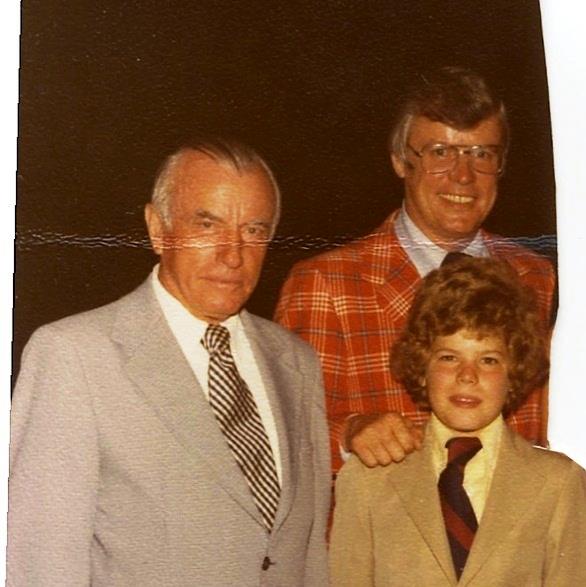
JYB Sr., JYB Jr. and JYB III circa 1972
“I try to keep up with your blogs (Recovering Politician) and I find most of them entertaining and thought provoking. I just finished catching up with the last week of blogs and you had a good week.What’s so amazing to your father is how informed you are on so many different categories and how uninformed I am. Guess it’s never too late to try and catch up to be relevant. Love, Dad (There was a time in my life I thought I was pretty well informed but with the computer information I been left far behind. I’m having more fun learning than ever. Even in my so called twilight years .)”
And if you can throw in a comment about you, as a father, having a weakness, even better.


 Blog this!