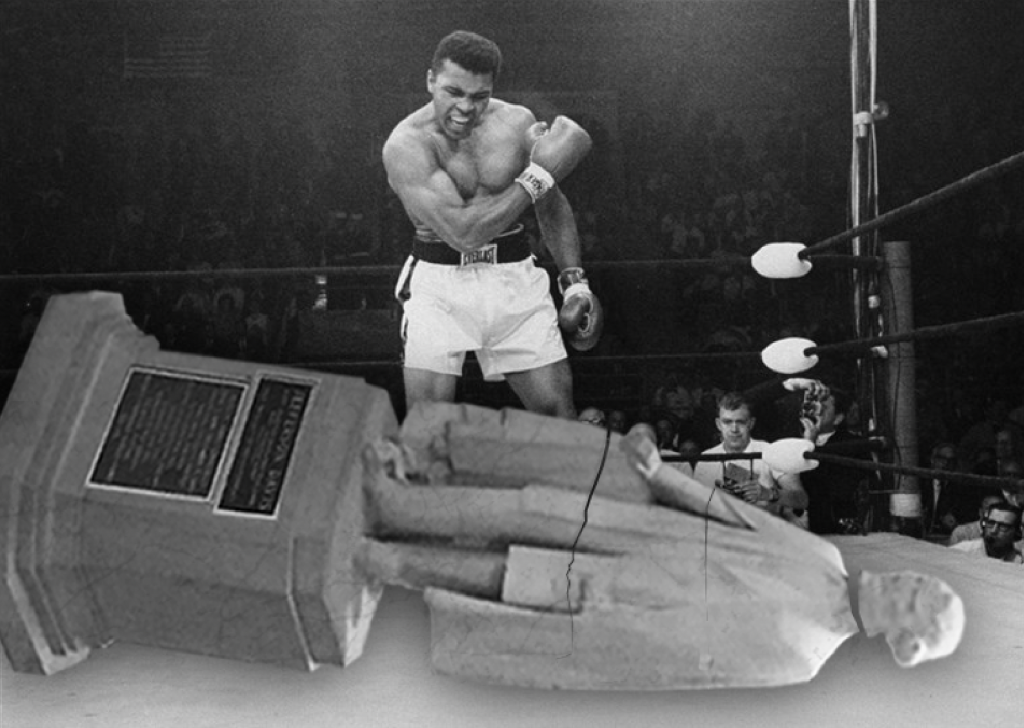
Please sign the petition below to remove the statue of Jefferson Davis currently in Kentucky’s Capitol Rotunda, and replace it with a tribute to Muhammad Ali, “the Louisville Lip” and “the Greatest of All Time.”
I just heard from the Ali family: It is the Champ’s belief that Islam prohibits three-dimensional representations of living Muslims. Accordingly, I have adjusted the petition to call for a two-dimensional representation of Ali (a portrait, picture or mural) in lieu of a statue.
UPDATE (Tuesday, December 2, 2014)
In this interview with WHAS-TV’s Joe Arnold, Governor Steve Beshear endorses the idea of honoring Muhammad Ali in the State Capitol (although he disagrees with removing Davis). Arnold explores the idea further on his weekly show, “The Powers that Be.”
Click here to check out WDRB-TV’s Lawrence Smith’s coverage of the story.
And here’s my op-ed in Ali’s hometown paper, the Louisville Courier-Journal.
UPDATE (Saturday, June 4, 2016)
In the wake of the 2015 Charlestown tragedy, in which a Confederate flag-waving murderer united the nation against racism, all of the most powerful Kentucky policymakers — U.S. Senator Mitch McConnell, Governor Matt Bevin, Senate President Robert Stivers and House Speaker Greg Stumbo — called for the removal of the Davis statue from the Rotunda. Today, as we commemorate last night’s passing of Muhammad Ali, there is no better moment to replace the symbol of Kentucky’s worst era with a tribute to The Greatest of All Time.
UPDATE (Wednesday, June 8, 2016):
Great piece by Lawrence Smith of WDRB-TV in Louisville on the petition drive to replace Jefferson Davis’ statue in the Capitol Rotunda with a tribute to Muhammad Ali.
UPDATE (Thursday, June 9, 2016):
Excellent piece on the petition drive by Jack Brammer that was featured on the front page of the Lexington Herald-Leader.
Highlight of the article:
Miller said he has received a few “angry comments” on his call to honor Ali.
“One of them encouraged me to kill myself,” he said. “You can quote me that I have decided not to take their advice.”
UPDATE (Friday, June 10, 2016)
The petition drives continues to show the Big Mo(hammed): check out these stories from WKYU-FM public radio in Bowling Green and WKYT-TV, Channel 27 in Lexington:
UPDATE (Saturday, June 11, 2016):
Still not convinced? Check out this excerpt from today’s New York Times:
By Zack Adams, RP Staff, on Thu Oct 18, 2012 at 10:00 AM ET
The Politics of Tech
Check out the tech behind Felix Baumgartner’s record-breaking free-fall. [Extreme Tech]
In a story that is becoming more familiar over time a major wireless provider has started selling information on their users that they have collected. This time it is Verizon that has been exposed. Verizon is accused of selling customers’ geographical locations, app usage, and Web browsing activities, this of course raises privacy questions and could possibly brush up against federal wiretapping law. [CNET]
The Pirate Bay has moved its entire file-sharing operation to the cloud – making what was already a hard organization to pin down for law enforcement even trickier. This move should make the Pirate Bay effectively raid-proof. [TorrentFreak]
A woman who lost her hearing due to a tumor and created a helmet that translates ambient vibration into vibration that the inner ear can interpret and “understand.” Adversity is the mother of invention? [Amelia Marzec]
Amazon admits it makes no profit on its Kindle sales. I didn’t see that one coming. Of course, Amazon counts on their Amazon store leading the industry in e-book sales. [Forbes]
By Artur Davis, on Thu Oct 18, 2012 at 10:00 AM ET
In a recent speech to the Accuracy in Media conference, “ObamaNation: A Day of Truth,” contributing RP Artur Davis had high praise for former President Ronald Reagan, saying that “Reagan took liberty and freedom, which are very imaginative concepts, and he gave them a power they had never had before.”
Speaking of the media, Davis said, “They don’t matter as much as they used to matter. That’s just the reality. Think about it: The New York Times—their own ombudsman says that their liberalism permeates their newsroom. Their own ombudsman says that they treat the liberal agenda as a cause to be nurtured instead of something to be inspected or analyzed. Their own ombudsman said that.”
You can watch his full speech below, or read the transcript here:
It takes 250,000 crunches to burn 1 pound of body fat.
If I did 200 crunches a day, everyday for the next 4 years I could hope to burn 1 pound of fat. Not exactly the best return on investment. In fact thats not worth my time or anyone else’s, So why are so many people under the impression that crunches, sit-ups give you a lean sexy core? Not sure the answer but it is the wrong impression we are getting.
As I mentioned in the last post the tissue is not best loaded the way we do crunches. It is actually best loaded the other direction. So this is all a matter of purpose. We have to ask ourselves; “What is the purpose of doing this exercise?”
If the purpose is to do crunches to burn your body fat off, you better get use to doing a lot of them. If the purpose is to work the abdominal muscles then you can expect that crunches will strengthen that motion greatly the more you do them. But are they the best option?
Maybe? Maybe not. Again this is all a matter of purpose. Which leads me to programming and more specifically core programming.
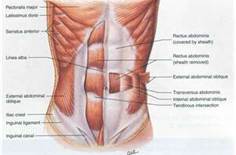
From an anatomical view the “core” is a group of muscles, at the center of the body that move in conjunction with other muscle group (particularly the extremities). I believe we short change ourselves by only looking at the center of bodies to strengthen our core. You must realize that our entire body is our core. All muscles move in harmony with eachother to create movement, they do not and have never acted in isolation.
So to give you a visual of what I am talking about picture this. Your abs are really sore after a good workout and you go to the grocery store and reach on the top shelf for something. What do you notice? Your abs contracting or bracing as you lift your arm overhead to pull something off the shelf. Ok another example; you take your groceries to the car, you open the car door and you notice that you can feel your abs contracting as you open the door. “But I only thought the abs or “core” were worked when we bend over?” Your core’s purpose is to decelerate movement, so as you reach for something your core is decelarating the movement for acceleration to occur. One more visual.
Let’s say we are working out, doing squats. Your abs are still sore and while you are squatting I add resistance to your left shoulder (as if to push you over) what do you notice. Your abs or “core” engaged. It is decelerating the movement so you don’t fall over. Moral to the story is situps and crunches are not the only way to develop your core muscles. In fact doing core movements on the ground (as in a plank) is not the only way to work your core. I would be willing to bet that you would get more from core programming on your feet than you would on your back. To back my claim, how many times a day are you laying on your back? One and that is to go to sleep. Point made.
Let’s talk about purpose:
In order to get to where we are trying to go, we have to have a purpose behind it. So if we are talking about core program design and specific workouts we can do targeting that part of the body, we have to have rhyme and reason. So what is the point of you doing crunches? If its to build abdominal strength/endurance in that particular motion, I would say that is a great purpose. If it is to burn body fat and give you an 8 pack, I would find a better purpose. So let’s evaluate a variety of goals and where core programming would fit in.
Purpose #1: Reduce Body Fat to Uncover 8 Pack
Well if all you are doing is crunches than your rate of return is minimal. The key to body fat reduction lies in nutrition not exercise. We cannot out exercise a bad diet. Genetics will always play a role but most of us are not genetic marvels that can eat what we want and still stay lean. However, to increase the likelyhood of the reduction of body fat, using more muscles will burn more calories. So, doing core exercises such as wood chops would be great for the metabolic increase, at the same time strengthen the areas we are looking to target.
Read the rest of… Josh Bowen: The Core — The Center of Our Universe, Volume 2
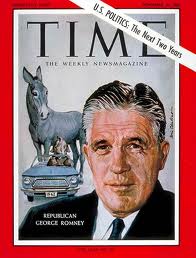
Krystal Ball advises that you check out this week’s piece from Buzz Feed Politics, “Making Mitt: The Myth Of George Romney.” Here’s an excerpt.
Everyone agrees: Mitt Romney is not like his father.
The late Michigan governor and 1968 presidential candidate George Romney is remembered as a principled man of spontaneity and candor. His example is regularly invoked by both admirers of his son’s disciplined campaign style and critics of Mitt’s back-and-forth pandering. George, it is said, told the truth about the Vietnam War before it was popular to do so, with an unfortunately worded comment about “brainwashing” by U.S. government officials that cost him the 1968 Republican presidential nomination. “Mitt learned at an impressionable age that in politics, authenticity kills,” historian Rick Perlstein wrote in Rolling Stone earlier this year. “Heeding the lesson of his father’s fall, he became a virtual parody of an inauthentic politician.”
This rejection of his father’s example, the thinking goes, is what has made Mitt a more successful presidential candidate — self-controlled but hard to pin down, flipping from moderate to conservative to moderate once again. It is observed that Mitt would never draw a line in the sand like his father did in 1964, when George dramatically “charged out of the 1964 Republican National Convention over the party’s foot-dragging on civil rights,” as the Boston Globe’s authoritative biography, “The Real Romney,” put it earlier this year. Outlets from the New York Times to the New Republic have recalled this story of the elder Romney’s stand against Goldwater’s hard-line conservatives. Frontline’s documentary “The Choice 2012” reported it as a formative event: “when Goldwater received the nomination, Mitt saw his father angrily storm out.” A Google search for the incident produces hundreds of pages of results. In August, Washington Postcolumnist E.J. Dionne cited the episode to write that Mitt “has seemed more a politician who would do whatever it took to close a deal than a leader driven by conviction and commitment. This is a problem George Romney never had.”
Only George Romney did not walk out of the 1964 Republican National Convention. He stayed until the very end, formally seconding Goldwater’s eventual nomination and later standing by while an actual walkout took place. He left the convention holding open the possibility of endorsing Goldwater and then, after a unity summit in Hershey, Pennsylvania, momentarily endorsed the Arizona senator. Then he changed his mind while his top aides polled “all-white and race-conscious” Michigan communities for a “secret” white backlash vote against LBJ’s civil rights advances — a backlash that might have made a Goldwater endorsement palatable at home. Finding the Republican label even more unpopular than civil rights in Michigan, Romney ultimately distanced himself from the entire party, including his own moderate Republican allies.
Exactly where the 1964 myth entered the public consciousness is difficult to pinpoint, but it has been promoted by Mitt, who made one of its earliest print mentions in an interview during his 1994 U.S. Senate campaign. (Romney’s longtime spokesman Eric Fehrnstrom did not respond to an inquiry about Mitt’s recollection of the incident.) “[My father] walked out of the Republican National Convention in 1964, when Barry Goldwater said, ‘Extremism in the defense of liberty is no vice,'” he told Bay Windows, a LGBT interest magazine in Boston.
By Jonathan Miller, on Wed Oct 17, 2012 at 1:30 PM ET
Fascinating article in the latest The Middle East Quarterly written by a friend of mine, David Brog, who is the Executive Director of Christians United for Israel. While the two of us come from a different ideological perspective, I share his concerns about declining support for the Jewish State among my fellow liberals and progressives.
Here’s an excerpt:
Over the years, a series of polls has asked variations of the following question: “With whom do you sympathize more, the Israelis or the Palestinians?” The results increasingly indicate a broad partisan divide with only a minority of Democrats siding with Israel. For example:
A March 2006 Gallup poll found that 72 percent of Republicans and only 47 percent of Democrats sympathized more with the Israelis than the Palestinians.[4]
A July 2006 NBC/Wall Street Journal poll found that 81 percent of Republicans and only 43 percent of Democrats sympathized more with Israel than the Arab nations.[5]
A February 2010 Gallup poll found that 85 percent of Republicans and only 48 percent of Democrats sympathized more with the Israelis than the Palestinians.[6]
An October 2011 Quinnipiac poll found that 69 percent of Republicans and only 36 percent of Democrats sympathized more with the Israelis than the Palestinians.[7]
Other measures of support demonstrate an even greater disparity. A March 2010 Zogby International poll, for example, found that 92 percent of Republicans—and only 42 percent of Democrats— had a favorable opinion of Israel.[8]
As Gallup summed up the situation in 2011, “Over the past decade, Republicans have consistently shown greater support than Democrats for Israel; however, the partisan gap has widened.”[9]
For decades, historian Daniel Pipes has been carefully monitoring these trends on the basis of ideology—conservatives vs. liberals—rather than party. In 1984, he concluded that there was no ideological divide, stressing that “conservatism does not predispose an American to favor one side, nor does liberalism.”[10]Writing almost twenty years later in 2003, Pipes recalled his earlier observation and wrote, “Today all that has changed. The Middle East has replaced the Soviet Union as the touchstone of politics and ideology. With increasing clarity, conservatives stand on one side of its issues and liberals on the other.”[11]
As the Atlantic‘s Jeffrey Goldberg observed in April 2011, “Particularly among liberals, Israel’s reputation is waning dramatically.”[12]
By John Y. Brown III, on Wed Oct 17, 2012 at 12:00 PM ET
“And just like that….”
That’s how Forrest Gump explains life’s sequences. How we begin something seemingly randomly and it leads to the next thing and that leads on to the next thing. Until a whole chunk of our life is played out and seems not only to make sense to others— but seems perfectly planned out all along.
Except it really isn’t.
Or is it?
I don’t know. But I think Forrest perfectly embodies the beautiful simplicity of living life by a pure and inspired intuition. And if done well—as Forrest does so effortlessly—trying to figure out what the ultimate plan may be seems beside the point. Like an absurd distraction.
“And just like that…” is how, I think, we should endeavor to live our own lives. And let the plan take care of itself.
I think that may be the most important message in this profoundly simple (or simply profound) movie.
Good morning from Las Vegas, and welcome to another edition of Prix Fixe Politics! I’m on my way out of town, but spent last night with 23 undecided voters, 18 of whom voted for Obama in 2008. After the debate, only five of the 23 committed to voting for the President again on November 6th. Still, I’m skeptical to believe there will be any significant movement in the polls after the town hall. For a quick look at why, here is today’s menu:
Appetizer: First, neither Obama nor Romney have that “Bubba Touch.” I’m not talking about some dish at the shrimp restaurant — I’m talking about Bill Clinton. Love him or hate him, you have to admit that the man could connect emotionally no matter the situation, and no matter the American. Obama’s a gifted rhetorician, but he isn’t the people person like the Democratic president that came before him. And Romney…well, there’s a litany of socioeconomic and demographic jokes that have been made about Romney’s potential interactions with the undecided “typical American” voters at the town hall. Regardless, neither candidate was going to score the bonus points that come not in the words of the answer, but in the empathy of the answering. And, sure enough, neither did. They spent more time trying to talk over each other than to listen to the concerns of the audience. Yes, Obama showed more life than he did in the Denver debate, but Romney matched him closely. I wish one of them had actually taken the time to ask one of the questioners a follow-up. After all, we’re the ones pulling the levers the first week of November.
Main Course: It’s a tried and true analogy now — sports and politics. Think about a sporting event you may have attended or watched between two teams to which you had no particular allegiance. Sure, we all love a good underdog; but, most of us in that situation (and in all other win/lose horse race scenarios) like to be connected to the winner. I think most of us, Democrat or Republican, can agree Romney won the first debate. The polls confirm as much, with the undecideds breaking toward the Governor in the last 10 days. But because this second debate was, and will be covered as, a draw (or a margin of error victory for Obama at the most), I expect the remaining undecideds to stay on the sideline and wait for the third and final debate next week. This one will be squeezed largely into irrelevance. As U2 and Linda Ronstadt sing, “everybody loves a winner”…and tonight’s debate left us lacking.
Read the rest of… Zac Byer: Prix Fixe Politics — The Second Presidential Debate
As our regular RP Nation readers know, contributing recovering politician and former Missouri State Senator Jeff Smith spent a year in a federal prison due to circumstances relating around a campaign finance violation. His pieces about his political rise and fall, and his observations about sex in prison have been this site’s most popular reads — by far.
A few months ago, he gave some helpful advice to former Governor Rod Blagojevitch upon the beginning of his prison term.
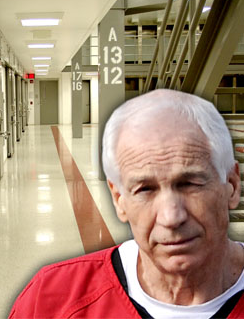
Today, he answers the question on the minds of many Americans: What can the nation’s most infamous pedophile — former Penn State assistant football coach Jerry Sandusky — expect during his life term in prison. It is certainly not what the mainstream media has reported:
Last week, the Washington Postran an AP story about what ex-Penn State coach Jerry Sandusky can expect in prison.
I’m not sure if they ran such an airbrushed version out of naivete or because it’s a family newspaper. But in case anyone is curious, let me see if I can shed a bit more light.
If prison were India, there would be two classes of untouchables: snitches and pedophiles. Child molesters try desperately to blend into the population. However, the most famous pedophile in the nation right now is going to have a hard time blending in.
1) According to the Post, Sandusky “will be able to watch college football, including Penn State, when the games are broadcast on ESPN or another major network.”
If the television set in the common area is tuned to the Penn St. game, then Sandusky just might be able to watch it. But if it’s not, and Sandusky – or any other newbie – walks up to try to change the channel, the result will not be pretty.
2) The Post notes that cards, dominoes, and board games. are popular prison activities in which Sandusky could participate.
No one will want to be seen playing cards with Jerry Sandusky. From the minute Sandusky walks onto the compound, he will be targeted, and anyone who voluntarily and publicly associates with him will immediately be suspect.
3) The Post writes that Pennsylvania prison cells are designed for two people, but it’s possible he could end up in his own cell or in a small dormitory.
It’s not just “possible,” it’s overwhelmingly likely. Given the fact that he will be in danger from the moment he arrives, I imagine that he’ll start out in isolation until emotions surrounding the case cool. If not, anyone Sandusky is placed with would have to fight Sandusky in order to preserve his own reputation, which would lead to the removal of one (or both) from the cell. The problem would likely continue for as long as Sandusky is placed in the general population.
4) According to the Post, Sandusky could be swapped in for an inmate in another state.
It’s possible, but it probably wouldn’t change anything for him: his face was ubiquitous around the country, not just in Pennsylvania.
5) Inmates, noted the Post, generally spend an hour in the yard, which might entail playing softball, though the bat has to be tethered and secured to the backstop.
The bat being tethered to the backstop would not prevent it from being used on anyone standing (or dragged to a location) near the backstop.
Read the rest of… Jeff Smith: What Sandusky Can Expect in Prison — And What the Washington Post Doesn’t Understand
By Jonathan Miller, on Tue Oct 16, 2012 at 9:00 PM ET
As Barack Obama and Mitt Romney duke it out, several of our contributing RPs — including Krystal Ball, Michael Steele, Jeff Smith, and Rod Jetton — will be providing their live commentary of the debate. Read below.
And you too can join the fun. Simply go to your normal Twitter account and use the hashtag #RecoveringPol. Your tweets will appear below LIVE!


 Blog this!