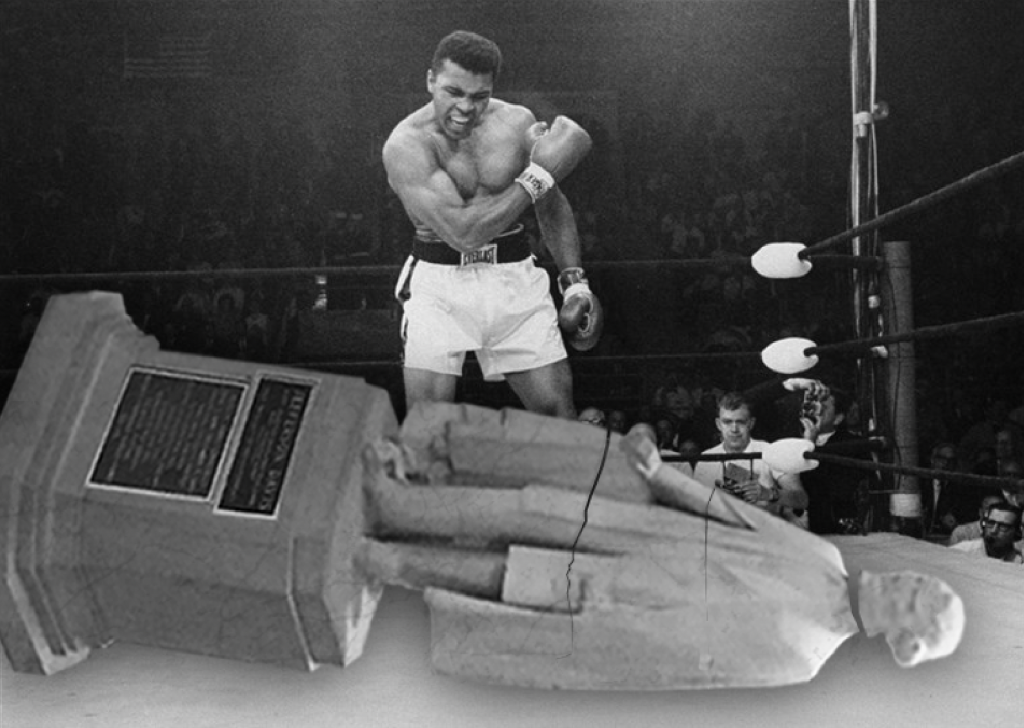
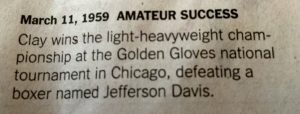
Please sign the petition below to remove the statue of Jefferson Davis currently in Kentucky’s Capitol Rotunda, and replace it with a tribute to Muhammad Ali, “the Louisville Lip” and “the Greatest of All Time.”
I just heard from the Ali family: It is the Champ’s belief that Islam prohibits three-dimensional representations of living Muslims. Accordingly, I have adjusted the petition to call for a two-dimensional representation of Ali (a portrait, picture or mural) in lieu of a statue.
UPDATE (Tuesday, December 2, 2014)
In this interview with WHAS-TV’s Joe Arnold, Governor Steve Beshear endorses the idea of honoring Muhammad Ali in the State Capitol (although he disagrees with removing Davis). Arnold explores the idea further on his weekly show, “The Powers that Be.”
Click here to check out WDRB-TV’s Lawrence Smith’s coverage of the story.
And here’s my op-ed in Ali’s hometown paper, the Louisville Courier-Journal.
UPDATE (Saturday, June 4, 2016)
In the wake of the 2015 Charlestown tragedy, in which a Confederate flag-waving murderer united the nation against racism, all of the most powerful Kentucky policymakers — U.S. Senator Mitch McConnell, Governor Matt Bevin, Senate President Robert Stivers and House Speaker Greg Stumbo — called for the removal of the Davis statue from the Rotunda. Today, as we commemorate last night’s passing of Muhammad Ali, there is no better moment to replace the symbol of Kentucky’s worst era with a tribute to The Greatest of All Time.
UPDATE (Wednesday, June 8, 2016):
Great piece by Lawrence Smith of WDRB-TV in Louisville on the petition drive to replace Jefferson Davis’ statue in the Capitol Rotunda with a tribute to Muhammad Ali.
UPDATE (Thursday, June 9, 2016):
Excellent piece on the petition drive by Jack Brammer that was featured on the front page of the Lexington Herald-Leader.
Highlight of the article:
Miller said he has received a few “angry comments” on his call to honor Ali.
“One of them encouraged me to kill myself,” he said. “You can quote me that I have decided not to take their advice.”
UPDATE (Friday, June 10, 2016)
The petition drives continues to show the Big Mo(hammed): check out these stories from WKYU-FM public radio in Bowling Green and WKYT-TV, Channel 27 in Lexington:
UPDATE (Saturday, June 11, 2016):
Still not convinced? Check out this excerpt from today’s New York Times:
By Zack Adams, RP Staff, on Thu Jan 10, 2013 at 10:30 AM ET
The Politics of Tech
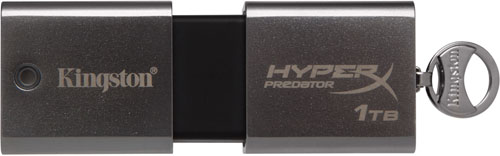
Kingston has announces the world’s first 1TB Flash Drive. It seems they will also release a 500GB model and they will be priced for consumers. I can’t wait for pricing to be released. [TechGage]
Check out these “StickNFind” Bluetooth stickers that allow you to locate lost objects using your phone’s Bluetooth connection. [engadget]
Undeterred by having a few of the most pirated shows of all-time HBO has signed a new contract that will continue to make it difficult for people to access their content. [TechCrunch]
Next-generation LTE chips to reduce power consumption by 50%. LTE chips cut the power required for newest cell phones in half, allow quality and data transfer rate improvements [Yahoo! News]
This 10.7in paper-thin e-ink tablet is pretty damn amazing. The future looks quite good for e-readers. [Stuff]
Our nation prides itself on intellectual achievements. We seek rational solutions. We live in an “information age” where knowledge is king.
Yet we are not solving drug addiction, violence, or war. After a record eleven years, war is routine. Mass gun murders occur monthly. One-third of us take anti-depressants. We have the biggest gap between rich and poor, and the smallest middle class, in three-quarters of a century. In a country that prided itself on education, debt increasingly precludes college and our international ranking is at new depths. Chronic disorders including autoimmune, intestinal, brain disorders at all ages, fibromyalgia, chronic fatigue, and diabetes, are growing rapidly. Is this where intellectualization leads?
We glamorize the brain and its abilities. The future, we insist, will be the result of technology, the product of a vast brain trust. But is that a future we want? Will that bring more social ineptness and alienation, more mass murders, more routine war?
Sage Mohammed Nasser says we must “speak from our heart, not our brain.” Can the heart be the next plane of evolution? Energetically, the electromagnetic field created by the heart extends 15 feet, and is 5000 times more powerful than the brain. The heart is mostly nerve tissue! It has a deep memory and a consciousness. When we interact, do we assess the heart more than brain?
Deep inside, we know the heart’s worth. We have watched Ebenezer Scrooge, and vowed that would never be us. We know baby monkeys given nourishment, languish and die without a mothers love. Alienation and loneliness shorten longevity.
Read the rest of… Dr. Jim Roach: Heart Intelligence
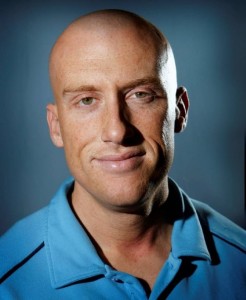
I have written a blog about this topic many times but at this very moment I am watching the Biggest Loser on NBC. Jillian Michaels, Bob the trainer and some other guy are imposing their fitness will on a select group of people for the world to see, all for a cash prize determined on how much a number on a scale decreases. Does anyone else see something wrong with that? First of all, I have been known to push people beyond their limits and I am by no means scared to make someone sore or scream uncle. However, pushing around a number of 300 plus pounders and treating them like United State Marine Corps privates doesn’t sit well with me. Neither does judging a contest by a number (yes it is “reality” TV but these things give people complexes). There are great things about weight loss shows but I often think this drives your everyday gym goer to obsess about the scale, when in all reality it’s not the end all be all. And as a side note, you have to inspire change in people not demand it. To get the very most out of a person, you must INSPIRE them to do it themselves, not force them into submission. This is not what personal training is about.
Off my soapbox. Back to the topic at hand….
I’ve often wondered about certain strategies gym goers employ. The one strategy that has vexed my mind is a ritual of sorts and a lot of people do it every day. You know if you do something every day and expect a different result, that makes you crazy rightJ. It is at like the Holy Grail, the very reason people come to the gym and try to eat right, it’s the difference between a good day and a bad day, it is the end all be all. It is stepping on the scale! Don’t try to pretend you don’t do it because we all are guilty, especially in a place where there are scales and we are trying to lose weight, gain weight or stay the same. But the very fact people are control by this instrument, this measurement of body mass can be alarming and skewed. The end all be all may not be “all” it’s cracked up to be.
Let’s back track for a second. What are we trying to do? Most people? Answer is losing weight. Statistics show the most common goal for any gym goers is losing weight. But that should really be the goal? The answer is yes and no. If you are 50 lbs overweight and you need to lose 50 pounds then I would say losing weight would be a great goal for you. However, if you are trying to lose 10-20 pounds, does it really matter what the scale says as long as your body fat changes? Of course not! I tell clients all the time; if I could have you weigh the same weight you are today and look 100% different, would it matter what the scale said? 9 times out of 10, the number didn’t matter.
Read the rest of… Josh Bowen: A Lesson from the Biggest Loser
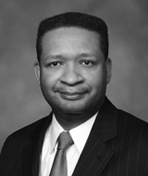
Admiring, but still mindful of two limitations that are often glossed over regarding the DLC’s trajectory: both the rough patch the centrist organization endured in its formative years before Clinton’s 1992 campaign, and the decidedly uneven record the group compiled during the Clinton presidency and beyond.
To a degree that is not widely remembered, the DLC’s first phase, which ran from 1985 to Clinton’s ascension to its leadership in 1990, was mired in internecine combat with more conventional Democratic forces, from Jesse Jackson to Mario Cuomo. The DLC was dubbed variously as a stalking horse for KStreet lobbyists (“the Democratic Leisure Class” in Jackson’s parlance), or Southerners trying to reassert their primacy over blacks and feminists, or unprincipled panderers trying to win over Reagan Democrats by channeling their resentment toward the liberal base. During that stretch, the DLC label was damaging enough that aspiring presidential possibilities like a young Al Gore avoided an overt association, and in the case of Missouri’s Richard Gephardt, worked overtime to purge his record of any links to the DLC as he emerged as a serious contender in the 1988 primary derby.
In other words, the DLC’s initial contribution to the Democratic debate was to polarize the party’s internal political landscape and to provide something of a convenient foil for the Democratic liberal wing. Rather than weakening under a centrist assault, that left wing dominated the 1988 primaries to the point that Jackson ran a competitive second, while a putative moderate like Gore never developed momentum outside his home base of southern whites. Nor was the issue environment that year one friendly to centrists: the spectrum ran, unhelpfully for moderates, from Gephardt’s protectionist pledge to slap tariffs on Korean and Japanese car manufacturers to a near universal consensus among the candidates that Ronald Reagan’s policy of aiding South American counter-revolutionaries be permanently scrapped.
It is also not likely that Kristol and his cohorts mean to emulate the DLC’s footprints in the administration it unmistakably helped elect. It is worth recalling that the only major DLC initiatives that were written into law were welfare reform, a tangible, signature achievement to be sure, and a valuable but relatively modest agenda of grants for community policy. A much larger portion of the group’s portfolio never made it beyond the policy binders: not middle class targeted tax relief; not vouchers for purchasing health insurance; not national service for college scholarships; not the substitution of class for race as the criteria for affirmative action. The Democratic Party’s embrace of a global free trade campaign did not really broaden beyond NAFTA, which George HW Bush primarily negotiated. S-Chip, a genuine advance for low income children, was less a Clinton or DLC priority than a fallback from the wreckage of the abandoned 1994 effort on national health care.
To be sure, the DLC deserves reams of credit for crafting a brand of political argument that was attractive to suburbanites and blue collars, including a robust emphasis on personal responsibility over entitlement and a newfound Democratic tough-mindedness on crime. But to the extent that conservative reformers are ambitious to construct a specific policy apparatus , the DLC seems like a low baseline of achievement that actually did not succeed in reorienting the ideological instincts of its party in a sustained way. To cite just a few examples, the Democratic Party’s Clinton era hawkishness on deficits and fondness for Social Security reform did not survive Clinton’s own vice president’s messaging in 2000, much less subsequent Democratic campaigns.
Finally, the DLC’s ascension was tied in an indispensable way to the gifts of one preternatural campaigner in Bill Clinton. Democratic centrism notably failed to produce a cohort of like-minded prospects at the federal or gubernatorial level. The DLC never fostered the machinery to wage primary battles on behalf of moderate candidates who were engaged in street fights with more traditional liberals. To the contrary, the model was less to nurture centrist candidacies than to sit on the sidelines and nurture relationships with the ever diminishing class of moderates who managed to win on their own (often by sliding to the left to paper over their centrist ways).
Read the rest of… Artur Davis: A DLC for Republicans?
I used to ask myself how I could become part of a world of solutions that create peace, if I as an individual, did not really feel peaceful most of the time. How could I have happy peaceful relationships if I knew that my own happiness and sense of peace was dependent on external factors that were fleeting at best: new jobs, latest diet, purchases, trips.
This was a distressing awareness, especially because I was professionally drawn to the fields of family counseling, social work, rehabilitation, motherhood! How could I represent health and vitality without living it in the way of enduring longevity?
To live at a heart-aware level of consciousness, where taking the deep breath that integrates head and heart can create profound changes, is really a simple process actually.
We begin with ourselves, with self-care strategies, and they become not only magical remedies for daily stress-reduction, but they serve as the foundation of how we extend ourselves forward into our personal and professional relationships, into the community, into the world.
Simply, meditation and deep breathing as regular practices can do it for you. There is no club to have to join, no equipment to have to buy, no complicated process to learn; it involves just sitting quietly and allowing yourself to clear your mind and in effect, to strengthen your heart, immune system, spiritual life.
By sitting in silence and really breathing for just 20-30 minutes out of 24 hours in the day, compelling scientific evidence shows the effects of decreased fight/flight response by way of lowered blood pressure, reduced production of stress hormones (like cortisol), and reduced anxiety.
But most compelling is how we feel in the remaining 23.5 hours of the day. There is no separation between our minds and bodies; when the mind is relaxed, physiology relaxes, rebalances, and can respond rather than react to the environment. Responding to the external world of chaos and change from a heart-head integrated place, can only come from an internal world of restful awareness.
This was an amazing realization for me and brought on some profound changes that I could never dream possible for myself. And the realization didn’t come from the data and information about how reactive, restless, and irritable I tended to be; it came as I began to feel the results of the actual practice of sitting in silence and breathing for at least 20 minutes a day.
Meditation and deep breathing are tools for rediscovering the body’s own inner intelligence. Practiced for thousands of years, it’s not about forcing the mind to be quiet; it’s about finding the silence that’s already there and letting it lead the way through your life.
Here are brief instructions for a personal meditation and deep breathing practice. If you are interested in personal coaching or in having me lead a workshop in your community, get in touch. For today, this can be a first step into this amazing realm of mind-body-soul medicine that reduces stress, strengthens immunity, and begins to open that space in yourself that transcends space and time.
Read the rest of… Lisa Miller: Meditation — A How-to Guide for Beginners
The decorations are down, the kids are back in school, and the New Year’s resolutions have already been broken – yes, it’s time for the post-holiday blahs. But before you sink into a pit of January despair, feeling like there’s nothing fun coming up for ages, here are a few ‘glass-half-full’ thoughts to help keep your spirits up.
– You don’t have to listen to any more Christmas carol muzak until at least next Halloween.
– It’s much harder to get a sunburn in cold, foggy, gray weather
– You have over 300 shopping days left.
– The dreaded ‘fiscal cliff’ turned out to be as anticlimactic as Y2K
– The kids are no longer sleeping til noon and then complaining they’re bored.
– Your inlaws have all gone home.
Meanwhile, there are tons of minor Jewish holidays coming up which we are happy to share with everyone else. In fact, it feels like we have one every other week, although most of us couldn’t define more than a handful. So with this week’s video, I’ve tried to clarify some common themes among Jewish holidays, as well as providing some upbeat gospel music to start the New Year on a positive note. (And yes, I know Jewish gospel music is an oxymoron, but this is the era of fusion where genres and ethnicities get blended in everything from social groups to cuisine, so think of this as fusion Jewish gospel . . . )


 Blog this!
 And yet I know found myself using it.

 I’ve often wondered about certain strategies gym goers employ. The one strategy that has vexed my mind is a ritual of sorts and a lot of people do it every day. You know if you do something every day and expect a different result, that makes you crazy rightJ. It is at like the Holy Grail, the very reason people come to the gym and try to eat right, it’s the difference between a good day and a bad day, it is the end all be all. It is stepping on the scale! Don’t try to pretend you don’t do it because we all are guilty, especially in a place where there are scales and we are trying to lose weight, gain weight or stay the same. But the very fact people are control by this instrument, this measurement of body mass can be alarming and skewed. The end all be all may not be “all” it’s cracked up to be.
 And then some mornings–like this one–I feel like a cup of warm brown water run through yesterday’s coffee grinds.
 I’ve written before that Republicans looking to recast themselves as middle class-friendly and more reform oriented should look for guidance at Bill Clinton’s renovation project for Democrats in the early nineties.
  It is also not likely that Kristol and his cohorts mean to emulate the DLC’s footprints in the administration it unmistakably helped elect. It is worth recalling that the only major DLC initiatives that were written into law were welfare reform, a tangible, signature achievement to be sure, and a valuable but relatively modest agenda of grants for community policy. A much larger portion of the group’s portfolio never made it beyond the policy binders: not middle class targeted tax relief; not vouchers for purchasing health insurance; not national service for college scholarships; not the substitution of class for race as the criteria for affirmative action. The Democratic Party’s embrace of a global free trade campaign did not really broaden beyond NAFTA, which George HW Bush primarily negotiated. S-Chip, a genuine advance for low income children, was less a Clinton or DLC priority than a fallback from the wreckage of the abandoned 1994 effort on national health care.
 But most compelling is how we