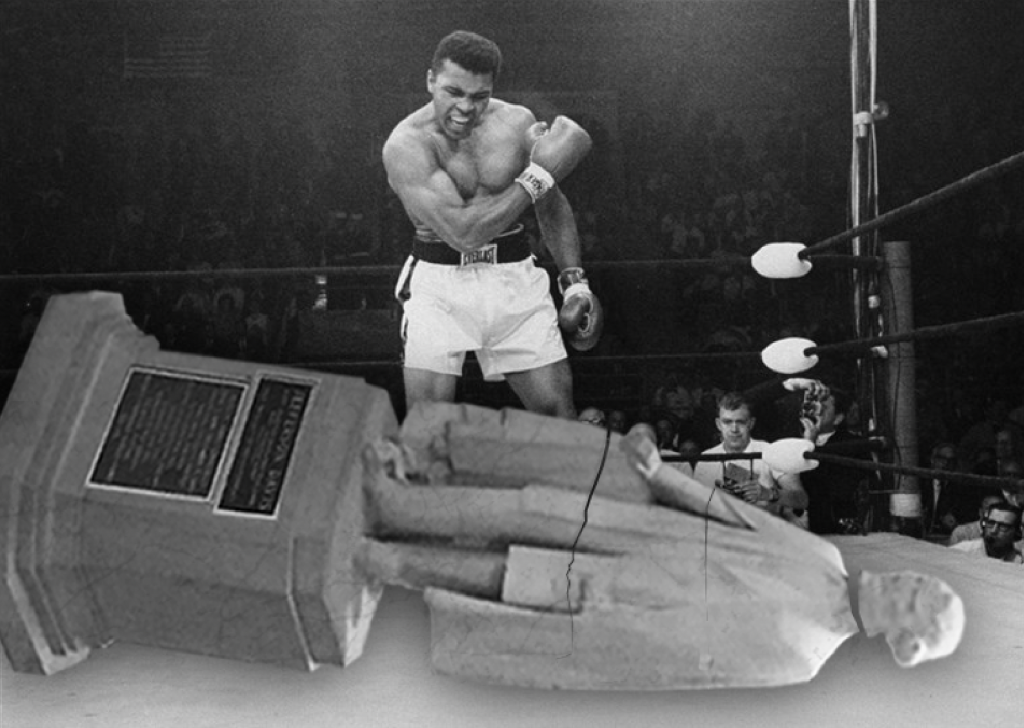
Please sign the petition below to remove the statue of Jefferson Davis currently in Kentucky’s Capitol Rotunda, and replace it with a tribute to Muhammad Ali, “the Louisville Lip” and “the Greatest of All Time.”
I just heard from the Ali family: It is the Champ’s belief that Islam prohibits three-dimensional representations of living Muslims. Accordingly, I have adjusted the petition to call for a two-dimensional representation of Ali (a portrait, picture or mural) in lieu of a statue.
UPDATE (Tuesday, December 2, 2014)
In this interview with WHAS-TV’s Joe Arnold, Governor Steve Beshear endorses the idea of honoring Muhammad Ali in the State Capitol (although he disagrees with removing Davis). Arnold explores the idea further on his weekly show, “The Powers that Be.”
Click here to check out WDRB-TV’s Lawrence Smith’s coverage of the story.
And here’s my op-ed in Ali’s hometown paper, the Louisville Courier-Journal.
UPDATE (Saturday, June 4, 2016)
In the wake of the 2015 Charlestown tragedy, in which a Confederate flag-waving murderer united the nation against racism, all of the most powerful Kentucky policymakers — U.S. Senator Mitch McConnell, Governor Matt Bevin, Senate President Robert Stivers and House Speaker Greg Stumbo — called for the removal of the Davis statue from the Rotunda. Today, as we commemorate last night’s passing of Muhammad Ali, there is no better moment to replace the symbol of Kentucky’s worst era with a tribute to The Greatest of All Time.
UPDATE (Wednesday, June 8, 2016):
Great piece by Lawrence Smith of WDRB-TV in Louisville on the petition drive to replace Jefferson Davis’ statue in the Capitol Rotunda with a tribute to Muhammad Ali.
UPDATE (Thursday, June 9, 2016):
Excellent piece on the petition drive by Jack Brammer that was featured on the front page of the Lexington Herald-Leader.
Highlight of the article:
Miller said he has received a few “angry comments” on his call to honor Ali.
“One of them encouraged me to kill myself,” he said. “You can quote me that I have decided not to take their advice.”
UPDATE (Friday, June 10, 2016)
The petition drives continues to show the Big Mo(hammed): check out these stories from WKYU-FM public radio in Bowling Green and WKYT-TV, Channel 27 in Lexington:
UPDATE (Saturday, June 11, 2016):
Still not convinced? Check out this excerpt from today’s New York Times:
By John Y. Brown III, on Mon Feb 11, 2013 at 12:00 PM ET
The difference between guys and dogs.
When a dog catches a car it pauses and looks genuinely confused….and saunters off knowing he miscalculated the payoff and feeling foolish (even by dog standards).
When a guy catches the equivalent of a car he has been chasing (so to speak), he seems uncertain for a nanosecond and then immediately projects the image of someone positively thrilled with his capture, of knowing exactly what he was doing and what to expect, and poses as if to say, “Seriously folks, have you ever seen such brilliantly successful car chasing before ? I didn’t think so.”
And then before any sliver of doubt emerges begins looking for the next car to chase (figuratively speaking) –as his audience watches on approvingly.
Other than this distinction guys and dogs are otherwise very similar.
By Erica and Matt Chua, on Mon Feb 11, 2013 at 10:00 AM ET
Jerusalem is a loaded word. I could preface that with “these days”, but the reality is that it’s been a place of dispute more than peace. ”It has been destroyed twice, besieged 23 times, attacked 52 times and changed hands 52 times,” according to Wikipedia. If Jerusalem was a sporting event it’d be the must watch game of all-time. We’d be glued to the television wondering how it was going to end, cheering when our side gained the lead and screaming in dismay when control changed hands. The only thing everyone would agree upon is that the officials, those “independent” outside arbiters, were terrible. Sadly the sporting analogy is all too apt, religions are the teams, officials are foreign powers, and Jerusalem is the trophy. Why fight for this trophy? The agnostic doesn’t see a reason.
The golden Dome of the Rock on the right is one of Sunni Muslim’s most sacred sites along with the location of the Holiest of Holies for Jewish people. Just behind this is the Church of the Sepulchre one of Christianity’s holiest sites.
Jerusalem and Israel as a whole is a place where assigned value trumps real value. The value of these places isn’t real, there aren’t $2 billion plus gold monuments like Shwedagon Paya in Myanmar. The land isn’t productive like Iowa. The riches don’t lie beneath the ground like in Venezuela. The country isn’t a paradise like Palawan. There is nothing tangible worth fighting for in Jerusalem or Israel. The reality is that if all of Israel were to fall into the ocean the world wouldn’t be affected. The problem is that people believe that it would affect us. Jewish people believe that theFoundation Stone in the Dome of the Rock is the meeting point of Heaven and Earth. Both Sunni Muslims and Christians believe that their prophet ascended to Heaven from Jerusalem. While these places have limited actual value, for the three of the world’s major religions, Jerusalem is priceless.
Read the rest of… Matt and Erica Chua: An Agnostic Walk Through Jerusalem
By Jonathan Miller, on Sun Feb 10, 2013 at 11:19 AM ET
Last week, I joined Kentucky Agriculture Commissioner Jamie Comer in support of legalizing industrial hemp on the public broadcasting program, Kentucky Tonight. Click the picture at left to watch our debate with law enforcement officials.
Viewers of the program noticed that the two sides disagreed on some very critical underlying facts about the differences between hemp and marijuana and how the two plants are grown.
Janet Patton of the Lexington Herald-Leader spent a few weeks investigating this matter, and interviewing objective experts. Here is an excerpt from her story published today:
The nightmare hemp scenario for Kentucky State Police apparently is a field legally licensed to grow hemp forgrain with illegally planted marijuana mingled in.
Unlike hemp grown for fiber (when the plants are inches apart to promote tall stalk growth), the hemp grown for grain and marijuana plants would look substantially the same, said Jeremy Triplett, supervisor of the state police forensic lab.
Both could be shorter and bushy. The only way to really know, he said, would be to test for delta-9 tetrahydrocannabinol, or THC, the chemical that gives marijuana smokers a high.
Such testing could cost hundreds of thousands of dollars each year, at $755 per quantitative analysis, not to mention $1.8 million in start-up expenses, state police have estimated.
But would that really happen? Would an unscrupulous pot grower plant marijuana with hemp?
Take Canada, where marijuana also is illegal but hemp has been legallygrown since 1998. “Health Canada’s Industrial Hemp Program has never found marijuana growing in hemp fields instead of hemp,” the agency said in a statement.
They’ve looked. A lot.
Canadian inspectors take samples annually from each field and have found THClevels slightly above 0.3 percent from stress during growing, but not above 0.5 percent, Health Canada said.
Keith Watson, Manitoba Agriculture Food and Rural Initiatives agronomist, has seen and tested most of the hemp grown in his province in the past 15 years. Does marijuana creep in?
“I’ve never run into it,” Watson said. About 95 percent of the crop is sampled annually, and he said that marijuana and grain hemp might look just alike and could be planted side by side and only an expert eye might distinguish the difference. But in his experience, it just doesn’t happen.
“Over the years, that’s taken me out to an awful lot of fields,” Watson said. “I’ve never found marijuana in the field or any trace of it.”
He said a “handful” of times he has seen paths cut into the fields, places where people have topped the plants. But it doesn’t happen much anymore.
“After a couple of years, nobody bothers it,” he said.
What about marijuana?
As for marijuana growers using hemp to pad their illegal pot, “the general impression is that’s a self-regulating industry,” Watson said. “They’ll get away with it once … but if the quality (of the marijuana) isn’t up to par, there will be a lot of broken kneecaps.”
By John Y. Brown III, on Fri Feb 8, 2013 at 12:00 PM ET
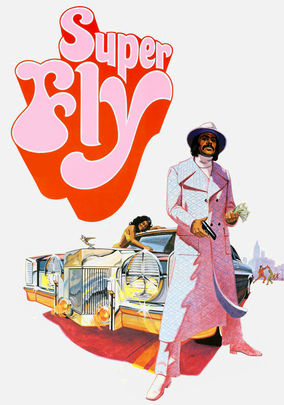
Leave ’em speechless. My inner-Superfly. And vivid imagination:
Me: I really don’t think you would have sent that snarky text this morning if you’d known the truth about what song I’d just listened to. That’s right. What song (and video) I had just listened to and watched. And was feeling. Superfly! Curtis Mayfield. Uh-huh. That’s right!
Texter: I’m sorry Mr Brown. I didn’t know.
Me: You’re sorry alright. Don’t text me in that sarcastic tone ever again.
Texter: I won’t, sir. I swear.
I love cool comebacks that I have with others during imaginary conversations I have in my head.
Sure, it’s not quite the same as if I actually said it during an actual conversation to an actual person. But it still sends a message. Maybe a message no one but me is aware of. But it sends a message to me that I’m not as important or feeble as I feel at the moment.
And, yeah, I’m pretty good at it, too. Like Yogi Berra said, “It ain’t braggin’ if you done it.” And I do have a lot of great comebacks that shut down rude people in their tracks. (Imaginary comebacks in imaginary conversations with imaginary people).
But as these fantasy conversations go, they are impressive, and plentiful, and I always get the last word. Leaving my rivals speechless and ashamed–and hopefully a little wiser the next time they find themselves in an imaginary conversation with me.
For the past three years, some Republican and Democratic lawmakers have sat next to each other during President Barack Obama’s annual State of the Union speech to Congress in a largely meaningless one-night show of bipartisanship.
Next week when Obama addresses the House of Representatives and the Senate in a joint session, 40 lawmakers from the two parties hope to add some beef: Under their official congressional lapel pins, they’ll wear orange buttons identifying themselves as Problem Solvers and displaying their pledge, “Committed to fix not fight.”
With congressional approval ratings at historic lows, the 23 Democrats and 17 Republicans say they want to move beyond mere symbolism as they tell their peers that they’ve pledged to try to end hyper-partisanship and work across the aisle to solve the country’s most pressing problems.
“We’re meeting on a regular basis, Democrats and Republicans just talking about areas where we think we can work together in a bipartisan way,” said Rep. Ami Bera, a California Democrat who defeated incumbent Republican Rep. Dan Lungren in November.
“The idea is we’ve got to move past being only Democrat or Republican,” Bera said in an interview. “It’s very evident in my freshman class. All of us got elected knowing there was an expectation that we would work together.”
Bera and his fellow Problem Solvers scored a major victory last week when Congress passed and Obama signed the No Budget No Pay Act. It raises the federal debt ceiling through May 18 while blocking lawmakers’ salaries if they fail to pass a budget for fiscal 2014, which starts Oct. 1.
Bera made the bill a central plank of his campaign against Lungren last year. While Bera preferred a tougher measure than the one that eventually passed – it holds lawmakers’ pay in escrow instead of eliminating it – the new Sacramento-area lawmaker voted for it in the spirit of compromise that he thinks is so important.
“Passing a budget is our core job,” Bera said. “It lets the public know what our priorities are and how we’re going to spend our resources.”
With the House under Republican control and the Senate holding a Democratic majority, Congress has operated without a budget for several years while passing stopgap spending bills that fund the government for shorter periods instead of moving annual appropriations measures…
The Problem Solvers caucus is a key initiative of No Labels, an advocacy organization launched in December 2010 by a group of high-powered politicians and political consultants who were fed up with Washington gridlock.
One of the No Labels founders is Mark McKinnon, an Austin, Texas, Republican political consultant who was a key adviser to the presidential campaigns of George W. Bush in 2000 and 2004, and John McCain in 2008.
“There really wasn’t a voice reflecting what the American people want,” McKinnon said in an interview. “They want to see Washington start dealing with our problems. They don’t care if it’s a Republican solution or a Democratic solution, they just want to see some progress.”
Jonathan Miller, a former Kentucky state treasurer and onetime head of the Kentucky Democratic Party, is another co-founder from his home base as a lawyer in Lexington.
“Most Kentuckians and other people I run into are fed up with politics and the way the parties are always fighting and nothing is ever accomplished,” Miller said. “We want to bring Democrats, Republicans and independents together to change the dynamics.”…
Miller graduated from Henry Clay High School in Lexington, named after a legendary lawmaker who crafted several measures that helped hold off the Civil War for a decade.
“His nickname was the Great Compromiser, but now ‘compromise’ is seen as a dirty word,” Miller said.
The Problem Solvers insist that theirs is not a centrist group, but rather one that includes lawmakers with viewpoints from across the political spectrum, from liberal to conservative.
Hoping to grow to 75 members by year’s end, they view themselves as a bipartisan and potentially more powerful version of two caucuses whose ranks have shrunk with the rise in partisanship: the Blue Dog Democrats and the Main Street Republicans, each of which bring together moderate pragmatists willing to compromise.
“Our potential is more meaningful because we have members of both parties,” said McKinnon, who is advising the Problem Solvers. “In Congress, if you can bring together 40 or 50 – or hopefully 70 or 75 – votes of Democrats and Republicans, that’s a substantial number of votes that can swing a big issue.”
In another sign of the group’s increasing influence, House Majority Leader Eric Cantor’s “Make Life Work” address Tuesday at the American Enterprise Institute, billed as a major piece of the Republicans’ ongoing rebranding effort, was a strong echo of the No Labels slogan “Make America Work.”
The No Labels office in downtown Washington features two towering posters of Republican President Ronald Reagan and former Democratic House Speaker Tip O’Neill, who are models for the group because of their ability to work together and reach compromises despite their political differences…
By Jonathan Miller, on Fri Feb 8, 2013 at 9:15 AM ET
The RP’s latest column for the Huffington Post explains why immigration reform is such an urgent issue for our national economic recovery. Here’s an excerpt:
When it comes to restoring strong, long-term growth in our nation’s economy, there are few solutions more practical, bi-partisan, and urgent than immigration reform.
Our current immigration system is rigid, outdated, and simply unable to keep up with demands of the new global marketplace. For our nation to thrive and transcend international competition in the 21st century economy, it is incumbent for us to build an immigration system that welcomes people who share our values, as well as the entrepreneurial spirit that has made our country great.
No one can doubt that we are a nation whose foundation was built by immigrants. But did you know that more than 40 percent of today’s Fortune 500 companies were founded by an immigrant, or a child of an immigrant? Or that more than 75 percent of all the patents received by the top ten U.S. universities in 2011 had an immigrant inventor? While we celebrate our nation’s first immigrants every Thanksgiving — and while many of us cherish the stories shared by our own family members who made the pilgrimage to our shores — we too often forget that today, and every day, recent immigrants continue to play a vital role in the American economy.
Unfortunately, far too often, our immigration policies drive too many foreign-born entrepreneurs and job creators away, even after we have trained them and given them degrees from American universities.
This is not simply a matter of compassion or human interest. This is about the very survival of our economy, way of life, and continued global leadership. We must make it easier for foreign-born, U.S.-educated students to get visas. We must create a startup visa program for entrepreneurs and innovators who want to come to our country to start businesses and hire American workers, especially when they already have U.S. investors to back their ideas. We must be doing everything we can to keep that capital in the U.S., rather than handing the next great idea over to our competitors.
True, I have been posting a lot lately about men’s boots, but in the winter, sometimes all you see on a person is his outerwear and footwear, and that’s why I’m a little obsessed. My general feeling about mens footwear is that it should be streamlined and not chunky or clunky. However (and maybe it’s the Maine in me), but when it comes to boots and outdoor gear, I love the look of something rugged and tough. It just screams out masculinity. Like this is a guy who would scoop me up, carry me across a puddle and deposit me on dry curb.
Here are my picks for rugged, lady-scooping goodness:
Red Wings
Red Wings have enjoyed a monster resurgence as of late, largely due to smart partnerships with some major clothing companies.
These babies above are a J. Crew exclusive. If you get them, make sure you go with the “dark wood” color. “Dark straw” is a color no one should ever put on his or her body, I don’t care how close to the ground it is.
Read the rest of… Julie Rath: Puddle Jumping and Lady Carrying
Kentucky Agricultural Commissioner James Comer announced on KET’s Kentucky Tonight “On February 11, when I testify with Senator Hornback for this bill, we’re going to have Senator Rand Paul, Congressman [John] Yarmuth and Congressman Massey all there testifying in favor of this bill [Senate Bill 50]. I’ve been there 13 years, and I’ve never seen three congressmen testify on the same bill, and of different parties. Today we learned former CIA director James Woolsey will be flying in to testify on behalf of this bill…”
Comer, a Republican, has made a full media press in support of industrial hemp in Kentucky, which cannot currently be legally grown in the U.S. Tonight, he was interviewed by KET’s Bill Goodman, on a panel that included former Kentucky State Treasurer Jonathan Miller, Kentucky State Police Commissioner Rodney Brewer, and Dan Smoot, vice president of Operation UNITE.
Senate Bill 50, proposed by senator Paul Hornback (Republican, Shelbyville), doesn’t legalize hemp. It establishes the framework for a regulatory agency (the Kentucky Department of Agriculture) to regulate this crop, if and when the federal government allows the growing of industrial hemp in the U.S. Key provisions: any grower would have to pass a criminal background check. Growers would have to submit GPS coordinates of their hemp fields. Growers would have to agree to inspections and grow a minimum of ten acres.
Comer says industrial hemp grows well in Kentucky (it was prevalent in Kentucky in the 1900s), and it “has a growing demand…. It’s a green crop,” adding “we’re at a crossroads in Kentucky agriculture.”
Jonathan Miller, citing his background as a Henry Clay high school graduate, and a childhood growing up on land that was once part of Henry Clay’s estate, reminded viewers that industrial hemp was Henry Clay’s key crop, but he was most excited about the environmental possibilities. “We’re facing some real issues here in terms of developing energy and developing clean energy.”
“Instead of trying to find examples of other places to follow, I’d love to see Kentucky take the lead. We need to be first in something we can be really proud of.”
Not everyone on the panel agreed with Comer and Miller.
Commissioner Brewer says he agrees with Comer that hemp and marijuana grow well in Kentucky. He says the problem is “you cannot distinguish between hemp and marijuana with the naked eye. You’ll hear a lot of proponents say that you can…but you cannot tell the difference.” He asks what would keep an enterprising or unscrupulous farmer from adding a few marijuana plants to the interior of a hemp tract, “when the going rate for marijuana is about $2300/lb,” adding that “the research has not been done to show [hemp’s] a viable product in Kentucky yet.”
Smoot, of Operation Unite, refers to UK’s 1998 study “concluding there was no market for hemp.” He says the market’s only declined since. He says, “The United States Department of Agriculture says ‘thin market at best, novelty item.’”
SB50 requires that the seeds that the certified growers use will have only trace amounts of THC. It’s an agricultural crop, with no narcotic value.
Comer says he appreciates the concerns of the law enforcement panelists, but that “there is a concern in Kentucky to create jobs. This is an opportunity.”
Brewer says “marijuana and hemp are not first cousins, they are twin brothers.” He adds, “you can get high off of hemp.” [If they are brothers, however, they are Cain and Abel — destroying each other every chance they get. “Hemp and marijuana, both members of the cannabis family, aggressively cross-pollinate with undesirable results for both. Interbreeding marijuana valued for high THC content with low-THC hemp dramatically lowers THC content and thus economic value of smoked marijuana. Likewise, lanky hemp plants grown for the fiber in their stems would lose those desired characteristics if interbred with bushy pot plants.” Ace 2000 archive.]
Miller says, this debate makes it “so compelling why we need Senate Bill 50. It’s not legalizing hemp. It says IF hemp is legalized at the federal level,” this establishes a strong regulatory framework around it.
He spoke of “empowering” the farmers with “new opportunities,” particularly as tobacco has faded from the economic landscape…
Host Bill Goodman then read an email from James Higdon, author of Cornbread Mafia:
“In reporting my book, I found that many illegal pot farmers were against the idea of reviving Kentucky’s hemp industry out of fear of what the increase in hemp pollen would do to the value of their crops. Why is it that Operation Unite and the Kentucky State Police agree with criminal marijuana growers that hemp is a bad idea?”
Smoot responded, first to the caller:
“I will guarantee you that those people that died of the pill overdoses, their first experience with illegal drugs was marijuana. “
He then suggested that anyone growing industrialized hemp should be prepared to hire armed guards.
Smoot countered, “If you take our whole federal delegation from Kentucky to DC, combined, I don’t think they have put a fraction of the time and effort into the drug crisis in Kentucky and this nation as Congressman Hal Rogers…He has made battling drugs a priority.”
Goodman adds, “he is one of the most powerful Republicans in Congress because he is chair of the appropriations and revenue committee.”
Comer says he respects Rogers’ point of view, but stresses “when Senate Bill 50 passes, that still doesn’t legalize industrial hemp in Kentucky. It just sets up the framework for how it will be regulated in Kentucky,” referring to the arguments against the bill as “shallow,” saying “it’s ok to be bold.”
Miller says, “we don’t claim this is a magic crop or panacea. It’s not gonna solve all of Kentucky’s problems.” But he referenced UK’s 1998 survey (before new applications for hemp were developed) identifying one processing plant as capable of generating 300 new jobs and $6.7 million of revenue.
Commissioner Brewer says law enforcement will have to prepare for “The Hemp Defense.”
“Everybody we stop from now on that has a bag of marijuana is going to say ‘that’s not marijuana, that’s hemp.’”
He estimates the testing that necessitates will cost the state about $1.75 million the first year.
Goodman asks, “can it be tested in the field? It can’t be tested when someone is pulled over for a nickel bag? Can it be tested in a growing field? It has to be taken to a laboratory?”
Miller says, “if someone is pulled over for a nickel bag and says it’s hemp, the immediate response should be to arrest them for marijuana possession.”
Commissioner Brewer says, “oh we will,” citing the arrest of Dr. Bronner last summer for growing hemp.
By Jonathan Miller, on Thu Feb 7, 2013 at 2:15 PM ET
A great column by Chuck Culpepper at Sports on Earth, “The Gay Super Bowl” (h/t Joe Sonka)
Eight days before the gayest Super Bowl week on record, I walked toward the Baltimore Ravens’ locker room in New England consumed entirely with thoughts of football, pure football, undiluted football.
I am that exotic creature, a gay male sportswriter, but on this frigid walk I was thinking only of Baltimore’s rout of the Patriots and how it had sustained my sense of the Ravens’ uncommon camaraderie. Hoping to learn more about a cohesion I had admired for five years, I joined the reporter scrum at linebacker Terrell Suggs’ locker, known to be a harbor of humor and insight.
Oh.
Oh . . .
There stood Brendon Ayanbadejo, age 36, born in Chicago to an American mother and Nigerian father, educated at UCLA, three Pro Bowls as a noble special-teams sort, a man whom I had never met but for whom I held a vast gratitude. In a giddy locker room in which the great Ed Reed waltzed around singing Eddie Money’s “Two Tickets To Paradise,” I momentarily had misplaced Ayanbadejo’s face. In fact, in the urgency of the game, I had not thought of him all weekend. Yet here was a man I had never expected to exist in all my life, a heterosexual football powerhouse who had spoken up voluntarily and beautifully and repeatedly for g-g-g-gay people.
Now a storm coursed through my head. Should I make this personal? Should I thank Mr. Ayanbadejo right then and there, just after Suggs had finished teasing a famous NFL reporter for an inaccurate game prediction? Or should I stick with my customary etiquette and proceed with the football questions?
In my offbeat life, I have clomped my klutzy size-13 shoes in two worlds you might call disparately disparate. On six continents I have hung around excellent gay people who find sports an unappealing mystery and look flabbergasted at my interest. I have hung around excellent sportswriters who would never stray near a gay bar unless they wandered too far down Bourbon Street at a Final Four. The gay people seldom ask about the sports people, and the sports people seldom ask about the gay people.
I am believed to be the only gay male extant who can recite the final scores of all 47 Super Bowls, and if we’re together and you’re unlucky, I might start it up.
So I have endured all the stages of my plight: the long dislike-myself stage, the longer please-tolerate-me stage, the still-longer I-might-be-OK stage and even the world-is-absurd stage, which arrived one day in a tiny flat in London when I read on Andrew Sullivan’s blog that a museum in Oslo would be exhibiting the 1,500 species in which homosexuality had been observed or studied.
Fifteen hundred! You mean I’m part of some natural continuum, and I’ve spent chunks of my life fretting myself silly over this?


 Blog this!