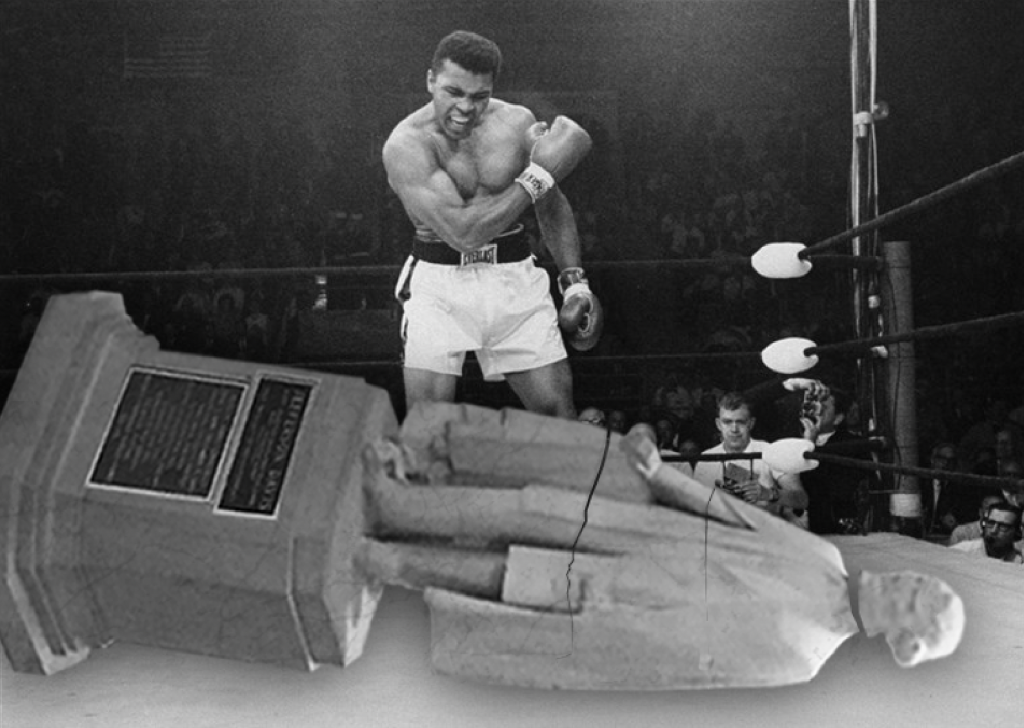
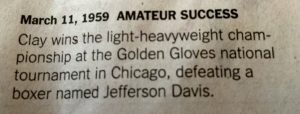
Please sign the petition below to remove the statue of Jefferson Davis currently in Kentucky’s Capitol Rotunda, and replace it with a tribute to Muhammad Ali, “the Louisville Lip” and “the Greatest of All Time.”
I just heard from the Ali family: It is the Champ’s belief that Islam prohibits three-dimensional representations of living Muslims. Accordingly, I have adjusted the petition to call for a two-dimensional representation of Ali (a portrait, picture or mural) in lieu of a statue.
UPDATE (Tuesday, December 2, 2014)
In this interview with WHAS-TV’s Joe Arnold, Governor Steve Beshear endorses the idea of honoring Muhammad Ali in the State Capitol (although he disagrees with removing Davis). Arnold explores the idea further on his weekly show, “The Powers that Be.”
Click here to check out WDRB-TV’s Lawrence Smith’s coverage of the story.
And here’s my op-ed in Ali’s hometown paper, the Louisville Courier-Journal.
UPDATE (Saturday, June 4, 2016)
In the wake of the 2015 Charlestown tragedy, in which a Confederate flag-waving murderer united the nation against racism, all of the most powerful Kentucky policymakers — U.S. Senator Mitch McConnell, Governor Matt Bevin, Senate President Robert Stivers and House Speaker Greg Stumbo — called for the removal of the Davis statue from the Rotunda. Today, as we commemorate last night’s passing of Muhammad Ali, there is no better moment to replace the symbol of Kentucky’s worst era with a tribute to The Greatest of All Time.
UPDATE (Wednesday, June 8, 2016):
Great piece by Lawrence Smith of WDRB-TV in Louisville on the petition drive to replace Jefferson Davis’ statue in the Capitol Rotunda with a tribute to Muhammad Ali.
UPDATE (Thursday, June 9, 2016):
Excellent piece on the petition drive by Jack Brammer that was featured on the front page of the Lexington Herald-Leader.
Highlight of the article:
Miller said he has received a few “angry comments” on his call to honor Ali.
“One of them encouraged me to kill myself,” he said. “You can quote me that I have decided not to take their advice.”
UPDATE (Friday, June 10, 2016)
The petition drives continues to show the Big Mo(hammed): check out these stories from WKYU-FM public radio in Bowling Green and WKYT-TV, Channel 27 in Lexington:
UPDATE (Saturday, June 11, 2016):
Still not convinced? Check out this excerpt from today’s New York Times:
By John Y. Brown III, on Fri Jun 28, 2013 at 9:15 AM ET
Sometimes, Sigmund Freud, was quoted as saying, “A cigar is just a cigar.”
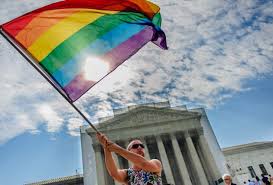
And if Siggie were alive today he’d probably offer a corollary that “Sometimes same sex marriage is just same sex marriage.”
I don’t want to get all controversial about this….but this DOMA decision by the SCt has me worried.
No, not worried so much about the threat to the institution of marriage between a man and a woman caused by same-sex couples wanting to marry. We heteros have already done a fine job of that ourselves and can’t–with a straight face, so to speak–even try to blame same sex couples for piling on.
Frankly, I don’t think same sex couples care a great deal about what we heterosexuals do in our personal lives. It’s not all that interesting, I admit. But I kind of like knowing that gays are analyzing our sex life every chance they get. And lucky them! That allows gay people time to think about other things—like decorating and dressing nice. They sure got us on those two fronts.
I’d even go so far as to say we heteros could probably learn a thing or two about not always talking and thinking about gay sex and gays marrying. Maybe it does scare some of us. But I suspect anybody who talks all the time about how bad gay sex is, is talking about gay sex because, well, he just likes talking about the topic…. and it gives him a sort of cheap thrill he doesn’t get by talking about heterosexual sex.
And that’s fine. I’m not judging them. I’m really not.
Heck, when I was in elementary school I acted that way myself. At recess I’d chase girls pretending they were gross and I didn’t want to have anything to do with them. But even though I swore I was trying to avoid gettin’ the cooties, there I’d go chasing after these very girls who we thought had cooties and trying to touch, pinch or push them anyway I could. And it wasn’t a coincidence that I’d always chase and push the ones I wanted the most to like me back.
It didn’t really work out well for me. And wont for politicians talking about animal marriage this time. But on that playground I did get a little thrill out of it all and suspect these older fellers talking about gay-this and gay-that get some kinky thrill in their own way, too, when they are chasing and pushing around gay people in the political playground. I could be wrong. But I know what it looks like when someone says they don’t want girl cooties and then can’t stop chasing and talking about girls.
Read the rest of… John Y. Brown, III: The DOMA Decision
Want to do something nice for yourself this summer? Love yourself up by adding linen to your wardrobe. Men are relatively limited in their options for staying breezy on blazing hot summer days, but as I’ve mentioned before, linen is a hot weather essential due to its lightweight and breathable qualities. The reason it can keep you comfortable is that the cloth absorbs up to 20% moisture without feeling wet.
You can buy linen either off-the-rack or through a custom clothier (if you’re a R&Co. client, you know how crazy I am for custom). Check out these fabric swatches below for some linen sportcoats I recently ordered for two clients.
Fabrics can made solely of linen as with the shirt below from Hartford, or they can be blended with other fabrics for a more refined look. The fabrics for the sportcoats above are combined with cashmere and silk, which makes them drape beautifully. We’ll pair them with everything from jeans and a henley or v-neck t-shirt to dress pants and a dress shirt and pocket square.
By Jonathan Miller, on Thu Jun 27, 2013 at 4:00 PM ET
Recovering Pol Jason Grill writes about his love for Kansas City Royals baseball in our new book, The Recovering Politician’s Twelve Step Program to Survive Crisis, but only this week did he have the opportunity to step on the field of the Triple-A baseball squad in his hometown.
In the picture at left, Grill receoves the Kansas City Entrepreneurial All-Star awar from Liberty Mayor Lyndell Brenton.
A hearty Mazel Tov to Jason Grill!
UPDATE: We just learned that the Kansas City Royals are a MAJOR LEAGUE TEAM.
As I argued in these pages over a year ago, a full scale retreat from racially influenced academic admissions would likely have the following impact: it would shrink the African American populations of the most elite private colleges without drying up the substantial market that would still remain for the same students: in blunter terms, fewer blacks at Harvard and Stanford, but plenty of slots for blacks who lose the Ivy League lottery available at, say, the University of Virginia and Cal-Berkeley; and a sizable, high quality pool of suitors for any reasonably strong black applicant, at institutions ranging from the University of Florida to Michigan State, from William and Mary to SMU.
Of course, that mostly rosy scenario would have its share of costs. In a society that is always one celebrity’s comments away from having its racial fissures exposed, and where attitudes on culture and politics have become more and not less racially polarized during the last several years, color-blindness seems more a quixotic than a realistic assessment of America circa the Obama era. In a political world where ten of the last twelve presidential nominees have diplomas from Harvard or Yale, and every single Supreme Court justice has the exact same credentials, it is impossible to dismiss our most elite degrees as just another inconsequential perk. Add to that mix the undeniable evidence of a growing gap between the children of highly educated parents and the rest of the social universe, and it is hard to argue that a major retrenchment on race in the admissions process wouldn’t contribute at least marginally to the level of inequality.
All of the above (and perhaps, a plaintiff’s strategy that was overly cautious) explains why even the conservative wing of the Roberts Court ultimately turned squeamish about a sweeping verdict on affirmative action. The Court’s 7-1 ruling in Fisher v. University of Texas returning a challenge to the college’s admission process to a lower court for a more demanding, but not inevitably fatal, review seems right given the still unsettled state of play around race: short term, most universities will keep doing what they are doing, with some gradual, defensible move toward weighting class distinctions more heavily and eventually, a subtle shift toward more blacks with parents who are teachers and cops rather than state legislators or partners in top 100 law firms.
There is a cautionary note, though, for critics on the left who feared that Fisher would be a disaster. For liberals, dodging a loss on race in higher education should spare some time for acknowledging an inconvenient set of truths. Roughly two generations of policies strengthening campus diversity have done nothing to close long term student achievement gaps along racial lines: those policies, in spite of their merits, are still the most top-heavy kind of success. They are measures that at their most robust only impact a cohort of talented individuals who will excel by any legitimate standard whether affirmative action lives or dies. The much needier and (numerically larger) set of minority students remains low income kids locked by geography and poverty into poorly performing K-12 schools—to date, improving their prospects attracts scant attention at best from contemporary liberals whose recent campaigns have focused on more redistributionist outcomes on taxes and healthcare, unfettered sexual autonomy, and tougher environmental rules. And when today’s liberals have waded onto the education front, it has either been in the context of expanded daycare or pre-K programs, which by definition offer first-blush, not often sustainable hits, or in the form of fending off conservative alternatives like vouchers and more testing, without offering any specific platform of their own for un-achieving schools.
To be sure, conservatives can seem out of touch when they profess to see no moral cost in wiping out the consideration of diversity by universities who are trying to make their campuses look something like the society around them. But it is the political left that has advanced an agenda that like it or loathe it, has been exceedingly ambitious on the economic, social, and regulatory front, but notably tepid in the arena of failing classrooms and barely literate eighth graders.
By John Y. Brown III, on Thu Jun 27, 2013 at 12:00 PM ET
Peanut butter and honey sandwiches on toasted grain bread and I have been going strong now for 47 years….and have yet to tire of one another.
There’s not many foods that I can say that about. Except spaghetti and possibly fresh squeezed orange juice (which I was tricked into liking as a boy because one of my father’s friends– George Baker—told me it would grow hair on my chest after I asked him how he got so much hair on his chest (and back) when he took off his shirt at the pool when I was about 8 years old. I thought it looked manly and was something I’d like to have on my chest and back. Finally, after several years of drinking lots of fresh squeezed orange juice and no new hair appearing, I decided he was fibbing to me when I was about 11.) But by then it was too late. I was already hooked on fresh squeezed orange juice and still am.
But peanut butter and honey sandwiches on toasted grain bread are different because I didn’t have to be induced into ingesting them in the hopes of chest hair growth. I just liked the taste of them and still do.
Spaghetti was something I liked naturally, too, without any increased potential for chest hair growth being part of the appeal. But I didn’t like it as much as peanut butter and honey sandwiches. Which makes peanut butter and honey on toasted grain bread a little more special to me, personally.
PS. I finally did get some chest hair in my late teens but only a little. Not sure what food I ate then should get the credit. Probably pepperoni pizza given my age. But I still prefer PB&H and have never missed any chest hairs I didn’t get because I ate a lot of PB&H instead of whatever food (or juice) grows chest hair. It was worth the sacrifice. And my view of the appeal of chest hair has waned over the years. Today when I see a guy take his shirt off today and he has a hairy chest and back I wonder if he wishes he’d a little more PB&H himself.
By Michael Steele, on Thu Jun 27, 2013 at 10:00 AM ET
“The Right of Citizens of the United States to vote shall not be denied or abridged by the United States by any State on account of race, color or previous condition of servitude and that the Congress shall have the power to enforce this article by appropriate legislation.”
At the dawning of the 21st Century, the words of the 15th Amendment to our Nation’s Constitution remind us of one of the most precious gifts of liberty: to freely exercise your right to vote.
And yet, even the 15th Amendment—on its face—did not guarantee that the “right of citizens of the United States” to vote would not be denied as America emerged from the fog of civil war and into the new reality that those individuals once enslaved under the constitution were now entitled to exercise their rights as citizens under that same constitution.
It would not be long, however, before certain of the states, particularly in the south, responded to the demand of the 15th Amendment by devising a variety of tools to disenfranchise African American voters for reasons of “eligibility”. From literacy tests to pole taxes, from property ownership to oral and written examinations, States began to enact laws that ultimately “denied and abridged” African Americans their right to vote.
Moreover, when intimidation at the ballot box failed to curb the thirst for full access to the rights guaranteed by the Framers of the Constitution, more insidious and violent means such as lynchings, fire bombs and murder were used to “remind the Negro of his place” in American society.
In our society, all rights are ultimately protected by the ballot box, not the sword.
By virtue of the efforts to “legally” circumvent the dictates of the 15th Amendment as well as the escalation in violence against African Americans in Philadelphia, Mississippi, Selma and Montgomery Alabama the promise of the Constitution for African Americans and many other minorities—full and equal political rights—was like a munificent bequest from a pauper’s estate until the passage of the single most important piece of civil rights legislation in American history: the Voting Rights Act of 1965.
Both Democrats and Republicans were moved to respond to President Johnson’s voting initiative when he declared in his State of the Union Address “we shall overcome”. With the efforts of individuals like Martin Luther King, Andrew Young, and Congressman John Lewis laying the foundation for what would become an increasingly important political movement, Congress took up an historic challenge to end the “blight of racial discrimination in voting…[which had] infected the electoral process in parts of our county for nearly a century” under the leadership of Senate Minority Leader Everett Dirksen (R-Il).
The Act’s remedial structure is Section 5 which places a federal “pre-clearance” barrier against the adoption of any new voting practice or procedure by covered states and localities whose purpose or effect is to discriminate against minority voters. For over 40 years thereafter, the federal courts, and the Department of Justice worked hand-in-hand to make this promise of Section 5 a very potent reality.
While the Court did not strike down Section 5, it did strike down its operational core—Section 4—which establishes the coverage formula the federal government uses to determine which states and counties are subject to continued federal oversight. Chief Justice John Roberts in writing for the 5-4 majority noted “Our country has changed, and while any racial discrimination in voting is too much, Congress must ensure that the legislation it passes to remedy that problem speaks to current conditions.” Under the majority’s reasoning, “If Congress had started from scratch in 2006,” the last time the Voting Rights Act was reauthorized, “it plainly could not have enacted the present coverage formula.”
For the Court to say that such coverage formulas are outdated is reasonable in the face of enormous improvements in minority voter registration and participation. Roberts illustrates his point by providing the following chart comparing voter registration numbers from 1965 to 2004.
As the Chief Justice stressed “There is no doubt that these improvements are in large part because of the Voting Rights Act,” noting “[t]he Act has proved immensely successful at redressing racial discrimination and integrating the voting process.” Roberts would conclude “Those extraordinary and unprecedented features were reauthorized — as if nothing had changed.” Likewise it is reasonable for the Court to want the Congress to update them.
Read the rest of… Michael Steele: Supreme Court ‘Gut’ the Voting Rights Act
I have written several blogs and articles on the importance of strength training, particularly as it relates to women. I have documented the reasons why women should pick up the weights. However, for some reason, some people don’t get it. Some think they are a genetic marvel that if they look at a 40 lbs. dumbbell that their quads will expand and it will prevent them from wearing pants. Remember this; any man that works out would love for that to be their problem. I wanted to take the time to profess that Strong is the New Skinny
To back up my claim for those non-believers let’s look one strong hormonal difference between men and women:
Testosterone- this hormone has a huge impact on muscle tissue growth (as well as other interactions in the human body). Men, on average, will produce 20 times more testosterone than women. This of course will determine the amount of muscle tissue a person can grow. That also is not to say women cannot build muscle, it just means you cannot build as much or as fast as a normal man.
So I bring this up because I firmly believe that strength training is as important, if not more important, for women than it is for women. Let’s look at those reasons:
Decrease in Body fat- women who strength train will naturally have less body fat than those that don’t. That looks good! Its ok to have a little muscle J
Increase in Bone Mineral Density- Women are more susceptible to osteoporosis than men and strength training helps combat that. The loading of the bones causes the bones to become stronger and increases the density, warding off brittle and weak bones
It is great for your health- Research has shown that women that strength train are in better overall health than those that don’t. So pick up a weight and start going at it!
By John Y. Brown III, on Wed Jun 26, 2013 at 12:00 PM ET
The winning edge?
Some would say it’s preparation . Others would say its knowing your opponent. Still others would tell you it’s who works the hardest. And some would claim its a matter primarily of natural ability
My expertise suggests it’s something. I believe the most significant competitive edge is the love of the game in question.
The individual who has a natural curiosity and enthusiasm for their work, in my view, has the greatest advantage and is a fortunate person. The individual who happily thinks about their work between sandwich bites because they want to and chose to , has an advantage that all the other advantages combined can’t overcome.
And, it seems, the love of one’s work breeds naturally many of the other mentioned advantages that we try to create artificially and distinct from the task at hand


 Blog this!