By Jonathan Miller, on Tue Apr 19, 2011 at 9:15 AM ET
Pardon the interruption for some HUGE RP NEWS:
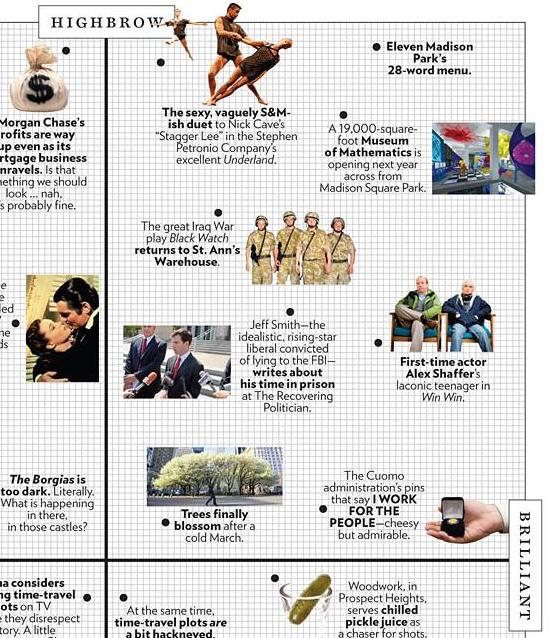
Contributing RP Jeff Smith, his stunning inaugural piece on his journey from politics to prison, and The Recovering Politician Web site, were highlighted this week by New York magazine’s The Approval Matrix, a leading national arbiter of the pop culture zeitgeist. (And now a TV show on Bravo.)
Best yet — Smith’s piece received the top rating: The Approval Matrix deemed it “Highbrow” (vs. “Lowbrow”) and “Brilliant” (vs. “Despicable”).
A pretty incredible development for a contributing recovering politician just beginning his second act and a Web site in only its third week.
Here is the screenshot of the top right corner of the matrix — click on it to read the entire page at the New York web site:
By Jonathan Miller, on Tue Apr 19, 2011 at 8:30 AM ET
By popular demand, today’s guest on RPTV’s Fifteen Minutes of Fame is contributing RP and former Missouri State Senator Jeff Smith. Jeff’s inaugural post for The Recovering Politician has electrified the blogosphere; already more than 10,000 people have read Jeff’s stunningly candid retelling of his post-political experiences in a federal prison.
In this morning’s interview, Jeff addresses many of the questions that our readers have posed since his article’s posting on April 4. If you are new to this site, be sure to read the following articles BEFORE you watch the interview:
By Jonathan Miller, on Mon Apr 18, 2011 at 5:00 PM ET
We lead off tomorrow with the latest segment of RPTV: Fifteen Minutes of Fame.
By popular demand, our guest is The Recovering Politician’s very own contributing RP, Jeff Smith. Jeff will be answering many of the questions you have posed since publication of his well-received post which has drawn attention (and links) from a wide variety of national sites across the blogosphere.
And for you sports fans (or spouses of sports fans who wonder what the fuss is about), I will offer my five favorite basketball books to enjoy on your front porch this weekend as you soak in the beautiful weather.
By Jonathan Miller, on Mon Apr 18, 2011 at 4:15 PM ET
Tonight begins the eight-day long celebration of Passover, one of the most religiously significant Jewish holidays. (Far, far more significant than Chanukah — but we’ll get back to that in December.)
Jews around the world celebrate tonight with a family seder, a dinner in their homes during which they read the story of Moses, the Pharaoh, and the exodus from Egypt.
What would the exodus have looked like if it happened with today’s technology and social media? The following video (h/t to my sister Jennifer for finding it) tries to answer that question. Enjoy and Chag Sameach (Happy Holiday!):
I am writing this while spending spring break with my family driving through North Carolina and Virginia visiting colleges with my sixteenyear-old daughter, Catherine. As we were driving from Lexington,Kentucky, to Charlotte, North Carolina, to begin our college search at Davidson, we began to discuss previous family spring break trips – Hilton Head, California, and skiing in Utah. I then asked my family what trip was before Utah and my family responded that I was still in politics before Utah and then reminded me that we seldom, if ever, went on spring break trips while I was a part of the political world.
That response is a perfect example of how my family discusses our family experiences: during politics and after politics. My children favor the after-politics period. A few months after my forced exit from public life, my son and I were heading home from the golf course and my son out-of-the-blue told me to not take it the wrong way, but he was glad I had lost my Supreme Court race. Although I wish that I had won the election, I, like my family, have loved my life after politics. I am probably still a recovering politician, but I think I may be in the final steps of recovery. In fact, I have traveled full circle.
I have known the founder of Recovering Politician since high school. When Jonathan Miller returned to Kentucky in the 1990s to run for State Treasurer, we had lunch together. I still remember our conversation. I had lost faith in the political system and I believed that it was generally a waste of time. I wrote Jonathan a small contribution and got my law partners to also write small contributions in support of Jonathan’s campaign. Jonathan had only Democratic opposition and this fact made it very easy to support my friend.
A few years later, I had become disenchanted with my law practice and in early 2000 I agreed to run Scott Crosbie’s 2002 Lexington, Kentucky, mayoral campaign. Although I had grown up around politics, I had never worked in a campaign full-time. Scott and I discussed that I may need to find some sort of campaign school or seminar to attend. It turned out that there was no need to find training because in April 2000, then-Congressman Ernie Fletcher asked me to run his 2000congressional campaign. Former Congressman Scotty Baesler had decided to try to take his seat back and I was thrust into one of the top-five targeted races by the Democratic Congressional Campaign Committee and the AFL-CIO. I was convinced that the Lord had opened this door to provide me the skills necessary toget Scott Crosbie elected Mayor in 2002. Congressman Fletcher went on to crush Baesler in the fall of 2000. I then returned to the law firm for a brief period and began to get ready for the Lexington mayoral campaign.
The 2002 mayoral election began in 2001 and for over eighteen months Scott and I experienced the highest highs and the lowest lows. We suffered at the hands of abiasednewspaper, with its seeminglydaily negative coverage of our campaign. We survived a three-way primary and then ultimately lost the general election by 1300 votes. The loss was one of the most difficult periods of my life. I was convinced that the Lord had brought Scott and me together to help change Lexington and I was extremely disappointed. After election night I had no idea what was next. I spent the next three weeks watching Season 1 episodes of “24” and watching multiple seasons of the Sopranos at all hours of the night.
By late 2002 Congressman Fletcher was running for Governor of Kentucky and I did not believe that I could participate in another campaign. I was extremely tired, and I spent much too much time away from my family. Instead, I became the district director of his congressional office. After Ernie’s victory in the fall of 2003, Governor Fletcher asked me to be General Counsel to the Governor. I was thrilled. I had grown up in the Democratic bastion of Frankfort, Kentucky, and was excited to be a part of changing the culture of Frankfort and our state. Ernie Fletcher is the most impressive and genuine person I ever had the privilege to meet in politics. He was smart and driven to make Kentucky more economically competitive. It was an honor to be his lawyer and the head lawyer for his administration.
The first year of the administration required a tremendous commitment of time. My family still reminds me of the 7 1/2 hour conference call while we were on vacation at Martha’s Vineyard in June of 2004. Our administration not only had to deal with the normal challenges of a first-year administration but also had to plan and defend running the government without a legislatively enacted budget. Ultimately, after my work schedule caused me to cancel a one-day family trip, I decided in early 2005 that I was ready to leave public service behind. I told Governor Fletcher that I would stay until the end of 2005.
A few months after that decision, Justice James Keller announced his retirement from the Kentucky Supreme Court. I gave the vacancy an initial passing thought but did not give it serious thought. However, that would soon change. Before oral argument at the Kentucky Supreme Court concerning the power of the Governor to run the executive branch without a budget, one of my law classmates who was representing State Treasurer Jonathan Miller in the litigation came up to me and said that I should pursue the appointment. He was a Democrat and indicated he would publicly support me. After prayer and discussions with my wife, I decided to inform Governor Fletcher of my interest. Governor Fletcher asked what had changed my mind about leaving public service. I responded that the Supreme Court position was a dream position and I decided it would be worth the sacrifices of public service.
Ultimately, I was appointed to the Kentucky Supreme Court. I loved my job. I loved the research and the writing and I believed that everything that had happened in my professional life had prepared me for the position. However, the dream would end in over seventeen months when I was defeated in an election to keep my position. What was most surprising about the defeat was that I did not enter into the same post-election mood that I suffered through when I was Scott Crosbie’s campaign manager. In fact, I got up the day after the election and I went to my chambers and worked on judicial opinions.
What was the difference between 2002 and 2006? Although I have miles to go, I believe that my faith had matured. By 2006, I understood that if God is sovereign on the day you were appointed to the Supreme Court he is also sovereign on the day you lost.
I returned to my old law firm in late 2006 and I am still with Ransdell & Roach PLLC. For the first time since I became a lawyer, I truly enjoy private practice. Since my forced early retirement from politics I have had little to do with politics and feel much like I did at my lunch meeting with Jonathan Miller in 1999. However, I must confess I stayed up most of the night during the election night coverage in November, 2010. I guess you are never fully recovered.
Thanks to all of our new readers — and especially our daily return viewers — for helping make this second week such an unexpected success.
Since we’ve got the “Big Mo” on our side, we’ve planned another exciting week ahead for you.
As per our long-standing (two-week) tradition, we will have three new recovering politicians to introduce to you. Wednesday’s will be a household name, at least in political circles: a former Governor and Senator whose name has twice shown up on short lists to be nominated as Vice President of his party. Friday will feature a party’s recent nominee for statewide office, who is also a bestselling author and one of the smartest policy minds of his generation.
And Monday, we feature a former state Supreme Court Justice who has been a longtime friend of the RP’s since they attended rival high schools in the 80s. That being said, he and the RP disagree on pretty much every major controversial policy issue of the day. The fact that they still have remained friends speaks volumes about our common humanity and the potential for civil discourse. We think you will enjoy hearing about his political and personal journey on Monday.
By popular demand, on Tuesday, RPTV will offer Fifteen Minutes of Fame with our own Contributing RP, Jeff Smith, who will help fill some of the blanks left by his powerful introductory piece, as well as answer some of the questions our readers have posed.
Of course, we will have a Friday Video Flashback, a new Friend of RP to introduce, and plenty of Weekly Web Gems to help you skim the best of the civil discourse that’s flowing through the Internet tubes.
We hope you have a relaxing weekend. Get ready for some more fun and fascination on Monday.
By Jonathan Miller, on Fri Apr 15, 2011 at 2:15 PM ET
In early 1995, one of my best friends, David Hale (now U.S. Attorney for the Western District of Kentucky) called me to see if I would help the campaign for Secretary of State of his law school classmate, John Y. Brown, III. I was certainly aware of Brown’s dad, the former chicken magnate and Governor, but my parents had opposed Brown Jr.’s last campaign, opting instead to support some guy named Steve Beshear.
Still, I was bored working as an associate for a big Washington law firm; David made a compelling case; and John, upon meeting, seemed like a nice, well-meaning, intelligent guy.
Somehow, as the only one in the room with a modicum of campaign experience, I was enlisted, pro bono, as the campaign’s media consultant. I wrote and directed a series of ads that, while extraordinarily amateurish, apparently didn’t hurt Brown too bad — he won both the primary and general elections by wide margins.
Most importantly, watch for the international television debut of my future running mate, John Y. Brown, IV, whose newfound mobility skills inspired the ad, and whose telegenic appearance cannot be underestimated for its vote-accruing effect:
We wrap up another very successful week (Our readership more than tripled since the week before) by introducing our sixth contributing recovering politician. He was a very successful Congressman who made a long-shot bid for the U.S. Senate against a popular incumbent, and fell a little short. Now in private life, he’s…blissful.
Read his story at 8:30 AM.
We also will feature another hilarious Friday Video Flashback, this time featuring our funniest contributing RP.
By Jonathan Miller, on Thu Apr 14, 2011 at 12:30 PM ET
The one thing that I miss least about leaving the political arena is the lying.
If there’s one quality that unites Democrats and Republicans, politicians and the press corps; it is their mutual propensity for, and expectation of, fabrication.
Often, it’s the small lies that wise and wary observers can sniff out before they do harm: Sure I’ll raise $10,000 for your campaign. You can count on me to support your cause in the legislature. My, you look way too young to be a grandmother! Don’t worry, I’ve had a vasectomy.
Most common is “political spin” which, all too regularly, is simply a euphemism for lying: Barack Obama is a Socialist. The Republicans want to hurt poor people.
Every now and then, you encounter stone-cold, pathological liars in the business. They’re rarer than the profession’s reputation, but I’ve run into too many elected officials, reporters, and political operatives whose every utterance I’ve learned to disbelieve or suffer the consequences. And I despise it.
But should we put all of these liars into jail? Of course not.
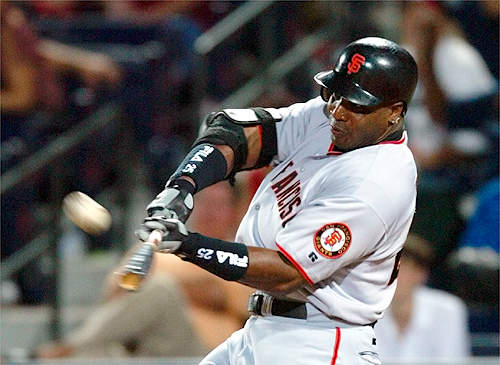
Yesterday, Barry Bonds was convicted for obstructing justice by lying to a grand jury about his personal steroid use. (Which begs the question — asked by Dashiell Bennett — how could Bonds be guilty of obstructing justice for lying when the perjury charges against him were rejected by the same jury?)
Note that Bonds was not convicted of — or even charged with — illegal use of steroids. His entire prosecution was based on his lying about his use, in an ultimately unsuccessful effort to protect his professional reputation.
Bonds is not the cleanest case because steroid use is illegal, and Bonds is such an unlikeable narcissist.
The most famous example of this controversy is even more polarizing. Like Bonds, President Bill Clinton lied to the American people and gave controversial answers to a grand jury in order to protect his public reputation. But here, the underlying misbehavior was not illegal. As Republicans like Newt Gingrich have been quick to assert, the 1998 impeachment was not about the sexual affair — which is not a crime in the District of Columbia — but rather about the President’s lying about it before a grand jury. While Clinton’s verbal parsing may have technically immunized himself against a perjury conviction, it is clear that he was impeached by the House for lying about underlying behavior that wasn’t a crime.
As a former member of the Clinton Administration, I’m biased; but I am comfortable saying that, without any partisan considerations, lying about a perfectly legal action should not be the basis of removal from office. And so did most Americans.
Let’s take an even cleaner case: that of contributing RP Jeff Smith. (Again, I admit bias: Jeff is my friend.) If you’ve read his stunningly candid story on this Web site, you know that Jeff was convicted of lying to federal investigators about whether he had knowledge of a scheme to distribute negative fliers about his campaign opponent. The underlying behavior may have violated campaign finance rules, but surely did not merit a jail sentence. And I argue, neither should his lying about it.
Did Jeff deserve to be punished? Absolutely. Stripped of his public office? Perhaps. But sentenced to serve a one-year term in a jail filled with violent offenders? I believe the punishment overwhelmingly exceeded the crime.
Of course, I am not arguing in any way that perjury and/or obstruction of justice should be considered misdemeanors or civil violations in every instance. Of course, lying to an authority about illegal activity, particularly of a violent nature, must be punished severely.
Nor am I arguing that there should be no punishment whatsoever in these circumstances. Lying to an authority is wrong; and the offender must be held accountable for his or her actions.
But someone who lies about a non-violent, non-criminal activity, in order to protect his reputation and family — a very natural, human instinct — should not be treated akin to a violent criminal.
I will soon be interviewing Jeff for RPTV to discuss this issue. But I’d like to know your opinion first: Does lying to a grand jury or an investigator about a legal activity merit a jail sentence? What are your suggestions for reform? Or do you like system the way it is?
By Jonathan Miller, on Wed Apr 13, 2011 at 5:00 PM ET
Thursday means a new Friend of RP, and this one turns out to be the RP’s closest friend. In fact she’s been married to the RP for more than 21 years. Tune in for all the juicy scoop. Or maybe some profound lessons from a recovering political wife.
We’ll also, of course, have some Weekly Web Gems, and some other great surprises.