By Saul Kaplan, on Mon Mar 3, 2014 at 8:30 AM ET “Education is not the filling of a bucket, but the lighting of a fire” W.B. Yeats
Excuse the rant but I am outraged by the state of the U.S. education system. We have let the pilot light go out and we are failing our youth. Particularly egregious is the way we are failing our urban youth.
We must refocus our national and regional innovation conversation on how to solve real world problems. Job number one is to design a better education system that lights a fire for every youth, creating lifelong passionate learners. It is time to move beyond public policy debates and institutional rugby scrums to try new solutions. What we are doing now isn’t working, and far too much of the federal stimulus investment in education is being spent to sustain the current system.
A report last year from the nonprofit network America’s Promise Alliance showed that 1.2 million students drop out of high school each year. Only about half of the students served by school systems in the nation’s 50 largest cities graduate from high school. The U.S. public education system, especially in the country’s urban centers, must be transformed.
Only about 40 percent of the U.S. adult population earns a college degree. That may have been fine in the 20th century when an industrial economy supplied good jobs to those without post-secondary education. It is not fine today when a college degree is a necessity for a good job.
Our education system was built for the 20th century.
 Everyone loves to point fingers at other players in the system as the cause of the problem. Observing our education system today is like watching an intense rugby scrum that is moving in slow motion hoping the ball will pop out. We have finger pointing and incessant public policy debates galore. We love to admire the problems: It’s the unions that are getting in the way. Teachers are resisting change in the classroom. Administrators don’t understand what is going on in the classroom. Parents are not engaged. Public policy makers can’t make up their minds. If only private sector companies were more engaged. Students are unruly, undisciplined and disrespectful. Everyone gets blamed and nothing changes. Everyone loves to point fingers at other players in the system as the cause of the problem. Observing our education system today is like watching an intense rugby scrum that is moving in slow motion hoping the ball will pop out. We have finger pointing and incessant public policy debates galore. We love to admire the problems: It’s the unions that are getting in the way. Teachers are resisting change in the classroom. Administrators don’t understand what is going on in the classroom. Parents are not engaged. Public policy makers can’t make up their minds. If only private sector companies were more engaged. Students are unruly, undisciplined and disrespectful. Everyone gets blamed and nothing changes.
The simple idea of “lighting a fire” expressed in Yeat’s quote says it all for me. Teaching is an important means to an end. Creating passionate lifelong learners is the objective of education. Content, subjects, jobs and requirements, will all change over time. The pace of change is accelerating and the half-life for assumptions and usable knowledge is decreasing. It has become a lifelong challenge to stay relevant. The only thing that is sustainable is a fire inside to keep learning.
The objective of education is to light a fire for learning in every single youth. When the pilot light is on, everything else is possible. For starters, let’s recognize that individuals have different learning styles. One-size industrial education models are not working and must be transformed. We have the enabling technology available today to create and scale an education system that provides access to killer content and experiential learning opportunities tailored to individual learning styles for every student. It is time to demonstrate that we can and will change our education system. Our country’s youth is waiting.
We need actionable platforms to enable real world experimentation for new education systems and solutions. We need to bring the voice of the student and student experience directly into the education innovation conversation. And we must create a purposeful network of innovators motivated to explore and test new system solutions. Join the conversation. The water is fine.
Let’s reignite the pilot light and demonstrate that there is a better way to light a fire for life long learning in every youth.
By Julie Rath, on Fri Feb 28, 2014 at 8:30 AM ET 
A lot of guys have a “uniform” – something they wear throughout the year, no matter what the weather is. I know one guy (not a Rath & Co. client) who wears the same logo’d windbreaker everyday to work over his dress shirt and keeps it on all day. On really cold days, he wears another jacket over it. Oh, and did I mention he even wore it to a holiday party I attended at his home — with shorts and flip-flops? He’s evidently missing the chip that handles distinctions for situational dressing.
To say the least, the “uniform” of the guy described above has room for improvement. However, in some cases, having a set look serves a positive purpose and is even desirable, but only if it’s well thought-out and well-executed. I get requests for this quite often from prospective clients – they want their own personal, iconic look, à la Steve Jobs. I get the appeal of this. First of all, it streamlines their getting-dressed routine. Also significant is that it can help cement one’s identity and give a solid sense of self both internally and outwardly with others. My only caveat here is that this needs to done in a way where a) it’s not boring (perhaps there are slight variations within what you wear each day – black v-neck sweater vs. black turtleneck sweater), and b) even though you’re sticking with the same theme each day, it shouldn’t look sloppy or as though you don’t care about your appearance (think Mark Zuckerberg’s hoody).
 Matthew McConaughey in his signature fitted Dolce & Gabbana suit (he appears in their fragrance ads). Matthew McConaughey in his signature fitted Dolce & Gabbana suit (he appears in their fragrance ads).
How to develop that look? Well, that’s easier said than done and, I’ll be honest, you may need help from a professional. But I’ve outlined four steps below on how to move toward creating your own.
1) Make a list of words that describe the look you’re going for and how you want to be received by others. Then narrow that list down to three or four. If you’re not a wordsmith, spend quality time on Google looking at images of other guys who embody what you’re going for. Then describe that look verbally. You may also want to consult the thesaurus for ideas once you come up with an initial word or two.
2) If you haven’t already found visual examples of others who give off the same vibe you’re looking for, do that now. Then ask yourself, what are the identifying characteristics in those outfits that create that sensibility? It may only be parts of different looks (the shirt fabric, or the way patterns are combined, as two examples) that resonate with you. Make a list of those items. This is the source list that you’ll be pulling from when you test things out.
3) Using the list above, test each of these things out one at a time. If your financial resources are limited, you can do this in a dressing room without purchasing items. Ask friends whose opinions you trust and who you know will be honest whether the look works for you or not. (Generally, this is not going to be a store salesperson.) Doing this will allow you to narrow down your source list to your final choice(s). A word of caution: if the elements you’re trying out make a really bold statement, like brightly colored bracelets or socks with a standout pattern, limit yourself to a max of 3-4 items along these lines per outfit.
4) Whatever you go with, have CONVICTION about it. This is important because if you don’t feel confident about your appearance, most likely others won’t either. And remember, everyone looks at himself more critically than other people do (honing in on specific perceived flaws like a thick midsection or short legs – which others might not notice as acutely as you do), so try to take a more macro approach as I mentioned in this article on defining your personal style.
I know this can sound like a big undertaking, but if you follow these steps above and get advice from a professional or people you trust, you can absolutely achieve it. If defining your style is something you’re working on, let me know how it goes for you. I’d love to hear about your hits and your misses.
By Josh Bowen, on Thu Feb 27, 2014 at 8:30 AM ET
“Too often we underestimate the power of a touch, a smile, a kind word, a listening ear, an honest compliment, or the smallest act of caring, all of which have the potential to turn a life around.”
Leo Bascaglia
It is said that 80 percent of communication is non-verbal. It is also common knowledge that there is a psychological effect to touching. In fact there are several scientific research articles stating that when a person is touched by a person they trust, it elevates oxytocin levels and decreases the stress related hormones. Touching has also been shown to develop relationships between two people.
It is the first language we learn,” said Dacher Keltner, a professor of psychology at the University of California, Berkeley, and the author of “Born to Be Good: The Science of a Meaningful Life” (Norton, 2009), and remains, he said, “our richest means of emotional expression” throughout life. One form of touching that is always acceptable and has the power to show appreciation, respect, care and develop the trainer/client relationship we are all after; the high five.

The high five, the same form of non-verbal communication professional athletes exude. The same expression we learn through pee-wee football and little league baseball to show praise for a good job. The high five is the ultimate trainer’s tool for relationship development and appreciation for a client.
Right, wrong or indifferent I touch my clients. I give them high fives to show they have done a good job; I give them a hug when I feel they need it and I tap them gently on the muscle being worked. The power of the high five allows me to do the following:
Develop a great relationship
When I give a high five to a client I show them respect and gratitude for the work they are doing. Sometimes that message is difficult to convey through words. For my super competitive clients this takes them back to athlete days and puts them in an environment they are use too. For everyone it shows appreciation for their work, something sometimes their out-of-the-gym life doesn’t supply. After a great set of bicep curls, supply a simple high hive to show you are paying attention.
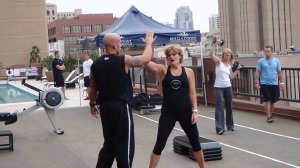
Conveys to potential clients my relationship with my clients
In a gym setting, during a 60 minute session on average 14 people will watch at least 20% of the session. This is marketing at its highest! I want to produce the vibe that I care about my clients, especially for potential clients watching me. Post workout, end the session with a powerful high hive, someone on the treadmill above will notice.
Fun
The word fun is often not associated with exercise. People view working out as a chore or that it hurts. Add a few high fives and a smile and now it becomes a little more tolerable. Honestly, after a few sessions, people realize how fun this really can be! Not everyone is an athlete or will think exercise is fun, provide a high five during the session changes the feelings towards exercise.
Help carry the load
Performing a high five to a client, physiologically, signifies I am offering to “carry” their load. “We think that humans build relationships precisely for this reason, to distribute problem solving across brains,” said James A. Coan, a psychologist at the University of Virginia. “We are wired to literally share the processing load, and this is the signal we’re getting when we receive support through touch.” Before a session, especially for my clients who come after work, provide that high five to show you understand their day and you are here to help “carry their load.”
The power of the high five is over reaching. It takes little effort but supplies dramatic reward. Personal training is all about relationships and how those relationships develop, no better way than to communicate through providing your client a simple high five.
Josh “JB” Bowen is an industry veteran, holding many positions within the industry and is currently a personal trainer in Lexington, KY and Quality Control Director for Compel Fitness. He was a global 2013 top ten finalist in Life Fitness’ Personal Trainer to Watch, and author of the 12 Steps to Fitness Freedom. You can find him on Facebook and Twitter.
By Lauren Mayer, on Wed Feb 26, 2014 at 8:30 AM ET If you’re as old as I am, or a devotee of topical comedy songs, you might be familiar with Tom Lehrer’s song, “Pollution,” in which tourists were advised, when visiting the US, “don’t drink the water and don’t breathe the air.” Which was making fun of the traditional advice to American tourists visiting other countries, advice which is still given regarding many destinations. (And rightly so in some cases – apparently journalists covering the Winter Olympics in Sochi received notes in their hotel rooms warning them not to drink the tap water or put it on their faces because it ‘contained something bad’ and was a dark yellow color. Some news anchors compared it to the color of beer, although as Jon Stewart pointed it, it looked more like ‘the result of beer.’ But I digress . . . )
No matter what we experience overseas, we expect safe water here in the US, so when it turns into gray sludge (like in North Carolina’s recent coal-ash spill) or smells like licorice (West Virginia’s chemical spill), it attracts quite a bit of attention. We are used to trusting our senses – if it looks or smells funny, we aren’t reassured by public health officials saying the water is fine (just not for pregnant women). Apparently regulations in those areas were so lax, no one had any idea that the pipes or storage tanks were going to fail. Sure, we can have a civilized debate over the best ways to regulate toxic chemical storage – but when several counties in two different states have either gray sludge or licorice water coming out of their faucets, we know something is definitely wrong! So I guess it’s time for a new song about tainted water . . .
By Erica and Matt Chua, on Tue Feb 25, 2014 at 8:30 AM ET Oman is a country that wasn’t our radar before we booked a flight to the UAE. Then our friends told us we had to visit Oman while in the area…how right they were! It was a highlight of our time in the region. We were intrigued by the mystery of a country covered in sand with reportedly gorgeous beaches, incredible hiking and a goat market that has to be seen to be believed. Oman delivered on all counts! Better yet, it was easy to get to from the UAE.
……………………………………
DON’T MISS: The Friday goat market in Nizwa.
MUST SEE: Nizwa’s old souk, Wadi Shab and Muscat.
MUST TASTE: Hummus and meat…think about it…it’s as decadent and delicious as it sounds!
……………………………………
TRIP PLANNING: Plan on at least a week to enjoy this beautiful country.
GETTING AROUND: Rent a car, there’s no way around it as there is no public transportation, however make sure you have the correct insurance if you are renting a car from the UAE.
……………………………………
OUR COST PER DAY (2 ppl): $123.22. Half of which was the car rental from Dubai to Abu Dhabi.
COST OF A BEER: Let us know if you get your hands on some in this beer desert (literally and figuratively).
KEY MONEY-SAVING TIP: Fill up your car in Oman as the gas is so cheap!
……………………………………
YOU NEED TO KNOW: It is hot and dry, even if you are in an air-conditioned car you’ll want a stash of water.
IF WE KNEW WHAT WE KNOW NOW: We would have budgeted many more days to explore Oman and do some hiking.
HELPFUL LINKS TO LEARN MORE: Wikitravel, Nizwa goat market information.
Read the rest of…
Erica & Matt Chua: Oman
By Saul Kaplan, on Mon Feb 24, 2014 at 8:30 AM ET In the coming months, our government is going to throw a lot of money at some very big problems. The amount is staggering—a $787 billion stimulus packagecombined with a proposed $3.6 trillion federal budget. That kind of market-making money should be able to drive the bold changes we need in health care andeducation.
I fear it will not.
It would be a shame if the nation’s palpable hunger for fresh ideas and approaches resulted only in incremental change. The problem I see is that most of the money is about to travel through existing pipes to sustain the way the health-care and education industries currently operate. This path simply maintains the status quo.
If we want bold change, we have to allocate more of the federal investment to the design and testing of new approaches that are not constrained by existing ones.
 Education and Workforce Development Education and Workforce Development
A report last year from the nonprofit network America’s Promise Alliance showed that 1.2 million students drop out of high school each year. Only about half of the students served by school systems in the nation’s 50 largest cities graduate from high school. The U.S. public education system, especially in the country’s urban centers, must be transformed.
Only about 40% of the U.S. adult population earns a college degree. That may have been fine in the 20th century when an industrial economy supplied good jobs to those without post-secondary education. It is not fine today when a college degree is a necessity for a good job.
Our education and workforce development system was built for the 20th century. Stimulus money spent solely to support the current system will not result in a population of life-long learners prepared for the new economy.
An example of how to channel resources toward bold change is the Labor Dept.’s WIRED (Workforce Innovation in Regional Economic Development) program. Launched in 2005 to catalyze the creation of a new 21st century workforce development system, WIRED has made three rounds of grants to 39 regions. Each grant recipient gets $5 million per year over a three-year period. The funds must be used to integrate a region’s economic and workforce development activities. WIRED funds are targeted to accelerate state agency coordination and system change in order to demonstrate that talent development can drive economic transformation in regions across the country.
WIRED is the right idea, but it doesn’t go far enough. There is not enough money allocated to it, and it is not bold enough in holding regions accountable for experimenting with truly transformative workforce development approaches.
Health Care
The first baby boomer turns 65 in 2011. By 2030 there will be 71.5 million Americans over the age of 65, vs. 36 million today. Our health-care system struggles to deliver quality care today at an affordable price. Imagine the implications of the coming silver tsunami, when 10 million to 12 million elders will need long-term care—and an estimated 5 million will need nursing-home care.
The current federal prescription calls for a big investment in electronic health records and making insurance options available to all. Ensuring access and increasing efficiency in today’s system is necessary but not sufficient.
We need bolder solutions to deal with the impending crisis. We need to transform from a sick-care system to a well-care system, with the patient at the center. Patients must become more responsible for their personal wellness and sick-care choices. Too much of the stimulus money is allocated to institutionally driven electronic health records, which will only increase the efficiency of today’s health-care system. A meaningful share (20%) of the funds should go toward electronic records controlled by the patient and to experimenting with patient-centered health-care approaches.
Unconstrained Experimentation
Every federal agency must be held accountable for channeling resources toward transformative and systemic change in its respective area. That should be the focus of Aneesh Chopra, America’s new chief technology officer, or Sonal Shah, head of the new Office of Social Innovation & Civic Participation. They should be armed with resources moved from agency budgets and tasked with driving bold change to build a national innovation agenda. While we balance the management of today’s systems, it’s imperative that we also experiment with new configurations that are not constrained by existing ones. It’s not easy, but all of the public and private sector levers and capabilities should be up for analysis—and reform—in order to enable these experiments.
I used to think you could catalyze innovation by proselytizing. You can’t. It is more important to network today’s innovators from every imaginable silo, sector, and discipline in purposeful ways. It is the innovator’s day. This is the time to experiment with bold new solutions. We must invest in the capacity to explore and test systems-level innovation. Our future depends on it.
By Julie Rath, on Fri Feb 21, 2014 at 8:30 AM ET How did 2013 go for you style-wise? Were you totally on point, or was there room for improvement? I’ve been traveling over the past month visiting out of town clients and doing some serious people-watching while on the road. I was sitting in LaGuardia Airport at 6AM one day, and I started a list of don’ts, which grew at each of my stops (Minneapolis, Chicago, North Dakota, and Palm Springs), evolving into the New Year’s Bad Style Cleanse below. Read on for 14 habits to purge from your style diet.
1) Don’t wear a crewneck undershirt with your button-up shirt. Showing your undershirt collar is like showing your underwear, something you don’t want to do in public (I hope). This goes for both casual and dress button-ups. I like Tommy John for great undershirts with v-necks that are low enough not to be visible. Here is my review of the brand.

2) Even if you’re traveling, you shouldn’t wear loafers with a suit. Try monk straps instead, as they can slip on and off easily when going through security (tip: packing a travel-size shoe horn will make your life easier).
3) You can leave the top button of your dress shirt undone with a tie, but don’t have the tie hanging down below your collarbone. Your tie knot should be no more than an inch lower than the top of where your shirt collar closes.

4) Never wear a backpack with a suit or sportcoat. It’s terrible for the shoulders. Also, you are going to work, not for a trail run.
5) Don’t wear a striped jacket as though it’s a sportcoat. A striped jacket is only worn as part of a suit, never as a separate.
6) Don’t wear a Hawaiian shirt unless you are going to an actual luau.

7) Avoid those hybrid sneakers-shoes at all costs. It’s a sneaker or a shoe. Not both.
8) While you’re at it, say no to those hiking-type sneakers for anything other than an actual mountain trek.
9) Skip the strong colognes or aftershaves (Old Spice, I’m talking to you) if you know you’re going to be on an airplane. This is a courtesy to those around you!
10) Grab the waistband of your pants (yes, right now) and yank on it. If you can pull it away from your body more than half an inch, your pants are too big. Go down in size until you find the right fit.

11) Avoid pocket square and tie combos that match too closely (and especially ones that come in sets!).
12) A t-shirt is too tight if it pulls such that the fabric creates a diagonal crease from your collarbone to your armpit. Go up a size if this happens to you.
13) Don’t be that guy who wears a parka with ski tags dangling from the zips out to a restaurant. Technical/athletic gear is meant for just that – not date night. This includes outerwear and accessories like hats and gloves. One of my favorite brands of outerwear that gets the job done sharply is Aether.
 a lobster bib in the truest sense of the term a lobster bib in the truest sense of the term
14) Don’t wear ties that are too wide for you. This is true even if you paid a lot for it/wide ties may come back in style someday/your Aunt Edna gave it to you. Either donate or send them to somewhere like Tiecrafters to have it narrowed. Here’s my guide on how to choose the best proportion for you.
Now that you’ve effectively cleansed yourself of bad style habits, check out this list of 8 style resolutions to embrace for the new year. Out with the old and in with the new! What are you adding and removing from your style repertoire this year?
By Josh Bowen, on Thu Feb 20, 2014 at 8:30 AM ET When starting or continuing a fitness program, it is vital to know the “insider information” from the pros. The following is a satire, a joke and a ruse designed to make you laugh and or cry while evaluating your fitness knowledge. Be mindful that some of us believe in these principles. Proceed with caution.
1. The proper amount of protein intake each day
 All of them…duh. All of them…duh.
2. Monday is International Chest-Day

Nothing is scheduled…nothing.
3. Posting your workout on Facebook.

You didn’t know? It scientifically proven.
4. Leg days are not to be skipped.

Its a must. And…
5. If you do squat, you must squat low

Not like this…
Commentary is worth it.
More like this…
6. Toning and muscle are the same thing.
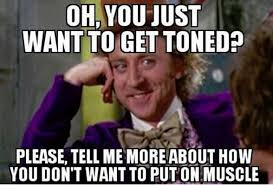
7. This is what happens when you take too much pre-workout

Great hair.
8. Priorities, Priorities, Priorities
Get your behind to the gym!
9. You can’t out train a bad diet

10. This is not good gym behavior
By Lauren Mayer, on Wed Feb 19, 2014 at 8:30 AM ET When Shirley Temple Black passed away last week, it reminded us how important entertainment had been to American during the Depression. It’s easy to mock statements about that impact – “Gosh, I have no job, no food, and I’m about to get evicted from my tenement, but I don’t care as long as I can watch a curly-haired moppet sing & dance!” – but good songwriting does have the power to connect with our emotions. (Which are not always positive – after my boyfriend dumped me on my 22nd birthday, I wrote a country revenge ballad titled “You Broke My Heart, So Now I Want To Break Your Legs” . . . but I digress.)
There does seem to be a correlation between economic woes and music. The Depression was the heyday of big silly musicals, but it also led to classic songs like “Brother Can You Spare A Dime,” and even the dippy cheerfulness of “We’re In The Money” starts with an incredibly ironic celebration of finding – gasp – a quarter! During the uproar of the 60s, the folk revival turned to protest songs (as embodied by Pete Seeger, another recent loss to the music world). That was also the birth of tongue-in-cheek comedy, including The Smothers Brothers. (If you haven’t heard their rendition of “John Henry” or “Streets of Laredo,” you’re in for a treat!, thanks to youTube.)
So with partisanship and income inequality at all-time highs today, you’d think we’d see yet another form of hard-times-inspired entertainment. Of course, trends are hard to see from within, so it will be a few years before we know whether this era is defined by bubbly escapism (“Gangnam Style,” anyone?), innocuous boy bands like One Direction, or a series of revenge songs penned by Taylor Swift about her various celebrity breakups. However, in the meantime I’ll offer my own contribution to protest songs, 2014-style . . . “The $10.10 Blues.”
By Erica and Matt Chua, on Tue Feb 18, 2014 at 8:30 AM ET Tibet is the highest region on earth, with an average elevation of 4,900 meters (16,000 ft) and one of the most fascinating places we have visited on our trip. The incredible spirituality and devotion of the Tibetan Buddhists just add to the intrigue of this region. Nestled among the Himalayas the location is stunning and a place you have to see to believe.
……………………………………
DON’T MISS: Potala Palace, one of the most spectacular palaces on earth.
MUST SEE: Mt. Everest, Lhasa, Gyantse and Shigatse
MUST TASTE: Yak butter tea, though you may not like the taste. It’s a staple of the Tibetan diet, but is definitely an acquired taste.
……………………………………
TRIP PLANNING: Traveling to Tibet is strictly controlled, foreign visitors must arrange a tour through a licensed company. Read this to learn how to visit Tibet.
GETTING AROUND: We recommend using a full service tour agency for visiting the key sights in Lhasa and getting from city to city, this will save a lot of headache and time lost setting up guides, drivers and permits.
Read the rest of…
Erica & Matt Chua: Tibet
|
|