By John Y. Brown III, on Wed Jan 23, 2013 at 12:00 PM ET Remember, the the “art of negotiation” is really the “art of problem solving.”
To get what you want in negotiating, however, you have to first be able to give the other side what they want, too.
Negotiation isn’t about who can yell loudest what they want until the other side capitulates. It’s a process of understanding until the wisest —and often most creative—resolution of the problem is discovered and properly disclosed and proffered. And you can’t do that unless you know fully what the other side “really” wants–both what they say they want and what they actually want (the two aren’t always the same….not because the other side is concealing something but because they may not have fully thought through the process themselves and can answer clearly and candidly.)
A great example I’ll never forget from my MBA program went something like this. Two companies in different industries were negotiating for a rare orange available in scarce supply from South America. They went to war in negotiations for the orange, escalating the price and trying to undermine the others need and use for the orange. Each needed more than “half” the supply and were willing to pay premium pricing for it. The two sides exhausted the different ways of dividing up ownership of the oranges between the two but none were satisfactory. And then, at the end of this disastrous and destructive and costly negotiation, it is discovered that Company A needs only the rind of the orange and Company B the pulp. But neither side took the time to find that out about the other before it was too late and both companies paid exorbitant prices and didn’t get what they wanted.
Why?
 Ignorance of the situation. Ignorance of the situation.
Or more pointedly, self-absorption and an unwilling to try to “solve a problem” rather than merely “getting mine.”
This is a great life lesson and business lesson to understand what each side is really needing and seeking. Knowledge is power. And smart. And ignorance is so very costly and wasteful. And ultimately humiliating and does a disservice to all involved. It’s never enough to know only what you want. The key, ironically, to the most successful negotiators (problem solvers) is that they also know what the other side wants –and how to deliver it to them.
If you enter a negotiation without a strong sense of that understanding, you aren’t really negotiating or problem solving. You are just making petulant, uninformed demands.
By John Y. Brown III, on Tue Jan 22, 2013 at 4:00 PM ET Watching Silver Linings Playbook.
Albert Camus once wrote that fiction is a lie through which we tell the truth.
This movie is a story that tenderly and impeccably reveals the truth about life and the world we live in. All of us.
It’s supposed to be a brilliantly authentic and deadpan depiction of the world within the world of those laboring under the weight of mental illness. But it’s really not.
Silver Linings Playbook seems to me to be something more real and less mysterious. About finding extraordinary moments amid the utterly banality of life made possible by those who find ways to cope most graciously with a world insanely obsessed with the delusion of sanity.
By John Y. Brown III, on Tue Jan 22, 2013 at 12:00 PM ET Sometimes what seems to be a confident answer turns into a cause for worry.
Last week I was asked by a client, “Is there any way in the world –anything that could possibly happen—that means this deal won’t go through?
I flippantly joked, “Yes. If the Mayans were off three weeks in their prediction of the end of the world.”
We both laughed.
But since then I keep worrying, “What “IF” the Mayans really were off three weeks?! And the world does end. And this deal doesn’t go through. I am totally sc***d. I will have lost my credibility with this firm and probably not get renewed for this year.
Gosh, I sure hope the Mayans didn’t have a tendency to be off 3 weeks in their predictions.
I mean, the Mayan culture seems like the kind of culture that if they were going to get something wrong, they would at least get it wrong on the right date. They seemed to be sticklers like that.
By John Y. Brown III, on Mon Jan 21, 2013 at 3:00 PM ET Happy Martin Luther King Day
A man who taught us about the importance of fighting for — in a humble, appropriate and civilly disobedient manner– the God-given freedoms bestowed on each of us.
Even if others who claim they are the actual bestowers of these freedoms, in fact, are usurping them.
“Free at last. Free at last. Thank God Almighty, I am free at last” has become the universal rallying cry for all who have ever found freedom from bondage, political or personal.
By John Y. Brown III, on Mon Jan 21, 2013 at 12:00 PM ET I’m easy, cheap, and proud of it.
On Facebook anyway.
Is that a bad thing?
I just found out about “deactivated” accounts of people who are Facebook friends and that you should probably delete or “unfriend” them since they are no longer active on Facebook.
That made sense until I got my real lesson from the process. Some of the “friends” I discovered with deactivated accounts included names like:
Jon Doe
A Fish Sandwich
Carissa Carmos Wayfm Shinefm (totally made up name)
John Doe (with an ‘h’)
And more…
It’s not my fault that my friendship with a fish sandwich or an imaginary person didn’t work out. At least I tried. If they were having fun at my expense, heck, well….it’s their loss.
And besides, I can comfort myself by knowing I was probably the best friend that fish sandwich had in its entire imaginary life. At least the longest. We were apparently friends for several years.
By John Y. Brown III, on Fri Jan 18, 2013 at 12:00 PM ET It was just another Sunday afternoon.
The Kansas City Chiefs were playing the Green Bay Packers on TV. I remember that.
And my father was playing cards with some friends, probably gin rummy. My mom was hosting and I was just kind of hanging around….I remember getting one of the men there to play basketball with me earlier in the day. We had a basketball goal in the driveway but not much room toplay. So we just shot around instead of playing HORSE or one-on-one. In the back we had a kidney shaped pool and area for grilling out. It was on the beach and I loved staying there because at nighttime you could hear the ocean waves crash rhythmically against the beach sand until I fell asleep.
But this was a Sunday afternoon and I was bored amidst all the activity. Not much for an 8 year old kid to do. Mostly adult fun. And so I walked out back and looked onto the beach. An older lady in a bathing suit wrapped in a towel seemed anxious and waved to me. She had long gray hair large sun glasses and asked if I’d seen a young child wandering on the beach. She described the child but I was only half-listening. She told me that she had fallen asleep on the beach watching her grandchild and just woke up. A man from the party, I didn’t recognize him, walked up to us and listened as she explained again what had happened. Suddenly, I had something to do. Like a game almost. My job was to find this wandering baby before anyone else did. I walked up the beach a bit and down and didn’t see any young children. The older man from my parent’s party acted like he was looking hard but really wasn’t. He stood by the grill area and craned his neck a little and used his hand to block the sun from his eyes so he could get a better view. But he saw no children either.
I felt bad for the grandmother but was also getting a little annoyed that she wanted me and not an adult to help her out. I was bored and had nothing to do but didn’t want to spend the next half hour looking for a child I didn’t even know. But I tried. Or at least pretended to, like the man from the party. I walked around to the front of the house and saw nothing. It was getting windy and a little chilly and I wondered back to where I had seen the grandmother and she wasn’t there. I figured she left. And I stepped toward the pool and walked alongside the curve where the pool was shaped like turned-in side of a kidney. My job every morning was to take a long pole and skim the pool of any debris that had collected from the day before. And I was imagining doing that as I walked toward the deep end and saw a child-like blur languishing at the pool bottom. I dashed inside and screamed to my father that a baby was in the bottom of the pool. My dad leapt out of his chair where he was playing cards, knocking it over as he ran outside and in seemingly one motion dashed outside and dove straight into the deep end and pulled out the baby. He had been a competitive swimmer growing up and got to the baby faster than anyone else there could have.
My mother called 911 and it seemed the paramedics were there instantaneously. My mother seemed calmer than she was as tears welled in her eyes and she led the paramedics to the baby. I was kept on the other side of the pool away from all the activity. I remember hearing that they turned the baby upside down and water apparently came flushing out of its tiny body. But it was too late. The baby had been underwater far too long and had drowned and could not be resuscitated.
I don’t remember much after that. It was a horrifying shock that wasn’t supposed to happen on a Sunday afternoon when parents are socializing with friends and kids are bored and it’s too chilly to be on the beach in Hallandale, Florida. And the Chiefs and Jets are playing a football game that everyone seems interested in. And a baby wanders off from a sleeping grandmother on the beach outside your house and falls into your pool and drowns…. and the whole world turns upside down and your life is changed forever. On just another Sunday afternoon.
And the waves at night never sound quite the same as they crash rhythmically against the beach sand while I try to fall asleep.
By John Y. Brown III, on Thu Jan 17, 2013 at 12:00 PM ET 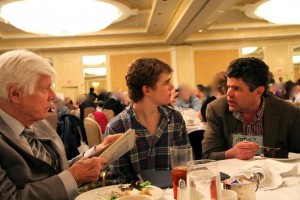 Great moments in family conversations. Great moments in family conversations.
Three dudes or guys (Johns, really) in a typical guy-like conversation.
The one on the right (that would be me) is enthusiastically trying to communicate something of moderate interest to himself and, he thinks and hopes of at least moderate interest to his father and perhaps some remote interest to his son.
The one in the middle (that’s my son, Johnny) knows what I am doing and knows the topic is not of any interest whatsoever to him and probably of no interest to my father either even though I think it may be —and the main goal now is to look distracted by something going on elsewhere in the room so he person can keep thinking about whatever it is he is thinking about and not be expected to respond to my comment. And eventually be able to change the subject to something of greater interest to him and his grandfather.
The one on the left (my father, Big John) is engrossed reading something of interest to him but also realizing the comment the one on the right is making is taking a very long time and some sort of response will be expected of him since it is directed his way, mostly, and he needs to hear enough of it to comment adequately without having to listen to everything I am saying, especially since the one in the middle doesn’t appear that he will help out by offering a comment of feigned interest to help out.
We have a lot of great conversations this way when we are together.
By John Y. Brown III, on Wed Jan 16, 2013 at 12:00 PM ET
A story borrowed from Jason Brangers.
I’m calling it, “Now you’ve got my attention.”
One of my Russian martial art coaches loved chess; which may be more of a national sport than Sambo.
Often he’d see me worried about the size, strength or speed of my opponents, and he’d recount an old proverb, “After the game, the king and… the pawn go into the same box.”
He had once continued, “You have anxiety because you are getting sucked down into the mere game. Look from the top. imagine you are pieces on a chessboard. Your pawn only weakens because you feel small next to his front, and so you feel anxiety about your lack of potential. But now view it from the top, see your pawn in its full strength, what it represents to your opponent, and realize it is the most important piece on the board.”
He taught me that my pawn could have the greatest courage and cause the entire opposition to rattle. If I remained brave enough to approach the opponent’s rear line, even a pawn could transform into the most powerful piece on the board: a queen. “Even the humble, unexpected pawn can change the course of a game,” he’d insist.
So what are you going to do in this game? If all you are doing is going back into the box, if you can’t take it with you, then HOW you play the game remains the only point to this all.
Your true powers exceed the movements you may feel restricted to execute. Your importance lies not in your potential powers, but by your very courage. So, how you choose to stand, how you decide you will act while you are on the board, is the entire point of our game. Even the humble, unexpected pawn can change the course of the game through bravery. None of us are getting out of here alive, so let us enjoy the game, but more importantly, let us not be deluded into collecting pieces or wins.
Let us focus our goals upon the courage to follow our values even against overwhelming odds, even with those who have become blind to the point of he game, and the inevitability that we will all go back in the box.
Very respectfully, Scott Sonnon www.facebook.com/ScottSonnon
By RP Staff, on Wed Jan 16, 2013 at 10:00 AM ET  In BREAKING NEWS from the Pulitzer Prize winning news site, DailyPix.Me, our own contributing RP, Jason Grill, was named the #12 best looking politician under the age of 40. In BREAKING NEWS from the Pulitzer Prize winning news site, DailyPix.Me, our own contributing RP, Jason Grill, was named the #12 best looking politician under the age of 40.
With breathless pose, the reputable news agency writes:
Grill is a former Democratic member of the Missouri House of Representatives. He’s also a lawyer, writer, TV analyst, radio host and an all around handsome man! Oh and did we mention that he’s only 33?
Check out the piece here.
Of course, Jason had already been labeled, by the hard news, Cosmopolitan magazine, as one of “7 Politicians We’d Like to See Shirtless (And One Who’s Already Taken It Off).”
Wrote Cosmo when Jason was an active politician:
This smokin’ hot Dem is running for a second term as a representative in the Missouri House of Representatives. Hey Jason, if you need anyone to hang out on the campaign trail, give us a call.
While we here at The Recovering Politician are big admirers of Jason’s dreamy blue eyes (or are they brown?), we are not sure if he is the sexiest recovering politician alive.
We need your vote below. Besides Jason, here are another few choices:
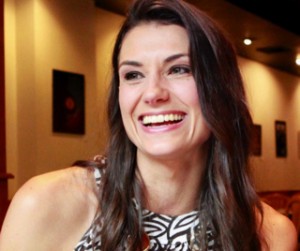 Krystal Ball
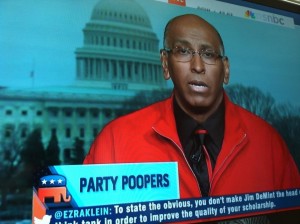 Michael Steele repping the red states 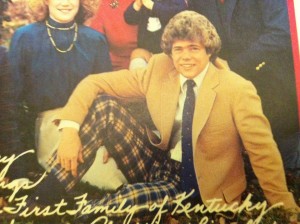 John Y. Brown, III in best fashion mode
By Artur Davis, on Tue Jan 15, 2013 at 1:30 PM ET The shortest distance in modern politics is the one between a Republican willing to denounce his party for extremism and the set of a cable or Sunday morning talk show. The gift of exposure is waiting for the cheap ticket of describing today’s Republicans as an intolerant set of know-nothings whom one no longer recognizes.
There are a variety of reasons why the current incarnation of the Republican Party is unfamiliar if you are a Republican moderate of a certain age. From the irrelevance of the establishment wing that once financed and vetted most of the party’s candidates, from president down to congressmen; to the spinning off of non elected influencers, from Grover Norquist to the Tea Party, who limit the maneuvering room of the elected leadership; to the devolution of its media center from the glass panels of the Wall Street Journal to a cable network owned by an Australian plutocrat.
To be sure, each of these trends has driven the party to be a straightforwardly conservative ideological vehicle, and each has made the party unwieldy and harder to direct. Is that tantamount to a descent into the darkness? It’s worth noting that for all of its turbulence, the right wing of the party has enrolled what are likely tens of thousands of non-involved homeowners, teachers, retirees, and even the unemployed into the ranks of activists—still a good thing in a citizen driven democracy. Yes, the difficulty of assembling a Republican coalition for congressional deal-making makes consensus harder to achieve than ever. But then an accounting of the “good old days” recalls that consensus generates its own flawed outcomes, like the unraveling of accountability around the capital markets in the latter Clinton years and the explosion of legally sanctioned influence peddling on both partisan sides of K Street.
Read the rest of…
Artur Davis: The Tempting of the Moderates
|
|


