By John Y. Brown III, on Mon Sep 10, 2012 at 12:00 PM ET
Why I am a Democrat.
Heading home from the Democratic National Convention I had a few minutes to kill and decided to type out why I think I’m a Democrat.
Part of it, of course, is inherited—in two senses. Your family’s politics, like your family’s business and religion, tend to have a long shelf life for future generations. It’s easier to go along than buck the family. There’s also a temperamental inheritance. Both major political parties, I believe, attract certain disposition types —characteristics that we largely inherit genetically. No, not a desire for lower taxes or building strong infrastructure—at least not directly. But an inclination to be trusting or skeptical; hopeful or protective. Or just not caring if one side of our jacket collar is flipped up.
Then there are the cultural and temporal factors that help determine our politics. More people who came of age in the 1930s became Democrats. More who came of age in the 1980s became Republicans.
But these are not the interesting or singular characteristics that cause a person like me, after all the more conventional factors are set aside, still to walk toward the democratic team when choosing sides. I think that’s a more deeply personal matter that we don’t take enough time honestly to understand.
Oh, and for the record, I don’t buy all this nonsense about Republicans and Democrats not being able to get along. If that were true, Republicans and Democrats would stop getting married to each other so frequently! Like married couples, we need each other. Each side has strengths and weaknesses and is better together than alone. But also like married couples, a little more understanding of each other (and a good counselor) can go a long way. I mean seriously, if Democrats could do a better job of “mirroring” what we believe we hear Republicans say; and if Republicans could do a better job using “I-statements,” we would be well on our way to a more functional polity. Or at least a fun weekend together. Which is why I am writing about why I am a Democrat. Like most people, it’s not really about ideology. I believe ideology is a byproduct of more core personal qualities and traits we possess. And it’s easier to accept differences if we understand these differences are more fundamental to who we are and impermeable— rather than merely malleable ideas that, like a fly, we seem merely to have randomly alighted on. And so with that intro, here goes.
For me, I am a Democrat because I am a “tinkerer”, a “wobbler,” and a “blender.” And on most days, these are positive traits, at least in my mind. And they are at my core.
Read the rest of… John Y’s Musings from the Middle: Why I Am a Democrat
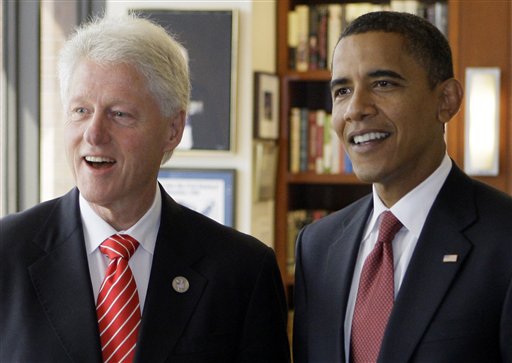
Last week, Bill Clinton was the consummate trial lawyer that he would have become had his Arkansas comebacks not worked out: saddled with bad facts, he talked three times as long and tugged on twice as many heartstrings as he and his text had planned.
To use a riff that Clinton regularly invoked, was he right? Infrequently, and the wrongs included some whoppers: like the Democratic meme that a grinch named Mitch McConnell stole Obama’s prospects by pledging to block his reelection. The only problem: when McConnell said it, he had a meager 40 votes in the Senate, and managed to stop a grand total of 0 Obama initiatives in the first half of this term (even after gaining a 41st vote to preserve the right of filibuster). Then there is the inconvenient truth that the allegedly obstructive McConnell cut a deal with Democrats that avoided a massive scheduled tax hike at the end of 2010 and by so doing, almost certainly saved Obama from a second recession in three years.
And the jobs bill that the grinch supposedly blocked in 2011: still waiting for an Obama loyalist, Harry Reid, to bring it to the floor in a Democratic Senate. Which of course calls to mind the multiple Obama budgets, the prescriptive documents that Clinton once called “blueprints for the future”, that failed to command a single Democratic vote in either house. An oddity perhaps of the legislative process, but one more thing that undercuts the theme that it is a unique kind of right-wing intransigence that has undone Obama.
What about the notion that hard-hearted Republicans have it in mind to devastate Medicaid and to leave the old and poor in a tear-inducing state? Powerful, beautiful words–it just happens that it was the Obama Administration that threatened to shut down state Medicaid programs if governors refused to accept the Affordable Care Act’s new Medicaid regulations, until seven Supreme Court justices stopped them. Or the glossing over of the Affordable Care Act’s 700 billion dollar reduction in Medicare on the grounds that it was “merely” a reduction in provider fees: a shrewdly constructed distinction until one recalls that the essence of Medicare is reimbursing providers rather than making direct outlays to patients.
It was telling, too, that Clinton in full flight, and with 50 minutes to do it, never found his way to a rendition of Obama’s record that is as succinct and as definitive as the former president’s take on his own tenure: 22 million jobs, expanded wealth and reduced poverty, and fiscal policies that augmented enough purchasing power to amount to a check to American. The Obama case, even in its most lovingly embroidered light, is too textured with mitigation—replacing precipitous losses with still meager private sector job growth that is way short of the natural expansion in the labor pool; a healthcare overhaul that does not contain private costs; a Wall Street reform that does not rein in wild speculative losses at JP Morgan; heightened poverty and child hunger on a liberal president’s watch, a relatively successful legislative record that few Americans feel affected by. That the master orator could not condense it into a success story with no “buts”, and the fact that the words “Barack Obama has succeeded” were missing from Clinton’s text and the ad-libs, speaks volumes to Obama’s dilemma.
Read the rest of… Artur Davis: Clinton for the Defense
By John Y. Brown III, on Fri Sep 7, 2012 at 12:00 PM ET
People who are where they are seem the happiest….
Another morning at Starbucks. Another observation about the human condition that seems to occur to me as I impatiently wait in line each morning.
As I walked in to Starbucks this morning, I passed a passel of high school students. One was wearing a Harvard t-shirt, thinking ahead to college applications, I thought.
As I passed there was an overpowering whiff of perfume from one of the other young ladies, trying to be a little older than she is. I thought to myself, they are a group of “Kids trying to be adults”
Inside I watched a 40-something gentlemen dressed in jeans and a t-shirt hanging out with a much younger man and, I suspected, trying to fit in and get the youthful man’s approval. And I thought to myself, grown-ups are often just “Adults trying to be kids.”
“Funny,” I thought to myself. One group is trying to be 10 years older; the other trying to be 10 years younger.
And as I walked out I noticed the older couple who always sit together in Starbucks every morning and read the news paper together, drink coffee, and talk.
I thought about them and asked myself, “How would you categorize them?”
I would say, “Happy.”
They are who they are, where they are. And seem to be enjoying it.
Q: I’m 28, a young JD/MBA, triple Ivy, considering a run for office in 5–7 years. Tell me exactly what I should be doing now. —K.S., New York City
First and foremost, please don’t ever use the term “triple Ivy” again. On behalf of everyone you will ever meet, thank you.
I’m torn on this one. On one hand, there are some tried-and-true things that will likely help you down the line. Join your local Democratic or Republican club. Attend fundraisers for local candidates—or even better, host them. Knock on doors and phone-bank for your party’s nominees. Those things aren’t foolproof, but if you do them cheerfully for a few cycles, you’re much more likely to earn the support of party insiders.
Though that can work, it wasn’t what I did, and I only advise it to certain types of people. Ultimately it can be just as effective to find a cause you care a lot about and immerse yourself in it. For me it was cofounding a charter school. For you it could be anything, as long as it’s something you’re passionate about. Learn all you can, meet the big guns in that policy space, and better your community in some tangible way. And then, should you decide to run, you’ll have a solid bloc of supporters around your signature issue. It won’t get you the party’s support, but it will brand you as a genuine citizen as committed to the community as to your own political advancement.
Ideally you can focus on the second approach, with just enough of the first to not be ostracized by your local party. But you’ll have to choose your mix. Given your three (!) degrees, my guess is that the first approach is more your style.
Q: I saw the documentary about you, and now I want to run for office. But I don’t like asking for money. What’s your advice? —Name withheld, via Twitter
Do one of the following: 1) Start a business and get rich so you can self-fund; 2) Marry a rich girl/guy (more options if you’re here in New York than in most states); 3) Befriend a billionaire who will instinctively know to fund an independent expenditure on your behalf without your asking; 4) Run for town council or another office with an electorate under 10,000 people; or 5) Ditch your political dreams.
Q: Do yard signs matter? —S.S., San Diego
In the movie Singles (1992), Bridget Fonda’s character asks her boyfriend (played by Matt Dillon), whose taste tends toward voluptuous women, if her breasts are too small. “Sometimes,” he replies.
And so it is with yard signs. In a presidential election they don’t matter. About 95 percent of the country has already made up its mind, and those who haven’t have ready access to nearly unlimited information about the two candidates.
In low-information down-ballot elections, especially primaries, signs matter, especially for little-known underdog candidates who are desperately trying to raise their visibility and to show the support of people who are well respected in their neighborhoods. Signs can also help candidates keep their supporters psychologically invested in the campaign.
Q: I have a friend in politics who’s headed to prison, and he wants to hire a prison consultant. The one he contacted wanted $7,500 up front. Is it worth it? —C.M., New York City
I’d do it for half that. Oh, and tell him not to eat the Snickers. That one’s free.
Read the rest of… Jeff Smith’s Political Advice Column: Do As I Say
By John Y. Brown III, on Thu Sep 6, 2012 at 12:00 PM ET
The Wounded Healer
My son, at our celebratory dinner the night before he left for college last week, brought up an interesting topic. He asked who were the three historical figures I admired most.
As usual, I hemmed and hawed and asked for more clarification and kept trying to dodge answering. . But my son wouldn’t give in.
Finally, I said, “It’s funny, when I was about your age, I was having dinner with your great-grandfather (my grandfather) and it was about a year before he died and I asked him the very same question. But I think I can only remember one of the people he told me and I want to make my three choices different. “
“OK,” I said, “Here goes.” I proceeded to give two predictable names but was stuck on the third.
My son interjected, “So who was the name your grandfather gave that you still remember?”
I said, “It was an unusual choice whose name I had never heard before. It was Bill Wilson, or Bill W., as he is better known. He was the co-founder of Alcoholics Anonymous. Your great-grandfather wasn’t a recovering alcoholic but had great respect for the program and, I guess, saw Bill Wilson as something of a pioneer who brought hope to people who had no hope.”
“So, Dad,” my son intoned, “Who is your third choice?”
“You know, Johnny, Bill Wilson was someone I was considering putting on the list but was trying not to because his contribution to the world is hard to explain–and he never sought the kind of public accolade we are talking about. He is a man who was faced with a life-threatening malady suffered by millions that science and logic could only grasp at impacting. He used pragmatic spiritual, psychological and common sense tools cobbled together with great humility to create something that on paper should never work. But did. And continues to. He didn’t have the luxury of caring how it looked on paper — only whether or not it worked. And he helped create a framework that has saved the lives of millions alcoholics and helped restore their families and spawned many related programs and therapies helping others with different but equally insidious diseases and disorders. And he did so as anonymously as he could to keep the focus on helping others rather than promoting himself.”
There was a pause.
And then I added, “So I guess that ought to be enough to make my top three list, huh? Bill Wilson.”
Check out the movie Bill W, the story of Bill Wilson’s life. Here’s the trailer:
By John Y. Brown III, on Wed Sep 5, 2012 at 12:00 PM ET
Troop Rallying or Pluribus Unuming?
(A long winded spiel–so long and windy that you may just forget what you were mad about at half-time during the DNC and RNC conventions)
It’s political party convention time– it’s a party for the parties, so to speak–where partisan cheerleading becomes the order of the day. The goal of both the Democratic and Republican parties is to “rally the troops.” Both major political parties strive, as they should, to make the case most dramatically for their side to win in November. It’s a time honored tradition–and an important one. And hyperbole and histrionics are not only expected—they are featured front and center.
But with every rhetorical flourish, left or right, that hits it mark at the conventions, something else is jarred too. The opposite of rallying the troops, I suppose, is trying to find common ground in our already very divided nation. Political conventions are constructs that are a bit like Midnight Madness if you are a UK basketball fan. You leave such events not only feeling a stronger than ever allegiance to your team but stronger than ever animosity toward any team that threatens them.
If political conventions are successful, when they are over, those who identify with each party should feel stronger than ever about their party being right —and stronger than ever about the other party being wrong. We don’t put on war make up. But we do, say and wear some awfully silly things at these conventions. In more primitive cultures, they had these sorts of partisan conventions but they called them tribal war dances. Seriously. (See clip below.) Note that neither Clint Eastwood nor Betty White were given prominent roles in the pre-convention warrior dances. Our political pros today could learn a thing or two from these ancient tribal rituals. Stay on message; whip up feelings of righteousness to a fever pitch; and dance like the dickens. No need to use chairs as a dialectical prop by a tribal elder (republicans) or matriarchal elder (democrats). Ever. Just keep dancing.
Oh sure, we should have fun celebrating and rallying with our political brothers and sisters during our side’s convention. I certainly intend to! And hope my republican friends did so last week.
But I suspect it would be good to note, too, that “rallying the troops” theater, while good for cheerleading, isn’t terribly useful once the political parties’ parties are over. That’s important to remember –as it is to recall that we have many more brothers and sisters than just those sharing our political opinions. Our Founding Fathers certainly realized this and memorialized it in our new nation’s motto that they selected– a simple Latin phrase: E Pluribus Unum. I’m really glad a few weeks before our Constitution was signed we didn’t have competing conventions represented by the political factions of the day. We may not have a constitution. We may have instead had some funny stories about Benjamin Franklin getting his lights punched out by a lesser signer because of his acerbic speech a few weeks earlier. But we didn’t have political parties back then. In fact, the Founders warned against the dangers of divisive factionalism—or extreme troop rallying.
E Pluribus Unum means essentially that within our diverse differences we are committed to an unassailable unity. Not “My country, right or wrong” blind allegiance, but more like “our country no matter how right or wrong we believe ourselves or our political opponents to be.”
In many ways E Pluribus Unum is nearly the opposite of the raw partisan blood sport we see played out regularly today masquerading as serious debate . Is it the worst it’s ever been? Hardly. It’s easy to pull up some old allegations about Abe Lincoln looking like a baboon, or Thomas Jefferson being an heathen atheist. But it’s pretty bad. And it’s not the end game our Founding Fathers had in mind. I suspect our Founders wanted more of legacy for their efforts than Glenn Beck lecturing about left wing conspiracy theories or The Daily Kos flaming the Internet about right wing conspiracies. If this is the apex of 236 years of a great republic’s maturation, the Founders probably would have stayed home and played cribbage instead.
But we are better than our partisan extremes. A whole lot better. We are not at our best divided and petty. Granted, it’s difficult to be united and idealistic for very long when there are over 300 million of us. But we don’t have to be that way all the time. I’d settle for opinionated but respectful –and a little more curious. Maybe a little more open-minded about where we might find common ground rather than determined to more deeply draw the boundaries that divide us.
But last week in Tampa and this week in Charlotte, is not the landscape for such things. Our country’s simple yet complex motto won’t be on prominent display in either city. That’s not the point of political party conventions. Or tribal war dances.
But unity among diversity is what makes for a great nation. And I hope that as we inch toward—and then beyond—the November election we don’t forget the motto our Founders hoped we’d live up to. To be a more unified nation. A time when political warrior dances are replaced again by Dancing with the Stars.
Even if it means I have to cheer again for Tom Delay.
I think that’s about as good as the guy can do. He can’t really offer specifics, because his policies are incoherent. Balance the budget, but cut taxes, reverse Medicare cuts and increase defense spending? Balance the budget by killing the wind energy tax credit? Riiight.
But of course, style trumps substance. And on those grounds, well, he’s no Rubio. He’s not even a Rob Portman. He’s just terminally incapable of appearing genuine.
My high school basketball coach once sat in on a meeting with a college coach who was recruiting me. “Too bad you can’t teach height,” he said. The college coach nodded grimly, much as Romney’s speech coaches likely did last night.
Read the rest of… Jeff Smith: Romney’s Convention Speech
By John Y. Brown III, on Tue Sep 4, 2012 at 12:00 PM ET
The importance of grandfathers—on Labor Day.
The most important thing my very wise and learned paternal grandfather ever told me was when I was 20 years old. We were having a philosophical discuasion about the ends never justifying the means being illustrated in a criminal law case he was involved with –and I took a personal turn with my next question.
“Papaw, how old was dad when you realized he was going to be really successful?” I asked, hoping I wasn’t out of time yet myself.
There was an uncharacteriatic pause and I looked at my grandfather’s winced face. It was the first time I had ever stumped him. Or at least the first time one of my questions had left him temporarily speechless. Recovering, he said in a stern tone raising one eyebrow, “Well, to tell you the truth, I never thought your dad would amount to much of anything.” And as he realized that even though my father was now 51 was helping support both of us, he couldn’t remember ever amending that opinion, he broke into a broad smile and a hearty laugh.
That’s it. The most important thing grandfathers usually pass down to grandchildren is the truth about their parents.
The wisest thing my maternal grandfather ever said to me.
I was in my final year of law school and into my late 20s. My grandfather Durall, who possibly had the finest mind of any of my family members, had to drop out of school at age 14 to go to work in the coal mines–for $2 a day pay.
We were about to sit down to chat and his first question to me was, “Reckon you are going to stay in college until you can draw Social Security?” he asked, chuckling to himself. It made me laugh hard–and was probably the harshest thing I ever recall my grandfather Durall saying to me.
The reason I thought of that conversation this morning is that whatever I can think or say about Labor Day, I’ll never quite be able to give the term “work” the kind of meaning that he did. Of all my family members, none worked harder, endured more, and received less than my grandfather Durall. And he almost never missed a day of work or took a vacation time. Or complained. It was just his way. He honored the term “labor” in a way his grandchildren can salute but will never replicate.
Last week, GOP U.S. Senate candidate Todd Akin once again said that he is staying in the race, despite calls from his own party to drop out following his controversial statements about rape and pregnancy.
In the following clip, contributing RP Jason Grill and Republican Annie Pressley debate whether Akin still has any shot at winning in November:


 Why I am a Democrat.