By John Y. Brown III, on Mon Aug 12, 2013 at 12:00 PM ET
Question: Is it possible for a 4000 pound vehicle to vanish?
Answer: Yes. But it costs $124 to make it come back.
Today in Lexington I had lunch with a client and when I returned to my car in the parking lot it wasn’t a matter of not remembering the slot I parked or seeing my car after it had been dented by another driver and left without any explanation. It was a matter of just not being ther…e at all. Poof!
I got a sinking feeling in my stomach. My usual defense mechanism for when I feel frustration, disappointment or anger coming on is to make a wisecrack to distract form the tension.
I went inside and asked for the towing company and called:
Me: “Do you have a Maroon Honda Accord?”
Operator at towing service: “Yes. We are on Manchester Lane and you can pick it up.”
Me: “How much is it to pick up?”
Operator at towing service: “$124”
Me: “Geez. You are kidding me?”
Operator at towing service: “No. I’m not”
Me: For $248 could you tow it back to where you picked it up? I don’t have a car to get to you.”
Operator at towing service: “No. We have to see a picture ID and proof of ownership before we can move the car.”
Later while paying my towing fee I asked the clerk if they had a punch card that offered a gift or prize after the 5th or 10th tow….like a car air freshener.
Clerk at towing service: No. Please sign here”
I then looked proudly at my car who was sitting there so unassuming and out of place. I wanted to ask the clerk if my car had behaved better than the other towed cars. But didn’t. I knew the feeble attempt at humor wouldn’t have been received well.
And yet I was proud of my car. it looked cleaner and not like an automotive miscreant like many of the others. “C’mon,” I said. “Let’s get you out of here. You don’t belong in this place. I’ve sprung you.”
And I grinned to myself. Which just goes to show you if you do somethign stupid and try to deflect attention from it by making other people laugh and that doesn’t work. You still have yourself to laugh at yourself. It works. And sounds so silly trying to explain it will help you laugh even louder at yourself until you no longer are mad at yourself.
Of course it helps if you have your same sense of humor. ; )
By John Y. Brown III, on Fri Aug 9, 2013 at 12:00 PM ET
I’m thinking of suing my tailor under the Dram Shop Act
A good lawyer, I’ve always been told, is one who can effectively use precedent from one area of the law and apply it by analogy to a new area of the law.
This morning at the coffee… shop I saw the gentlemen who has for years sold me clothing at Jos Banks. Not only does he sell me my clothes but he measures me and suggests the exact alternations for each article of clothing I buy that needs alternation. Over the course of the past 5 years I’ve probably spent $1000 on alterations alone.
And here’s the rub.
Under The Dram Shop Act (most states have such laws), the owner of an establishment selling liquor has a responsibility to its patrons not to serve them alcohol after they are clearly intoxicated. Most states allow for recovery when the defendant owner knew (or should have known) the customer was intoxicated but continues to serve him alcohol anyway.
Now, back to my Jos Banks example. For 5 continuous years I have advised the tailor NOT to let out my waistline as much as he suggests I should because “I’m going to lose 5-10 pounds and the pants will fit perfectly then.”
And for 5 years he was watched and this has never, ever happened. Yet he continues to give in to me even though I am essentially in an inebriated state of mind when it comes to projecting my weight loss and waistline. And inevitably I bring the pants back 3-6 months later and have the waistline taken out and pay another $10-$20.
Have any others ever been injured by this act of negligence? Not really, of course. Certainly nothing compared to the horrific accidents that can happen when excessive alcohol is involved. But I have been forced to pay double for every new pair of pants I buy to be altered not once but twice. And I think the store owner is taking advantage of my vanity, delusional perspective and aspirational thinking. And making me a danger to myself, at least where estimating my waistline for tailoring purposes are concerned.
There just has to be a remedy for this injustice. And Justice, after all, is symbolized by a blind woman holding out a scale. Demonstrating the importance of not taking advantage of people where scales are involved.
By John Y. Brown III, on Thu Aug 8, 2013 at 12:00 PM ET
The paradoxes of our closest friendships.
Friendships are a delicate thing. More important than money, title, and prestige…at least we say that it is. Of course we don’t do as good a job of living as though close friendships were more im…portant than the fleeting worldly things we chase each day. But they are. And we eventually come to realize this, though usually much later in life than we want to admit.
And close friendships are, after all, worldly things, too. But they are much harder to make sense of, figure out, plan for, or predict than other worldly things. We don’t collect them like objects and categorize them into neat and sensible patterns.
Psychologists and sociologists have tried to find common traits we have with our closest friends and they have had some success at intellectually explaining aspects of the friendship process. But we still understand the whys and hows of friendship less than we do most other important matters of our daily life.
We can talk about our closest friends in generalities much easier than specifics. They touch something sacred in us that is uncomfortable to talk about. Maybe they see us as we really are. And see us as we want to be. And see us as we have been. And accept—perhaps even celebrate– all three.
Surely there is something transactional about our closest friendships. But try to describe it in 3 sentences. Or 33 sentences. Tough.
And so….and so….and so… I suppose our closest friendships– like the other most valuable things in our lives tend also to be– are better to be savored than rationalized. Better to be appreciated than analyzed into a pseudo-scientific formula. Better to be enjoyed more than explained.
I mention this because I was taken aback moments ago by the beautiful background in the Facebook profile of the wife of probably my dearest friend in this life. If I died tomorrow and had to fill out a form for the afterlife summarizing my life here, under “Name of Best Friend” I would probably write in John Bell.
John Bell and I have the same first name and a lot of quirky personal traits in common. But on paper we’d be hard pressed to make the second round in a Friendship Match.com System. John Bell doesn’t care much for politics and didn’t go to law or business school. He’s a licensed social worker and a darned good one along with many other talents and gifts –most of which deviate from mine. He doesn’t love to write and doesn’t care for public speaking. We like some of the same books and movies and music…but only a few.
In the picture above, John Bell is captured with a full beard standing in front of a glorious background in Patagonia, Chile where he went mountain climbing for several weeks last summer. John Bell knows me well enough to never bother to invite me on his annual mountain climbing treks. He knows me better than that. I don’t know what I was doing while John Bell was scaling mountain tops in Chile…but I can assure you it involved air conditioning, wifi, a laptop and nearby coffee shops. If I discussed Chile at all during those couple of weeks last summer it was the political economy of the country and pointing out how Chile is an example of free market principles flourishing in South America. Mountain climbing was not part of my conversations. I can’t even grow a full beard. Only small patches. John Bell and I are different like that too.
John showed me a few pictures from his Chile trip and I was awed. I showed him the chapter I wrote for a book recently and suspect he read it. He said he did and liked it–and I believe whatever he tells me. But those avocational interests in our lives aren’t what bind us together as friends either–any more than our vocational interests.
We met in high school and went through adolescence together…holding on to each other when our worlds were turning upside down and helping each other realize that neither was crazy. We were just teenagers. And we got through our 20s as friends. And 30s and 40s and soon both of us will be 50. And in all that time we hardly ever have discussed the worlds we work in or our most time consuming avocations, like mountain-climbing and politics.
We mostly talk about real stuff that goes deep. “How you doin’?” means much more coming from a close friend than a colleague at work. Answering that question alone may take an hour or more. And doesn’t leave time for the less substantial stuff like revenue projections or new client growth or even discussing where we are planning our next family vacation. That stuff just doesn’t seem that important by comparison. And not nearly as interesting as what we do discuss when we talk for a few moments here and a few moments there each week or two in our busy lives. But it’s talk that matters and is honest and inarticulate and from the heart and the gut– rather than fact-filled and goal oriented. It is subjective and personal and without an agenda or “action items.” It’s much more than words to communicate a task or simply information. Probably just the opposite, if there is such a thing.
And then we turn away from each other– after a brief hug—and return to our very different lives. But we keep coming back to that sacred place we have in common–called friendship.
By John Y. Brown III, on Wed Aug 7, 2013 at 12:00 PM ET
Lost in Translation?
How do you communicate with a mere gesture or casual glance to the guy in the Pontiac Sunfire tailgating you on the Watterson this morning that you are listening to and channeling Lenny Kravitz BUT that you can’t go any faster because you got a speeding ticket in this same area last week and can’t risk being late for your 7:30 client update meeting.
But you want him to know …that Mr Lenny Kravitz has no patience with tailgaters and does not want to see this happen ever again on the Watterson. Especially during an air guitar solo of Are You Gonna Go My Way.
I did the best I could to communicate this specific message with the facial expression that came to mind but am afraid parts of it–especially the Lenny Kravitz part—may have gotten lost in translation.
By John Y. Brown III, on Tue Aug 6, 2013 at 12:00 PM ET
How to know if you have reached middle age?
When someone asks you “If you could live your life over again what things would you do differently?” and you give them an exasperasted look that has an undercurrent of disgust and reply,
“What are you talking about? Are you even serious? People don’t get to live their lives over. At this point I’m not even sure I have the energy to finish the life I am living now much less think about a do over.”
If your response sounds like this you are probably middle-aged.
By John Y. Brown III, on Mon Aug 5, 2013 at 12:00 PM ET
My big little idea. And the importance of mentoring–a dying art.
Several years ago Leadership Louisville and the Courier-Journal spearheaded a project to identify the 128 “Connectors” in our community. These are the people who are descri…bed as often the unsung heroes but also the glue in a community to help bring people and groups together and help get things done. They are energetic, trusted and enthusiastic and play an integral leadership role but aren’t necessarily in the most visible leadership position. And they exist in a variety of fields— profit and non-profits, commercial and public sector.
I was honored to be selected as one of these 128 “Connectors” (the concept came from Malcolm Gladwell’s breakthrough book Tipping Point).
The most important byproduct of this program was that it highlighted the idea of so-called connectors in our community as a role that is important and worth doing. I think in some small but important ways it “upped our city’s game” in this department. It inspired those identified connectors —and those who could or should have been on that list— to embrace this role that they play and to try to do it even better. It gave a name to this vague art and identified it as important and worthy of development.
The downside of this exercise is the “Now what?” conundrum. What do we do with this group now that they’ve been identified to improve the community. So that it doesn’t end up appearing to be little more than a high school senior superlative exercise. There was a study done and suggested, among other things, that connectors don’t necessarily work at their best with a group of other connectors. And so it was difficult to galvanize the group in some formal way…but it was a worthy project that was more than just a self-congratulatory yet probably didn’t leave as deep or as broad a legacy benefiting our community as its sponsors had originally hoped.
Which brings me to my big little idea.
Does Louisville have another group of individuals who are integral to our community’s growth and future but too often fly under the public radar and aren’t encouraged or thanked enough for the important role they play? And–here’s the pivotal question– if a similar project to the “Connectors” was established for them could leave a significant and lasting legacy?
I think the answer is yes! And I propose we have a project identifying and celebrating “Mentors” in our community. Those who take the time to show their younger eager counterparts the ropes and serve as role models and sounding boards and touchstones and are relied on for the sound sober guidance so critical when the stakes are high and emotions running higher.
By identifying and cultivating our city’s mentors everyone wins. We don’t value our wiser and more experienced elders enough in our world today–and it is to our detriment. And these mentor-types derive great personal satisfaction in giving back and helping facilitate new and better leaders for the future. But there is no formal mechanism to identify and encourage this practice. At least right now.
Louisville has a lot of great natural resources and is blessed with a central location and rich history. But perhaps our greatest resources is the fund of experiences so many accomplished people in our community have —and have in a host of different fields and professions. And our other great resource is we have some highly energetic, dynamic and ambitious young people who have more confidence than experience and more smarts than judgment. Their shortcomings begin where the untapped expertise of the mentors in our community begins.
Think of the underutilized mentors in our community as an internal brain drain we can’t blame on our sister states bleeding from us. We can only blame ourselves.
Wouldn’t it be great if we found a way to connect these two powerful but currently fragmented forces? I think so.
By John Y. Brown III, on Fri Aug 2, 2013 at 12:00 PM ET
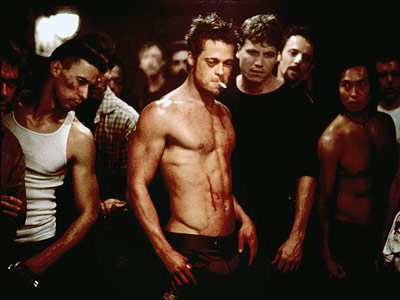
Fight Club. Did it inspire you…but seem just a tad too much?
Now there may be a new option.
Pinch Club.
That’s right. Sort of like Fight Club but from the Ladies Tees.
I was fascinated by the movie Fight Club which I saw for the first time about 2 years ago. No doubt many males can fall into a consumer-culture corporatized and commoditized ennui that leaves them needing something deeper and… more primitive to bring meaning to their lives.
Fighting–the punching with fists kind– would seem the natural dramatic first choice. But what it yours is a milder case? Or you are less disposed to physical violence? The option of a Pinch Club seems to accomplish the same end without all the messy and needlessly painful excesses.
By John Y. Brown III, on Thu Aug 1, 2013 at 12:00 PM ET
Redefining being “overweight.”
When I was in college I had a “reducible hernia” in my lower left abdomen. I had a small protrusion that could be “pushed back in,” hence “reducible.” I would push it back in until I finally got the problem properly diagnosed and repaired. And I haven’t seemed to have a problem with it ever since.
Until this afternoon when I felt my stomach before playing basketball and my stomach is, well, I guess you could say it sort of protrudes. The main problem, however, is that it isn’t “reducible.” I can’t push it back in like I used to be able to do with the hernia in my youth.
This may just be a product of getting older or it may be a more dramatic tear….or something.
I can’t tell if I’m not pushing in the right place, or not pushing at the correct angle or perhaps not pushing hard enough. Whatever I do my stomach stays, more or less, slightly protruded and doesn’t appear to have anything it’s poking out of to be pushed back into.
But how is it my fault that I haven’t figured out yet how to put it–my stomach– back into its proper place. Until someone tells me otherwise, I’ve decided to conclude that I’m not really overweight but merely have a “temporarily irreducible and slightly herniated stomach” in my lower and upper abdomen on both sides.”
All I know is that this is a medical condition that isn’t a reflection of my lack of will power or discipline. And it’s probably just a minor flair up from my hernia repair 28 years ago. These repairs can’t last forever. This one is just a little more pronounced.
That’s my story and I’m sticking to it.
Oh, and don’t you dare ask me in my current medical condition to lift any heavy objects. I do remember that’s the last thing you ask someone with a small hernia (or even medium sized hernia–or larger) is to do heavy lifting —at least until they are fully recovered. ; )
By John Y. Brown III, on Wed Jul 31, 2013 at 12:00 PM ET
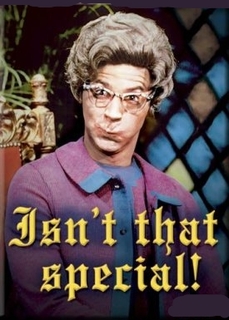
How to be special. And be able to prove it.
I just realized, according to a popular idiom, that are very few individuals out there who can be considered special.
How did I come to this inevitable conclusion?
Yesterday I used the phrase in describing two well known public figures I had met many years ago in my childhood as two men who, “Put their pants on one leg at a time just like the rest of us.” Therefore, my friend and I agreed that since that was the case, it was surely true that these two public personalities were “just like us” in all the important ways. That they were just normal and ordinary, after all.
But that got me to thinking, “Does that mean that everyone—every single person—who puts their pants on one leg at a time is basically an ordinary person?” I mean, that’s the whole point of the phrase, right? “He (or she) puts his (or her) pants on one leg at a time.” Ergo, they aren’t special. It’s the great equalizer. Pants putting on, that is.
In other words, anyone who puts their pants on one leg at a time instantly moves from the category of “special” (if they possess some rare talent or skill) to the category of “ordinary.”
So, how to we find truly special people? It means we should really ask–for the sake of efficiency —who DOES NOT put their pants on one leg at a time. Since that is a small group, presumably, we will quickly limit all the possible candidates for being a special person. Once we have this tiny group of people who, for whatever reason, pass the “ordinariness” threshold test by putting their pant on in some way other than one leg at a time, we are ready for the critical next step.
Of these individuals in the “non-one leg at a time pants putting on routine when getting dressed,” which ones also have some rare talent or gift? Once we identify those individuals–given we have eliminated the great equalizer test in the pants department, we will, technically speaking, have a list of the only truly “special” people in this world. Just like that!
Isn’t logic a a wonderful tool enabling us to reach correct conclusions?! It sure is!
Oh by the way, I’m trying to teach myself to put my pants on over my head like a pull over shirt. It’s slow-going so far… but I am determined. To be special, that is.
By John Y. Brown III, on Tue Jul 30, 2013 at 12:00 PM ET
Imagine Paris (“That’s hot”) Hilton commenting, “That’s so luke warm.”
A middle-aged friend finalized his divorce recently and I tried my hand, feebly, at matchmaking.
In describing him to a divorcee woman I work with I tried to buikd him up to her.
She asked half-jokingly with a smirk, “So, is he hot?”
That caught me off guard and I recovered with this failed response.
“I wouldn’t say hot in the conventional sense of the word.. but a more middle aged kinda hot. Like something that you made to eat two days ago that gets heated up and you are pleasantly surpried to find it is still edible. Sooo, kind of hot but in the warmed-over sense. Which can be good. Like pizza.”


Me: “Do you have a Maroon Honda Accord?”














Follow John Y: