Sometimes, a stupid lie that seems inconsequential at the time – in my case about a campaign postcard – can lead to betrayal, the end of a friendship, and a prison term. Other times, a stupid, inconsequential lie can lead to the blossoming of a long and meaningful friendship.
***
During my first Senate session in early 2007, I drove to Louisville for the weekend to visit my ex-girlfriend, who served as press secretary for Kentucky gubernatorial candidate Bruce Lunsford. It was the weekend before the Democratic primary, and on Sunday afternoon before I headed back to St. Louis, we stopped at a restaurant which we soon realized shared a patio with an adjacent restaurant hosting a campaign BBQ for one of her gubernatorial campaign opponents, Kentucky House Speaker Jody Richards.
Lis, whose jet-black hair, pale skin, haute couture dress, and staccato delivery screamed New York City, hid her head in her hand. “Oh my God,” she said, “they’re totally gonna recognize me and think I’m tracking them. Ohmigod, this is so embarrassing. Let’s get the fuck out of here.”
Although most people in St. Louis politics viewed me as a Type A politician, who sprinted door-to-door and whose campaign aides who worked 16 hours a day seven days a week, I tended to take a much more relaxed view of campaigns than Lis did. A year earlier, she had famously called my campaign manager and berated him for failing to blind-copy a group of reporters on a routine press advisory. I’d watched the call from his side in the office; he stood there, mouth agape and crumpling like a boxer taking gut punches, for 60 seconds while the office listened to her tear into him, the phone a safe distance from his ear.
Knowing her aversion to even the smallest gaffes, I mischievously decided, as was my wont, to antagonize her. “Hey, I’m gonna go meet Jody,” I said, rising from the table. As a politician, a political scientist, and a huge geek, I liked meeting and analyzing politicians. The only thing better than meeting and analyzing them was to do it undercover.
Lis trembled and turned ashen. “Do NOT do that. Ohmigod I will fucking KILL you if you do that! Let’s just get the check and get out of here.”
***
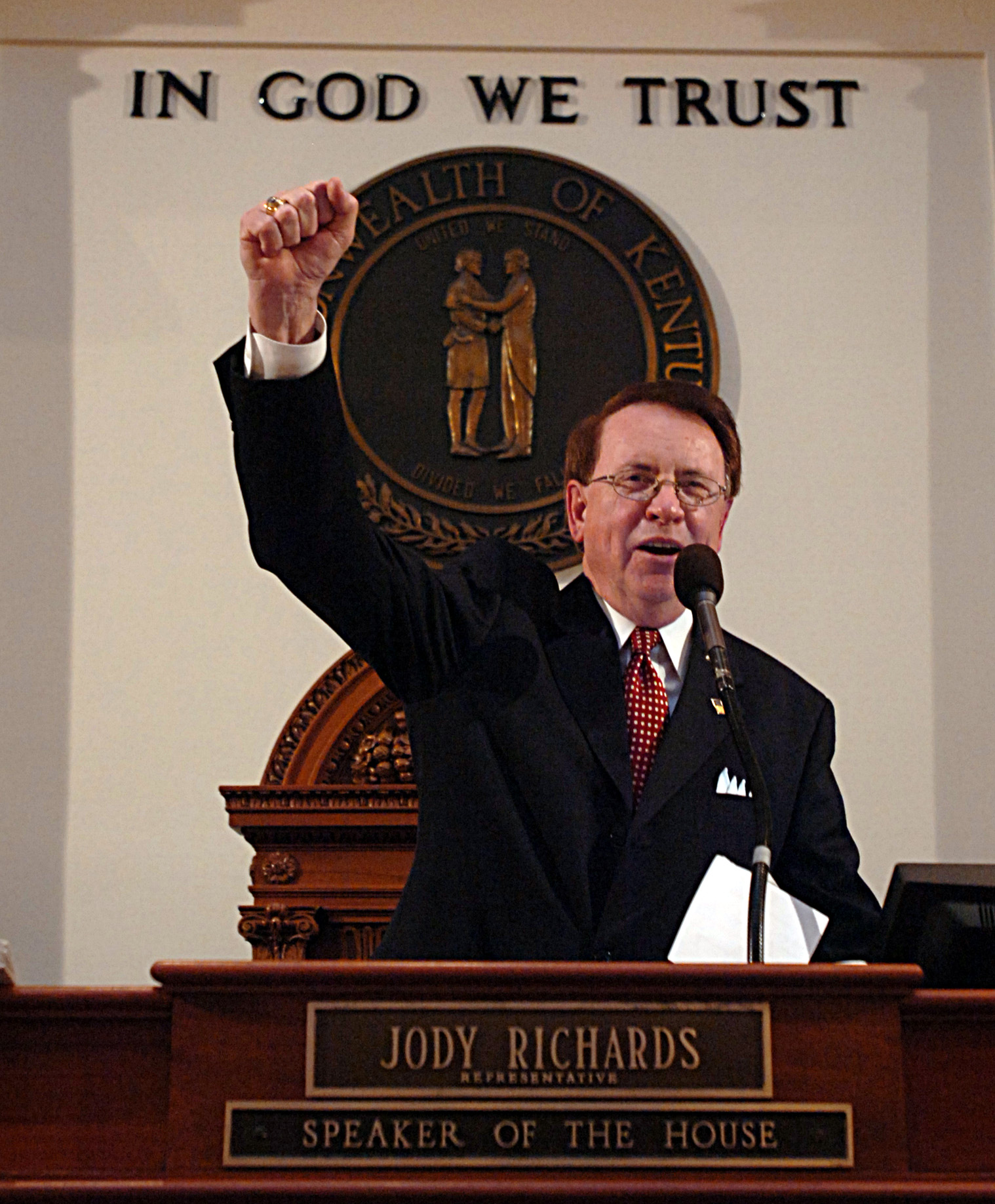
Former KY House Speaker Jody Richards
I rose from my seat and approached Richards. “Hey, Mr. Speaker, how’s it goin’?”
He clasped my outstretched hand and pumped it furiously. “Hey there, young fella, how ya doin’?”
“I’m great. How’s the campaign going?”
“Well, pretty dern good!” He gestured to the patio, where an embarrassingly small group of supporters had gathered for the BBQ. “Look at all these folks! I’d say things are pretty dern good! What’s yer name, young fella?”
“John,” I lied.
He reached out and pumped my hand some more. “It’s great to see ya, John. Where ya from?”
“Oh, right down Bardstown,” I replied, gesturing vaguely to my left, praying he wouldn’t pursue that line of inquiry any further. I needed a distraction, fast. “So, tell me about your platform.”
Read the rest of… Jeff Smith: When “John” Met John Y.
In his role as a contributing member of Politico’s “Arena,” contributing RP Jeff Smith was asked if he believed the U.S. Senate’s “Gang of Six” — a bipartisan group formed to develop a solution to the budget deficit crisis — would remain relevant after the recent departure of conservative Republican Senator Tom Coburn of Oklahoma.
Here’s Jeff’s answer:
The Gang remains relevant. Given his nature, Coburn could return as easily as he left; sure, he may be frustrated, but it’s probably just a tactic to get more movement from Durbin. Apparently they’re close to an agreement; if $130 billion more in Medicare savings is the main sticking point in an effort to achieve $4 billion in overall debt reduction, it would seem that this impasse can be bridged. And the ten weeks remaining to bridge it is an eternity: as with a tied NBA championship game with ten seconds left, there may be many more twists and turns to come.
Last week I wrote about congressional redistricting, and the messy inter- and intra-party hostility it engenders – and is currently sparking in my home state of Missouri.
Congressman Russ Carnahan
And as hypothesized, more hostility developed in Missouri following the Legislature’s override of Governor Nixon’s veto of the map. Because Missouri lost a seat during the apportionment process, the new map divides up Congressman Russ Carnahan’s district among four other districts, and Rep. Carnahan has been lashing out – first a few weeks ago at his fellow Missouri Democrat Rep. Lacy Clay, and then a few days ago at another Missouri Dem, Rep. Emanuel Cleaver, for going along with the decimation of his district. Of course, he is more privately seething at the four Democratic members of the state House who defected and voted for the override.
Does anyone really think Rep. Carnahan would be working to kill the map if the Republican Legislature had proposed to divide Rep. Clay’s district four ways and force him to run in an overwhelmingly white district? If you do, you’ve probably never seen Jane Elliot’s famed Brown Eyes, Blue Eyes experiment – and you don’t know much about human nature. Instincts for self-preservation are strong, power intoxicating, and race often wielded as a tool to gain and maintain it.
***
Now, surely Rep. Carnahan is angry at the Republicans for drawing these maps, but that anger is mild: he had to have expected it from them. Carnahan’s more visceral fury has been directed at his co-partisans.
Read the rest of… Jeff Smith: Dirty Tricks: On Race, Redistricting, and Stalking Horses
We are proud to announce that our own contributing RP, Jeff Smith, has been asked to join “The Arena,” Politico’s daily debate with policymakers and opinion shapers.
Jeff’s first piece was in response to the group’s discussion of the state of the economy:
Using the absolute number of jobs created as a gauge of employment trends can be deceiving for a couple simple reasons.
1) The economy needs to add somewhere in the neighborhood of 200,000 jobs per month just to keep up with population growth. So the first couple hundred thousand jobs added generally won’t reduce unemployment because of a growing denominator…
Before and during my time in the state Senate, I taught political science for a decade, and no issue fascinated my students more than redistricting. Once I opened class during the week on redistricting by bringing several chairs to the front of the lecture hall, turning on Snoop Dogg’s anthem “Who Am I?”, and leading students in a game of Musical Chairs. (I picked Snoop because the mentality of politicians facing redistricting is pure gangsta: you do whatever you need to do to survive. Also, I wanted students to think that in a past life, I was pretty cool.)
Bow Wow Wow.
It was thru the prism of Musical Chairs that I explained how redistricting works in states that lose a congressional seat, as Missouri has this year. The seat that disappears under the Republican-drawn map is the seat I contested back in 2004. (In the interest of full disclosure, it is occupied by Congressman Russ Carnahan (D-MO), the man who narrowly beat me and pursued an FEC complaint about an anonymous postcard mailed at the end of the campaign, the knowledge of which I hid from the feds, ultimately leading to my prison term.)
In any case, the current situation has inspired quite a bit of internecine tension. For instance, according to Politico, after their districts were combined in a way perceived as unfavorable to him, Rep. Carnahan recently told fellow Missouri Democratic Rep. Lacy Clay to f- off. In his public response, Rep. Clay channeled former warrior-entertainers “Nature Boy” Ric Flair and Muhammad Ali. The F-bombs weren’t limited to the Democratic side: Republican leaders of the House and Senate were also at odds in their attempt to draw a map that appeased the varied interests at the table.
Read the rest of… Jeff Smith: The Recovering Redistrict-aholic
The recent attention to local and national politicians’ racial gaffes reminds me of my own.
As readers may be aware, politicians have lately dredged up one of the ugliest aspects of our nation’s history: slavery and the subsequent century of brutality and discrimination. Haley Barbour has often tripped himself up, beginning with his 1982 watermelon comment. More recently he’s praised the ignominious Citizens Councils and declined to condemn a proposal to venerate Confederate war hero and founding KKK Grand Wizard Nathan Bedford Forrest with an honorary license plate.
Former Virginia Sen. George Allen of “macaca” fame had another recent gaffe, where he twice (erroneously) assumed that a tall black reporter was an athlete. Even the ever-poised Alex Trebek may have slipped up.
Closer to home in St. Louis were the comments of State Sen. Maria Chappelle-Nadal, who compared the black state legislators opposing her on a bill – that is to say, all of them – to “house slaves.”
***
I spent years walking a racial tightrope in city politics. I represented a district that was roughly 55% black, 6% Asian, 5% Bosnian, and 4% Latino. Since it was also estimated to be 15% gay, the percentage of straight white males like me was likely in the single digits.
Not that I minded. I actually found it exhilarating. At first.
See, I’d grown up in a mostly white, middle-class suburb, but about 10% of my graduating class was comprised of black kids bused from the city as part of a school desegregation program. By my senior year, they comprised most of the basketball team, and as point guard, it was my job to lead the team.
My co-captain once told me that when he came out to our school freshman year, he was three years behind us academically. That pissed me off. It also made me want to learn more about the history behind the inequity. So at UNC-Chapel Hill, I majored in African-American Studies.
Conservatives like to invoke the guilty white liberal. I wasn’t guilty as much as obsessed. I wanted to immerse myself in the city’s black community and help black kids get to college.
So I came home from UNC and worked in the city public schools. Frustrated at the system’s dysfunction, I co-founded a charter school whose enrollment was 99% black. I served on the boards of non-profits focused on racial justice and black uplift. I coached basketball for a decade at a boys club where the only white people I saw were the occasional white refs. I taught ACT prep courses for black high school players in danger of becoming Prop 48 casualties. And when I played, it was with strangers in one of the small parks that dotted the corners of the city’s North Side, where the competition was fierce.
The point is, when I jumped in the race for Missouri’s 4th Senatorial District, I felt at least as comfortable around black people as I did around white people.
By Jonathan Miller, on Tue Apr 19, 2011 at 9:15 AM ET
Pardon the interruption for some HUGE RP NEWS:
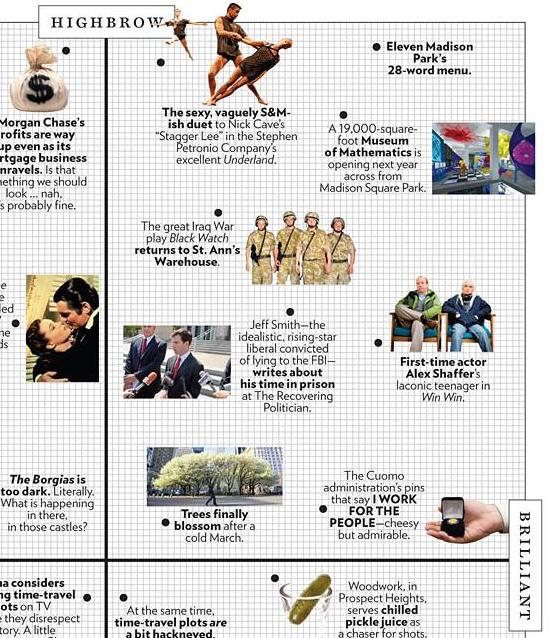
Contributing RP Jeff Smith, his stunning inaugural piece on his journey from politics to prison, and The Recovering Politician Web site, were highlighted this week by New York magazine’s The Approval Matrix, a leading national arbiter of the pop culture zeitgeist. (And now a TV show on Bravo.)
Best yet — Smith’s piece received the top rating: The Approval Matrix deemed it “Highbrow” (vs. “Lowbrow”) and “Brilliant” (vs. “Despicable”).
A pretty incredible development for a contributing recovering politician just beginning his second act and a Web site in only its third week.
Here is the screenshot of the top right corner of the matrix — click on it to read the entire page at the New York web site:
By Jonathan Miller, on Tue Apr 19, 2011 at 8:30 AM ET
By popular demand, today’s guest on RPTV’s Fifteen Minutes of Fame is contributing RP and former Missouri State Senator Jeff Smith. Jeff’s inaugural post for The Recovering Politician has electrified the blogosphere; already more than 10,000 people have read Jeff’s stunningly candid retelling of his post-political experiences in a federal prison.
In this morning’s interview, Jeff addresses many of the questions that our readers have posed since his article’s posting on April 4. If you are new to this site, be sure to read the following articles BEFORE you watch the interview:
Our own Contributing RP, Jeff Smith, may have never dreamed that any good would come from his required stay at a federal prison. But the unlikeliest of environments proved to be an unexpected fountain of entrepreneurial spirit.
Jeff writes about what he learned in this week’s Inc. magazine:
B.J. was one of many fellow inmates with big plans for the future. He vowed that upon his release, he’d leave the dope game and fly straight. He’d recently purchased a porn website targeted at men with a fetish for women having sex on top of or inside luxury cars, with a special focus that explained his nickname. For just $10,000, he had purchased the domain name, the site design, and all of the necessary back-end work enabling financial transactions. The only component B.J. needed to supply were the women, and due to his incarceration, he’d named his 19-year-old son “vice president for personnel and talent development” and charged him with overseeing auditions. Who says a good old-fashioned family business can’t make it anymore?
It was my first week in a federal prison, and I was beginning to see that it was far more nuanced than the hotbed of sex, drugs, and violence depicted on television documentaries. It was teeming with ambitious, street-smart men, many who appear to have been very successful drug dealers on the outside, and some of whom possess business instincts as sharp as those of the CEOs who wined and dined me six months before. Using somewhat different jargon than you might hear at Wharton, they discussed business concepts such as promotional incentives (“I don’t never charge no first-time user”), quality control and new product launches (“you try anything new, you better have some longtime crackhead test your new shit”), territorial expansion (“Once Dude on the East Side got chalked, I had my dopeboys out on his corners befo’ that motherf—er’s body was cold”), and even barriers to entry (“Any motherf—er that wanna do bidness on the West Side know me and my boys ain’t scurred to cap his ass”).
By Jonathan Miller, on Thu Apr 14, 2011 at 12:30 PM ET
The one thing that I miss least about leaving the political arena is the lying.
If there’s one quality that unites Democrats and Republicans, politicians and the press corps; it is their mutual propensity for, and expectation of, fabrication.
Often, it’s the small lies that wise and wary observers can sniff out before they do harm: Sure I’ll raise $10,000 for your campaign. You can count on me to support your cause in the legislature. My, you look way too young to be a grandmother! Don’t worry, I’ve had a vasectomy.
Most common is “political spin” which, all too regularly, is simply a euphemism for lying: Barack Obama is a Socialist. The Republicans want to hurt poor people.
Every now and then, you encounter stone-cold, pathological liars in the business. They’re rarer than the profession’s reputation, but I’ve run into too many elected officials, reporters, and political operatives whose every utterance I’ve learned to disbelieve or suffer the consequences. And I despise it.
But should we put all of these liars into jail? Of course not.
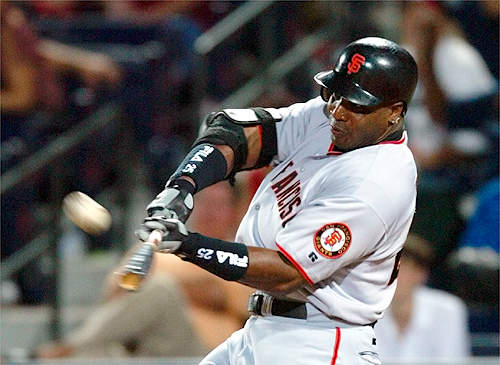
Yesterday, Barry Bonds was convicted for obstructing justice by lying to a grand jury about his personal steroid use. (Which begs the question — asked by Dashiell Bennett — how could Bonds be guilty of obstructing justice for lying when the perjury charges against him were rejected by the same jury?)
Note that Bonds was not convicted of — or even charged with — illegal use of steroids. His entire prosecution was based on his lying about his use, in an ultimately unsuccessful effort to protect his professional reputation.
Bonds is not the cleanest case because steroid use is illegal, and Bonds is such an unlikeable narcissist.
The most famous example of this controversy is even more polarizing. Like Bonds, President Bill Clinton lied to the American people and gave controversial answers to a grand jury in order to protect his public reputation. But here, the underlying misbehavior was not illegal. As Republicans like Newt Gingrich have been quick to assert, the 1998 impeachment was not about the sexual affair — which is not a crime in the District of Columbia — but rather about the President’s lying about it before a grand jury. While Clinton’s verbal parsing may have technically immunized himself against a perjury conviction, it is clear that he was impeached by the House for lying about underlying behavior that wasn’t a crime.
As a former member of the Clinton Administration, I’m biased; but I am comfortable saying that, without any partisan considerations, lying about a perfectly legal action should not be the basis of removal from office. And so did most Americans.
Let’s take an even cleaner case: that of contributing RP Jeff Smith. (Again, I admit bias: Jeff is my friend.) If you’ve read his stunningly candid story on this Web site, you know that Jeff was convicted of lying to federal investigators about whether he had knowledge of a scheme to distribute negative fliers about his campaign opponent. The underlying behavior may have violated campaign finance rules, but surely did not merit a jail sentence. And I argue, neither should his lying about it.
Did Jeff deserve to be punished? Absolutely. Stripped of his public office? Perhaps. But sentenced to serve a one-year term in a jail filled with violent offenders? I believe the punishment overwhelmingly exceeded the crime.
Of course, I am not arguing in any way that perjury and/or obstruction of justice should be considered misdemeanors or civil violations in every instance. Of course, lying to an authority about illegal activity, particularly of a violent nature, must be punished severely.
Nor am I arguing that there should be no punishment whatsoever in these circumstances. Lying to an authority is wrong; and the offender must be held accountable for his or her actions.
But someone who lies about a non-violent, non-criminal activity, in order to protect his reputation and family — a very natural, human instinct — should not be treated akin to a violent criminal.
I will soon be interviewing Jeff for RPTV to discuss this issue. But I’d like to know your opinion first: Does lying to a grand jury or an investigator about a legal activity merit a jail sentence? What are your suggestions for reform? Or do you like system the way it is?























Follow Jeff Smith: