Karl Rove has been spectacularly right about one big thing in his far-flung career: his calculation that Republicans in the late nineties and early 2000s needed to be rebranded as problem solvers, who had a formula to compete on Democratic terrain like education and health-care, outflanked Clintonian centrism when it was on the verge of realigning American politics. Rove was just as spectacularly wrong on another front, his blind spot on the risks of conservatism “going corporate” and turning into just another patchwork of special interests and powerbrokers.
It’s worth keeping the dual nature of Rove’s Bush era legacy in mind as he plots an ambitious effort to intervene in primary fights on behalf of Republicans who are…well, that part remains vague, but excludes at least candidates with a history of dabbling in witchcraft or who have a penchant for philosophizing on gynecology.
If Rove’s version of influence merely takes the form of injecting one more source of shadowy cash into races, then he has already misread recent campaign cycles. Deep-pocketed front-runners from Charlie Crist to Bill Bolling never made it past the starting gate, and it is the insurgents who have cleaned up in GOP state primaries who have been chronically under-funded. The missing element for the losers in these fights has not been a lack of cash to sustain ads or phone banks, but an inability to mobilize rank and file primary voters with either a policy vision or a rhetorical message beyond inside baseball about electability.
In an era where the activists who dominate party primaries award no extra points based on time served in office, or chits from funneling checks to local party committees, the populist, anti-establishment wing of the party has filled a void. In blunt terms, their fears are not getting outflanked with swing voters, but getting trammeled by a government that serves every agenda but theirs. They distrust “reform” as a code for more mandates. They are corrosively suspicious of political power because it seems too subject to being rented or bought by corporate power. And many of them have adopted a Manichaen view of politics that genuinely considers constitutional liberty and fiscal stability to be in some degree of jeopardy.
Read the rest of… Artur Davis: The House that Rove Built
My friends, family, and students are used to my repeated profession of love for modern technology. They laugh when I pledge adoration for my camera, washing machine, air travel, television, teleconferences, the iron lung (I just watched The Sessions with Helen Hunt and John Hawkes—great movie by the way), movies, my blender, power-point projectors, computers and the web, and, my iPhone!
This is an amazing time to be alive; I feel deeply, deeply, deeply fortunate to live in this part of the world today. I have such gratitude for these intelligent inventions that make my life easier and bigger (consider the amount of time it used to take our great grand-mothers just to wash family laundry. I don’t know about you but I don’t have time to beat my husband’s shirts and underwear against the rocks at the local stream). And I love my automatic garage-door opener so much.
BUT, no matter how terrifically these things enhance, ease, and upgrade my life, they take up but a speck of space in my heart compared to what I feel for the essential celebration-worthy, beauty of interaction between human beings.
I’m talking about friendship here. Today I profess my love and adoration for this. It’s fitting for valentine week, too.
The typical starter in blooming friendship is life-commonality—resonating with the experiences, views, needs, interests, and dreams that others also hold dear.
“We know this, we know this—we’ve had friendships since kindergarden—they come and go, some last, there will be more where that came from.” For many people the commonality of friendship has become so expected that its essential value to human happiness is enormously undervalued.
Have you ever observed the way that 10 year olds appreciate their new friends, or on the flip-side, teenagers who don’t have any? What about Facebook—I know a lot of people who spend some good amount of time there, making friends and keeping them, in space, ahem.
From a human-development hierarchy-of-needs perspective, friendship is to the human spirit as manna was to the Hebrews.
Watch this terrific video about the blooming of friendship—it’s just 4 minutes and 53 seconds long—your heart will like it and you will observe human spirit in action as time and place seem to recede (and that’s not an easy set-up for grown-ups sittin in a ball-pit on a busy urban side-walk), and complete strangers become important and personal to one another:
(This video created by Soul Pancake by the way, a fabulous site that captures art, philosophy, science, spirituality and humor, and serves it up all warm and (ful)filling.)
Now I ask myself what it is that I look for in friendship today. Have you deliberately thought about this lately? Me thinks this an important question. As adults we’re no longer really limited in our choices for the most part—we’re out there in the world with options greater than who lives next door or who sits next to us in classroom alphabet seating.
I loved that the question from the ball-pit was “who inspires you?” not, who pisses you off that you want to complain and gossip about? We absolutely have choice when it comes to whom we want to spend time with. And time is definitely a “spending”—there’s no reason to waste it in depleting relationships with “friends” who remind us of our worst qualities.
So I’m making this a valentine week of heartfull thought about what I most appreciate about my loved-ones (you know who you are! Mu-ah!), all those I’ve loved in friendship but who are no longer in my life, and the type of friend I want to continue to grow into.
And finally, with this brilliant invention called YouTube, applaud with me here as I sit in awe as two of my favorite things come together in this video: the seeds of unexpected spontaneous friendship, and the technology that allows us a ringside seat at the beauty of it.
By Jonathan Miller, on Tue Feb 12, 2013 at 3:00 PM ET
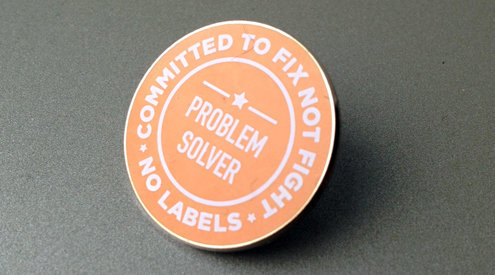
ICYMI, Sen. Joe Manchin was all over the airwaves yesterday, talking about No Labels and sporting our new Problem Solvers’ pin:
“I’m wearing the [No Labels] pin… We’re not here to fight, we’re here to fix things. That’s what we do in West Virginia and that’s what I’ve found No Labels to be here in Washington,” he said.
The problem solvers’ pin says something about Sen. Manchin: that he will put his country first and reach across the aisle to face down the challenges that threaten our future.
Forty members of Congress will wear their problem solvers pin, like Sen. Manchin’s, at the State of the Union tonight — they’re showing their colleagues that they are committed to working across the aisle and building trust between parties. Sign the petition to show your support for these problem solvers.
Follow along with the State of the Union tonight and tweet your thoughts using the hashtag#FixNotFight.
By Lauren Mayer, on Tue Feb 12, 2013 at 1:30 PM ET
We all have our own irrational fears, based on an emotional response rather than facts. Kids are afraid of monsters in the closet, phobics are afraid of spiders or the color red, single men are afraid of commitment, I’m afraid of cheerleaders – none of these things actually pose a threat, and we eventually either grow up, learn to move past our fears, or in the case of my husband, realize that being married is way more fun than he’d thought.
So with the Supreme Court preparing to hear cases related to gay marriage, it’s time to apply that same standard of rationality to the objections raised by opponents. Gay marriage has been legal in Massachusetts since 2004 (as well as in many progressive states and countries, and frankly, we in California should be ashamed of ourselves for being less progressive than Iowa and Canada!). Therefore, instead of vague fears, we can look at the actual effects on society in those locations – and guess what, absolutely nothing bad has happened. The predictions of societal catastrophe, public fornication, gender confusion, and children behaving terribly have not come true – in fact, the divorce rate has declined in Mass, and experts predict we’ll see the same effect in other states once more data is in. So one could argue that gay marriage is GOOD for society as a whole, not just for all those committed couples who are denied the legal protections we take for granted. (Note – the way I convinced my previously commitment-phobic husband that we needed ‘just a piece of paper’ was to point out that our gay friends have to spend thousands of dollars in legal fees to get a fraction of the protection we could get for $50 and a quick trip to City Hall.) (Although now I let him think the whole thing was his idea!)
There are so many real things in this world of which to be afraid – financial collapse, global warming, more Kardashian reality shows – so I believe it’s time for opponents of gay marriage to recognize that there is nothing to fear, and to go find something that actually justifies worrying. And to help them along, here’s a song examining the evidence.
By John Y. Brown III, on Tue Feb 12, 2013 at 12:00 PM ET
Identity management tool
I was asked by Apple iTunes a question to confirm my identity and allow me access to my account
The identity question ?
What was the first album you purchased?
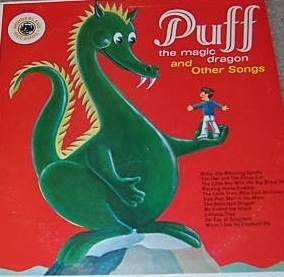
I answered–after considerable thought –Puff the Magic Dragon. It was 45 years ago but I remember it well.
But I was told “no” that wasn’t the album.
How do they know?
Can I find out from Apple what the album was I first purchased?
May be they will say the Monkees….but that was my second album.
I will call tomorrow to protest this block to my account and I will have affidavits from my mom and two sisters that, indeed, it was Puff the Magic Dragon.
By Nancy Slotnick, on Tue Feb 12, 2013 at 8:30 AM ET
“The only way you could meet my crazy was by doing something crazy yourself.” –Bradley Cooper as Pat in Silver Linings Playbook
We all bring our crazy to a relationship. Silver Linings does a beautiful job of writing a relationship where both participants are crazy but they take turns. They meet each other where they’re at. They end sentences with a preposition. They scream and throw dishes in public. They hug people whom they have a restraining order against or from. They end sentences with a preposition again. Did I mention that people call me crazy? They think I’m dreaming my life away, just like John Lennon wrote.
I struggle with how to let people into my life without letting them take over. How to embrace my crazy without getting caught up in it. How to recognize someone else’s crazy when they’re telling you it’s you. And when it’s also you. So complicated.
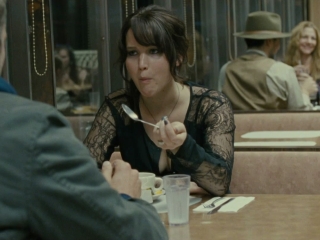
Spoiler alert- I’m going to talk about Silver Linings some more- I just loved it so much. It is rare for a romantic comedy (nay, romantic comedy/drama) to get it right without being trite. One of my favorite scenes was at the diner. Tiffany (Jennifer Lawrence) opens up about herself and seems to be having a moment with Pat. She offers to help her out and then he insults her by not wanting to be associated with her in the context of his ex-wife.
Rather than crying and running out of the restaurant (at first, at least), which I would have done, she balks. That’s the best word for her face. She looks at him, condescendingly, and says; “You actually think I’m crazier than you.” Not in the form of a question, but as a statement of disbelief. It’s great. I admire that. I wish that in the midst of a heated argument I could have the composure to do that. It was awesome. And then she smashes all the dishes off the table in one fell swoop and runs out of the restaurant, crying. I kind of wish I could do that too. The dishes part. The crying part I’m good at.
The beauty of it is that Pat realizes in that moment that he’s crossed a line and then he comes to the rescue on her crazy. They go back and forth on this as their relationship blooms. And that gives new meaning to the phrase the “dance of intimacy.”
Read the rest of… Nancy Slotnick: People Think I’m Crazy
Contributing RP and former Missouri State Sen. Jeff Smith talks about his political advice column, “Do As I Say,” which helps other politicians and professionals who find themselves in compromising positions:
By John Y. Brown III, on Mon Feb 11, 2013 at 12:00 PM ET
The difference between guys and dogs.
When a dog catches a car it pauses and looks genuinely confused….and saunters off knowing he miscalculated the payoff and feeling foolish (even by dog standards).
When a guy catches the equivalent of a car he has been chasing (so to speak), he seems uncertain for a nanosecond and then immediately projects the image of someone positively thrilled with his capture, of knowing exactly what he was doing and what to expect, and poses as if to say, “Seriously folks, have you ever seen such brilliantly successful car chasing before ? I didn’t think so.”
And then before any sliver of doubt emerges begins looking for the next car to chase (figuratively speaking) –as his audience watches on approvingly.
Other than this distinction guys and dogs are otherwise very similar.
By Erica and Matt Chua, on Mon Feb 11, 2013 at 10:00 AM ET
Jerusalem is a loaded word. I could preface that with “these days”, but the reality is that it’s been a place of dispute more than peace. ”It has been destroyed twice, besieged 23 times, attacked 52 times and changed hands 52 times,” according to Wikipedia. If Jerusalem was a sporting event it’d be the must watch game of all-time. We’d be glued to the television wondering how it was going to end, cheering when our side gained the lead and screaming in dismay when control changed hands. The only thing everyone would agree upon is that the officials, those “independent” outside arbiters, were terrible. Sadly the sporting analogy is all too apt, religions are the teams, officials are foreign powers, and Jerusalem is the trophy. Why fight for this trophy? The agnostic doesn’t see a reason.
The golden Dome of the Rock on the right is one of Sunni Muslim’s most sacred sites along with the location of the Holiest of Holies for Jewish people. Just behind this is the Church of the Sepulchre one of Christianity’s holiest sites.
Jerusalem and Israel as a whole is a place where assigned value trumps real value. The value of these places isn’t real, there aren’t $2 billion plus gold monuments like Shwedagon Paya in Myanmar. The land isn’t productive like Iowa. The riches don’t lie beneath the ground like in Venezuela. The country isn’t a paradise like Palawan. There is nothing tangible worth fighting for in Jerusalem or Israel. The reality is that if all of Israel were to fall into the ocean the world wouldn’t be affected. The problem is that people believe that it would affect us. Jewish people believe that theFoundation Stone in the Dome of the Rock is the meeting point of Heaven and Earth. Both Sunni Muslims and Christians believe that their prophet ascended to Heaven from Jerusalem. While these places have limited actual value, for the three of the world’s major religions, Jerusalem is priceless.
Read the rest of… Matt and Erica Chua: An Agnostic Walk Through Jerusalem
By Jonathan Miller, on Sun Feb 10, 2013 at 11:19 AM ET
Last week, I joined Kentucky Agriculture Commissioner Jamie Comer in support of legalizing industrial hemp on the public broadcasting program, Kentucky Tonight. Click the picture at left to watch our debate with law enforcement officials.
Viewers of the program noticed that the two sides disagreed on some very critical underlying facts about the differences between hemp and marijuana and how the two plants are grown.
Janet Patton of the Lexington Herald-Leader spent a few weeks investigating this matter, and interviewing objective experts. Here is an excerpt from her story published today:
The nightmare hemp scenario for Kentucky State Police apparently is a field legally licensed to grow hemp forgrain with illegally planted marijuana mingled in.
Unlike hemp grown for fiber (when the plants are inches apart to promote tall stalk growth), the hemp grown for grain and marijuana plants would look substantially the same, said Jeremy Triplett, supervisor of the state police forensic lab.
Both could be shorter and bushy. The only way to really know, he said, would be to test for delta-9 tetrahydrocannabinol, or THC, the chemical that gives marijuana smokers a high.
Such testing could cost hundreds of thousands of dollars each year, at $755 per quantitative analysis, not to mention $1.8 million in start-up expenses, state police have estimated.
But would that really happen? Would an unscrupulous pot grower plant marijuana with hemp?
Take Canada, where marijuana also is illegal but hemp has been legallygrown since 1998. “Health Canada’s Industrial Hemp Program has never found marijuana growing in hemp fields instead of hemp,” the agency said in a statement.
They’ve looked. A lot.
Canadian inspectors take samples annually from each field and have found THClevels slightly above 0.3 percent from stress during growing, but not above 0.5 percent, Health Canada said.
Keith Watson, Manitoba Agriculture Food and Rural Initiatives agronomist, has seen and tested most of the hemp grown in his province in the past 15 years. Does marijuana creep in?
“I’ve never run into it,” Watson said. About 95 percent of the crop is sampled annually, and he said that marijuana and grain hemp might look just alike and could be planted side by side and only an expert eye might distinguish the difference. But in his experience, it just doesn’t happen.
“Over the years, that’s taken me out to an awful lot of fields,” Watson said. “I’ve never found marijuana in the field or any trace of it.”
He said a “handful” of times he has seen paths cut into the fields, places where people have topped the plants. But it doesn’t happen much anymore.
“After a couple of years, nobody bothers it,” he said.
What about marijuana?
As for marijuana growers using hemp to pad their illegal pot, “the general impression is that’s a self-regulating industry,” Watson said. “They’ll get away with it once … but if the quality (of the marijuana) isn’t up to par, there will be a lot of broken kneecaps.”


 In an era where the activists who dominate party primaries award no extra points based on time served in office, or chits from funneling checks to local party committees, the populist, anti-establishment wing of the party has filled a void. In blunt terms, their fears are not getting outflanked with swing voters, but getting trammeled by a government that serves every agenda but theirs. They distrust “reform” as a code for more mandates. They are corrosively suspicious of political power because it seems too subject to being rented or bought by corporate power. And many of them have adopted a Manichaen view of politics that genuinely considers constitutional liberty and fiscal stability to be in some degree of jeopardy.