The virtual economy of Facebook: how much is it worth? [CNN Money]
The bidding war over James Bond. [Forbes]
The battle of the sexes at Harvard Business School. [Fortune]
Fed Chairman Ben Bernanke’s latest press conference: a non-event? [The Street]


 |
|||
|
The virtual economy of Facebook: how much is it worth? [CNN Money] The bidding war over James Bond. [Forbes] The battle of the sexes at Harvard Business School. [Fortune] Fed Chairman Ben Bernanke’s latest press conference: a non-event? [The Street] Today’s guest for RPTV’s Fifteen Minutes of Fame is the noted author, television commentator and GOP policy guru, Jim Pinkerton. Going back to the George H.W. Bush Administration, Pinkerton has been one of the leading Republican policy minds in Washington. Unlike most of cable TV’s talking heads, Pinkerton does not stick to the party script, and has consistently pushed his party to the center on social issues, while remaining a fierce advocate for fiscal conservatism and the free markets. Pinkerton is also a frequent blogger. Check out his Web site here. During his Fifteen Minutes of Fame, Pinkerton discusses the debt, his prescription to battle income inequality, and despite needling from the RP, does NOT endorse Donald Trump in 2012. Watch here:
Here’s an excerpt — the link to the entire op-ed piece (originally published in the Manchester Union-Leader) can be found below it:
The Shanghai Car Show’s rise to prominence pits it against the NYC Car Show. Do you go to see the cars or the models? Be honest! [MSNBC] Finances are dictating college and career choices according to latest polling data. [Businessweek] Rising prices are beginning to hit home. [NBC Nightly News] Don’t tell Junior. Boomers are keeping their kids in the dark about their wealth. [Forbes] Trump-watch continues: Just how rich is he? As rich as he feels! [CNN Money] Citigroup’s annual shareholder meeting: no longer a cage-match? You decide. [NY Times]
Among the dozens of hats that he wears, Contributing RP Andrei Cherny edits Democracy: A Journal of Ideas. His post this month reflects on his status as a recovering politician. But even more, it makes a passionate case for progressive economics in an era that seems to be focused on selfish materialism and me-first politics Here is an excerpt — the full link is below:
I am a partner at Akin Gump Strauss Hauer & Feld, an international law firm with more than 800 attorneys around the world. And not just *any* partner, but the Pro Bono Partner, leading a firm-wide practice group in which more than 550 of my colleagues work every year, collectively devoting nearly 60,000 hours annually to a wide variety of indigent clients and public interest causes. I work very hard, but I rarely bill an hour. How did I get this gig? Well, like many such stories, this one starts with a large Nigerian coming to my office one spring afternoon. On that day more than 13 years ago, I was a litigation associate at an even larger international law firm, Latham & Watkins. My practice consisted primarily of advising large corporations facing all manner of antitrust issues, from mergers and acquisitions being challenged by the Department of Justice to competitors suing over allegedly wrongful conduct. To put it bluntly, my practice was as relevant to a Nigerian man as the Washington Nationals are to the National League pennant race. 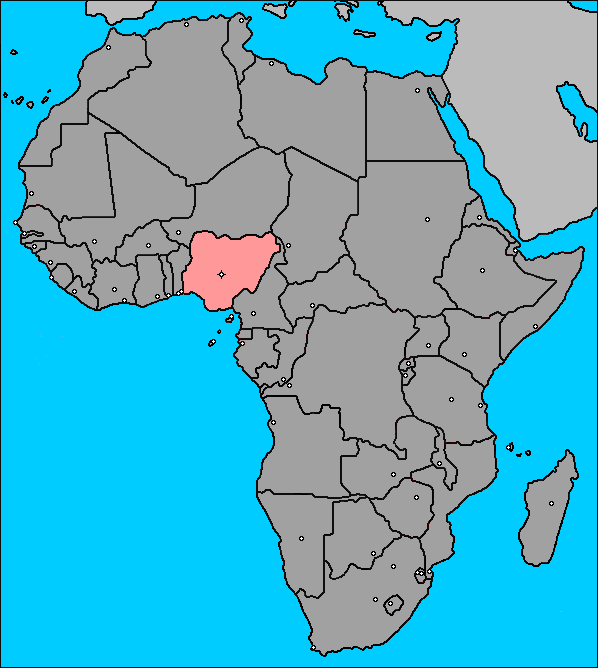 Placing Nigeria on a map... But there he was, because I had raised my hand at a litigation group lunch when someone asked for help in this Nigerian’s immigration court case. Once we settled into a conference room, Tolu introduced himself and then his quite large family — both physically and numerically. My charge: get them asylum. Second place: deportation back to Nigeria, likely to return to the prison where he had been detained and tortured for his pro-democracy activism. I had never set foot in an immigration court, not could I confidently place Nigeria on a map. But I did have enough legal training to figure it all out, and enough pressure, given the stakes, to motivate me to work as hard as I would for any paying client. Obviously, we won, or else I would still be worrying about how to get approval for the merger of the largest and second-largest widget makers in the North American market. Winning Tolu’s case set me on an unusual path, one that eventually led me to focus on pro bono practice half-time (at Latham) and then full-time (when I joined Akin Gump in 2006). It consequently led Jonathan to place on me the moniker of “recovering antitrust lawyer.” I resisted this label at first – after all, I did not surrender my law firm credentials or lifestyle, and count among my partners some fine antitrust lawyers. I am still very much part of the law firm world. Then again, the recovering politicians who contribute to this site are in similar positions – at once quite engaged in politics, even if no 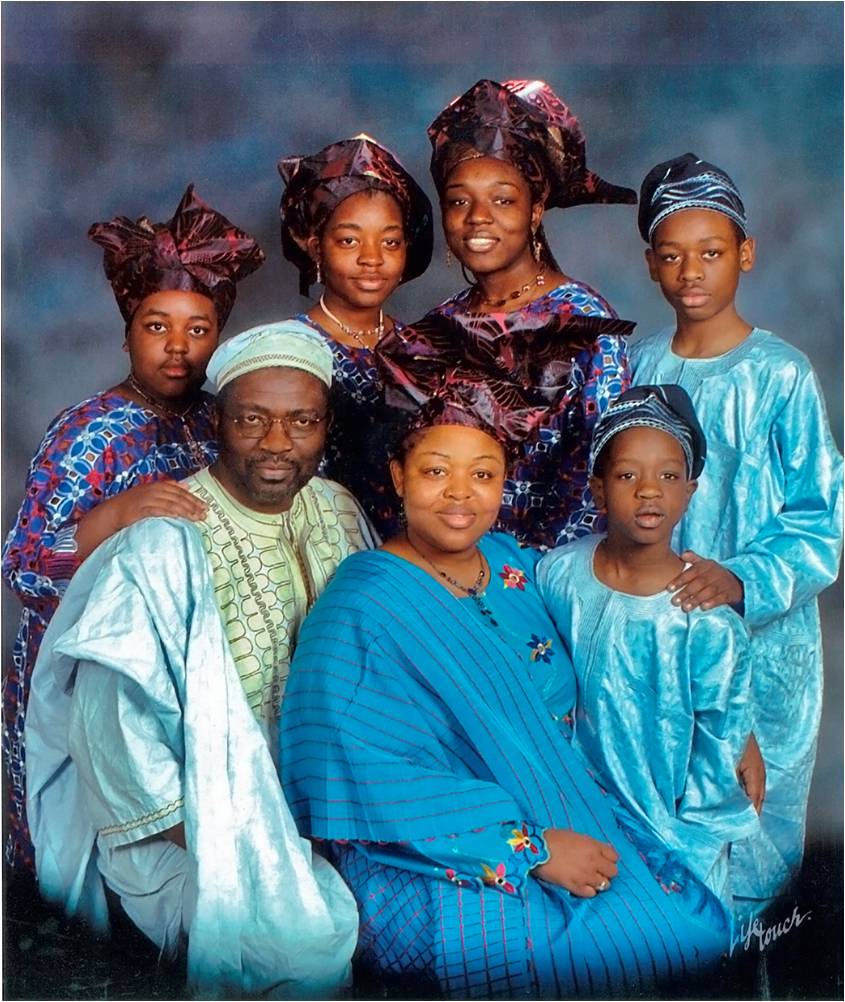 Tolu and family Like these RPs, I don’t reject my former practice. Rather, I embrace the law firm model and ethos, but work to improve our firm by pushing it to meet the lofty ideals of our profession. Representing Tolu, and subsequently other refugees from all over the world, inspired me not just to do this work myself, but to enlist others to use theirtalents to serve the less fortunate among us. I continue to be inspired by my colleagues, who selflessly give their time to advise the KIPP charter schools or fight for Social Security benefits for disabled clients. My fellow Akin Gump attorneys show every day that the billable hour isn’t the only law firm value, as much as the profession has been driven to act more like a bottom-line business. ——
I want to thank Jonathan Miller for giving me the chance…as a recovering politician…to contemplate this week on the relation between faith and politics. After my eight years as Lt. Governor of Maryland, I wrote “Failing America’s Faithful: How Today’s Churches are Mixing God with Politics and Losing Their Way.” I thought that many churches that had once served as a counterweight to a nation overly obsessed with money were no longer were fulfilling this critical function. Religious communities were strong and vocal during the Civil Rights era, and in the protests against the Vietnam war, following a strong tradition which began in the First and Second Great Awakenings, during which ministers preached to thousands (and this was the time before microphones!!) demanding justice. The Abolitionist movement and the Suffragette movement both grew out of the Second Great Awakening. The late 19th century was the time of the Social Gospel activists, who asked “What would Jesus do?” as a way to urge the end of child labor, and to promote safe working conditions, a strong union movement and fairness for prisoners. FDR compared the New Deal to the “Sermon on the Mount” enacted into law. In the thirties and forties, Jesuits ran over 300 labor organizing schools. This Holy Week — Passover, Good Friday and Easter — is the perfect time to reflect on our lives. What have we done? What should we be doing? Questions of justice and fairness permeate our conversations. As an added bonus, this spiritual moment coincides with the fierce debates about the budget. We can and should engage in examination of conscience and examination of country. My fear is that the religious communities will not play the vigorous role in this debate as they have in our past. Unfortunately today, may churches seem to have shrunk God, so that rather than a Deity who cares for the whole nation, this God is concerned with only “me”. They ask: “What is my relationship to God?” not “What is my duty to be concerned with all God’s children?” God seems to be created in the image of the believer, not a large God who is concerned with everyone. 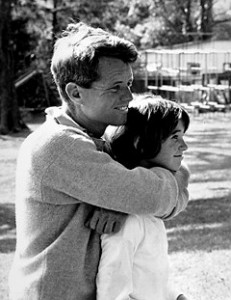 Kathleen and her dad. Click on the picture to watch a video on RFK's South Africa trip. When my father, Robert Kennedy, returned from South Africa, he wrote an article for Look magazine entitled, “Suppose God is Black?” He knew that God cared about justice for all, not just the few. He knew that Christ had said it was easier for a camel to get through the eye of the needle than for a rich man to enter heaven. Today, America seems to celebrate the rich and famous. We tax work at higher levels that we tax wealth. There are some wonderful leaders such as Jim Wallis of Sojourners and groups that are concerned with the Common Good, with the proper relation between faith and politics. I hope that we use this time to use our religious teachings to inform questions of public policy. And, of course, I am interested in any response to these ideas. China’s economy is beginning to slow, but inflation is still a problem. [CNN Money] The competing economic visions of President Obama and Rep. Paul Ryan. [NY Times] Wealth Managers advise you to rethink that Roth IRA conversion. [Reuters] What kind of leader does Google need right now? [Forbes] Japan to compensate victims of evacuation. [MSNBC] In early 1995, one of my best friends, David Hale (now U.S. Attorney for the Western District of Kentucky) called me to see if I would help the campaign for Secretary of State of his law school classmate, John Y. Brown, III. I was certainly aware of Brown’s dad, the former chicken magnate and Governor, but my parents had opposed Brown Jr.’s last campaign, opting instead to support some guy named Steve Beshear. Still, I was bored working as an associate for a big Washington law firm; David made a compelling case; and John, upon meeting, seemed like a nice, well-meaning, intelligent guy. Somehow, as the only one in the room with a modicum of campaign experience, I was enlisted, pro bono, as the campaign’s media consultant. I wrote and directed a series of ads that, while extraordinarily amateurish, apparently didn’t hurt Brown too bad — he won both the primary and general elections by wide margins. As you watch them, notice John’s delivery — I was so enamored with my too-long scripts, that I forced him to rush through them like the guy in the old Federal Express commercials. Most importantly, watch for the international television debut of my future running mate, John Y. Brown, IV, whose newfound mobility skills inspired the ad, and whose telegenic appearance cannot be underestimated for its vote-accruing effect: Our own Contributing RP, Jeff Smith, may have never dreamed that any good would come from his required stay at a federal prison. But the unlikeliest of environments proved to be an unexpected fountain of entrepreneurial spirit. Jeff writes about what he learned in this week’s Inc. magazine:
|

| ||
| Copyright © 2026 The Recovering Politician - All Rights Reserved | |||