After two unaccustomed weeks away from writing on this site, I return with some observations about the shortened, but effective Tampa convention. The primary one is that Mitt Romney completed a phase in which he has strengthened himself without having to accumulate unnecessary risk: unlike George H.W. Bush, whose bid to inject energy into the Republican ticket saddled him with Dan Quayle, or John McCain, whose move to exploit Barack Obama’s residual weakness with working class white females prompted him to gamble on Sarah Palin, Romney’s selection of Paul Ryan has added a needed reservoir of boldness with a downside that has proved, so far, to be minimal: two weeks of hammering from Democrats have not had measurable negative impact (the comparably weak favorability numbers for Ryan have much more to do with the hyper polarized climate than the partisan knock-up of his budget proposals) on Romney’s standing. Nor, given Ryan’s deftness so far, the ample experience he has defending his proposals, and the compromised hand Democrats hold on Medicare, is there much reason to fear that the upcoming debate between he and Joe Biden pose more danger than opportunity.
Second, the most obvious vulnerability for Republicans heading into Tampa—that the party’s more hard edged social conservatism might spill too much into view—never materialized. Ironically, had Missouri Senate candidate Todd Akin not imploded a week earlier over his tone-death, primitive case against a rape incest exception to an abortion ban, the Republican platform’s own hard line might have garnered more withering scrutiny. Instead, the swiftness and intensity of the Republican blowback against Akin cast one obscure candidate rather than a platform plank as the extreme element in the abortion wars, offering Romney and his party an opportunity to isolate the far right rather than being crowded by it.
Third, Condoleezza Rice’s elegant speech the convention’s second night, marking Rice’s evolution from respectful neutrality to forceful opposition to Obama, was the most significant defection on stage last week—and that is no false modesty on my part. The relatively apolitical Rice’s evisceration of Obama’s tentativeness on the diplomatic stage (as opposed to his assertiveness in marshaling American power in unilateral contexts like the campaign against terror networks) couldn’t be diminished with ad hominem attacks. The surest sign of her impact: the fact that Democratic commentators like Chris Matthews were reduced to coopting the moment by praising its substance and making a mountain out of her failure to call Obama’s name.
Fourth, Marco Rubio’s tour de force address preceding Romney may not have been classic introduction fare, but it signaled that the Florida senator could conceivably dominate the landscape in the next few years in the event of a Romney defeat in a way that resembles George W. Bush’s meteoric ascension in the late Clinton years: like Bush, and unlike Romney, John McCain, or Bob Dole, Rubio seems capable of assembling a front-runner’s coalition that is comprised of grassroots activists as well as establishment donors and operatives. For all of Chris Christie’s brilliance as a conservative reformer in an unpropitious environment, and Paul Ryan’s bona fides as a fiscal truth-teller, it is Rubio whose rhetorical narrative seemed to most energize the delegates. The template is one that could prove enormously appealing if the party’s aspirations shift to reconnecting conservatism to both imagination and boldness, as opposed to austerity. (It will help that unlike Christie, he will not face the peril of a reelection prior to 2016, and unlike Ryan, will not be in any way accountable if the ticket ends up losing.)
Read the rest of… Artur Davis: Takeaways from Tampa
By Jonathan Miller, on Mon Sep 10, 2012 at 9:15 AM ET
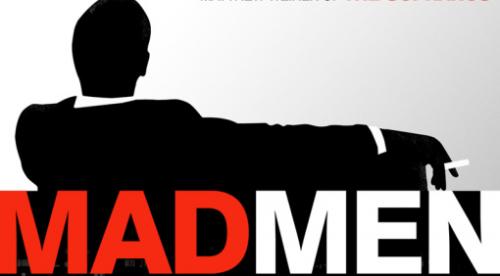
I’ve got for you the perfect antidote to the Monday-morning blues: 4 minutes of sublime enjoyment — the cast of Mad Men (inadvertently) performing Rick Astley’s infamous “Never Gonna Give You Up.” An insta-Web-classic:
By John Y. Brown III, on Thu Sep 6, 2012 at 12:00 PM ET
The Wounded Healer
My son, at our celebratory dinner the night before he left for college last week, brought up an interesting topic. He asked who were the three historical figures I admired most.
As usual, I hemmed and hawed and asked for more clarification and kept trying to dodge answering. . But my son wouldn’t give in.
Finally, I said, “It’s funny, when I was about your age, I was having dinner with your great-grandfather (my grandfather) and it was about a year before he died and I asked him the very same question. But I think I can only remember one of the people he told me and I want to make my three choices different. “
“OK,” I said, “Here goes.” I proceeded to give two predictable names but was stuck on the third.
My son interjected, “So who was the name your grandfather gave that you still remember?”
I said, “It was an unusual choice whose name I had never heard before. It was Bill Wilson, or Bill W., as he is better known. He was the co-founder of Alcoholics Anonymous. Your great-grandfather wasn’t a recovering alcoholic but had great respect for the program and, I guess, saw Bill Wilson as something of a pioneer who brought hope to people who had no hope.”
“So, Dad,” my son intoned, “Who is your third choice?”
“You know, Johnny, Bill Wilson was someone I was considering putting on the list but was trying not to because his contribution to the world is hard to explain–and he never sought the kind of public accolade we are talking about. He is a man who was faced with a life-threatening malady suffered by millions that science and logic could only grasp at impacting. He used pragmatic spiritual, psychological and common sense tools cobbled together with great humility to create something that on paper should never work. But did. And continues to. He didn’t have the luxury of caring how it looked on paper — only whether or not it worked. And he helped create a framework that has saved the lives of millions alcoholics and helped restore their families and spawned many related programs and therapies helping others with different but equally insidious diseases and disorders. And he did so as anonymously as he could to keep the focus on helping others rather than promoting himself.”
There was a pause.
And then I added, “So I guess that ought to be enough to make my top three list, huh? Bill Wilson.”
Check out the movie Bill W, the story of Bill Wilson’s life. Here’s the trailer:
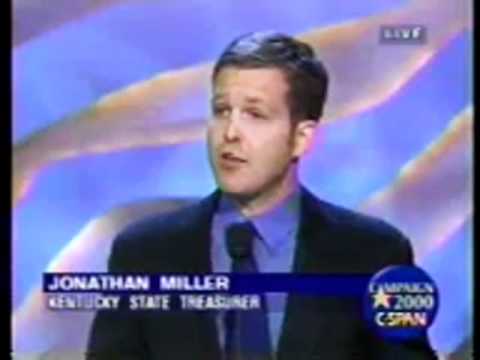
On the last evening of the 2000 Democratic National Convention, as the newly elected State Treasurer of Kentucky and a former staffer of the party’s presidential nominee, The RP spoke for three minutes in near-prime-time about his mentor and friend, Al Gore. It would be the highlight of his political career — he’d suffer through a decade more in the muck, never to be on such a large stage.
But thanks to the magic of YouTube, you can enjoy this twelve-year-old flashback:
By John Y. Brown III, on Wed Sep 5, 2012 at 12:00 PM ET
Troop Rallying or Pluribus Unuming?
(A long winded spiel–so long and windy that you may just forget what you were mad about at half-time during the DNC and RNC conventions)
It’s political party convention time– it’s a party for the parties, so to speak–where partisan cheerleading becomes the order of the day. The goal of both the Democratic and Republican parties is to “rally the troops.” Both major political parties strive, as they should, to make the case most dramatically for their side to win in November. It’s a time honored tradition–and an important one. And hyperbole and histrionics are not only expected—they are featured front and center.
But with every rhetorical flourish, left or right, that hits it mark at the conventions, something else is jarred too. The opposite of rallying the troops, I suppose, is trying to find common ground in our already very divided nation. Political conventions are constructs that are a bit like Midnight Madness if you are a UK basketball fan. You leave such events not only feeling a stronger than ever allegiance to your team but stronger than ever animosity toward any team that threatens them.
If political conventions are successful, when they are over, those who identify with each party should feel stronger than ever about their party being right —and stronger than ever about the other party being wrong. We don’t put on war make up. But we do, say and wear some awfully silly things at these conventions. In more primitive cultures, they had these sorts of partisan conventions but they called them tribal war dances. Seriously. (See clip below.) Note that neither Clint Eastwood nor Betty White were given prominent roles in the pre-convention warrior dances. Our political pros today could learn a thing or two from these ancient tribal rituals. Stay on message; whip up feelings of righteousness to a fever pitch; and dance like the dickens. No need to use chairs as a dialectical prop by a tribal elder (republicans) or matriarchal elder (democrats). Ever. Just keep dancing.
Oh sure, we should have fun celebrating and rallying with our political brothers and sisters during our side’s convention. I certainly intend to! And hope my republican friends did so last week.
But I suspect it would be good to note, too, that “rallying the troops” theater, while good for cheerleading, isn’t terribly useful once the political parties’ parties are over. That’s important to remember –as it is to recall that we have many more brothers and sisters than just those sharing our political opinions. Our Founding Fathers certainly realized this and memorialized it in our new nation’s motto that they selected– a simple Latin phrase: E Pluribus Unum. I’m really glad a few weeks before our Constitution was signed we didn’t have competing conventions represented by the political factions of the day. We may not have a constitution. We may have instead had some funny stories about Benjamin Franklin getting his lights punched out by a lesser signer because of his acerbic speech a few weeks earlier. But we didn’t have political parties back then. In fact, the Founders warned against the dangers of divisive factionalism—or extreme troop rallying.
E Pluribus Unum means essentially that within our diverse differences we are committed to an unassailable unity. Not “My country, right or wrong” blind allegiance, but more like “our country no matter how right or wrong we believe ourselves or our political opponents to be.”
In many ways E Pluribus Unum is nearly the opposite of the raw partisan blood sport we see played out regularly today masquerading as serious debate . Is it the worst it’s ever been? Hardly. It’s easy to pull up some old allegations about Abe Lincoln looking like a baboon, or Thomas Jefferson being an heathen atheist. But it’s pretty bad. And it’s not the end game our Founding Fathers had in mind. I suspect our Founders wanted more of legacy for their efforts than Glenn Beck lecturing about left wing conspiracy theories or The Daily Kos flaming the Internet about right wing conspiracies. If this is the apex of 236 years of a great republic’s maturation, the Founders probably would have stayed home and played cribbage instead.
But we are better than our partisan extremes. A whole lot better. We are not at our best divided and petty. Granted, it’s difficult to be united and idealistic for very long when there are over 300 million of us. But we don’t have to be that way all the time. I’d settle for opinionated but respectful –and a little more curious. Maybe a little more open-minded about where we might find common ground rather than determined to more deeply draw the boundaries that divide us.
But last week in Tampa and this week in Charlotte, is not the landscape for such things. Our country’s simple yet complex motto won’t be on prominent display in either city. That’s not the point of political party conventions. Or tribal war dances.
But unity among diversity is what makes for a great nation. And I hope that as we inch toward—and then beyond—the November election we don’t forget the motto our Founders hoped we’d live up to. To be a more unified nation. A time when political warrior dances are replaced again by Dancing with the Stars.
Even if it means I have to cheer again for Tom Delay.
I think that’s about as good as the guy can do. He can’t really offer specifics, because his policies are incoherent. Balance the budget, but cut taxes, reverse Medicare cuts and increase defense spending? Balance the budget by killing the wind energy tax credit? Riiight.
But of course, style trumps substance. And on those grounds, well, he’s no Rubio. He’s not even a Rob Portman. He’s just terminally incapable of appearing genuine.
My high school basketball coach once sat in on a meeting with a college coach who was recruiting me. “Too bad you can’t teach height,” he said. The college coach nodded grimly, much as Romney’s speech coaches likely did last night.
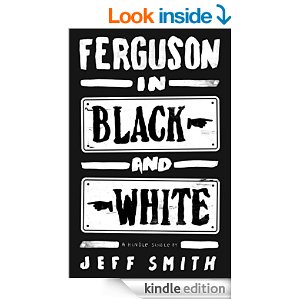
Read the rest of… Jeff Smith: Romney’s Convention Speech
By Jonathan Miller, on Mon Sep 3, 2012 at 1:00 PM ET
Just caught this on “Showtime.” Derivative of the coolearly Social Network trailer — with the chorus of kids singing Radiohead’s “Creep” — but still awesome nonetheless.
Less than a month until the September 30 season premiere. Enjoy:
By Bradford Queen, Managing Editor, on Fri Aug 31, 2012 at 10:00 AM ET
The Politics of The Screen
“The Politics of The Screen” were on full display last night at the Republican National Convention with Clint Eastwood’s bizarre showing. The actor conversed with @InvisibleObama for almost 15 minutes. [WaPo]
An interesting look at today’s film distribution models. “What is a movie’s sell-by date?” [HuffPo]
Paramount Pictures and the children of the author of the “Godfather” series are in a court battle to cut ties. [LA Times]
Keanu Reeves details how 21st-century filmmaking is changing the industry in new documentary, Side by Side. [NYT]
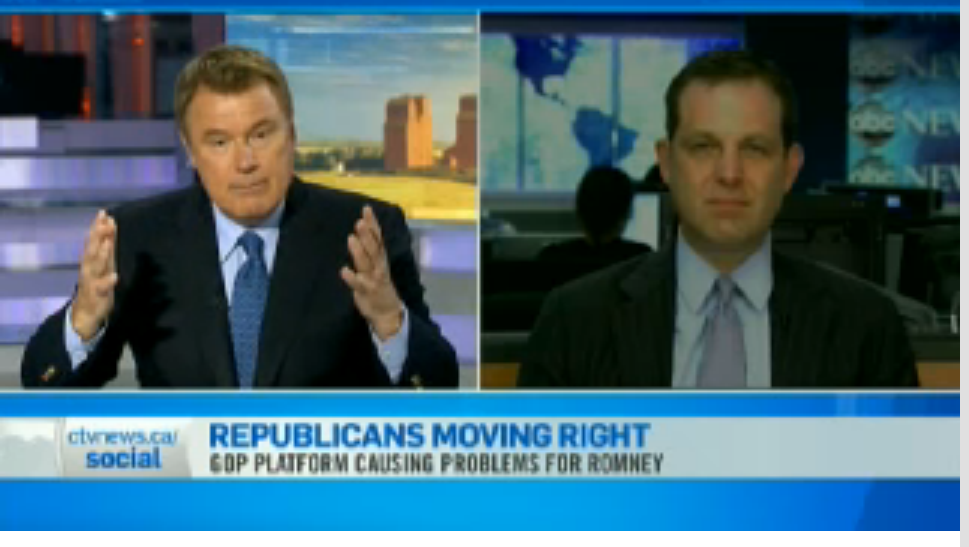
In his semi-regular gig as political commentator for CTV News — Canada’s version of CNN, Fox and MSNBC all rolled into one — The RP opined about the Republican National Convention, the impact of Ann Romney’s speech, the hazards of the GOP platform, and his friend and contributing RP, Artur Davis.
By Jonathan Miller, on Mon Aug 27, 2012 at 9:15 AM ET
For the past year and a half, I have used my platform at The Recovering Politician to share my opinions on a wide variety of issues, from politics to sports to pop culture. One consistent theme is that I have always respected — indeed invited — dissent and disagreement, in a civil dialogue, of course.
But now, I have come to the conclusion that on one matter, there is no room for even the smallest disagreement. You must not only concur with my opinion, but I urge you — in fact, I beg you — to join me in this essential pledge:
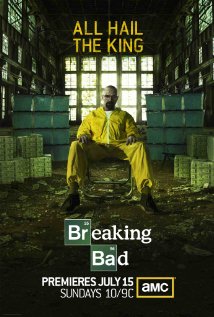
BREAKING BAD IS THE BEST TELEVISION PROGRAM IN HISTORY. YOU MUST WATCH IT!
For those of you who are fellow Walt-heads (OK, maybe that’s not the best expression), you already know what I am talking about.
But I know there are thousands of you who’ve never watched the program, or may have seen an early episode and dismissed it as an uber-violent slice of Americana you’d rather hide in the proverbial cellar. That’s what I thought for five years — I always preferred shows that I could relate to — the ad men of Mad Men, the Jewish geeks of Seinfeld, the poker-playing mobsters of The Sopranos, etc., etc.
But once I subscribed to Netflix, and paced myself through the first half season, I was as hooked as many of the protagonist Walter White’s clientele. By the time the third season rolled around, I recognized it was a masterpiece. But this weekend, when I finished the 4th season finale, I couldn’t sleep — it was the most extraordinary writing, plotting, narrative, and most of all, acting, that I have ever witnessed. I haven’t even begun watching this year’s 5th season, and I’m met with brutally conflicting emotions — I want to savor the series’ final 16 episodes, knowing that thee will never be another show like it, but I live in a constant fear that some malevolent reporter or tweeter will spoil the plot developments before I get a chance to enjoy them.
I realize that you, like me, might not identify with a struggling chemistry teacher, struck with lung cancer, who turns to cooking meth to pay the hospital bills. But if you care about politics, or philosophy, or religion, or psychology; there is no book, novel, film or opera that better illustrates the human condition — particularly the moral decisions that each of us struggle with every day — than Breaking Bad. And there’s no better primer on why seeking revenge is the most self-destructive act a person can take. (Sure, I like Revenge, but c’mon…)
So, I insist, RP Nation. Sign up for Netflix today. Or if you don’t want to make Reed Hastings any richer, click here to buy the box sets of the first 4 seasons.
STOP READING, STOP PLAYING OUTSIDE, TURN ON THE TV AND WATCH IT NOW.


 After two unaccustomed weeks away from writing on this site, I return with some observations about the shortened, but effective Tampa convention. The primary one is that Mitt Romney completed a phase in which he has strengthened himself without having to accumulate unnecessary risk: unlike George H.W. Bush, whose bid to inject energy into the Republican ticket saddled him with Dan Quayle, or John McCain, whose move to exploit Barack Obama’s residual weakness with working class white females prompted him to gamble on Sarah Palin, Romney’s selection of Paul Ryan has added a needed reservoir of boldness with a downside that has proved, so far, to be minimal: two weeks of hammering from Democrats have not had measurable negative impact (the comparably weak favorability numbers for Ryan have much more to do with the hyper polarized climate than the partisan knock-up of his budget proposals) on Romney’s standing. Nor, given Ryan’s deftness so far, the ample experience he has defending his proposals, and the compromised hand Democrats hold on Medicare, is there much reason to fear that the upcoming debate between he and Joe Biden pose more danger than opportunity.