By RP Staff, on Tue Jul 12, 2011 at 12:30 PM ET  Tune in from 3:00-4:00 PM TODAY to listen to the RP talk about his piece yesterday in The Huffington Post about Henry Clay and today’s debt ceiling on the DC radio talk show, Afternoons with David Anderson. Tune in from 3:00-4:00 PM TODAY to listen to the RP talk about his piece yesterday in The Huffington Post about Henry Clay and today’s debt ceiling on the DC radio talk show, Afternoons with David Anderson.
Here’s the link.
And please call in to share your questions: 1-888-432-7434
By Jonathan Miller, on Mon Jul 11, 2011 at 2:30 PM ET As part of today’s theme here at The Recovering Politician, the RP himself weighs in on the debt ceiling crisis consuming Washington. Here is his column, cross-posted at The Huffington Post:
For my maiden political stump speech, I faced a daunting challenge.
I had not yet turned 30 years old, looked 22, and was desperately trying to convince a group of good-ole-boy county chairs that I was qualified to serve in the US Congress.
I decided to address the 800-pound elephant head-on: I noted that my hometown’s (Lexington, Kentucky) favorite son, Henry Clay, was only 29 when he was elected Speaker of the U.S. House of Representatives in the early 19th Century.
Of course, I simply was setting the crowd up for a joke. I pointed to my silver-haired friend in the front of the room, Terry McBrayer — a popular former state legislator, gubernatorial candidate, and state party chair — and told the crowd that Terry had warned me not to make the Clay comparison:
“Jonathan, I knew Henry Clay. I served with Henry Clay. And you’re no Henry Clay.”
= = = = = = = =
A few weeks ago, we celebrated the 200th anniversary of Clay’s ascension to the highest legislative position in the country. Three of Clay’s successors (Dennis Hastert, Nancy Pelosi, and John Boehner) flew to Lexington to pay tribute. Reflecting on Clay’s extraordinary domestic diplomacy in the decades prior to the Civil War — earning him the nickname “The Great Compromiser” — Speaker Boehner remarked, “There was no one person more responsible for holding our union together than Henry Clay.”
I reflected on Boehner’s comments this past weekend. Our Union today is much too strong to worry about the existential threat posed in Clay’s era. But as we stare into the oncoming tsunami of potential credit default for the first time in the nation’s history — and as we watch Democrats and Republicans so bitterly divided that they are making a seemingly impossible impasse quite plausible — we sure could use a Henry Clay right about now.
And John Boehner is no Henry Clay.
Click here to read the rest of the RP’s column at The Huffington Post.
By Will Allison, on Mon Jul 11, 2011 at 12:00 PM ET  On August 2, the United States of America is set to default on its debt obligations. I am not an economist, and would not deign to pretend that I understand the economic repercussions of such a move. However, I do have another important credential, and that is called a “survival instinct.” This instinct is stronger than I remembered. On August 2, the United States of America is set to default on its debt obligations. I am not an economist, and would not deign to pretend that I understand the economic repercussions of such a move. However, I do have another important credential, and that is called a “survival instinct.” This instinct is stronger than I remembered.
I know this, because I am now up at 3am, scared right out my damn sleep from the horror movie that would be defaulting on our nation’s debt. I have read too many of these Freddy Krueger-themed articles not to believe it. Phrases like “global financial meltdown”, “financial apocalypse”, “the American economy dragging the global economy down the drain”, and “millions of unemployed joined by millions more” own me now, people. This is a cry for help.
 The raising of the debt ceiling, typically a pro forma vote Congress takes every year to meet our rising spending obligations, has met a wall this summer with a newly emboldened, GOP-controlled House. This House is heavily influenced if not directed by the Tea Party, willing to risk default to deal with what it feels is our top fiscal priority: spending cuts. In response, the Democrats, true to their nature, have already offered massive concessions on spending, in return for some kind—any kind—of tax increase on the very wealthy. The GOP has replied with “no”. Despite their deficit-obsessed rhetoric, they are not interested in increasing revenues to lower the deficit. They only want spending cuts, and apparently are willing to allow our economy to collapse if they don’t get exactly that, only that, and on a massive scale. The raising of the debt ceiling, typically a pro forma vote Congress takes every year to meet our rising spending obligations, has met a wall this summer with a newly emboldened, GOP-controlled House. This House is heavily influenced if not directed by the Tea Party, willing to risk default to deal with what it feels is our top fiscal priority: spending cuts. In response, the Democrats, true to their nature, have already offered massive concessions on spending, in return for some kind—any kind—of tax increase on the very wealthy. The GOP has replied with “no”. Despite their deficit-obsessed rhetoric, they are not interested in increasing revenues to lower the deficit. They only want spending cuts, and apparently are willing to allow our economy to collapse if they don’t get exactly that, only that, and on a massive scale.
And so it goes. The Republican Party’s “top negotiator” on the debt ceiling, House Majority Leader Eric Cantor, has already walked out of the talks. Democrats, in return, have begun to urge the President to invoke a little-known clause in the 14th Amendment to the Constitution that may legally require our nation not to default on its debt. The President could simply say he’s not legally allowed to permit our nation to default, and instruct the Treasury to continue to pay the bills. The GOP’s response is to threaten impeachment if the president goes that route, claiming he will have superseded Congress’ power of the purse. I am going insane trying to keep up with this stuff, people.
Read the rest of…
Will Allison: Watching the Ceiling Cave In
By RP Staff, on Fri Jul 8, 2011 at 12:00 PM ET Yesterday, the RP conducted a fascinating interview with Christine Todd Whitman, the former GOP Governor from New Jersey and the Administrator of the Environmental Protection Agency during George W. Bush’s first term in office.
Whitman shared her frustrations with the hyper-partisanship in Washington, the impact of the Tea Party on her beloved GOP, and the gridlock on environmental action and climate change remediation. She also offers her ideas on how to fix her party and her country’s political system.
Listen here:
No Labels is a new grassroots movement of Democrats, Republicans, and Independents who are united in the belief that we do not have to give up our labels, merely put them aside to do what’s best for America. No Labels Radio will offer a weekly dose of news and interviews with the policymakers who are working to find bipartisan answers to the otherwise intractable problems our country faces.
By Artur Davis, on Fri Jul 8, 2011 at 8:30 AM ET  Alabama’s new immigration law is about to become a flashpoint in the culture wars. Alabama’s new immigration law is about to become a flashpoint in the culture wars.
It is the first hard push to the right by a moderate Republican Governor who is an ally of the state’s powerful, and liberal, teachers’ union and who has soft-pedaled his opposition to what his party calls “Obamacare.” I think, taken in its totality, it is a push too far, and the Obama Justice Department should challenge its worst features as fiercely as it has attacked Arizona’s controversial 2010 restrictions.
I don’t criticize the provisions that make businesses confirm the legal status of their employees through E-Verify, or the stiff sanctions the law imposes on companies who knowingly hire illegal immigrants: those policies add teeth to current laws that are reasonable but often under-enforced.
There is also a sound underlying rationale: employers who hire undocumented workers are not motivated by a rush of generosity, but usually by a desire to undercut wages and to pad their payrolls with vulnerable, cheap laborers who can’t sue and who fear deportation too much to complain about lax safety standards.
Read the rest of…
Artur Davis: Alabama’s Ugly New Immigration Law
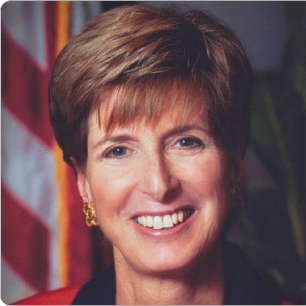
By RP Staff, on Thu Jul 7, 2011 at 2:00 PM ET RIGHT NOW contributing RP Lisa Borders and the RP are co-hosting the weekly episode of No Labels Radio.
Their primary guest is former New Jersey Governor Christine Todd Whitman.
Click here to tune into the broadcast.
No Labels is a new grassroots movement of Democrats, Republicans, and Independents who are united in the belief that we do not have to give up our labels, merely put them aside to do what’s best for America. No Labels Radio will offer a weekly dose of news and interviews with the policymakers who are working to find bipartisan answers to the otherwise intractable problems our country faces.
By Jonathan Miller, on Thu Jul 7, 2011 at 12:00 PM ET Today at 2 PM EDT, contributing RP Lisa Borders and I are co-hosting the weekly episode of No Labels Radio.
No Labels is a new grassroots movement of Democrats, Republicans, and Independents who are united in the belief that we do not have to give up our labels, merely put them aside to do what’s best for America. No Labels Radio will offer a weekly dose of news and interviews with the policymakers who are working to find bipartisan answers to the otherwise intractable problems our country faces.
Our primary guest is former New Jersey Governor and Bush Administration EPA Administrator Christine Todd Whitman. Whitman has been a long and strong advocate of bipartisan cooperation in Washington and our state capitals.
Click here to find out more about today’s broadcast.
OK, RP Nation.
Here’s your chance to suggest a question for Governor Whitman.
Make your suggestions in the comments section below. And then tune in at 2 PM EDT to see if I used it.
Thanks for your help!
By Will Allison, on Wed Jul 6, 2011 at 10:30 AM ET Hello there! My name is Will Allison, and Jonathan has quite generously offered to let me blog at RP. I thought I’d use my inaugural piece to fill readers in on who I am, and where I am coming from.
You might be wondering…who? Well, first and foremost, I am a proud native son of Louisville, KY. I grew up in the Highlands, in a family that passionately mixed politics with the arts. My father was a civil rights attorney, my mother an actress and acting teacher. If we weren’t at Actor’s Theatre, we were at a rally at Memorial Hall. One of my earliest memories is watching my mother perform in a one-woman show, portraying the South African anti-apartheid activist Ruth First. I guess you could say that experience was emblematic of my parents’ activism, and the values they taught their children.
Both of my sisters entered the arts, so as I became a teenager, I tried to take a different path, focusing on writing rather than politics or the theatre. However, I was quickly drawn back to the stage, attending the Youth Performing Arts School and falling in love all over again with Euripides and Stephen Sondheim alike. Assured I would become the next Ralph Fiennes, I journeyed far after high school from Louisville to Boston to continue my acting training. I had some great moments with Pinter, Brecht, Kaufman, Shakespeare and others. Assured I would become the next Philip Seymour Hoffman, I journeyed (not so) far after college from Boston to New York, to take the world by storm.
Well, that didn’t pan out so much. So, I turned back to the other family business.
 Jane Hoffman In the spring of 2002, I joined Democrat Jane Hoffman’s campaign for Lieutenant Governor of NY State as a junior staffer. It’s worth pointing out that joining any Democrat’s campaign for anything in the spring of 2002 was a risky proposition at best. The city was still reeling from the terrorist attacks of September 11, 2001. George W. Bush had poll numbers in the stratosphere. Locally, Republican Rudy Giuliani had gone from disgraced philanderer and failed Senate candidate to “America’s Mayor”. And Gov. George Pataki was cruising to re-election for a third term with more money than any opponent could compete with. All three men were wielding 9/11 as a deadly political weapon, and doing it brilliantly (if cynically).
But Jane was a compelling presence on the stump, a dedicated Consumer Affairs Commissioner, and a highly telegenic figure. As the summer campaign wore on, we felt we had at least an outsider’s shot of upsetting the establishment candidates in the race. That feeling ended the day Jane announced she had become very ill with a rare eye disease, and the campaign would have to end. A campaign without a victory is by its very nature a sad place to be, but I can’t recall a sadder way to end a campaign than that.
Read the rest of…
Will Allison: Let’s Begin the Conversation
By Jonathan Miller, on Wed Jul 6, 2011 at 8:30 AM ET Two weeks ago, I shared with readers of The Recovering Politician a disturbing interview in which Kentucky GOP bigwig Larry Forgy stated his bizarre and pernicious theory that Jews such as George Soros, Barbra Streisand and Steve Spielberg would be pumping in significant loads of cash to support their co-religionist, Jerry Abramson, in his bid for Lieutenant Governor.
The RP Nation responded with outrage — dozens of your comments and emails unanimously denounced Forgy’s slur.
As far as the Kentucky mainstream media…well…the response was much more muted. It took two weeks for one of the state’s leading newspapers to issue a condemnation, and it did not even address the most offensive remarks. The other editorial page — from the very paper that broke the story — has been atypically silent.
I share my own views about the media response — as well as my belief that it is incumbent on all of us to denounce intolerance whenever it rears its ugly head — in my column this week in The Huffington Post:
My bet is that is that it was a conscious decision [by the media] to deprive oxygen to the flames of anti-Semitism. I suppose they believe that ignoring the issue and refusing to publish the more outrageous accusations will prevent them from being repeated and then accepted in areas of the state where latent anti-Semitism could be transformed into something much worse. Hopefully if this is the case, the rest of the media, as well as the state Republican party, will get the message and send Forgy off to permanent pasture.
But if the 20th Century taught us anything about the proper response to anti-Semitism, it is that we must confront it whenever it raises its ugly head. As I argued in this column two weeks ago, we no longer need to be afraid that this sort of anti-Semitism would be welcomed in this country, even in the rural, conservative Bible Belt. Indeed, by exposing and then denouncing language such as Forgy’s, we help reinforce the message now emanating from rural, evangelical churches — to love their Jewish neighbors.
To read my full column, click here.
By Kathleen Kennedy Townsend, on Tue Jun 28, 2011 at 8:30 AM ET
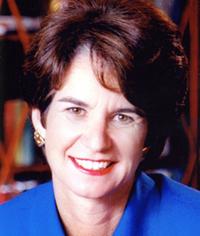
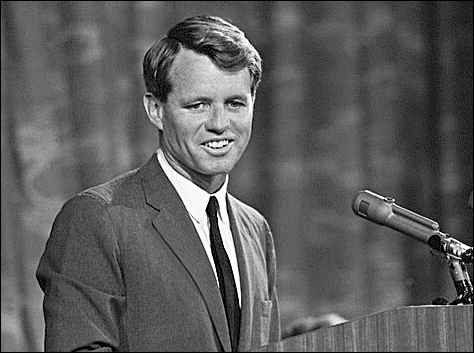
Last week, I wrote about my father, Robert Kennedy, and his critique of Gross Domestic Product (GDP) as the measure of national well-being. He said, “It measures everything except that which makes life worthwhile. And it can tell us everything about America except why we are proud that we are Americans.”
Had my father lived, we might have started work a lot sooner on truer ways to measure the state of the nation. Sadly, that did not happen. His critique of the GDP was forgotten. Instead, other values came to govern American life.
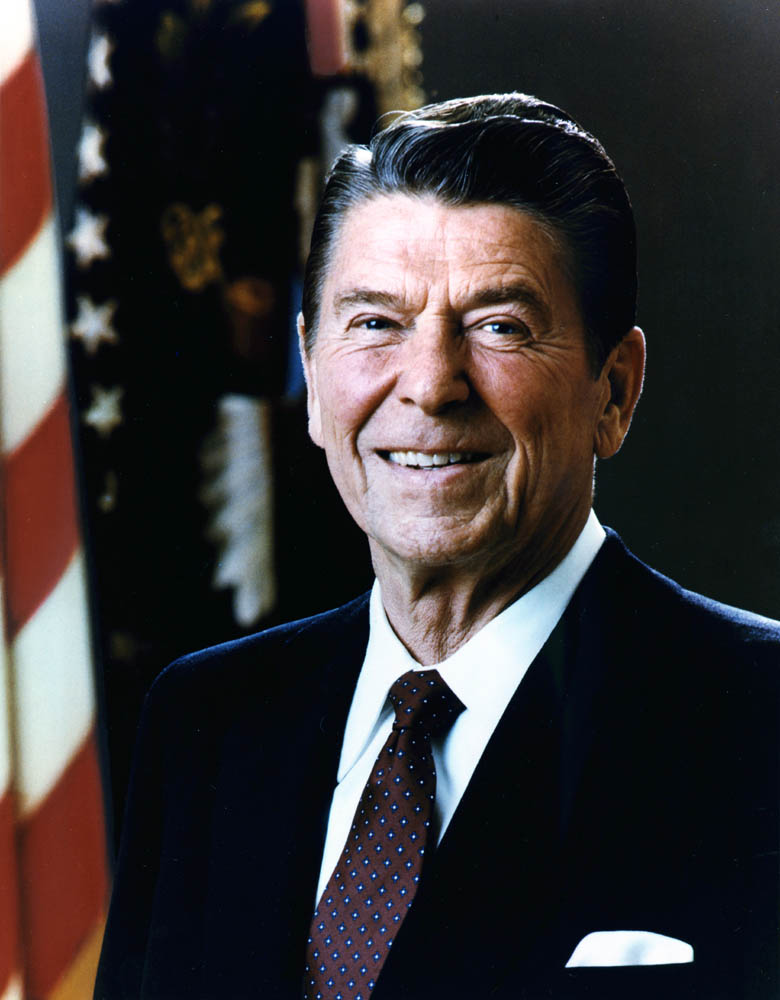
In 1968, David Frost asked both Ronald Reagan and my father to speak on the purpose of life. Ronald Reagan answered:
 Well, of course, the biologist I suppose would say that like all breeds of animals, the basic instinct is to reproduce our kind, but I believe it’s inherent in the concept that created our country–and in the Judeo-Christian religion–that man is for individual fulfillment; for our religion is based on the idea not of any mass movement but of individual salvation. Each man must find his own salvation; I would think that our national purpose in this country–and we have lost sight of it too much in the last three decades–is to be free–to the limit possible with law and order, every man to be what God intended him to be. Well, of course, the biologist I suppose would say that like all breeds of animals, the basic instinct is to reproduce our kind, but I believe it’s inherent in the concept that created our country–and in the Judeo-Christian religion–that man is for individual fulfillment; for our religion is based on the idea not of any mass movement but of individual salvation. Each man must find his own salvation; I would think that our national purpose in this country–and we have lost sight of it too much in the last three decades–is to be free–to the limit possible with law and order, every man to be what God intended him to be.
My father said:
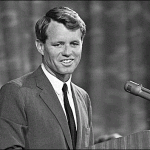 I think you have to break it down to people who have some advantages, and those who are just trying to survive and have their family survive. If you have enough to eat, for instance, I think basically it’s to make a contribution to those who are less well off. ‘I complained because I had no shoes until I met a man who had no feet.’ You can always find someone that has a more difficult time than you do, has suffered more, and has faced some more difficult time one way or the other. If you’ve made some contribution to someone else, to improve their life, and make their life a bit more livable, a little bit more happy, I think that’s what you should be doing. I think you have to break it down to people who have some advantages, and those who are just trying to survive and have their family survive. If you have enough to eat, for instance, I think basically it’s to make a contribution to those who are less well off. ‘I complained because I had no shoes until I met a man who had no feet.’ You can always find someone that has a more difficult time than you do, has suffered more, and has faced some more difficult time one way or the other. If you’ve made some contribution to someone else, to improve their life, and make their life a bit more livable, a little bit more happy, I think that’s what you should be doing.
Ronald Reagan’s views came to dominate the political landscape. Later, when he was asked what he meant by freedom, he described driving up the Pacific Coast Highway in a convertible with the wind blowing through his hair. Here was a man truly doing his own thing, alone.
George Washington and Thomas Jefferson had nice houses. They could have enjoyed contented private lives. But it was not just about their property.
What Ronald Reagan is remembered for does not reflect what he actually did. Of course, he believed in public engagement. He was a six-term president of the Screen Actors guild, calling union membership a “fundamental human right.” He was governor of California and president of the United States. He spoke eloquently about America as a “shining city on a hill.”
Read the rest of…
Kathleen Kennedy Townsend: The Pursuit of Happiness: What the Founders Meant—And Didn’t
|
The Recovering Politician Bookstore
|


 Tune in from 3:00-4:00 PM TODAY to listen to the RP talk about his piece yesterday in The Huffington Post about Henry Clay and today’s debt ceiling on the DC radio talk show, Afternoons with David Anderson.