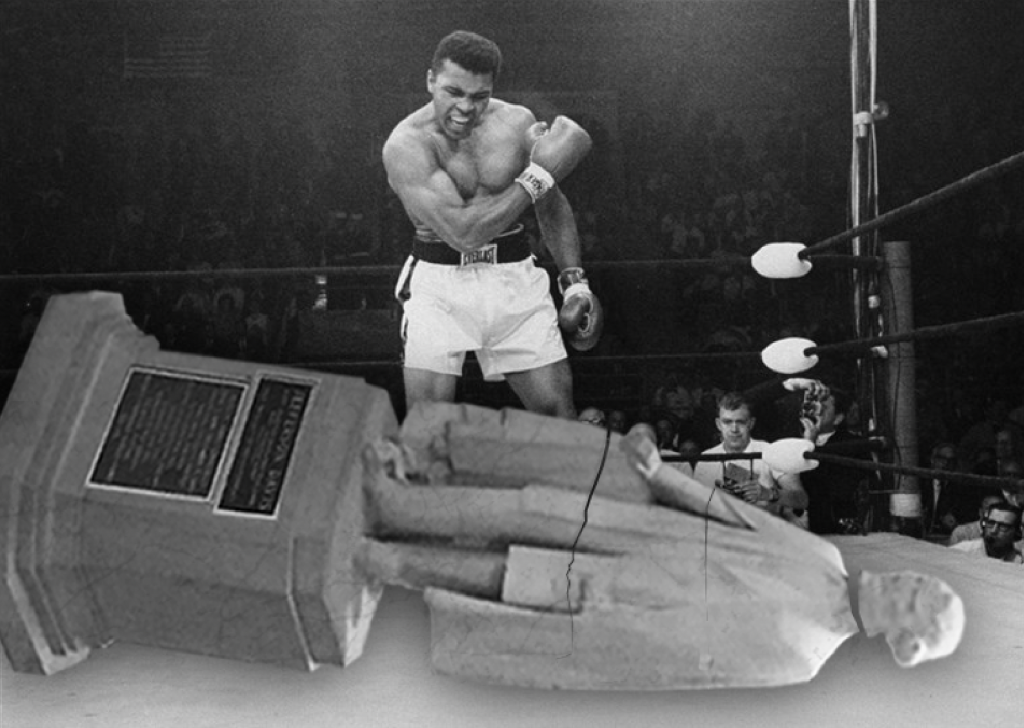
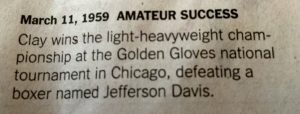
Please sign the petition below to remove the statue of Jefferson Davis currently in Kentucky’s Capitol Rotunda, and replace it with a tribute to Muhammad Ali, “the Louisville Lip” and “the Greatest of All Time.”
I just heard from the Ali family: It is the Champ’s belief that Islam prohibits three-dimensional representations of living Muslims. Accordingly, I have adjusted the petition to call for a two-dimensional representation of Ali (a portrait, picture or mural) in lieu of a statue.
UPDATE (Tuesday, December 2, 2014)
In this interview with WHAS-TV’s Joe Arnold, Governor Steve Beshear endorses the idea of honoring Muhammad Ali in the State Capitol (although he disagrees with removing Davis). Arnold explores the idea further on his weekly show, “The Powers that Be.”
Click here to check out WDRB-TV’s Lawrence Smith’s coverage of the story.
And here’s my op-ed in Ali’s hometown paper, the Louisville Courier-Journal.
UPDATE (Saturday, June 4, 2016)
In the wake of the 2015 Charlestown tragedy, in which a Confederate flag-waving murderer united the nation against racism, all of the most powerful Kentucky policymakers — U.S. Senator Mitch McConnell, Governor Matt Bevin, Senate President Robert Stivers and House Speaker Greg Stumbo — called for the removal of the Davis statue from the Rotunda. Today, as we commemorate last night’s passing of Muhammad Ali, there is no better moment to replace the symbol of Kentucky’s worst era with a tribute to The Greatest of All Time.
UPDATE (Wednesday, June 8, 2016):
Great piece by Lawrence Smith of WDRB-TV in Louisville on the petition drive to replace Jefferson Davis’ statue in the Capitol Rotunda with a tribute to Muhammad Ali.
UPDATE (Thursday, June 9, 2016):
Excellent piece on the petition drive by Jack Brammer that was featured on the front page of the Lexington Herald-Leader.
Highlight of the article:
Miller said he has received a few “angry comments” on his call to honor Ali.
“One of them encouraged me to kill myself,” he said. “You can quote me that I have decided not to take their advice.”
UPDATE (Friday, June 10, 2016)
The petition drives continues to show the Big Mo(hammed): check out these stories from WKYU-FM public radio in Bowling Green and WKYT-TV, Channel 27 in Lexington:
UPDATE (Saturday, June 11, 2016):
Still not convinced? Check out this excerpt from today’s New York Times:
At President Clinton’s first inauguration, I was at a dinner of 500+people.
At the end as we were leaving, I saw Mr Mandela standing alone.
Feeling the need to say something, I introduced myself and said whatever came to mind about his courage, sacrifice, and contributions to peace in South Africa.
His response I will never forget: He said ” It honors me that you would say that.”
At that point I was so in awe that he was there and I had met him.
The word “hero” is thrown around a great deal today; sometimes appropriately; sometimes to stroke some group or person for political gain.
This hero though, meets the definition of those willing to sacrifice to make the way for others, straight.
Nelson Mandela is THE modern day example of liberation without firing a shot.
He gave up a third of his life jailed as a criminal who committed no crime except to yearn to be free to be able to do as President Kennedy often noted to be, “the master of my own fate.”
You can incarcerate the man, but the ideal he stood for was freedom and liberty itself. It is a blessing to have lived during his time. His countrymen know that truth all too well.
His legacy is not only forgiveness but the challenge for all time that dreams are just not impossible to come true. He is a hero and a man for all seasons.
Raamie Barker is Senior Advisor to West Virginia Governor Earl Ray Tomblin
I am saddened that we lost a great political and spiritual general yesterday when President Nelson Mandela transitioned from earth to eternity.
In 1981, I remember as a sophomore at the University of Texas at Austin wearing my free Mandela t-shirt in an effort to support the oppressed leader in his struggle to bring equality to the masses of Black and Colored South Africans. As we protested with the hopes of encouraging our University and other American Corporations to withdraw their investments from a country that supported an apartheid system, it never occurred to me that our small efforts might have made a big difference.
Who would have thought that the then incarcerated political leader would one day be freed in spite of his unwillingness to compromise? Who would have thought that he would be like Joseph in the book of Genesis going from Robben Island Prison in 1990 to become the president of South Africa in 1994, just four years after his release from prison?
Like Jesus Christ, He taught us so much, he chose to forgive his oppressors, he chose to bless those who cursed him and he chose to do good to those who spitefully used him. His act of forgiveness has taught us that love is what heals a nation!
Thank you Madiba for the life, legacy and love you have bestowed on your nation and the world!
Dianne Jones McVay is a former Texas criminal court judge and Assistant U.S. Attorney
By John Y. Brown III, on Fri Dec 6, 2013 at 12:00 PM ET
Warning: If you try to go to Walmart to pick up a half gallon of milk, you will soon realize your errand is not about the 2% milk.
Instead your journey is about the exploration of a wild, weird and wonderfully kitschy world where you will see things that will bend your conventional mind and make you whisper to yourself, “Gee, I could use that.” Followed by “and that too.” Or maybe, “Who thinks up these products?” Followed finally by “These prices can’t be beat.”
And you will soon realize that even though you walked into a Walmart that you have really entered the Hotel California.
That’s right. “You can check out any time you want (through self-service check out), but you can never leave.”
I had never heard of Nelson Mandela, of South Africa, of apartheid, until I was an 18-year-old college freshman at Rutgers University in the mid-1980s. At that time I had no interest in politics, in community, and “democracy” was a very strange and elusive word to me, something we had been taught in American schools, but which felt like it belonged to the people in our textbooks, forever frozen in history. But there was something happening at Rutgers, and on campuses everywhere, called “the anti-apartheid movement,” which was bringing together students of different races and cultures, in a way our country had not seen, I read and was told, since the civil rights movement of the 1960s.
Except this time the struggle for freedom was in a foreign land, a magical but terribly oppressive and violent place called South Africa, where the white minority had been ruling the black, “colored” and Indian majorities for many decades. And there was a leader, locked away with others in prison cells, in locales with names like Robben Island, for daring to oppose the white power structure of South Africa. I was both transformed and liberated as I learned about this man Mandela, as I joined the student protest and building takeover at my school directly challenging Rutgers’ ties to corporations invested in the apartheid regime. I absorbed everything I could on Mandela, his speeches, his life story, the facts and mythologies. I was changed forever. Gone was the desire for a career merely to make money, replaced by a determination to live a life of service to others.
Mandela’s influence on me lapsed between the time of my school’s protests and my early 20-something life. But it was re-ignited when I watched the global broadcast when he was released, after 27 long years, on Feb. 11, 1990, and walked hand-in-hand with his then-wife Winnie Mandela from Victor Verster Prison. Iconic and transformational leaders like Dr. King and Bobby Kennedy were long gone. In Mandela we had a living and breathing example not simply of struggles for freedom and democracy, but also of someone who was willing and able to be a bridge-builder for humanity, like Gandhi, like Jesus Christ.
But let’s also be clear: While Mandela is today widely viewed as a man of peace, he did advocate for self-defense and armed resistance against the brutal apartheid regime when he was first sent to jail in the early 1960s, and again in his first speech after walking away from that prison. Mandela was clear, just as America’s founding fathers were, that freedom was not free.
Regardless, what captured my imagination and what will be one of Mandela’s enduring gifts to humanity was his bottomless capacity to forgive his white oppressors and his openness to working with them for a new South Africa. Nothing in my lifetime prepared me for this post-prison Mandela. Nothing. The absence of bitterness from Mandela’s words and demeanor were extraordinary to me, given that he lost 27 years of his life to prison.
In my still very young American and African-American mind of the 1990s this was the true revolution for humankind, to see each other as sisters and brothers, to be able to have honest conversations about the past, by way of South Africa’s truth and reconciliation commission, so that there could be healing, yes, and an opportunity to move forward as one people.
This Mandela impacted my work greatly, and I went from being someone focused mostly on race issues to an activist and speaker who began, however difficultly, to embrace the lives and challenges of people everywhere no matter their race, gender, class, religion, ability or sexual orientation. In Mandela I saw a living and breathing example of what was possible, as a human being, as a man, as a leader, if only we could dig deeper into the reservoir of our spirits and find the capacity to love each other, to know each other, to get along with each other.
Sports was certainly central to Mandela’s life. In his childhood he loved to run. Some of my favorite photos of him are the ones of Mandela in workout gear with boxing gloves on. While in prison he was held in isolation for much of his time. The famous stories are of Mandela watching the Robben Island soccer league, or hearing the retellings after a wall was built in front of his window.
Mandela would see sports as a way to unify South Africa into the “Rainbow Nation” his fellow South African freedom fighter Desmond Tutu called for once he was freed and eventually became South Africa’s first black president of the post-apartheid era.
The 1995 Rugby World Cup, the 1996 African Cup of Nations in soccer, the 2003 Cricket World Cup and then the big one, the 2010 FIFA World Cup, were all played on South African soil. Those sporting events advanced the idea that if people could play and root together, then maybe, just maybe, people would acknowledge the evil of separating and dissing each other because of skin color.
Nelson Mandela is gone now, and I think about my own work here in America, of our first black president, Barack Obama, of how much race relations have changed in my nation because of sports just as sports dynamics affected Mandela’s South Africa. But I also think about the ugly divides that still exist in my America, on our planet, of the still unequal and very violent South Africa that Mandela leaves behind. So much progress and yet so much more work to be done.
Finally, with profound sadness, we say goodbye to you, Mr. Nelson Mandela. I know the best way to honor you, Madiba, in your death, is for all of us to make a renewed commitment to come together, even where there are differences, for the sake of humanity. And if we can simply embody a fraction of the capacity for love, grace and unity that you possessed for nearly a century on this Earth, then our lives will be as victorious as yours.
— Kevin Powell is an activist, public speaker, and author or editor of 11 books, including “Barack Obama, Ronald Reagan, and The Ghost of Dr. King: Blogs and Essays.” He is also the president of BK Nation, a new national and multicultural organization focused on civic engagement, leadership training, and volunteerism. Email him at kevin@kevinpowell.net or follow him on Twitter @kevin_powell
By Michael Steele, on Fri Dec 6, 2013 at 11:00 AM ET
Imprisoned for 27 years because he fought to be equal and free, a man can become bitter, even angry at his jailers and the oppressors they represent. But as Nelson Mandela recalled “As I walked out the door toward the gate that would lead to my freedom, I knew if I didn’t leave my bitterness and hatred behind, I’d still be in prison.”
For the Mandela family, their loss is personal, but it is a loss shared by a world that has been touched by the quiet strength and fearless determination of Nelson Mandela. While we mourn with them and the people of South Africa, we also celebrate with them the life of a great man.
God blesses us with the precious gift of life. What we do with that gift is the legacy we leave behind.
And what a legacy Mandela has left for us.
He empowered generations of South Africans not just to dream but to do. His vision of equality became a reality for them and a galvanizing force for change for the rest of us.
Today, South Africa stands taller because it stands on the shoulders of Nelson Mandela.
It is freer because he never wavered in his core belief in the advancement of equality and freedom for its people.
And it is richer because he believed in its possibilities. As Mandela once said “Never, never and never again shall it be that this beautiful land will again experience the oppression of one by another.”
Well done good and faithful servant. Rest in peace Madiba.
On a trip to South Africa ten years ago, I read Mandela’s biography prior to arrival.
I visited Robbyn Island and was guided through his cell and activities by a cheerful intelligent man who had been a prisoner with Mandela for 18 years. At the end of the tour, I asked him why he was not angry. His answer was “What good would it do?”
I never forgot it. It was in fact what Mandela represented that anger doesn’t solve problems — that understanding and patience and goodwill towards all does.
What a privilege for all of us to have seen and heard what Mandela was and will always be…a guide to a better world.
Mike Leven is President and Chief Operating Officer of the Las Vegas Sands Corporation


 Blog this!