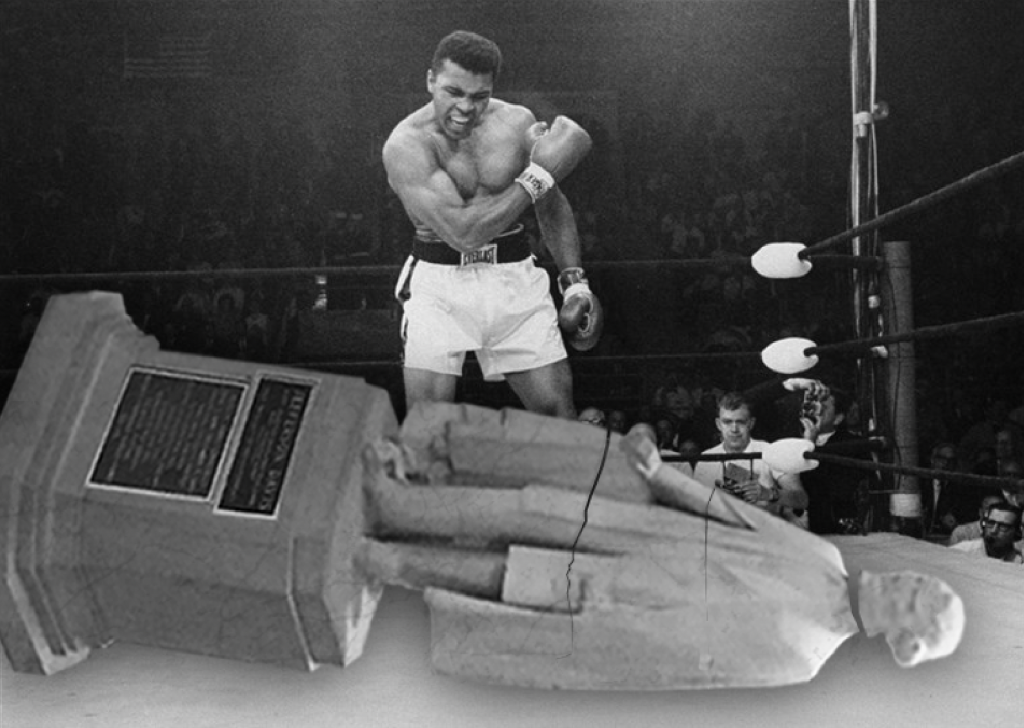
Please sign the petition below to remove the statue of Jefferson Davis currently in Kentucky’s Capitol Rotunda, and replace it with a tribute to Muhammad Ali, “the Louisville Lip” and “the Greatest of All Time.”
I just heard from the Ali family: It is the Champ’s belief that Islam prohibits three-dimensional representations of living Muslims. Accordingly, I have adjusted the petition to call for a two-dimensional representation of Ali (a portrait, picture or mural) in lieu of a statue.
UPDATE (Tuesday, December 2, 2014)
In this interview with WHAS-TV’s Joe Arnold, Governor Steve Beshear endorses the idea of honoring Muhammad Ali in the State Capitol (although he disagrees with removing Davis). Arnold explores the idea further on his weekly show, “The Powers that Be.”
Click here to check out WDRB-TV’s Lawrence Smith’s coverage of the story.
And here’s my op-ed in Ali’s hometown paper, the Louisville Courier-Journal.
UPDATE (Saturday, June 4, 2016)
In the wake of the 2015 Charlestown tragedy, in which a Confederate flag-waving murderer united the nation against racism, all of the most powerful Kentucky policymakers — U.S. Senator Mitch McConnell, Governor Matt Bevin, Senate President Robert Stivers and House Speaker Greg Stumbo — called for the removal of the Davis statue from the Rotunda. Today, as we commemorate last night’s passing of Muhammad Ali, there is no better moment to replace the symbol of Kentucky’s worst era with a tribute to The Greatest of All Time.
UPDATE (Wednesday, June 8, 2016):
Great piece by Lawrence Smith of WDRB-TV in Louisville on the petition drive to replace Jefferson Davis’ statue in the Capitol Rotunda with a tribute to Muhammad Ali.
UPDATE (Thursday, June 9, 2016):
Excellent piece on the petition drive by Jack Brammer that was featured on the front page of the Lexington Herald-Leader.
Highlight of the article:
Miller said he has received a few “angry comments” on his call to honor Ali.
“One of them encouraged me to kill myself,” he said. “You can quote me that I have decided not to take their advice.”
UPDATE (Friday, June 10, 2016)
The petition drives continues to show the Big Mo(hammed): check out these stories from WKYU-FM public radio in Bowling Green and WKYT-TV, Channel 27 in Lexington:
UPDATE (Saturday, June 11, 2016):
Still not convinced? Check out this excerpt from today’s New York Times:
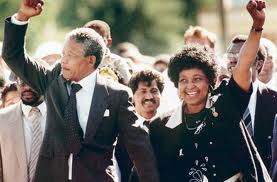
I read with interest your memorial pieces on Nelson Mandela.
There were various metaphors and comparisons to angels, to Martin Luther King and Gandhi, but little discussion of the reality of this complex political figure who was on USA’s terrorist watch list until 2008! Don’t get me wrong, I’m am a great admirer of Mr. Mandela and in fact the international plea for his release from prison was the start of my very long career as an Amnesty International Urgent Action writer.
But let’s not forget that Mr Mandela’s incarceration was lengthened due to his unwillingness to renounce violence as a means for gaining his people’s emancipation, and his unwillingness to denounce those committed to this cause who felt violence was indeed their only recourse.
As a pacifist I feel conflicted with this stand as indeed non-violent resistance yielded no result for this cause and it would seem they were right that the Afrikaner minority and international community only noticed their actions when they turned violent and when the rightful rulers of South Africa governed from behind the bars at Robben Island.
I think it was Homer who pled “Paint me with all my warts!”. I feel we do not honour Mr Mandela’s memory by glossing over his warts, and the gravity, the reality of his life and work.
Wouldn’t it be great if someone in Washington would imulate Mandela and try to put the country first and work together for the betterment of the ol USA.
Just think of all the less fortunate in South Africa that are better today because he “raised all ships”.
Thanks, I made one minor subject very edit and one other small change: please use the version below!
Nelson Mandela should rank as the Man of the 20th Century and I would go so far as to say the honor is really not in dispute. If Franklin Roosevelt overcame a broken body and marshaled the world to conquer a monster, remember that 27 years in prison should have broken both a body and a spirit, and appreciate that Mandela had no global army to conquer his beast. There were other democratic founders who were tested in prison—Walesa, Havel—but no one else mastered conciliation so skillfully that they made their captors voluntarily negotiate the terms of their own political demise.
There were other visionaries who spoke to the soul, from Gandhi and John Paul II to Martin Luther King, but no one but Mandela translated vision to power deftly enough to re-make a nation so thoroughly and so swiftly.
Another measure of his stature is that to emulate him seems superhuman. The moral nature of Mandela, from the forbearance to the forgiveness to the restraints he self-imposed in response to a people who would have made him a civil king, is about as foreign to our fractious ways, and our self-promoting mindset, as our technology would be to a caveman.
There is one other aspect to Mandela that gets overlooked. He understood that the measure of a society is not its elegant constitutions or robust markets or even the most egalitarian laws but the extent to which its culture enshrines mutual respect. (Pay attention, liberals and conservatives!) The heartbreak of his life may well have been watching the ways apartheid kept diminishing his country, years after its rules were buried: the insidious manner in which the children of apartheid were too predisposed to turn into thugs; or demagogues who stuffed their pockets; or men who abused their women or women who debased their own bodies. The most gifted politician of the 20th Century knew that politics by itself cannot rebuild what a culture breaks.
Many will know you from his story books. Others from the news, with all its peculiarities. Still more from what they have heard, or stories yet told.
For those of us privileged to have lived as you lived, we will remember you… remember as you non-violently faced the ugly face of unspeakable inhumanity…remember you tried using the law to challenge an immoral system repressing just us. And when you picked up your spear, our people faced gas, guns and tanks; standing up as they fell down.
From across oceans of blood, and mountains of diamonds and dollars we heard your song, Madiva.
We heard the echoes from all those cells, on and off the island. We listened, learned and witnessed the transformative power of dying for a cause; and not just because… Oh, but if these young brothers would hear you today!
We celebrate your walk on this side. They rolled away the stone that was your prison door and we witnessed you walk among the people as if on air.
We heard your voice and saw the workings of your mind as a nation transformed itself when seen in the light of your mirror. You challenged, and you changed; now its on us to do the same.
Bless you for being a blessing to us all. Meegwetch.
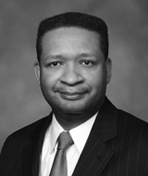
Reginald Meeks is a Member of the Kentucky House of Representatives, representing parts of Louisville
Nelson Mandela’s incredible example and leadership not just in South Africa, but globally, is one that we not only remember from the past, but must seek to emulate in our future.
Through some of the worst injustice a person can face at the hands of government, Nelson Mandela emerged believing that government could still be a force for good, change, and justice in the world. And then he lead and did the work necessary to make that happen.
Mandela supported so many causes that are still crying out for that kind of continued leadership and support from government today – organized labor, human dignity, and freedom from poverty, just to name a few.
Nelson Mandela reminds us that each person can make a difference in the world around them. I had the opportunity to meet his daughter, Zindzi Mandela, in New York at a premiere for “Long Walk to Freedom” just a few weeks ago, and heard her story firsthand – an incredibly powerful experience.
Mandela changed a nation with a steadfast and unwavering belief in what is right and just for all. A belief I still hold today, and an example I can only hope to live into a part of.
His example is one not only for his time, but for all time. I hope that we continue to hold up Nelson Mandela not only for the work he did, but for the work he can continue to inspire all of us to do.
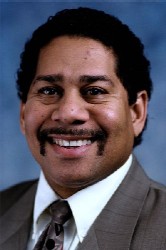
Elisabeth Jensen is a Democratic candidate for the U.S. Congress in the Sixth District of Kentucky.
I am very familiar with the Truth and Reconciliation Commission, having read the book. President Mandela and Desmond Tutu embody what we Christians like to believe we are like.
However, I cannot think of Nelson Mandela without thinking of this song that haunted me at the time. It is prescient and hopeful and quite moving. I still play it on YouTube when working and it reminds of what can be accomplished by those who never give up hope.
I was in the hospital in New Zealand at the time, and the Kiwis were having their own problems with the South Africans.
“Nelson Mandela” (known in some versions as “Free Nelson Mandela“) is a song written by Jerry Dammersand performed by his Coventry-based band The Special A.K.A. – with lead vocal by Stan Campbell – released on the single Nelson Mandela / Break Down The Door in 1984 as a protest against the imprisonment of Nelson Mandela by the apartheid South African government. Unlike most protest songs, the track is upbeat and celebratory, drawing on musical influences from South Africa. The song reached No.9 in the UK charts and was immensely popular in Africa.
My wife, Bonnie and I just returned from 10 days in South Africa which included our “Nelson Mandela Day” last Friday. That day we visited the amazing Apartheid Museum in Johannesburg, stood in Nelson Mandela’s house (now museum) in Soweto, visited Desmond Tutu’s house on the same street, took in an African restaurant for lunch in Soweto and the toured some of the adjacent neighborhoods. We also drove by and took pictures of the guarded compound in Jo-burg where he was spending his last days.
That evening, we went to see the opening of the movie “Mandela” because we wanted to view it with a local South African audience. It’s a powerful piece based on his autobiography and at several points during the movie, the audience laughed at things that were said in the movie – things that frankly passed over our heads. The audience was of mixed race – white Afrikaners (who speak Afrikaans), black Africans, Indians and others. There were a few mixed race couples – something that would have been a criminal offense just a few years ago. The audience was predominately white, perhaps because the cinema was in an upscale urban shopping mall on the Nelson Mandela Square in Jo-burg. The movie was very well received and the audience applauded at the end.
I had begun reading Mandela’s autobiography on the flight over. Like many chapters in history, you read them and wonder in retrospect how much attention you paid to the major events at the time they were occurring. I remember protests in the mid-seventies on my university campus encouraging the university to divest itself of its endowment holdings in companies doing business in S. Africa. I’m sure I read a few articles in Time magazine or the newspapers about the events unfolding across South Africa, but I’m embarrassed that I wasn’t more aware of the intensely racist system of apartheid that existed.
Mandela was truly a giant of the 20th century. I feel fortunate that last week I caught a glimpse of his history and profound contributions to humanity while he was still alive.
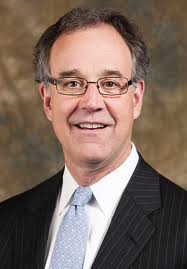
David Adkisson is the CEO of the Kentucky Chamber of Commerce
By Ronald J. Granieri, on Fri Dec 6, 2013 at 4:30 PM ET
Nelson Mandela was a great man whose life and work was a blessing to humanity. I say that even as I recognize it took me longer than it should have to realize it. Like a lot of campus conservative types in the mid-1980s, I knew little about Mandela while I was in college, but never let that stop me from having a lot of opinions about him, South Africa, and the ANC, and also making a lot of predictions about the future that sound pretty idiotic in retrospect. Truth is, he surprised his enemies and not a few of his friends by his post-Robben Island career. All I can say is that I am delighted to have been proven wrong so decisively by a man who left prison as he entered it, determined to free his people, but then set an example for all people of the politics of racial harmony. His actions and statements after his release transcended mere tolerance, challenging us to build a world where all work together respecting every fellow human being.
Did he completely succeed in translating his vision into reality? Is South Africa a utopia of racial transcendence? Certainly not. Human frailty being what it is, we all still have a lot of work to do everywhere. But in our efforts to do that work, we can all profit from the legacy of words and actions that Mandela has bequeathed to us.
In my faith tradition, we have a word for people whose exemplary lives inspire us to greater good. We call them saints. I use the term here carefully, not wanting to put off secularists, or to provoke reactions from my more religious brothers and sisters. Nevertheless, the ecclesiological analogy is important as we consider the political world. Saints are great not only because of what they believe, but because of what they do with that belief. They do not merely proclaim their personal purity and leave the world to burn. They see their own virtue not as a secret they can hoard and smugly lord over others, but as a responsibility, a trust to be put to use here on earth. Their works, their example, offer a spark of the Divine. That spark can and should kindle in every open heart a redoubled desire to do better, to be better, and to embrace our common human responsibilities.
Nelson Mandela is free from all care now. It is up to us to continue the work he began. His legacy inspires us, offering strength for the challenges to come.
Nelson Mandela, with the possible exception of Winston Churchill, has been the most positively transformational figure of the past 100 years. The impact of his courage, spirit, faith, persistence, forgiveness, intelligence, and leadership in bringing South Africa out of the depths of apartheid cannot be overstated. But his passing should invite more scrutiny as to how South Africa and its neighbors are faring today. Perhaps Mandela’s absence can help the rest of us revisit the unacceptable level of political, economic and civil discourse that is South Africa today, without the distraction his life has provided.
For the indices of income inequality, government integrity and transparency, economic growth, health care and cultural progress, the record is abysmal. For literacy, education, and racial integration the record is a little better. Here are some 21st century vignettes from my own family’s experience in the country:
· My college sophomore daughter’s semester abroad at Grahamstown University in 2000-2001 was highlighted by her volunteering one day per week in the neighborhood township ; while the campus was modestly integrated, not a single white student joined her and most thought she was crazy to so “risk her life”;
· At a November 2000 dinner with the white provost (a liberal) at Grahamstown University, we learned that more than 2/3 of his children and their friends (25-30 years old) had emigrated to UK, US, or Australia since l995.
· A black taxi driver in Capetown told us he perceived his then six-year old black majority government no better than the previous apartheid, and even more corrupt;
· My sister’s 2013 two-week training in Pretoria and Capetown of predominantly black hospital administrators in the basics of hospital finance yielded her perception of intelligent people with college degrees (and the most grateful students she has ever had) and not a clue of how to manage a hospital or the basics of health care finance.
While the world must be more patient than I am about a country emerging from such abject poverty and oppression for 85% of its citizenry (the Capetown townships occupying the medians of express highways are the most appalling living spaces I have ever seen), one cannot be optimistic about fifteen years of tenure by Mbeki and Zuma so unwilling to confront AIDs, tribal conflict, government ineptness and corruption, or any of the major economic challenges confronting them. And South Africa’s long term unwillingness to mitigate the murderous tyranny of Zimbabwe’s Robert Mugabe is analogous to the Germans’ tolerance of Hitler after the spring of l944.
Given the rich natural resources and relatively advanced industrial development of this beautiful, haunted country, we should expect better. Then again, with no democratic tradition, undeveloped civic institutions, no uniform rule of law, too small a black middle class, inferior schools, not yet equality for women, legitimate government, little national pride, and no overarching commitment of the country’s black and white elites to fundamentally redistribute income widely, what can we expect?
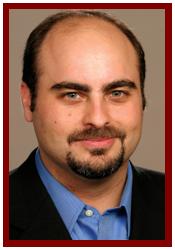
Steve Morgan is President of Clean Energy Solutions, Inc., of Boston, MA


 Blog this!