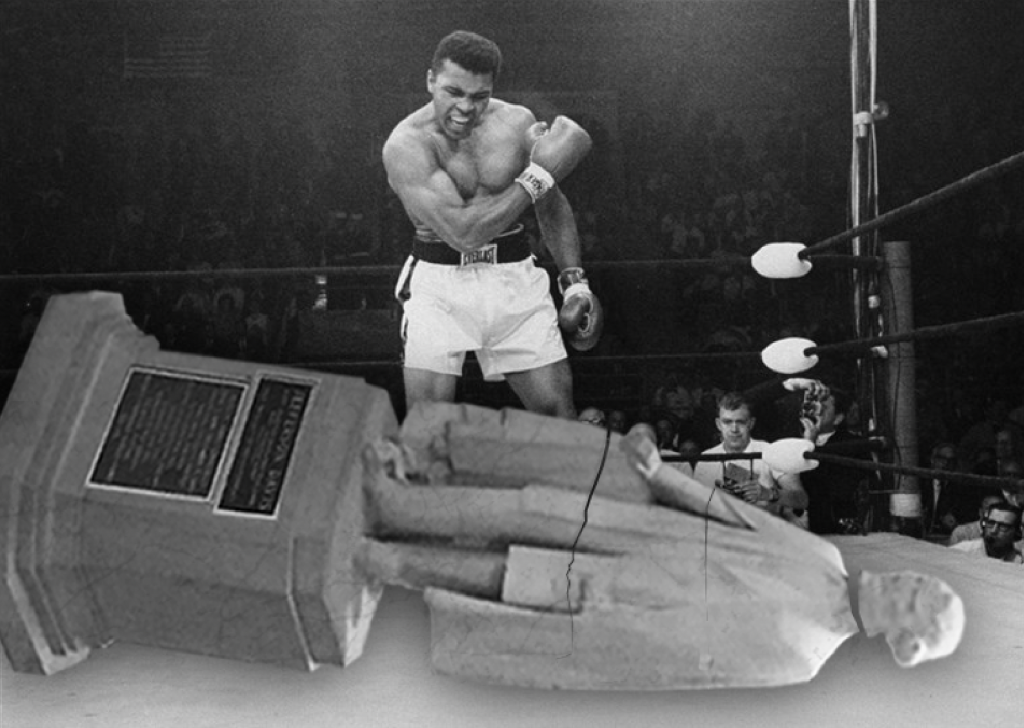
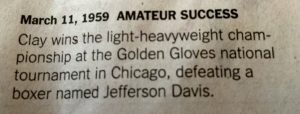
Please sign the petition below to remove the statue of Jefferson Davis currently in Kentucky’s Capitol Rotunda, and replace it with a tribute to Muhammad Ali, “the Louisville Lip” and “the Greatest of All Time.”
I just heard from the Ali family: It is the Champ’s belief that Islam prohibits three-dimensional representations of living Muslims. Accordingly, I have adjusted the petition to call for a two-dimensional representation of Ali (a portrait, picture or mural) in lieu of a statue.
UPDATE (Tuesday, December 2, 2014)
In this interview with WHAS-TV’s Joe Arnold, Governor Steve Beshear endorses the idea of honoring Muhammad Ali in the State Capitol (although he disagrees with removing Davis). Arnold explores the idea further on his weekly show, “The Powers that Be.”
Click here to check out WDRB-TV’s Lawrence Smith’s coverage of the story.
And here’s my op-ed in Ali’s hometown paper, the Louisville Courier-Journal.
UPDATE (Saturday, June 4, 2016)
In the wake of the 2015 Charlestown tragedy, in which a Confederate flag-waving murderer united the nation against racism, all of the most powerful Kentucky policymakers — U.S. Senator Mitch McConnell, Governor Matt Bevin, Senate President Robert Stivers and House Speaker Greg Stumbo — called for the removal of the Davis statue from the Rotunda. Today, as we commemorate last night’s passing of Muhammad Ali, there is no better moment to replace the symbol of Kentucky’s worst era with a tribute to The Greatest of All Time.
UPDATE (Wednesday, June 8, 2016):
Great piece by Lawrence Smith of WDRB-TV in Louisville on the petition drive to replace Jefferson Davis’ statue in the Capitol Rotunda with a tribute to Muhammad Ali.
UPDATE (Thursday, June 9, 2016):
Excellent piece on the petition drive by Jack Brammer that was featured on the front page of the Lexington Herald-Leader.
Highlight of the article:
Miller said he has received a few “angry comments” on his call to honor Ali.
“One of them encouraged me to kill myself,” he said. “You can quote me that I have decided not to take their advice.”
UPDATE (Friday, June 10, 2016)
The petition drives continues to show the Big Mo(hammed): check out these stories from WKYU-FM public radio in Bowling Green and WKYT-TV, Channel 27 in Lexington:
UPDATE (Saturday, June 11, 2016):
Still not convinced? Check out this excerpt from today’s New York Times:
By Lauren Mayer, on Wed Dec 18, 2013 at 8:30 AM ET
Last week I wrote about how Bill O’Reilly, Sarah Palin, et al were trying to stir up a frenzy over their imaginary ‘War on Christmas.’ Which at the time seemed like the height of going on the attack by trying to make oneself into a victim – but oh, ye of little faith, ye didn’t count on Megyn Kelly and ‘Santagate’.
In case you’ve been under a rock all week, a writer for Slate (an online magazine) wondered why traditional images of Santa Clause were always Caucasian, and she suggested that we consider race-free options (like a Penguin Claus – sort of like the Easter Bunny, or the Purim Hamster). This prompted Fox News anchor Megyn Kelly to trash her previous reputation for being more intelligent than her colleagues (remember her arguing with Karl Rove about the 2012 election results?), by convening a ‘panel’ to debate the issue, which as far as I could tell consisted of just one article (that hadn’t been very widely read until Kelly publicized it). She expressed her outrage that political correctness might trump truth, because it was a historical, verifiable fact that Santa is white – just like Jesus.
When critics began weighing in, Kelly immediately went on the defensive, claiming she was being attacked by race-baiting humor-less haters who didn’t get that the whole thing was tongue-in-cheek. On top of the fact that the original segment wasn’t particularly funny, one could also point to Kelly’s recent appearance on The Tonight Show, when she insisted she was a serious journalist, not an entertainer. But my biggest issue is that it’s hard to complain about being criticized when she’s the one who started criticizing in the first place.
The whole thing reminds me of sitcom fights where a younger sibling (Cindy Brady?) kicks an older one (Jan?) and when Jan retaliates, Cindy runs to mom, claiming “Jan is picking on me.” (And no, I don’t know what episode that was, it just sounds pretty plausible – plus I promised my own sons I’d stop embarrassing them by using them as examples.)
So as long as I’m in parental mode, I’d give Ms. Kelly the same advice most parents give their offspring – try to get along by putting yourself in each other’s shoes. And if you’re going to say something as silly as “Santa just IS white, it’s a historical, verifiable fact,” put yourself in the shoes of a liberally-inclined humorist and see if YOU could resist the temptation!
By Jonathan Miller, on Tue Dec 17, 2013 at 5:00 PM ET
Interested in being a part of Mark Nickolas’ first significant film project? The political operative-turned blogger-turned documentary filmmaker is in the middle of his first Kickstarter campaign to fund his latest film titled ‘This Is Not Graffiti,’ an important short film that will explore the use of political graffiti and street art as a catalyst for popular revolutions and uprisings around the world.
Mark is 17 days into his 36-day fundraising period and has already raised about 50% of his $18,500 budget, with pledges ranging from $1 to $2,500. But Kickstarter is an all-or-nothing platform. If he doesn’t hit his target, no pledges are processed and he gets nothing. Besides, the project offers very cool rewards starting at the $10 level, so they are great stocking stuffers!
As you may recall from our reporting here, his first film (which was simply a graduate film school project), garnered considerable national press, was a Smithsonian finalist, and is now on the film festival circuit. (check out his website if you want see/read more about his work at mosaicfilmsnyc.com).
Love him or hate him, those of you that know or remember Mark will recall his impressive level of success at his work, be it campaigns, with his writing, or with his very early film work. His new film project is already getting a considerable amount of attention and backing (including from yours truly), and you should check it out here.
By John Y. Brown III, on Tue Dec 17, 2013 at 3:00 PM ET
How does one say RIP to a man, Peter O’Toole, who once quipped, “I hate the light. I hate weather. Heaven for me is moving from one smoke-filled room to another?”
And to complicate matters further, O’Toole hilariously played an aristocratic delusional man who believed he was God in The Ruling Class. His doctor asks, “When did you realize you were God?” and O’Toole explains, “One day when I was praying I realized I was talking to myself.”
Today we lost, professionally, one of our greatest actors and even greater stage presences; and personally, we lost a preposterously delightful and divinely charming character’s character.
Upon hearing of Peter O’Toole’s death, I kept thinking of the story he told nearly a decade ago about what he wanted written on his tombstone.
After a trip to his dry cleaners’ to drop off his beloved leather jacket, one that he sent in “because it was covered in blood and Guinness and scotch and Cornflakes, the usual,” the jacket was returned with a note pinned on it:
“It distresses us to return work which is not perfect.”
And that’s what Peter O’Toole wants his tombstone. Maybe he’ll get his wish.
There are too many memorable video clips to pick just one. But since one is the limit for a post, this is a fitting one and they way I prefer to remember, Mr O’Toole–whose most magical role as an actor, perhaps, was simply playing himself.
“Don’t bend; don’t water it down; don’t try to make it logical; don’t edit your own soul according to the fashion.” – Franz Kafka
While Kafka wasn’t talking about baking, he may as well have been. In the midst of hectic holiday preparations and festivities, I’m here to implore you: don’t water down your favorite recipes just because they may be rich or “unhealthy.” I won’t be so dramatic as to compare it to editing one’s soul…however! Don’t edit the soul of your dish. It’s the holidays. Live a little.
To that end, let’s talk about your to-do list. Have you finished everything? What about those last-minute presents you’ve been putting off? What about that hard to shop for uncle, or the boss who has everything? What about the acquaintance that unexpectedly gave you a gift, and now you’re scrambling to find something for them?
I’ve got a (relatively) quick solution for you: make them something. It’s meaningful, easy, and can be shared with a wide audience. Scads of recipes lie in wait for you within the Internet abyss: homemade jams, pickles, sauces, and hot chocolate are all great options.
Last year, I baked chocolate hazelnut cookies for some of my cohort from a recipe I found online. Recipients liked them so much, I decided to make them a Christmas tradition. I’ve shared a copy of the recipe below, which I promise is not as complicated as it looks.
For a savory option, you can’t go wrong with bourbon beer cheese. My cousin Amanda Cole and good friend Ashley Baker get together every December to whip up a batch, and my aunt Robyn has kindly shared the recipe for your consumption.
My only rule for these recipes is this: no low calorie substitutions allowed. You’ve got a foodie soul to protect.
3 1/2 ounces (100g) unsalted butter, at room temperature
1/2 cup (100g) sugar
Pinch of salt
2 ounces (55g) bittersweet or semisweet chocolate, chopped
Directions:
Toast the hazelnuts in a 325ºF (160ºC) for 10 to 15 minutes, until they’re a deep golden brown color and the skins are peeling away. Remove from the oven and as soon as they’re cool enough to handle, rub the hazelnuts in a tea towel (or if they’re not too hot, with your hands), until as much of the loose skins come off as possible. Let them cool completely before grinding them up.
1. Put the hazelnuts in the bowl of a food processor and pulse them until very fine; they should be the consistency of coarse polenta.
2. Transfer the ground nuts to a bowl and add the rice flour (if using all-purpose flour, sift it in). Cut the butter into pieces then add the butter, sugar, and salt to the dry ingredients. Use your hands to mix all the ingredients together until the butter is dispersed and completely incorporated. The dough should be very smooth and hold together. If not, knead it until it does.
3. Divide the dough into three equal pieces and roll each piece until it’s 3/4-inch (2cm) round. Try to get them as smooth as possible, with no cracks. If the dough is too long to work with as you roll them out, you can cut the dough at the midway point and work with it in batches.
Chill the dough logs until firm on a small baking sheet or dinner plate lined with plastic wrap or parchment paper. (Terresa recommends refrigerating them for 2-3 hours, but we put them in the freezer and they were cold within 15 minutes.)
4. Preheat oven to 325ºF (160ºC) and line two baking sheets with parchment paper or silicone baking mats.
5. Working with one length of dough at a time, keeping the others in the refrigerator or freezer, cut off equal-sized pieces using a knife or pastry cutter. The ideal is 5 grams each, if working with a scale. The fastest way to do it is to cut one to the right weight, then hold that one alongside the logs and use it as a template to cut the others. Once you’ve cut a length of dough, roll the pieces into nice little balls and place them on the baking sheet, slightly spaced apart.
If you don’t have a scale, simply roll the dough to the size of a marble, trying to keep them as similar in size as possible.
6. Continue cutting the dough and rolling it into little balls. Bake the cookies for 10 to 14 minutes, rotating the baking sheets in the oven midway during cooking, until the tops are lightly golden brown. Let the cookies cool completely.
7. In a clean, dry bowl set over a pan of barely simmering water, melt the chocolate until smooth. Put a chocolate chip-sized dollop of chocolate on the bottom of one cookie and take another cookie, and sandwich the two halves together.
Once filled, set the Baci di Dama sideways on a wire cooling rack until the chocolate is firm. The cookies will keep in an airtight container at room temperature for up to one week.
(Liz’s note: To get more bang for your buck out of the dough, I skip sandwiching the cookies together.)
Bourbon Beer Cheese
(adapted from Jonathan at Gratz Park chef Jonathan Lundy’s recipe http://jagp.info/bluegrass-table-cookbook.html)
Ingredients:
14 ounces sharp cheddar cheese
4 ounces smoked cheddar cheese
8 ounces cream cheese, softened
2 tablespoon caramelized onions
12 ounces Ky Bourbon Barrel Ale
1 tablespoon of Bourbon
1 tablespoon ground black pepper
1/2 teaspoon salt
1/2 teaspoon onion powder
1/2 teaspoon garlic powder
2 tablespoons paprika
1/4 teaspoon cayenne powder
Directions:
Shred cheddar cheeses. In food processor, puree caramelized onions and shredded cheeses. Slowly add beer. Process until smooth and add remaining ingredients, continuing to process until creamy smooth consistency.
Can be stored in refrigerator for up to 2 weeks. Make ahead as flavor takes a while to develop.
By John Y. Brown III, on Tue Dec 17, 2013 at 12:00 PM ET
Being 50 years old gives one a lot of advantages over those young upstarts gunning for us in the rough and tumble business world.
But sometimes you try and try and try and try again.
And no matter where you are or who is around or who there is to look to for help….
And no matter how hard you keep trying as everyone around you is watching and waiting and listening and waiting some more….
You just can’t remember what you were going to say.
At least you think you can’t remember it. In fact, you can’t even remember if you forgot what you originally thought you forgot and now realize you may not have even been talking about the topic you thought you had lost your train of thought on in the first place.
It’s not so much embarrassing when that happens as it is liberating.
So, you just laugh and go along with it and finish that story just the way you feel it probably was supposed to end. Or at least possibly was supposed to end. Or hope, if it wasn’t the way it was supposed to end, no one notices. Or if they did notice, since they are about your age, maybe they will forget in about 15 minutes.
And if there are any of those young hot shots standing around looking at you and grinning knowingly like a vulture circling its prey before it breaths its final breath, stare them down with a look that says unmistakeably, “All I have to do is make one call and you’ll never work in this industry again. Got that?!”
By Erica and Matt Chua, on Tue Dec 17, 2013 at 8:30 AM ET
What picture comes to mind when you think of South America? Jungles? Maybe. Machu Picchu? Possibly. Beaches? Of course. Colonial architecture? Certainly. Countless tourism brochures and TV shows have etched the picture of South America’s colonial gems into minds everywhere. The reality though is different. Colonial architecture is far and few between in the modern cities of South America. From Rio to Lima, South America isn’t the centuries ago throwback that many visitors expect. Then where should time traveling wannabes go? Bolivia.
After a tumultuous start to the millennium, Bolivia has made startling progress both in embracing the new and restoring the past. It can be argued in fact, that Bolivia didn’t shake colonization until it elected its first indigenous president, Evo Morales, in 2006. That was the first time, since being colonized almost 500 years prior, that the indigenous, still a majority of the population, took control of their country. Evo, a polarizing figure, has led an effort to both to restore the historic sights and modernize the country. From my first visit 10 years ago to today, the changes to the naked eye are remarkable.
Bolivia’s cities are built around the colonial core, from La Paz to Sucre to Potosí. Each one has their unique aspects, but all have a central square with a massive church on one side and an administrative building on another. No matter what the buildings are used for today, visitors are guaranteed to see the colorful and grandiose edifices of South American tourist brochures.
Read the rest of… Erica & Matt Chua: South America’s Best Colonial Towns
By Jonathan Miller, on Mon Dec 16, 2013 at 1:30 PM ET
If you are a fellow #upper, particularly a fan of the Steve Kornacki version of MSNBC’s “Up,” you undoubtedly have watched the best political game show on TV — “Up Against the Clock.” Typically hosted by Kornacki, the all-time leading scorer on the show had been contributing RP (and MSNBC “The Cycle” co-host) Krystal Ball.
Well, this week. Krystal guest hosted for Steve, and the game show featured new contestant, and fellow contributing RP, Jeff Smith. And who’d have thunk it, but Jeff emerged as the Greatest Of All Time Up Against the Clock contestant. Watch him stumble over a Judd Gregg question, and then make a miraculous recovery to claim the all-time championship:
By John Y. Brown III, on Mon Dec 16, 2013 at 12:00 PM ET
How close to happiness?
Today I am just 23 pounds, $300,000, one more college degree, a new room created upstairs from the unused space in the attic, one deluxe car wash, one spring cleaning of my closet (this fall), two car payments, a new cream for my adult eczema, one tuition payment, one mini-marathon, a year of Yoga classes, 3 years of missed time with my daughter and son and wife, a full physical check up, a new dentist, 35 emails, 12 voice mail messages, 3 weekend couple invitations for dinner, 4 meetings for coffee, one meeting for lunch, one really good night’s sleep, a contribution to my IRA, de-duplicating software tool for my contacts on Outlook, one new iPad Air, 4 conference calls, 3 new clients, getting alterations done on the new blue blazer I bought 8 months ago, one gas tank fill-up, some new stationary with my name on it for thank you notes, and one cup of coffee away from true happiness.
We need to try more stuff. Innovation is never about silver bullets. It’s about experimentation and doing whatever it takes, even if it means trying 1000 things, to deliver value.
Making progress on the real issues of our time including health care, education, and energy will require a lot more experimentation than we are comfortable with today. These are all systems challenges that will require systems solutions. Tweaking the current systems will not work. Technology as a sustaining innovation may improve the efficiency of current systems but will not result in the transformation that we all know is needed. We need to learn how to leverage technology for disruptive innovation and to experiment at the systems level.
My mantra is Think Big, Start Small, Scale Fast. The imperative for all innovators is R&D for business models and systems. We know how to do R&D for new products and technologies. We need to also do R&D for new business models and systems. It is not technology that is getting in the way, it is humans and the intransigent organizations we live in that are both stubbornly resistant to change. We have plenty of technology available to us. We need to learn how to leverage it to open up transformative ways to deliver value. Designing and experimenting with new system approaches, particularly those that cut across sectors and silos, is the path to the transformation that we need. We must design around the end user and learn how to harness the potential of social media platforms and storytelling to enable purposeful networks.
I recently watched a 60 Minutes segment highlighting the success of the Harlem Children’s Zone in NYC. Listening to Geoffrey Canada, the program’s founder, was inspiring and reminded me of the importance of systems level change. Everyone wants to know the one thing that makes a program like HCZ successful. What is the silver bullet that will allow the program to be replicated with ease across the country? We are always looking for an easy answer. There is no silver bullet and it is not easy to transform systems. At HCZ it is doing 1000 things with passion to help those children succeed. It is about focusing on the customer, in this case, the children within 100 city blocks in Harlem and doing what ever it takes to help them secure a bright future. There is no one thing. There are a lot of things that were tried, many that didn’t work or add value, and a strong appetite for trying new approaches to achieve the goal.
Systems transformation is all about experimentation. It is about combining and recombining capabilities from across silos until something clicks and value is delivered in a new way. It is never just one thing. It starts with a big idea that gets the juices flowing and attracts others with similar passion to the purposeful network. The big idea has to be translated from the white board on to a real world test bed to demonstrate that the idea is feasible. Starting small and demonstrating progress is key to building credibility and expanding a network of interested stakeholders. An ongoing portfolio of small-scale experiments to fail fast on those without merit and to prioritize those with the potential to scale is critical. Those experiments that demonstrate the feasibility of a new model or approach become candidates for expansion. Scaling fast becomes more likely with the ability to leverage the proof point of a successful real world experiment and the opportunity to leverage a network of passionate supporters.
Systems level innovation is about enabling purposeful networks with the capacity to Think Big, Start Small, Scale Fast.


 Blog this!