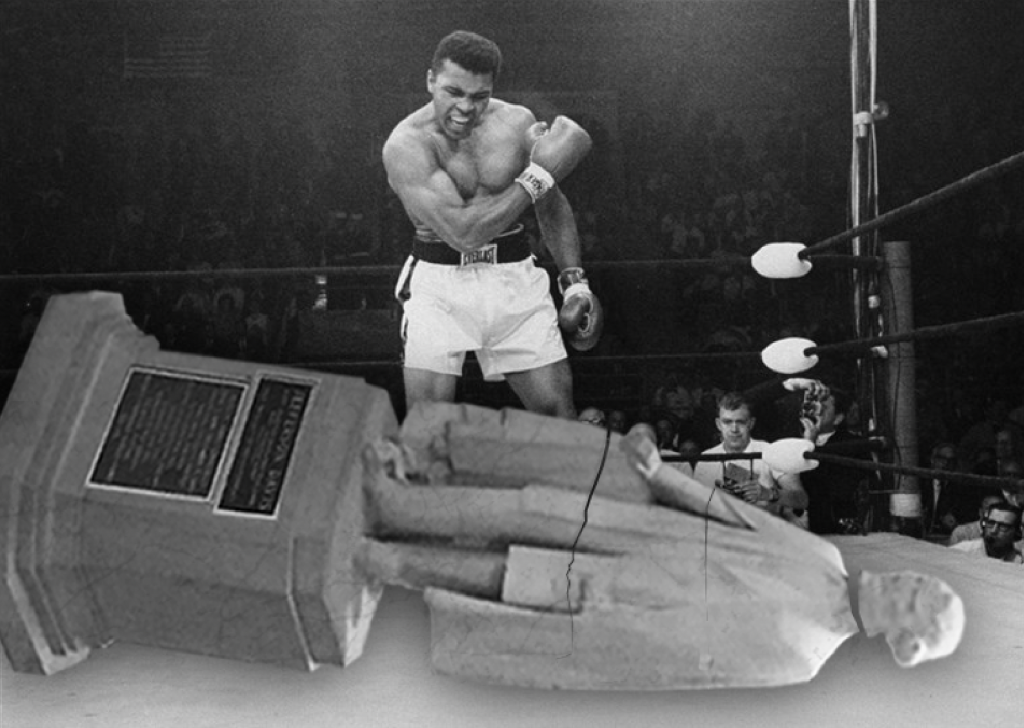
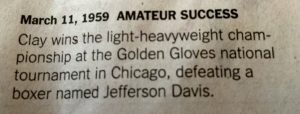
Please sign the petition below to remove the statue of Jefferson Davis currently in Kentucky’s Capitol Rotunda, and replace it with a tribute to Muhammad Ali, “the Louisville Lip” and “the Greatest of All Time.”
I just heard from the Ali family: It is the Champ’s belief that Islam prohibits three-dimensional representations of living Muslims. Accordingly, I have adjusted the petition to call for a two-dimensional representation of Ali (a portrait, picture or mural) in lieu of a statue.
UPDATE (Tuesday, December 2, 2014)
In this interview with WHAS-TV’s Joe Arnold, Governor Steve Beshear endorses the idea of honoring Muhammad Ali in the State Capitol (although he disagrees with removing Davis). Arnold explores the idea further on his weekly show, “The Powers that Be.”
Click here to check out WDRB-TV’s Lawrence Smith’s coverage of the story.
And here’s my op-ed in Ali’s hometown paper, the Louisville Courier-Journal.
UPDATE (Saturday, June 4, 2016)
In the wake of the 2015 Charlestown tragedy, in which a Confederate flag-waving murderer united the nation against racism, all of the most powerful Kentucky policymakers — U.S. Senator Mitch McConnell, Governor Matt Bevin, Senate President Robert Stivers and House Speaker Greg Stumbo — called for the removal of the Davis statue from the Rotunda. Today, as we commemorate last night’s passing of Muhammad Ali, there is no better moment to replace the symbol of Kentucky’s worst era with a tribute to The Greatest of All Time.
UPDATE (Wednesday, June 8, 2016):
Great piece by Lawrence Smith of WDRB-TV in Louisville on the petition drive to replace Jefferson Davis’ statue in the Capitol Rotunda with a tribute to Muhammad Ali.
UPDATE (Thursday, June 9, 2016):
Excellent piece on the petition drive by Jack Brammer that was featured on the front page of the Lexington Herald-Leader.
Highlight of the article:
Miller said he has received a few “angry comments” on his call to honor Ali.
“One of them encouraged me to kill myself,” he said. “You can quote me that I have decided not to take their advice.”
UPDATE (Friday, June 10, 2016)
The petition drives continues to show the Big Mo(hammed): check out these stories from WKYU-FM public radio in Bowling Green and WKYT-TV, Channel 27 in Lexington:
UPDATE (Saturday, June 11, 2016):
Still not convinced? Check out this excerpt from today’s New York Times:
Time and time again, we’ve heard our leaders tell us they want to be “uniters, not dividers,” but no one has ever explained how they plan to achieve that.
That is why No Labels is calling for a new governing process — a process that starts with bringing our political leaders to the table to develop shared national goals before the debates and policymaking begin.
In our book released today, we lay out our blueprint – howwe bring our leaders together and forge consensus around an American agenda for national success. No Labels: A Shared Vision for a Stronger America, edited by Governor Jon Huntsman and featuring a forward by Senator Joe Manchin, is just the beginning of a three-year campaign to change politics in America. It will take combined efforts and resources to get the word out. So once again, we need to ask for your help.
Please click here and take a moment to rate and review No Labels: A Shared Vision for a Stronger America. Your comments are integral to building buzz around the ideas, moving the e-book up the charts, and helping others to find and join our campaign for a new politics of problem solving.
From Mexico to Singapore to Brazil, our competitors are thinking strategically about how to achieve clear goals for their own success. If we don’t start thinking strategically, we will fall behind.
And while you’re at it … be sure to tell your friends and colleagues about the e-book. Get them reading! No Labels: A Shared Vision for a Stronger America is about developing shared goals. The only way our leaders will be convinced that the time is right for a new national strategic agenda is if the groundswell of support from across the country is impossible to ignore.
Please, help us spread the message. We all have our sights on a strong, prosperous, secure nation. Together, we can get there.
By Jonathan Miller, on Tue Jan 14, 2014 at 2:19 PM ET
UK President Capilouto
U of L President Jim Ramsey
The two largest universities in Kentucky — the University of Kentucky and the University of Louisville — have been friendly rivals on the court and gridiron for decades.
(OK, sometimes, not so friendly…).
But they are united by the fact that they boast of Presidents who are deeply committed to the ideals of higher education — especially academic freedom.
And today, The Recovering Politician was proud to break the news that U of L President Jim Ramsey and UK President Eli Capilouto each joined the growing list of college and university leaders (192 and counting) who have denounced the American Studies Association’s pernicious academic boycott of Israel. (Read about it here.)
By Jonathan Miller, on Tue Jan 14, 2014 at 1:44 PM ET
This morning, we reported that University of Louisville President Jim Ramsey joined the growing list of college and university leaders (191 and counting, according to intrepid blogger Avi Mayer) who have denounced the American Studies Association’s pernicious academic boycott of Israel. (Read about it here; and read why boycotts like this are so pernicious in my book, The Liberal Case for Israel).
Well, make it 192: University of Kentucky President Eli Capilouto.
While U of L and UK may be big rivals on the basketball court and the gridiron, they share the distinction of boasting outstanding Presidents, who both are advocates of free speech and a strong US/Israel relationship. Here’s President Capilouto’s statement, “Open Inquiry is Essential in Higher Education”:
A college campus – perhaps more than anywhere else – is a cherished crucible for the free exchange of ideas and beliefs.
This is a fundamental characteristic when you consider that our faculty and staff are charged with developing new scholarship, and our students are at an age when their civic and personal philosophies are evolving. Over time, these necessary attributes of a campus have been challenged, debated and protected. Though honoring it can be demanding at times, our commitment to academic freedom, fostered in a safe and respectful environment, is at the core of our work in a university community. It is who we are.
UK President Capilouto
Recently, I was reminded again of that fundamental tension as members of the American Studies Association (ASA) endorsed a resolution boycotting Israeli academic institutions for that country’s policies toward Palestine. The proposed boycott has elicited strong responses from other professional organizations in the academy — ranging from the American Association of University Professors (AAUP) to institutional organizations such as the Association of American Universities (AAU) and the Association of Public and Land-grant Universities (APLU). Administrators and faculty — individually and collectively — at several colleges and universities also have engaged in the debate.
Their statements clearly indicate a national dialogue, one happening on college and university campuses like ours. I disagree with the ASA’s resolution to boycott academic institutions in Israel.
The values of inquiry and discourse in American academia – applied within a scholar’s responsibilities as an academic – reflect the foundation and principles of our system of higher education.
As institutions of higher learning, in particular, we are tasked with producing independent, testable scholarship, while educating the next generation of civic and business leaders. If we hope to advance our own understanding of the world around us, a scholar’s capacity to build a body of work in his or her field must run unimpeded by politics and external forces. At the heart of that process is the idea that many voices — sometimes in harmony, sometimes discordant — are critical to education and community.
Our capacity to foster constructive dialogue is at the core of what we do at the University of Kentucky. We should resist at all times temptations — or voices — that call on us to circumscribe or inhibit that dialogue. No matter where such temptation comes from, or however well-intentioned it may be, it is a self-defeating proposition.
By John Y. Brown III, on Tue Jan 14, 2014 at 12:00 PM ET
“Want to quickly and easily get your credit score right now for free?
If you answered ‘Yes’ then click here….
Oh, wait a minute….
Let’s decode that offer.
“Would you like to pay a $30 monthly fee to have your credit score sent to you each month (nearly $400 a year if you forget to cancel) and if you try to cancel it’s a real pain in the neck because although they will sign you up in a jiffy… online, to cancel you have to call in during certain hours and remain on hold for a maddeningly long time until you speak to a customer-service representative who will essentially refuse to cancel your membership until you shout at them that, “Yes, you understand all the amazing benefits of having your score sent to you monthly and despite the fact you are an inexplicable ignoramus unable to decipher obvious commonsensical benefits to yourself and my family, you still want it cancelled?”
A “rebellion” is about to begin the second day. I am tracking its progress on the Internet.
Staging what they have dubbed “the New Hampshire Rebellion,” a group led by Harvard professor, author and activist Lawrence Lessig set out for a 185 mile journey across the “live free or die” state calling attention to what they see as one of the most important issues in U.S. politics today—the dire need for campaign finance reform.
Lessig recently wrote in The Daily Beast:
On Saturday, we begin a walk across the state of New Hampshire, to launch a campaign to bring about an end to the system of corruption that we believe infects DC.
The march will pay homage to a similar attempt by famed activist Dorris Haddock, or “Granny D,” who, fifteen years ago at the age of 88, marched across the United States from Los Angeles to Washington DC with a sign reading “Campaign Finance Reform” across her chest.
Haddock is credited with helping to galvanize public will around the McCain-Feingold Campaign Finance Reform Act,” “which was signed into law in 2002.
However, since then, the Supreme Court, has ruled in favor of big donors, and the politicians who use them. In 2010, in Citizens United vs. Federal Election Commission, and in 2013, in McCutcheon vs FEC many of the limits put in place on campaign finance has been overturned, paving the way for a new era of unprecedented spending by special interests, corporations and individuals.
Lessig said he expects over 100 people to join him along the way as they stop in over a dozen towns over the course of two weeks. The group will hold events and public discussions centered around the issues of big money in politics—and how to cleanse such influence from the democratic process.
Citing the importance of New Hampshire in U.S. presidential elections, being the site of the first presidential primary, the goal of the walk will be to convince voters to pressure candidates on the issue of campaign finance reform.
Lessig continues:
Along the way, we will recruit everyone we can to do one thing: We want them to ask every presidential candidate at every event between now and January 2016, this one question: ‘How will YOU end the system of corruption in Washington?
A system of corruption, a system of campaign funding in which fundraising is key, and the funders represent the tiniest fraction of the 1%. That system, we believe, corrupts this democracy. (We, and 71% of Americans according to a recent poll.) And until that system changes, no sensible reform on the right or the left is possible.
As this question gets asked, we will record the responses. Literally. And post them. And through allied campaigns, we will put pressure on the candidates to surface this issue — and if we’re lucky — make it central to their campaigns”.
The walk began in Dixville Notch, NH, the place where the first presidential ballots are cast and will end in Nashua, NH, on the day Granny D was born, January 24th.
The activists embarked Saturday January 11th, exactly one year after the the suicide of internet activist Aaron Swartz, a close friend and colleague of Lessig’s.
“I wanted to find a way to mark this day,” Lessig writes. “I wanted to feel it, as physically painful as it was emotionally painful one year ago, and every moment since. So I am marking it with the cause that he convinced me to take up seven years ago and which I am certain he wanted to make his legacy too.”
Lessig talks about the New Hampshire Rebellion:
The walkers current location, Akers Pond Inn, Errol, NH. Distance Traveled: 10 miles. Distance To Go: 175 miles.
How would YOU end the system of corruption in Washington? Send responses to garyyarus@yahoo.com. I will summarize them in a future article.
By Jonathan Miller, on Tue Jan 14, 2014 at 8:58 AM ET
A big Mazel Tov to University of Louisville President Jim Ramsey, who joins the growing list of college and university leaders (191 and counting, according to intrepid blogger Avi Mayer) who have denounced the American Studies Association’s pernicious academic boycott of Israel. (Read about it here.)
As I discussed extensively in my book, The Liberal Case for Israel, while Israel is by no means perfect — no government is — even under the most distorted, jaundiced view, her transgressions pale in comparison to her neighbors, and in fact to most countries in the world. Singling out the Jewish State for a boycott is hypocritical at best, anti-Semitic at worst.
Bravo to President Jim Ramsey. Here’s his letter:
January 8, 2014
Dr. M. Peter McPherson
President
Association of Public and Land-grant Universities
1307 New York Avenue, NW
Suite 400
Washington, DC 20005
Dear Peter,
The University of Louisville is committed to diversity and to ensuring the free exchange of ideas on our campus. We promote the ability of our faculty to share knowledge, research, and ideas with university faculty throughout the world. Because of our view that the free exchange of ideas is paramount to academic freedom, we oppose any effort to boycott academic institutions regardless of the political systems in which they operate.
We appreciate the position of the APLU that any boycott could limit the ability of UofL professors and researchers to collaborate with faculty whose institutions are targeted by the boycott. This could hinder not only UofL’s efforts but those of colleges and universities across the United States to find new cures for diseases, to develop new sources of energy, or to bridge cultural divides.
Thank you for the leadership of the APLU and I wanted to communicate to you that I support the APLU position.
By Erica and Matt Chua, on Tue Jan 14, 2014 at 8:30 AM ET
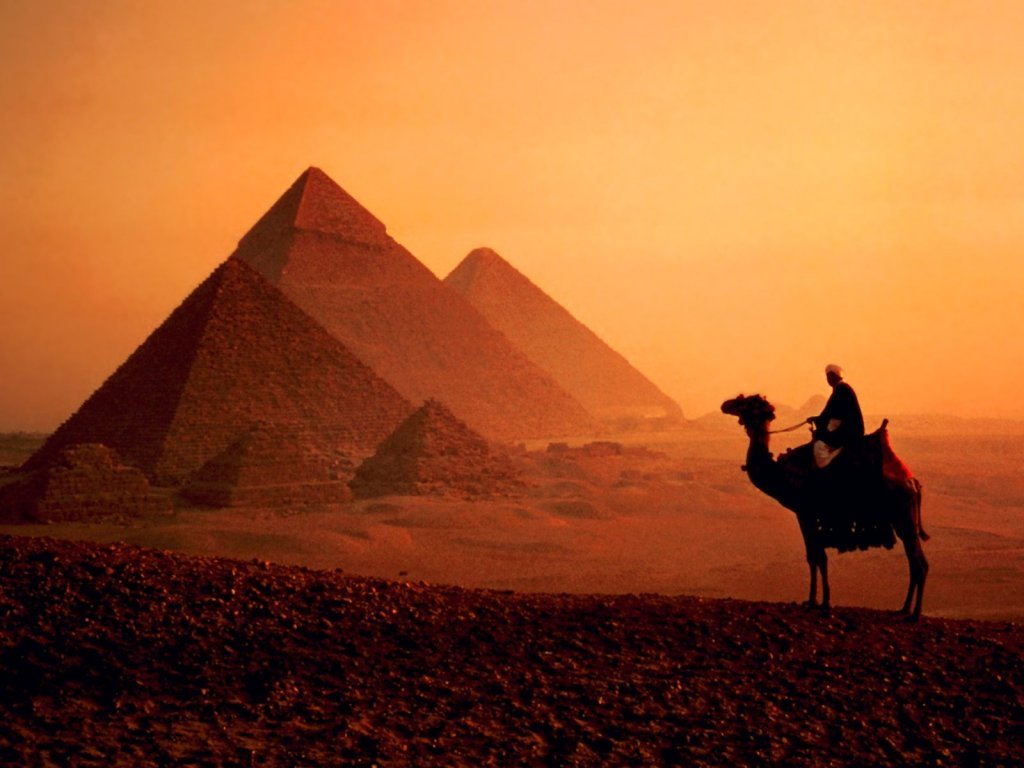
Egypt’s modern history may be in the spotlight, but it’s ancient history is it’s gem. Having given birth to the world’s first major civilization, Egypt amazes with the depth and breadth of experiences to have, places to go, and ancient wonders to see. While the Pyramids and temples are the main attraction, the magnificent beaches of the Red Sea and chaos of Cairo add to the intrigue of this country caught somewhere between Africa, the Middle East and Europe.
……………………………………
DON’T MISS: The Pyramids at Giza. They are magnificent. MUST SEE:The Temples of Karnak (Luxor), Luxor Temple at night, Valley of the Kings (Luxor), the marine life of the Red Sea, the Library in Alexandria and the striking temple of Abu Simbel. MUST TASTE: GAD, Egyptian fast food…it’s delicious. Also try koshary, all the carbs that fit in one dish…you have to taste, because it can’t be described!
……………………………………
TRIP PLANNING: Two weeks provides enough to see the historic sights, but adding another week for the Red Sea will make the trip. GETTING AROUND: The main sights of the country along the Nile, Alexandria-Cairo-Luxor-Aswan, are connected by train. Take tours to get to far-flung sights and consider flying to the Sinai (Sharm El Sheikh or Dahab on the Red Sea).
……………………………………
OUR COST PER DAY (2 ppl): $55.87 COST OF A BEER: $1-$2.50 for the local brew at restaurants and liquor stores (if you can find one). KEY MONEY-SAVING TIP: Traveling to the main attractions independently will save you loads of money, but taking a tour to get to many relieve a lot of the hassle.
……………………………………
YOU NEED TO KNOW: There is no avoiding the touts, even if you are on a fully inclusive guided tour…be prepared. IF WE KNEW WHAT WE KNOW NOW: We wouldn’t take a first class train. There isn’t much of a difference between first and second class other than first class costs twice as much. HELPFUL LINKS TO LEARN MORE:The Egyptian Railways website for train schedules and booking and wikitravel for an overview of sights to see.
……………………………………
WE WERE THERE FOR: 3 weeks OUR HIGHLIGHT: Finally making it to the Pyramids, one of the main sights we wanted to see when we started our trip two years ago! WHERE WE WENT:Dahab, Luxor, Aswan, Abu Simbel, Edfu, Kom Ombo, Cairo, Alexandria, Pyramids of Giza WE REGRET MISSING: The Western Desert.
By Jonathan Miller, on Mon Jan 13, 2014 at 1:30 PM ET
Turns out that “Miller” comes from the profession of milling!
OK, that was obvious, but if you are a fellow Jew with a more interesting last name, this is a cool article by Bennett Muraskin in Business Insider:
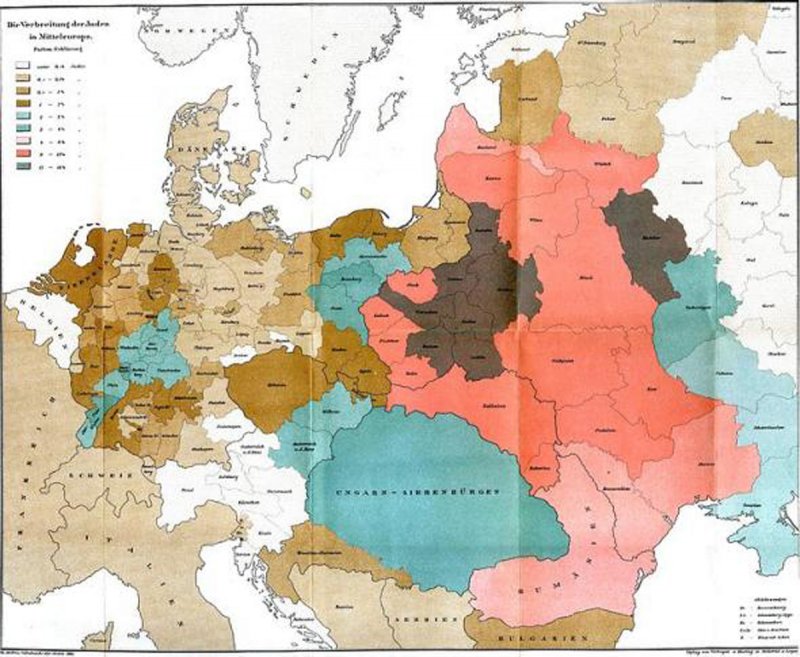
Ashkenazic Jews were among the last Europeans to take family names. Some German-speaking Jews took last names as early as the 17th century, but the overwhelming majority of Jews lived in Eastern Europe and did not take last names until compelled to do so. The process began in the Austro-Hungarian Empire in 1787 and ended in Czarist Russia in 1844.
In attempting to build modern nation-states, the authorities insisted that Jews take last names so that they could be taxed, drafted, and educated (in that order of importance). For centuries, Jewish communal leaders were responsible for collecting taxes from the Jewish population on behalf of the government, and in some cases were responsible for filling draft quotas. Education was traditionally an internal Jewish affair.
Until this period, Jewish names generally changed with every generation. For example, if Moses son of Mendel (Moyshe ben Mendel) married Sarah daughter of Rebecca (Sara bat rivka), and they had a boy and named it Samuel (Shmuel), the child would be called Shmuel ben Moyshe. If they had a girl and named her Feygele, she would be called Feygele bas Sora.
Jews distrusted the authorities and resisted the new requirement. Although they were forced to take last names, at first they were used only for official purposes. Among themselves, they kept their traditional names. Over time, Jews accepted the new last names, which were essential as Jews sought to advance within the broader society and as the shtetles were transformed or Jews left them for big cities.
The easiest way for Jews to assume an official last name was to adapt the name they already had, making it permanent. This explains the use of “patronymics” and “matronymics.”
PATRONYMICS (son of …)
In Yiddish or German, “son” would be denoted by “son” or “sohn” or “er.” In most Slavic languages, like Polish or Russian, it would be “wich” or “witz.”
For example: The son of Mendel took the last name Mendelsohn; the son of Abraham became Abramson or Avromovitch; the son of Menashe became Manishewitz; the son of Itzhak became Itskowitz; the son of Berl took the name Berliner; the son of Kesl took the name Kessler, etc.
MATRONYMICS (daughter of …)
Reflecting the prominence of Jewish women in business, some families made last names out of women’s first names: Chaiken — son of Chaikeh; Edelman — husband of Edel; Gittelman — husband of Gitl; Glick or Gluck — may derive from Glickl, a popular woman’s name as in the famous “Glickl of Hameln,” whose memoirs, written around 1690, are an early example of Yiddish literature.
Gold/Goldman/Gulden may derived from Golda; Malkov from Malke; Perlman — husband of Perl; Rivken — may derive from Rivke; Soronsohn—son of Sarah.
By John Y. Brown III, on Mon Jan 13, 2014 at 12:00 PM ET
My wife and I have just endured the worst flu virus either of us has ever experienced.
This was no ordinary “Stay-in-bed-and-watch-TV- flu.”
This was more of a “Don’t-speak-to-me-for-three-days-except-to-bring-me-a-cup-of-tea-on-the-third-day-or-a-copy-of-Albert-Camus’-The-Plague-but-preferably-tea-because-I-don’t-have-the-physical-strength-to-read-and-I-was-serious-about-not-speaking-to-me-seriously-oh-no-I-have-to-throw-up-again-please-just-leave-me-alone-like-I-already-asked-several-times-but-do-leave-the-book-on-Bubonic-plague-and-know–I-love-you-and–I-am-sorry-about-this-and-also-sorry-about-that-thing-I-said-several-years-ago-but-can’t-remember-now-I-will-make-it-up-to-you-if-I-survive.”
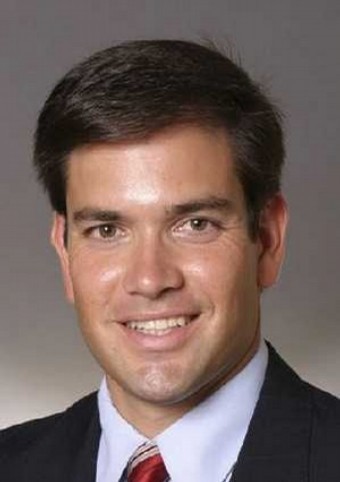
These aren’t quibbles, and some of them leave Rubio’s ideas vulnerable to the charge that they would in practice gut or outright eliminate subsistence for millions of low income Americans in the name of “upgrading” the War on Poverty.
But to enlarge the discussion beyond policy specifics, there are arguably two broader dimensions to the Rubio address, each of which illustrates the challenges Republicans face when they venture into this arena. First, the senator’s context from start to finish was that a (relatively) bipartisan generation of antipoverty legislation amounts to a massive systems failure. Liberal commentators were correct to shoot this overstatement down: a country stripped of Medicaid, SSI disability, Title I education funding and food stamps would not only be fundamentally crueler, it would have inevitably fractured into revolt under the strains of the Great Recession. In the same way that De Blasio style liberals have glossed over the contributions the Giuliani/Bloomberg run made to a safer, more livable New York City, the “failure” critique that Rubio and most conservatives advance regarding the War on Poverty is too glib, too shallow.
This criticism, by the way, isn’t just finding fault with rhetoric. The legislative challenge for a President Rubio would be assembling a coalition of a unified Republican Party and more centrist Democrats to enact a new anti-poverty agenda: and one of the primary requirements for attracting any Democrats into that coalition would be the preservation of most of the anti-poverty regime that exists today. Could Rubio even begin to sell the right wing of his party on such a trade-off if his premise has been that the status quo is a disaster?
And that leads to the second challenge that Rubio tackled, but not forcefully enough. The leading ideological sensibilities of today’s GOP voters are that (1) poverty is not really systemic and is a product of either inept economic management by Barack Obama or of weak individual choices and that (2) stirring up public interest in poverty or income inequality is usually “class warfare” based pandering. Rubio has earned credit for implicitly rebuking this mindset by bringing up the issue at all.
Read the rest of… Artur Davis: What Rubio Did and Did Not Say About Poverty


 Blog this!