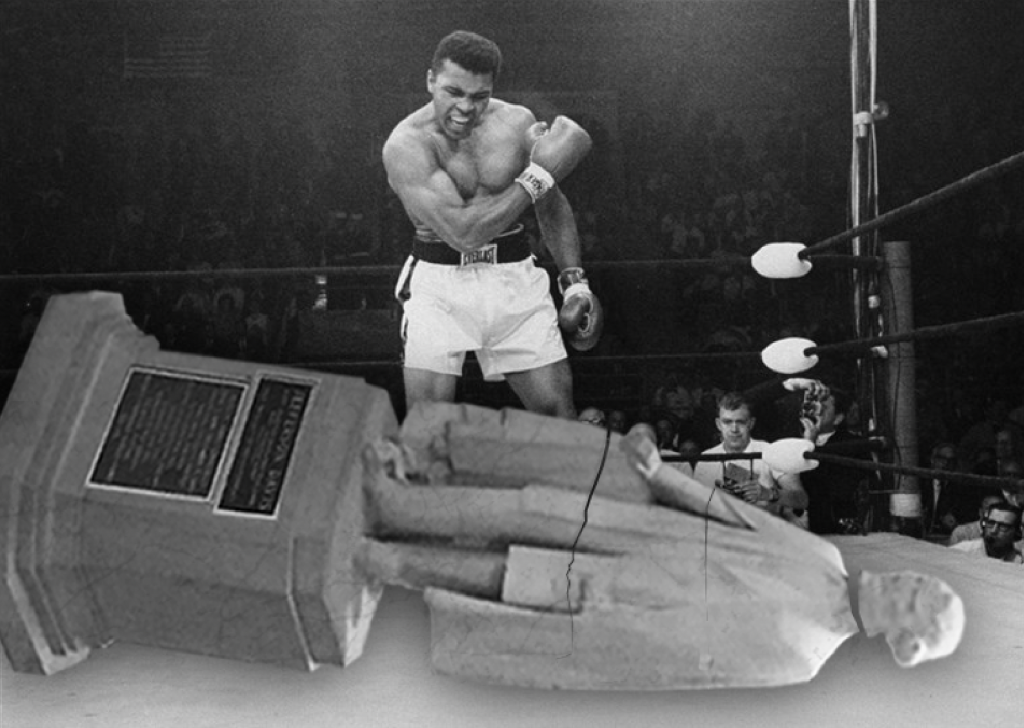
Please sign the petition below to remove the statue of Jefferson Davis currently in Kentucky’s Capitol Rotunda, and replace it with a tribute to Muhammad Ali, “the Louisville Lip” and “the Greatest of All Time.”
I just heard from the Ali family: It is the Champ’s belief that Islam prohibits three-dimensional representations of living Muslims. Accordingly, I have adjusted the petition to call for a two-dimensional representation of Ali (a portrait, picture or mural) in lieu of a statue.
UPDATE (Tuesday, December 2, 2014)
In this interview with WHAS-TV’s Joe Arnold, Governor Steve Beshear endorses the idea of honoring Muhammad Ali in the State Capitol (although he disagrees with removing Davis). Arnold explores the idea further on his weekly show, “The Powers that Be.”
Click here to check out WDRB-TV’s Lawrence Smith’s coverage of the story.
And here’s my op-ed in Ali’s hometown paper, the Louisville Courier-Journal.
UPDATE (Saturday, June 4, 2016)
In the wake of the 2015 Charlestown tragedy, in which a Confederate flag-waving murderer united the nation against racism, all of the most powerful Kentucky policymakers — U.S. Senator Mitch McConnell, Governor Matt Bevin, Senate President Robert Stivers and House Speaker Greg Stumbo — called for the removal of the Davis statue from the Rotunda. Today, as we commemorate last night’s passing of Muhammad Ali, there is no better moment to replace the symbol of Kentucky’s worst era with a tribute to The Greatest of All Time.
UPDATE (Wednesday, June 8, 2016):
Great piece by Lawrence Smith of WDRB-TV in Louisville on the petition drive to replace Jefferson Davis’ statue in the Capitol Rotunda with a tribute to Muhammad Ali.
UPDATE (Thursday, June 9, 2016):
Excellent piece on the petition drive by Jack Brammer that was featured on the front page of the Lexington Herald-Leader.
Highlight of the article:
Miller said he has received a few “angry comments” on his call to honor Ali.
“One of them encouraged me to kill myself,” he said. “You can quote me that I have decided not to take their advice.”
UPDATE (Friday, June 10, 2016)
The petition drives continues to show the Big Mo(hammed): check out these stories from WKYU-FM public radio in Bowling Green and WKYT-TV, Channel 27 in Lexington:
UPDATE (Saturday, June 11, 2016):
Still not convinced? Check out this excerpt from today’s New York Times:
By Jonathan Miller, on Mon Mar 24, 2014 at 3:00 PM ET
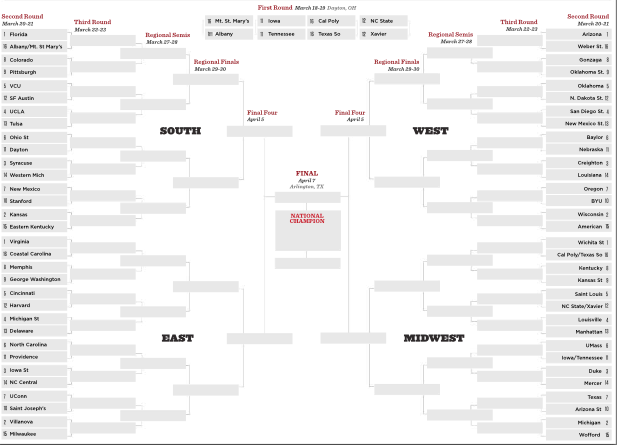
It was the best week of college hoops since James Naismith emptied out a peach basket.
No let me go further: It was the greatest week in the history of the world. Consider:
1. My home team — my favorite squad in all of sports — the University of Kentucky Wildcats — overcame all of its freshman jitters and poor play to advance to the Sweet Sixteen, by upsetting the only 35-0 squad in the history of the game. I haven’t rooted so hard for an underdog like this since 1992, and we all know what happened then.
2. My alma mater — Harvard University — which I don’t believe had a basketball program when I attended in the late 1980s, announced itself as a legitimate, gritty basketball school on the 25th anniversary of my graduation by coming thisclose to beating Michigan State, which many of predicted to win the whole thing.
3. The source of all evil in the world — the Duke Blue Devils — lost to Mercer in the first round. With all apologies to anyone who went to Mercer, I still don’t know where it is located.
Meanwhile, our popular, No Labels-co-sponsored “No Bracket, No Pay” prediction tournament saw nearly 100 entries. We have 5 people tied at the top (I’m respectfully tied for 15th place): check out the full standings here. And don’t forget to vote on the prizes to be awarded to our winners.
So, it will all be a letdown from here. All we have going on in Kentucky is THE BIGGEST GAME IN THE HISTORY OF THE UNIVERSE on Friday. Go Cats!
By John Y. Brown III, on Mon Mar 24, 2014 at 12:00 PM ET
I am soooo smart sometimes….
Why do I say this?
Mostly because I am always looking for clever and cost-saving short cuts in life.
And it is fun when I come up with one.
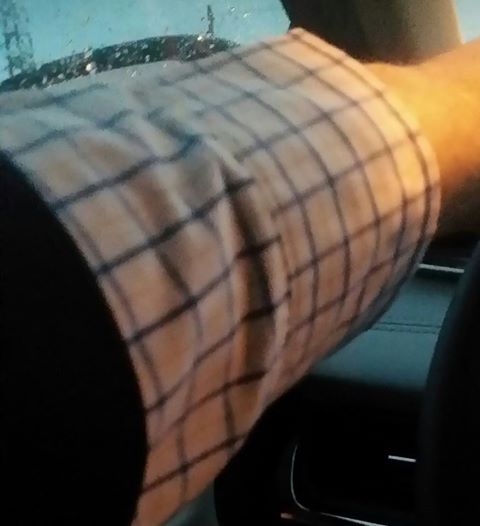
For example, last month I decided the 5 sportscoats and suit jackets I wear most frequently all had arms thst came down to long on my shirt sleeve and I was going to do something about it. The typical person would go to a tailor or to the store they bought the jackets.
But not me. That is too expensive and time consuming for a guy like me–who can comes up with ingenious short cuts I simply tried each jacket on and estimated in my mind how much needed to be taken out of each arm. Took me all of 3 minutes.
Then I dropped them off at the cleaners with my instructions.
And Voila!! Just look at that sleeve now!! It’s not too long anymore, is it?
Ok, maybe a little too short….I know. Ahem. So this week I am taking the 5 jackets and suit jackets to a tailor to have them taken back out to the appropriate length.
Ok. So, maybe I’m not sooo smart after all. But it was fun thinking for a day or two that I really was.
The political season is in full swing, and it is not uncommon to see candidates/potential candidates, consultants and supporters at public events and in the media floating trial balloons and testing the political waters. And while many gravitate toward one candidate and/or party, most would agree certain candidates on both sides of the isle seem to have more appeal than others and are clearly gaining more traction. That appeal and political movement may have more to do with “Emotional Intelligence” than any other factor.
From a life, business and political perspective, Emotional Intelligence is changing our concept of “being smart.” Emotional Intelligence (EI)-how we handle ourselves and our relationships-coupled with IQ, determine life, career and political success. Most have witnessed someone with extremely high IQ coupled with low EI crash and burn. In the business world way too many CEO’s are hired on their expertise and fired on their personality. Politically, way too many candidates are recruited because of their resume and defeated at the ballot box because they never really connected with voters.
Simply put, a candidate’s emotions are contagious, resonating energy and enthusiasm, all playing a crucial role in the success of a political organization. Volunteers, campaign staff and voters get excited, want to get involved, will work the long hours and most importantly, support the EI candidate and recruit others to do the same. Similarly, in business, we follow leaders with whom we connect. In fact, a recent Gallup Poll cited the number one reason for employee engagement was a personal relationship with one’s immediate supervisor, a supervisor with high EI that recognizes this important link between relationship and performance.
In short, our view of human intelligence tends to be narrowly focused, and often ignores a crucial range of abilities that matter immensely in terms of how well we do in politics, business and in our personal life. Emotional Intelligence might be a key factor and help explain when people of high IQ flounder and those of modest IQ coupled with high EI do surprisingly well. The following are key factors in determining our Emotional Intelligence:
Self-Awareness
Emotional self-awareness: understanding one’s own emotions and recognizing their impact; using “gut sense” to guide decisions
Accurate self-assessment: knowing one’s strengths and limitations
Self-confidence: A sound sense of one’s self-worth and capabilities
Self-Management
Emotional self-control: Keeping disruptive emotions and impulses under control
Transparency: Displaying honesty and integrity; trustworthiness
Adaptability: Flexibility in adapting to changing situations or overcoming obstacles
Achievement: The drive to improve performance to meet inner standards of excellence
Initiative: Readiness to act and seize opportunities
Optimism: Seeing the upside in events
Social Awareness
Empathy: Sensing other’s emotions, understanding their perspective, and taking interest in their concerns
Organizational awareness: Reading the currents, recognizing/managing cliques, understanding decision networks, and an awareness of the politics at the organizational level
Service: Recognizing and meeting the needs of others
Innovation is about a better way to deliver value. Innovators are all around us. They are taking advantage of today’s technologies and creating new ways to deliver value. We can learn from them if we look up from our silos.
Sometimes the most inspiring innovators are in places we would never have thought to look. Or perhaps we just don’t notice them because our attention is focused on the inventors of new technologies or the entrepreneurs who are making progress in bringing inventions to market. Those people are important but not the whole story.
Meet the plumber and the police chief.
Anthony Gemma is president of Gem Plumbing in Lincoln, R.I. Together with his brothers, Anthony runs one of the most innovative businesses I have seen. I didn’t expect it when I first visited the company. After all, how innovative can a plumbing supply company be? The answer is very innovative.
Gem is on a mission to win the Baldrige National Quality Award. I believe they will achieve it. They have established a culture of excellence and innovation in every aspect of their regional business. They collect, analyze and share data ranging from the location of every part — from the supplier to the service truck to the home — to how long a customer waits to talk live to the dispatcher on the phone. They benchmark themselves against the best. Not the best plumbing supply company, the best companies.
Gem’s customer call and dispatch center would blow you away. It is like standing in NASA mission control. On 12-foot monitoring screens they have live feeds of real-time traffic conditions and satellite mapping of every service vehicle. If there is available capacity in the fleet, Gem is placing a customized radio ad to create tailored demand. They are so good at tracking traffic conditions they supply information to the Department of Transportation and local radio stations for traffic reports.
Their business grew from $9 million in 1999 to $40 million in 2007. They get so many businesses coming in for tours and information about their innovation programs they set up the Gem Institute for Performance Excellence. Who would have thought to look at a regional plumbing supply company as an example of innovation best practices?
Next, meet Dean Esserman, chief of police in Providence, R.I. When he was hired by Mayor David Cicilline in 2003, Esserman found a city where the crime rates were high and a force that was troubled by corruption and distrusted by the community. People were afraid to travel downtown. What he’s done since is a great story of business model innovation, and he has delivered significant value to the citizens of Providence.
In six years, Esserman transformed the Providence policing model from a centralized department where police were anonymous and came to the neighborhood after receiving a 911 call to a decentralized department with neighborhood substations and district commanders who are accountable for crime in the local community. His philosophy is that when police get out of their cars and into the life of a neighborhood they become trusted allies.
I have attended the chief’s regular Tuesday morning command meetings where a sophisticated crime tracking system displays crime statistics by district. Each commander is called upon to talk about crime activity in their district and what they are doing about it. The new business model is working, with double digit declines in the overall Providence crime rate. Who would have thought to look at a police chief as an example of innovation best practices?
The plumber and the police chief are just two examples of the innovators among us. Examples are everywhere. We just have to look in the places that we would least expect to find them.
By John Y. Brown III, on Fri Mar 21, 2014 at 12:00 PM ET
I’m not talking about highest IQ-smart, most knowledge, the most deeply insightful or profoundly creative.
I am talking about useful, practical, everyday smarts that arguably is the most important kind of smart we can seek to be.
Those people. Those are the ones I am talking about.
And their intelligence is hard to define, pigeonhole or quantify.
In many cases they aren’t even described by friends as “smart” and may not think of themselves as overly bright or well educated.
It is more than street smarts, too. Although that is a big part of it.
They are the people you go to when you have an important life or work or personal problem to solve and you need help.
Maybe the best test for these kind of people is this. You know when you hear someone say–even yourself— “Well, when you think about it that way, it does make sense?” I know I say that a lot.
My theory is that the kind of smart people I am trying to describe are the ones who we never hear say that. Because they are always thinking in “that way” –the seemingly odd and unconventional way about a problem that may make little logical sense but just seems to work.
Those are the smartest people I know.
And the advice I have received from them has meant everything to me. And they probably don’t even know it because I rarely tell them how smart their suggestion is. I usually just say, “Well, when you think about it that way it does make sense.”
There’s nothing better than a well-dressed man in a suit. And yet, while suiting is one of my favorite things to style, many Rath & Co. clients work in casual environments and don’t have the need or opportunity to wear dressy clothes very often. For these clients, the challenge becomes how to be well-dressed and get noticed without looking out of place among their peers. There’s a fine line between putting some effort into your appearance and seeming like you’re trying too hard (which can often result in getting busted on by coworkers – never fun). Those offices where jeans, t-shirts and sneakers are more common than a jacket and tie can range from tech startups to laboratories.
With these challenges in mind, I’ve created the below list of 8 tips on how to step up your style just enough so that it improves your self-image and the way you’re perceived by others, but not to the degree that you overdo it and become the object of skepticism or even ridicule.
1) If you’re wearing sneakers, make sure they’re not ones you’d actually exercise in but rather what I call “social sneaks.” These are sneakers you wear for every day, not working out. They should be clean and fresh-looking. Wash or replace them as soon as they start to look grungy. Converse Jack Purcell’s are a great choice.
2) Same goes for any other kind of footwear you might find yourself in: keep it classy and avoid anything with the word “hybrid” in its description. The place where the sneaker meets any other kind of shoe (i.e., dress shoe, boot or sandal) is like a dark alley late at night — nowhere you’d want to be.
3) Just because you’re wearing a casual shoe, you don’t need to wear white gym socks or plain black dress socks. In fact, wearing more interesting socks is a great way to inject style into your look without going over the top. Try different colors or patterns, like those above from Drumohr. And even simply switching from black to navy or grey is a big improvement.
Read the rest of… Julie Rath: Bringing Your Style A-Game in a Casual Work Environment
By Jonathan Miller, on Thu Mar 20, 2014 at 1:50 PM ET
Nearly 100 brave souls signed up to compete in the third annual Recovering Politician/No Labels NCAA basketball tournament prediction contest, No Bracket, No Pay.
(The name comes from No Labels’ signature proposal, “No Budget, No Pay,” the simple proposition that if Congress doesn’t perform its constitutional duty to pass a budget, they shouldn’t get paid. Click here to learn more about No Labels, and here to learn about “No Budget, No Pay”).
Today, we announce the fabulous prizes to be awarded to the winners of this free contest:
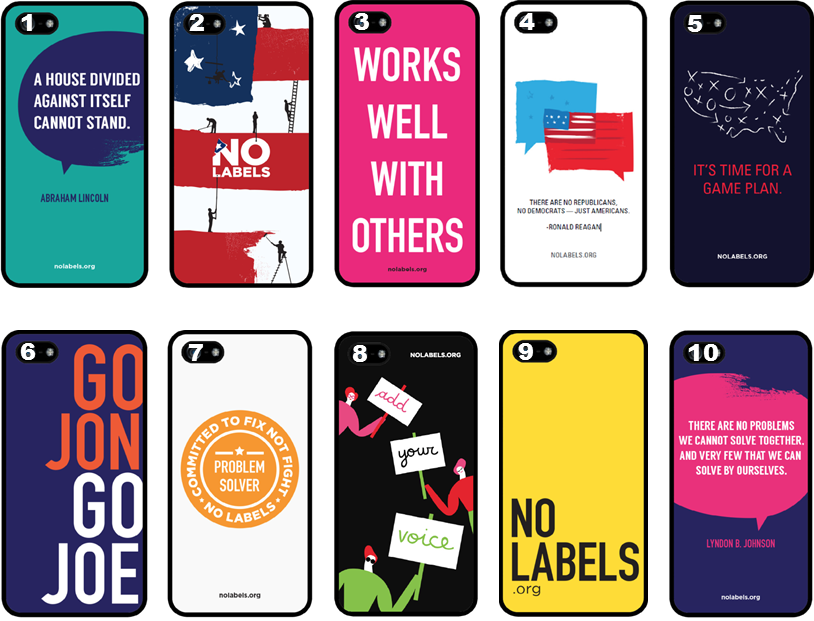
1. The top prize — for the person who earns the most points through being the best predictor of the entire bracket, wins the new No Labels iPhone case. What does it look like? Well, take a look at the finalists above and vote on your favorite by clicking here.
2. Everyone who correctly predicts the NCAA Champion, but doesn’t win the entire contest, will receive a No Labels car magnet!
So good luck to all, and in the interim, help us decide on the best iPhone case.
By John Y. Brown III, on Thu Mar 20, 2014 at 12:00 PM ET
Time to mix it up
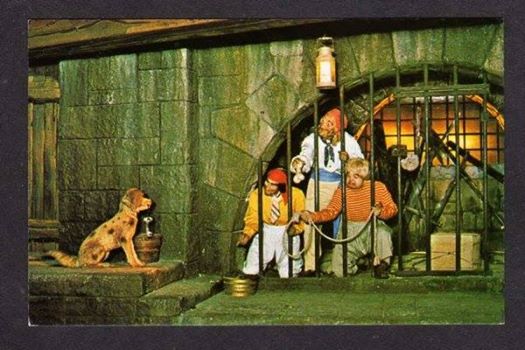
Last night went to Disney with family for couple hours and rode Pirates of the Caribbean –again.
And, again, for the 47th consecutive year the three jailed pirates were unsuccessful at coaxing the keys from the dog a few feet away.
Just once I would like to see an empty jail cell with the door swung open and the dog chewing on the bone that tempted him, finally, to part with the keys.
By John Y. Brown III, on Wed Mar 19, 2014 at 12:00 PM ET
A good friend with an exciting opportunity for a career change recently messaged me about the fear of making such a big change.
I shared a Zen parable I heard years ago that I think exemplifies shrewdly the fear of “letting go” of something we know for something new and scary.
I can’t recall the specifics of the story but this is my very paraphrased version.
“A monk was being chased by a lion and to save himself had to jump of a cliff in the dark of night where he grabbed a thin limb growing on the side of the cliff. The monk, dangling for his life in the pitch black dark, waited for the sun to come up before his strength gave way and, he feared, falling to his death.
But the sunrise didnt come soon enough and the monk’s arms, exhausted and numb, gave way slipping off the branch.
And the monk fell 6 inches to the ground below.
About that is often about as far we have to fall when making a compelling life change.
Something to think about…when you feel like letting go.
===
Thought for the day
Each day try to learn one thing that will enhance your life
And….more importantly
Try to unlearn one old thing that is diminishing your life


 Blog this!