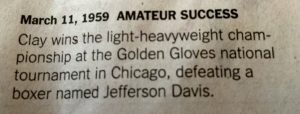
Please sign the petition below to remove the statue of Jefferson Davis currently in Kentucky’s Capitol Rotunda, and replace it with a tribute to Muhammad Ali, “the Louisville Lip” and “the Greatest of All Time.”
I just heard from the Ali family: It is the Champ’s belief that Islam prohibits three-dimensional representations of living Muslims. Accordingly, I have adjusted the petition to call for a two-dimensional representation of Ali (a portrait, picture or mural) in lieu of a statue.
UPDATE (Tuesday, December 2, 2014)
In this interview with WHAS-TV’s Joe Arnold, Governor Steve Beshear endorses the idea of honoring Muhammad Ali in the State Capitol (although he disagrees with removing Davis). Arnold explores the idea further on his weekly show, “The Powers that Be.”
Click here to check out WDRB-TV’s Lawrence Smith’s coverage of the story.
And here’s my op-ed in Ali’s hometown paper, the Louisville Courier-Journal.
UPDATE (Saturday, June 4, 2016)
In the wake of the 2015 Charlestown tragedy, in which a Confederate flag-waving murderer united the nation against racism, all of the most powerful Kentucky policymakers — U.S. Senator Mitch McConnell, Governor Matt Bevin, Senate President Robert Stivers and House Speaker Greg Stumbo — called for the removal of the Davis statue from the Rotunda. Today, as we commemorate last night’s passing of Muhammad Ali, there is no better moment to replace the symbol of Kentucky’s worst era with a tribute to The Greatest of All Time.
UPDATE (Wednesday, June 8, 2016):
Great piece by Lawrence Smith of WDRB-TV in Louisville on the petition drive to replace Jefferson Davis’ statue in the Capitol Rotunda with a tribute to Muhammad Ali.
UPDATE (Thursday, June 9, 2016):
Excellent piece on the petition drive by Jack Brammer that was featured on the front page of the Lexington Herald-Leader.
Highlight of the article:
Miller said he has received a few “angry comments” on his call to honor Ali.
“One of them encouraged me to kill myself,” he said. “You can quote me that I have decided not to take their advice.”
UPDATE (Friday, June 10, 2016)
The petition drives continues to show the Big Mo(hammed): check out these stories from WKYU-FM public radio in Bowling Green and WKYT-TV, Channel 27 in Lexington:
UPDATE (Saturday, June 11, 2016):
Still not convinced? Check out this excerpt from today’s New York Times:
Thanks for your support and a hearty welcome to all of our new readers.
We will keep you updated over the weekend on all matters concerning the budget crisis, and unfortunately expect to be railing about it next week as we quickly approach the August 2 default deadline.
By David Snyder, on Fri Jul 29, 2011 at 2:00 PM ET
While our government struggles to get its financial house in order, perhaps there is a lesson for all of us from what is happening in Washington.
I do not think any of us really ever want to reach the point where we say, “How did it get this way? How did it get this bad?” So what to do – just a few simple steps to make sure your financial house is in order:
1. Risk Management (A) Long Term Disability Coverage (Income Replacement insurance) – Whether you are single, married, divorced – it does not matter – just make sure you have adequate Long Term Disability coverage in place. In the event a disability stops you from working due to an illness or injury, you need to maximize your income. A disability could cause not only loss of income, but also loss of health insurance, loss of retirement benefits, increase health costs, etc. And the typical group plan only covers a portion of your income and that benefit is typically going to be taxable income to you. You need to have supplemental coverage from a highly rated company.
(B) Life Insurance – this discussion may depend on your family situation. But even if you are single, but plan to have a family, getting coverage while you are young and healthy may be an advantage. Too many times, a person waits and then later has a medical issue that either prevents them from getting coverage or makes it more expensive. With a family, life insurance is a must. A great rule of thumb here is that for every $1,000 of after tax monthly income you want to provide to a surviving spouse, you need $250,000 of death benefit in place. And when factoring in inflation, this sum will typically last the survivor about 20 years. So calculate the after tax monthly needs for your family and make sure you have adequate life insurance in place.
Lastly, don’t discount the value of a non-working spouse. Imagine the expenses if a stay at home Mom or Dad were not around. Non-working spouses need coverage too. A rule of thumb here – $250,000 of coverage on the non working spouse for each child.
(C) Cash – build up a reserve of about 3 months income and keep it in readily accessible cash. Use a money market or similar account that is safe and secure.
2. Wealth Accumulation
Once Risk Management issues are resolve, the next step in planning for your financial house is wealth accumulation:
(A) Retirement Planning – Utilize your company 401(k) plans or pensions. If there is a matching contribution on behalf of your company, then at least contribute enough to maximize the company match. If there is a Roth option, use it. Conventional wisdom tells us that tax rates have nowhere to go but UP. If you believe this, then the old paradigm of straight tax deferral must be changed. You need to move as much as possible from Tax Deferred vehicles into Tax Free vehicles. Roth 401(k)’s provide this regardless of income level. Roth IRA’s do as well. For those that make too much to contribute on their own to Roth IRA’s (single – $122,000 of Adjusted Gross Income, and Married filing jointly – $179,000 of Adjusted Gross Income), the tax laws currently allow a non-deductible contribution to a traditional IRA and then the ability to convert it into a Roth IRA (regardless of your income level).
Read the rest of… David Snyder: While the U.S. Can’t Get its Financial House in Order, You Can
The RP wil be interviewed tonight at 7:00 PM EDT on Wall Street Radio about…what else…the debt ceiling crisis and his nationally-discussed piece, Debt Ceiling for Dummies.
To find out what radio affiliate carries the show in your area, click here.
By Artur Davis, on Fri Jul 29, 2011 at 12:30 PM ET
Until this week, Democrats were as split as Republicans over the debt ceiling endgame. But John Boehner has a far tougher task in keeping his party unified, and it is rooted in the very different political character of the rank and file membership within the House.
A substantial part of the Democratic caucus consists of professional politicians who have climbed the ladder in a manner that makes them responsive to their party’s demands – they often won their first primaries by maneuvering to gain institutional support, and their ambitions invariably turn on the good graces of their party leadership. In turn, they are partisans first, ideologues second.
After the demise of the Blue Dogs in 2010, the remaining Democrats also represent disproportionately liberal districts where their pressure emanates from a base that scolds them for not doing enough to help President Obama.
In sharp contrast, a major part of the Republican caucus, particularly its massive freshman class, consists of relative newcomers who did not form ties by climbing the traditional ranks, and in many cases, won their primaries by overcoming their party establishment and their local versions of John Boehner. More of them owe their organizational strength to the Tea Party than to the local chamber of commerce.
As a result, their ideological fervor shapes them much more than their party loyalty. Their hopes for advancement rest as much on carving out a profile with their party’s “movement conservatives” as it does currying favor on the Hill. Their external pressure arises from a base that loathes Barack Obama and grades them based on the intensity of their opposition to his agenda.
Rallying the Democrats I describe to swallow a deal that is imperfect but “supports the President” is one thing; rallying the Republicans I describe to make an accommodation that cuts spending but salvages Obama is an infinitely harder mission. That is the reality that constrains John Boehner and it has the potential to wreck a deal even after one is reached.
By Stephanie Doctrow, RP Staff, on Fri Jul 29, 2011 at 12:00 PM ET
Trying to eat less? Experts say using a bigger fork can make a difference in how much you eat. [Time]
Walter Reed Medical Center, a hospital that saw multiple wars and decades of history, will be closing in August. [NY Times]
Medical officials were once worried about caring for crack-addicted babies, but now more and more children are born addicted to prescription drugs. [CNN]
Would you like a side of apple slices? That’s the newest addition to Happy Meals, in an attempt to make them healthier for kids. [Wall Street Journal]
Here’s scientific proof on why we eat our feelings when we’re down. [Huffington Post]
By Patrick Derocher, on Fri Jul 29, 2011 at 9:30 AM ET
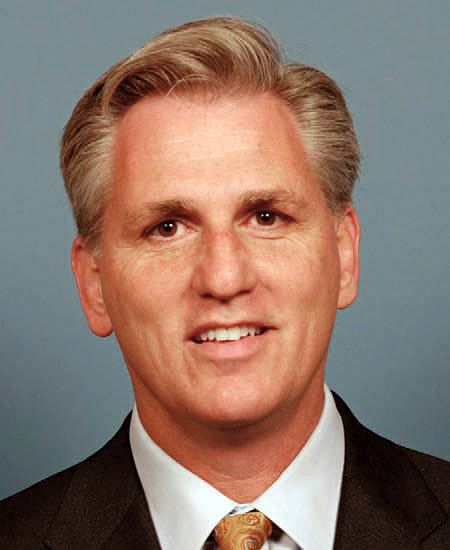
House Majority Whip Kevin McCarthy (R-Calif.) worked with Speaker Boehner to obtain votes for his ultimately delayed budget vote until late last night.
There was one major development in the Budget Crisis yesterday: Nothing happened. After a vote originally scheduled for 6 p.m. was delayed several times, Republican leadership announced at around 10:30 that no vote would be taken on Speaker Boehner’s debt-reduction plan until Friday at the earliest. Republican leadership had been having difficulty, highly publicized, rounding up a sufficient number of “yes” votes from the Republican Caucus to pass the bill with no Democratic support. [The Hill]
On the up side, New York-based analyst Brian Gardner, who works for a boutique investment bank in that city, theorizes that threats to lower the United States’s credit rating under certain circumstances even if the debt ceiling is raised may be a bluff. According to his analysis, some level of “enforceable cuts” with an appropriate debt ceiling increase would avert the downgrade. [Huffington Post]
Democratic congressional leaders are floating the idea of a compromise bill that they hope will be amenable to House Republicans. According to the plan, the debt ceiling increase would still be in two steps, but the second raise would not be contingent upon the findings and recommendations of a panel dedicated to cutting the deficit. [Politico]
House Minority Whip Steny Hoyer of Maryland became the highest-ranking Democrat to call on President Obama to raise the debt ceiling unilaterally if a deal is not reached in time for the August 2 default deadline. The President’s authority to do this is said to derive from the 14th Amendment, which says that the validity of the US’s public debt shall never be called into question, though Congressional powers derived from Article 1 muddy the issue some. [Huffington Post]
Adding urgency to budget negotiations, at least over the long run, a study from Medicare economists has come to the conclusion that by 2020, healthcare costs will hit $4.6 trillion, or one-fifth of the American economy. At that point, per capita health spending is estimated to be at $13,710. [Huffington Post]
By Jason Atkinson, on Fri Jul 29, 2011 at 8:30 AM ET
I took part in the Aspen Institute’s Global Leader Network bi-annual gathering, and once again I felt like the bellhop to these accomplished people.
Just over 200 fellows from 27 counties all with the same ‘virus’ to change the world. For the seminar “why I stepped up,” I was asked to be a presenter, and like everyone there, my phony meter had long ago broke. I look at the self-help genre through the same Vaurnets as the guy with the Madonna microphone selling the slap-jack.
The seminar was all honesty, and the answer to why people step up and put themselves forward for public service is not linear. It’s very hard to put into words. Some people are hard-wired to mix their personal confidence with their convictions, look past the personal sacrifices and pitfalls, and try to do their best knowing they might never be recognized for it.
As I wrote that sentence, it dawns the need for recognition could be the difference between states-people and politicians.
Mark Hatfield
A few concerns on modern service were articulated I think need to be discussed at the intellectual temple of the The Recovering Politician: First, is service today accepting the values of the party over the values of the person? I know firsthand the stinging backlash from ones own party for being too independent. Caucus politics can be small, petty and very effective. In my state, I’ve never seen a pro-life Democrat go anywhere and neither do pro-conservation Republicans. In my experience, the behind the door caucus politics and the perceived party policies are entirely different. I wonder if Mark Hatfield could get elected today?
The second concern about modern service is process. We have created a system of governance in which process (committees, task-forces, blue ribbon panels) are hallowed. Every state in America has plenty of process; because the process is suppose to provide a voice to everyone, right?
Not so fast. I think process protects the status quo in modern service and makes the role of the elected harder. In my state, task-force members are all bureaucrats and paid lobbyists-both with kingdoms to protect. Why are elected servants not part of process? Simple- they can’t afford it. Most states do not even pay public servants minimum wage. So does everyone have a seat at the process table?
Channing
Before I leave you with the impression that I am a Debbie Downer, let me leave you with a quote from one of her contemporaries–William Ellery Channing who wrote “The office of government is not to confer happiness, but to give men opportunity to work out happiness for themselves.” Yep, that’s my kind of stepping up. It’s a complicated calling.
By Zack Adams, RP Staff, on Thu Jul 28, 2011 at 3:00 PM ET
The Politics of Speed
Tomorrow, the Obama administration will announce the the compromised fuel economy standards set to take effect in 2025. The original goal was to make the standard 56.2 mpg, however that number was met with opposition from several automakers. The compromise is by the year 2025 54.5 mpg will have to be the average of automaker vehicles. This is all-things-considered a good step for fuel conservation and the environment. [Reuters]
Those of you who are Chrysler fans will be happy to hear that even though the company is merging with the Italian automaker Fiat, CEO Sergio Marchionne has recently confirmed that Chrysler will remain American. [The Detroit News]
Due to the recent earthquake in Japan, Toyota has lost its hold on the global sales lead. At the half-year mark it has been overtaken by the Volkswagen Group and Renault-Nissan. Once, General Motors release their figures they are expected to take the lead. Of course, Toyota’s slip is only due to the natural disasters. [Go Auto]
Although Ford was the only Detroit automaker to avoid bankruptcy after 2009, they still lag behind others in Asian markets. That is why they are investing $1 billion to build production plants in India. [NY Times]



 Blog this!