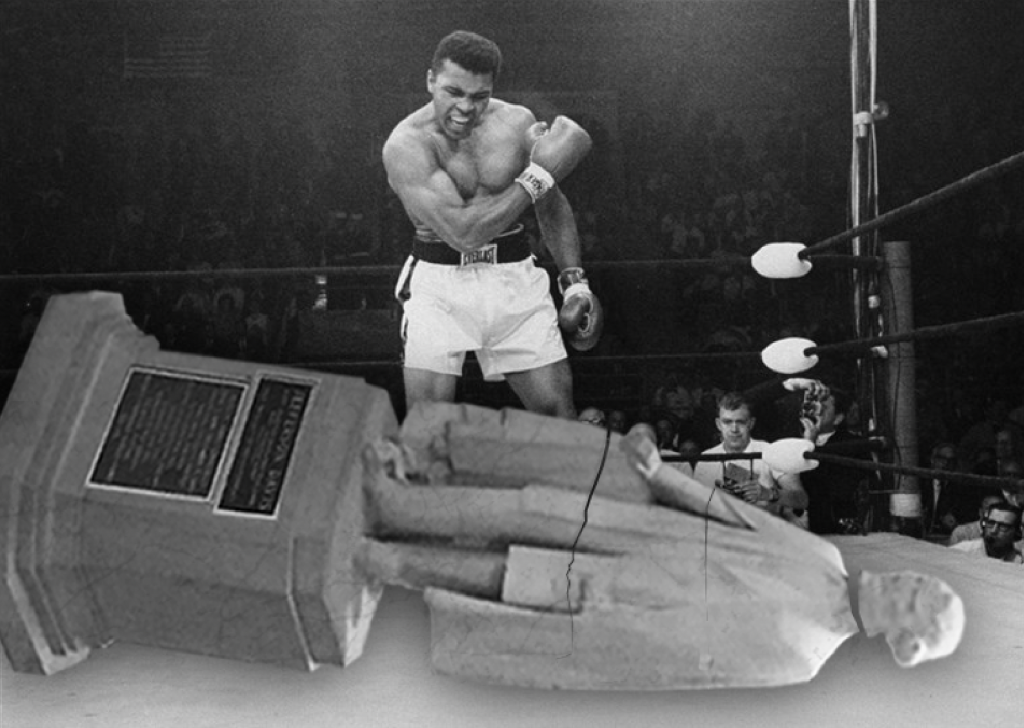
Please sign the petition below to remove the statue of Jefferson Davis currently in Kentucky’s Capitol Rotunda, and replace it with a tribute to Muhammad Ali, “the Louisville Lip” and “the Greatest of All Time.”
I just heard from the Ali family: It is the Champ’s belief that Islam prohibits three-dimensional representations of living Muslims. Accordingly, I have adjusted the petition to call for a two-dimensional representation of Ali (a portrait, picture or mural) in lieu of a statue.
UPDATE (Tuesday, December 2, 2014)
In this interview with WHAS-TV’s Joe Arnold, Governor Steve Beshear endorses the idea of honoring Muhammad Ali in the State Capitol (although he disagrees with removing Davis). Arnold explores the idea further on his weekly show, “The Powers that Be.”
Click here to check out WDRB-TV’s Lawrence Smith’s coverage of the story.
And here’s my op-ed in Ali’s hometown paper, the Louisville Courier-Journal.
UPDATE (Saturday, June 4, 2016)
In the wake of the 2015 Charlestown tragedy, in which a Confederate flag-waving murderer united the nation against racism, all of the most powerful Kentucky policymakers — U.S. Senator Mitch McConnell, Governor Matt Bevin, Senate President Robert Stivers and House Speaker Greg Stumbo — called for the removal of the Davis statue from the Rotunda. Today, as we commemorate last night’s passing of Muhammad Ali, there is no better moment to replace the symbol of Kentucky’s worst era with a tribute to The Greatest of All Time.
UPDATE (Wednesday, June 8, 2016):
Great piece by Lawrence Smith of WDRB-TV in Louisville on the petition drive to replace Jefferson Davis’ statue in the Capitol Rotunda with a tribute to Muhammad Ali.
UPDATE (Thursday, June 9, 2016):
Excellent piece on the petition drive by Jack Brammer that was featured on the front page of the Lexington Herald-Leader.
Highlight of the article:
Miller said he has received a few “angry comments” on his call to honor Ali.
“One of them encouraged me to kill myself,” he said. “You can quote me that I have decided not to take their advice.”
UPDATE (Friday, June 10, 2016)
The petition drives continues to show the Big Mo(hammed): check out these stories from WKYU-FM public radio in Bowling Green and WKYT-TV, Channel 27 in Lexington:
UPDATE (Saturday, June 11, 2016):
Still not convinced? Check out this excerpt from today’s New York Times:
By John Y. Brown III, on Fri Sep 26, 2014 at 12:00 PM ET
This morning as I left a business meeting I spotted a long snaking line outside an ATT store as people waited for a chance to buy the new iPhone 6.
I self-righteously shook my head and muttered sarcastically to a guy snapping a picture of the line, “Wonder if any of those people would wait in line that long to talk to someone on their new iPhone?” We snickered condescendingly like adolescents and he responded, “Pitiful, isn’t it?” After he stepped aside, I snapped this shot myself and got in my car and left –off to do something more important than anticipating the new iPhone.
45 minutes later I was driving by a different ATT store and parked outside the store to do a conference call. After the call I had a few minutes to spare and wandered inside just to see what the new iPhone 6 looks like. The sales rep started pitching me and encourged me to hold the phone, which I did. He smiled at me, “Feels good, doesn’t it? Looks good, too.” I replied, “You are good….but I am just looking and not buying” and I scurried out the door.
Two hours later I had another meeting at the coffee shop by the ATT store in this picture. I got to the coffee shop about 15 minutes early and decided to stop inside ATT since there was no line and because I wanted to just “look” at the new iPhone one more time.
As I stared at the display model and was about to touch it a sales rep interrupted me and asked if I would like to get one and said they still had a few in stock.
“Probably just in white, though. Right?” I said discouragingly.
“Actually we have a few silver and black models left.”
I pointed to my watch and said, “Thanks anyway but I have to meet someone in 15 minutes and don’t have time to get a new iPhone today even if I wanted to and had the extra money.”
“Fifteen minutes is plenty of time” the sales rep assured me, “and under our new plan you don’t pay anything down and only a monthly fee of about $30.”
“Really?” I responded dumbly.
Twelve minutes later I walked out of the ATT store with a new iPhone 6. And I felt good about myself and happy to be an “early adopter” as they call it. As I walked toward the coffee shop I looked back where the line had been this morning –the line that I had smugly taken a picture of to post in Facebook later tonight to poke fun at people who seemingly had nothing better to do today than make sure they got the new iPhone the day it went on sale.
But I didn’t do that. I did post the picture—but posted it because even though I am not standing in that line in the picture, I might as well have been. In fact, I was worse. I doubt any of those eagerly waiting in line this morning went to three stores before buying their phone. And they were happy, not ashamed, to admit their enthusiasm.
Fortunately for me I don’t think anyone in this picture bothered to snap a photo of a smirking guy standing a few yards away taking a picture of them— and then post the picture of me on Facebook under the title “Pitiful.”
As a Personal Stylist, my mission is to create outfits that make my clients look and feel terrific. Dressing well is about manhandling the rules and trends to create a look that’s uniquely one’s own.
This roundup of Fall’s menswear trends and my corresponding “real life” suggestions are meant to serve as inspiration as you figure out what works for you.
Trend #1 Military
Military is a perennial favorite, and designers are adept at keeping it fresh each season. A major bonus that comes with it is the epaulette, which fools the eye into thinking the wearer’s shoulders are broader than they actually are. Look for jackets like Reiss’s military macintosh coat ($485) or Burberry’s wool and cashmere peacoat ($1195).
You could also go the authentic route and hit up an Army-Navy surplus or thrift store for a military peacoat. I found this handsome one (complete with arm patch and interior stencil and name plate) below for $60 at a thrift store in Connecticut last Fall.
By John Y. Brown III, on Thu Sep 25, 2014 at 12:00 PM ET
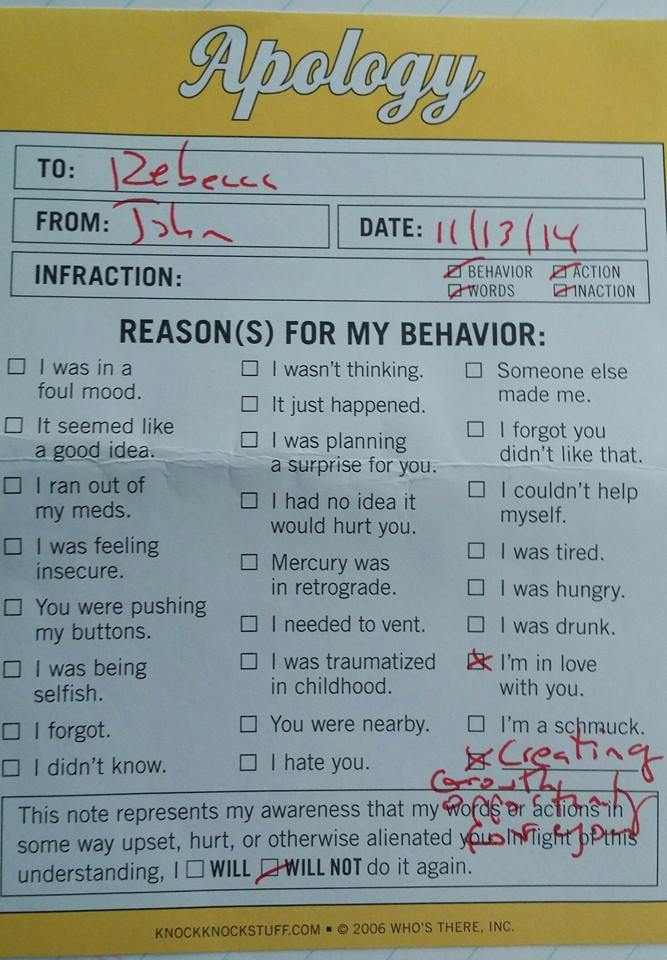
This is my first “Apology Form” to Rebecca and I checked “Other” for the reason for bad behavior –and wrote I was merely “creating a growth opportunity” for Rebecca.
Rebecca appreciated the effort and felt like it was “a start.”
And asked if I got several pads of Apology Forms for the future.…
Rebecca also noted I put down the wrong date (11/13). I told her I would fill out a new form with the correct date and to just hold on to this one for me to use in mid-November.
Cancer is real and serious concern for us all. The following blog is dedicated to Beth, who bravely battled breast cancer for 14 years, Claude Bowen, Sr who passed away in December from prostate cancer and the many other who have fought cancer head on and never gave up the fight. This is for you.
Cancer
A word that strikes utter fear in people. And with good reason. As you see below the statistics are staggering. Every year, cancer becomes more and more prominent. In comes in all faces and types, packaged differently to wreak havoc on the human body. This post is not so much about the stats or what causes cancer but what can we do to prevent or slow the progress of this problem. This post is not to show you how smart or not smart I am as it relates to the disease. This about my grandfather, who was 88 years old and is put up the fight of his life against several types of cancer. Over the course of several months, I have saw the personal struggle he went under and the downward spiral of an independent country boy. It took hold of him and it didn’t let go. It is tough to watch but it shows how tough he was to continue to put up a fight against insurmountable odds.
This is also about my beliefs. Something that I often catch strange looks for and snide remarks about. However, I firmly believe in my heart of hearts that all things are possible through fitness. It is our fountain of youth, protector of disease and an absolute must for the human body. My motto is all things through fitness, it is the name of my website and is etched on my skin. I believe it because I have seen it.
I have seen people overcome disease, fight obesity and win, improve their personal lives and overall become better people. Fighting cancer is no different. Fitness plays an important part in the fight with all forms of cancer. Check these statistics from the National Cancer Institute:
Colon Cancer- Many studies in the United States and around the world have consistently found that adults who increase their physical activity, either in intensity, duration, or frequency, can reduce their risk of developing colon cancer by 30 to 40 percent relative to those who are sedentary regardless of body mass index (BMI), with the greatest risk reduction seen among those who are most active.
Breast Cancer-Most studies indicate that physically active women have a lower risk of developing breast cancer than inactive women; however, the amount of risk reduction achieved through physical activity varies widely (between 20 to 80 percent)
Endometrial Cancer-
About 20 studies have examined the role of physical activity on endometrial cancer risk. The results suggest an inverse relationship between physical activity and endometrial cancer incidence. These studies suggest that women who are physically active have a 20 percent to 40 percent reduced risk of endometrial cancer, with the greatest reduction in risk among those with the highest levels of physical activity. Risk does not appear to vary by age.
Lung Cancer- At least 21 studies have examined the impact of physical activity on the risk of lung cancer. Overall, these studies suggest an inverse association between physical activity and lung cancer risk, with the most physically active individuals experiencing about a 20 percent reduction in risk.
As you can see fitness can dramatically changed the diagnosis and prognosis of cancer. Think about what the statistics would be on people who exercised regularly who got cancer. I stand behind my belief that all things are possible through fitness, fighting cancer is not an exception to that rule. Regardless of activity level cancer affects us all. Our loved ones and even ourselves will be faced with this disease. The struggle and the will to live is the most important.
Through fitness you can fight and win. For those struggling with the disease, continue to fight and never give in. The spirit to beat it and the mindset is all you need. Keep fighting!
Yours in fitness,
JB
Selected References
National Center for Chronic Disease Prevention and Health Promotion and Centers for Disease Control and Prevention (1996). Physical Activity and Health: A Report of the Surgeon General. Retrieved June 26, 2009, from: http://www.cdc.gov/nccdphp/sgr/sgr.htm.
National Center for Chronic Disease Prevention and Health Promotion and Centers for Disease Control and Prevention (2008). Preventing Obesity and Chronic Diseases Through Good Nutrition and Physical Activity. Retrieved June 26, 2009, from: http://www.cdc.gov/nccdphp/publications/factsheets/Prevention/obesity.htm.
Slattery, ML. Physical activity and colorectal cancer. Sports Medicine 2004; 34(4): 239–252.
IARC Handbooks of Cancer Prevention. Weight Control and Physical Activity. Vol. 6. 2002.
Ballard-Barbash R, Friedenreich C, Slattery M, Thune L. Obesity and body composition. In: Schottenfeld D, Fraumeni JF, editors. Cancer Epidemiology and Prevention. 3rd ed. New York: Oxford University Press, 2006.
Lee I, Oguma Y. Physical activity. In: Schottenfeld D, Fraumeni JF, editors. Cancer Epidemiology and Prevention. 3rd ed. New York: Oxford University Press, 2006.
McTiernan A, editor. Cancer Prevention and Management Through Exercise and Weight Control. Boca Raton: Taylor & Francis Group, LLC, 2006.
Tardon A, Lee WJ, Delgado-Rodriguez M, et al. Leisure-time physical activity and lung cancer: A meta-analysis. Cancer Causes and Control 2005; 16(4):389–397.
Giovannucci EL, Liu Y, Leitzmann MF, Stampfer MJ, Willett WC. A prospective study of physical activity and incident and fatal prostate cancer. Archives of Internal Medicine 2005; 165(9):1005–1010.
Holmes MD, Chen WY, Feskanich D, Kroenke CH, Colditz GA. Physical activity and survival after breast cancer diagnosis. Journal of the American Medical Association 2005; 293(20):2479–2486.
Pinto BM, Frierson GM, Rabin C, Trunzo JJ, Marcus BH. Home-based physical activity intervention for breast cancer patients. Journal of Clinical Oncology 2005; 23(15): 3577–3587.
Meyerhardt JA, Giovannucci EL, Holmes MD, et al. Physical activity and survival after colorectal cancer diagnosis. Journal of Clinical Oncology 2006; 24(22):3527–3534.
By John Y. Brown III, on Wed Sep 24, 2014 at 12:00 PM ET
Theological question:
If you say something to someone at church that is supposed to be humorous –and only moderately inappropriate –and the other person sighs, shakes his head, and says he will pray for you, is it OK to tell him you prefer he didn’t because “I don’t want God to know we are friends”?
(Note: I did not say this. But thought to afterwards and may try out the line some time. I tend to get this comment a lot.)
===
Remember when you felt as excited about the iPhone 5 as you do today about the iPhone 6?
By Lauren Mayer, on Wed Sep 24, 2014 at 8:30 AM ET
Those of us old enough to remember rotary phones, black & white TV, and cars without seatbelts are now at an age when a forgotten name or misplaced car keys can make us worry about age-related memory loss. My response is always to joke about my hard drive being full – it’s not age, it’s data overload.
And that actually makes sense – by the time we’re in our 50s, we’ve had so many experiences, met so many people, learned so many facts, and memorized so many phone numbers that it’s amazing we can remember our own names. (And as far as the phone numbers – anyone under 30 has it far easier, because these days who needs to memorize a number when your smart phone does it for you?)
This sense of data overload is particularly profound during campaign season – which these days is pretty much all the time, given that we’re already talking about 2016 and we haven’t even had the 2014 election yet. It’s not just that every news outlet has its own poll, which all seem to contradict each other, but now pundits are making a science out of poll data aggregation, and none of them agree all of the time. Plus the results seem to change on a daily basis, depending on the latest lawsuits or stories of errant behavior.
Since this relatively new field of unending data aggregate analysis feels a bit like the untamed wild west, I thought it was appropriate to memorialize it with a wild-west-themed song (and one which only those of us old enough to remember rotary phones are likely to recognize):
By John Y. Brown III, on Tue Sep 23, 2014 at 12:00 PM ET
I have received multiple “messages” today from Facebook’s new “Messenger” app. It essentially forces you to download it by making it too complicated to figure out how to avoid the irritation of the constant requests by Facebook to download it—and so you just downloading it to stop the requests to, well, download it.
And then I seem constantly to have a tiny person pictured in a circle in the bottom right-hand corner of my phone who just messaged you. The messaging itself i…s fine, of course, but the giant bubble of a person appearing on your phone –and, again, being too complicated (for me anyway) to figure out how to get rid of– is making this exciting new Messaging app on Facebook too burdensome for simple low-tech people like me to want to mess with.
Besides, bubbles just aren’t a good contour for me personally. I look better inside a rectangle or square.
I would message this message complaining about the new Messenger app to the right person at Facebook if I knew how to –and who at Facebook to contact. But there doesn’t appear to be a little bubble of a Facebook person to “message” about such things. Maybe the folks at Facebook don’t care for that little irritating bubble person on their phones either. I can’t say I blame them.
Sometimes, perhaps, the best “app” is the one you don’t create.
As we carry more electronics, whether at home or while traveling, we need to take special precautions to protect them. The reality is that electronics have one nemesis: water. There are a few other ememies such as heat, sand, and falls, but water is the ever present, catastrophic enemy of electronics. While we want to assume our devices won’t take a bath, a small slip on a dock, a clear day that turned rainy fast, or the somewhat funny “falling-out-of-pocket” into the toilet accidents happen. Here are tips on how to avoid aquatic catastrophe and what to do when it happens.
THE PROBLEM
Water, beer, wine and other liquids are somewhat conductive. Luckily for us they are not that conductive, but still, electronics are filled with tiny circuits and paths for electricity to travel, if the electricity jumps its track to another one (thereby bridging circuits) you get a short circuit. While you may remember Short Circuit as a funny movie, you won’t be laughing if your laptop, phone or camera short circuits.
PREVENTION
As with most things in life, prevention is the best medicine. Preventing your electronics from getting wet can be as cheap and easy as putting them in Ziploc/Glad bags. The key to this method of prevention is maximizing the time your electronics can be near liquid danger, but not get wet. The longer you can protect them, the longer you have to remove them from a dangerous situation. Prevention is buying time, not necessarily the solution in itself.
Keeping your electronics in a backpack versus a pocket will buy substantial time as even a driving rain will take a while to soak through. Having your device in a waterproof bag inside the backpack will substantially decrease your risk of anything going wrong. For smaller devices, pocket cameras and phones, Glad Freezer Zipper bags are perfect. I’ve tested Target store brand and ZipLoc freezer bags, but the Glad Freezer Zippers seem to be most air tight. Let me know if your testing proves otherwise.
LOCAVORista and I, simply due to having way too much camping gear, carry SeaLine Electronics Cases and Outdoor Research Sacks. These are supposed to be completely waterproof when used properly and were recommended by kayakers.
The last method of prevention is knowing where your electronics are at all times. This means knowing where, exactly, in your bag is your phone, camera(s), and laptop. Knowing this will allow you to immediately remove them from a soggy bag that may have fallen into a river with your significant other.
OH SHIT! It happened… my _______ fell into the !@&*@% water
Accidents happen, so what to do if you get your electronics wet? Memorize this and you can save your electronics life:
DO NOT TURN IT ON FOR 2 DAYS! Water kills electronics by creating a short circuit, which isn’t possible if there is no power going through the circuits in the first place.
Remove the battery (if possible).
Remove any media devices such as memory card and/or SIM card. While your device may not work again, saving your photos, music, and addresses can still be accomplished.
Let the device and removed components dry separately. There are several ways to do this: hair dryer on low for several minutes, followed by either putting it in a ZipLoc bag with dry rice or those silica packets that say “do not eat” and come with many purchases such as shoes. (here is some detailed instructions for an iPhone, but all electronics can be treated the same).
Wait, wait, don’t fret, and wait. The longer you can wait before using the device, the better off you will be.
These steps probably seem too simple, but it works, sometimes. There is no guarantee that your wet electronics will work again due to differing circumstances, the only thing you can do is try to prevent it and take these steps if it does happen.
—————————————————————————————————-
This article is one in a series on protecting your digital ass(ets). Here are the other articles:
By John Y. Brown III, on Mon Sep 22, 2014 at 12:00 PM ET
Slow down people.
It’s Monday. We have all week to get on each others nerves.
===
Some mornings I wake up and look over at my lovely wife Rebecca and am overcome with joy at how lucky she must feel to be married to me. God is good.
I just smile and let her sleep. And keep my happy thought to myself.
===
Deep thought:
If thinking something –but not saying it— is almost as bad as saying it, does that mean that saying something –but not thinking it –is almost as bad as thinking it?
Note: I didn’t think about this or say it out loud before writing it. I just wrote it. And am probably going to keep it that way.
I am an innovation junkie. It’s a good place to be right now because there’s no more important time for New England to fulfill its promise as a regional innovation hot spot. Our region has the capacity to lead the way out of this economic mess and toward solutions for the big issues of our time, including health care, education, and energy independence. We must play offense.
Here’s some good news: Innovators thrive during turbulent times. In the 2001 recession, Apple Inc. unveiled the first iPod and The Procter & Gamble Co. launched Crest Whitestrips. The bad news is that innovation has become a buzzword. Everything is an innovation and everyone is an innovation expert. We must get below the buzzwords. I have a simple definition: Innovation is a better way to deliver value. I also differentiate invention from innovation. I assert it is not an innovation until it delivers real value to a consumer.
Ideas, inventions and new technologies are the lifeblood for innovation. We must continue to invest in basic and discovery research. It is necessary, but it is not sufficient. We also must improve our ability to get inventions out of the lab and into the real world, where they can solve problems and deliver value.
Business model innovation is the key to realizing the full potential of new technologies. A business model is a network of capabilities and a sustainable financial model to deliver value to target customers. Successful executives are really good at squeezing more value from existing business models. In this context innovation means either revenue growth from new products and services or reducing operating costs with process improvements. For most, innovation is about finding ways to ring the cash register by pedaling the bicycle of today’s business model faster.
Institutionalizing innovation While there’s nothing wrong with an incremental strategy, there is a problem. Business models aren’t lasting as long as they used to, and most CEOs have only had to lead a single business model throughout their career. Going forward, I suspect CEOs will have to change business models several times over a career and establish an ongoing process to explore new business models — even models that might threaten the current one. Organizations must establish R&D for new business models the way they do R&D for new products and services today. Business model innovation needs a discrete focus or it will get marginalized, producing again only incremental change.
In today’s networked world, business model innovation means connecting capabilities across traditional boundaries. Companies, schools and government agencies all must rethink existing business models and all struggle with the capacity to explore and test new ways to deliver value.
Don’t you wonder, as I do, with so much new technology available why we haven’t made more progress? Technology isn’t the barrier to business model innovation. It is humans and the institutions we live in that are stubbornly resistant to change. Everyone loves the idea of innovation, until it has a personal impact. I used to think that we could enable large-scale change and create more innovators by proselytizing. But that doesn’t get you past the buzzwords. I now believe in sorting the world to identify the innovators and finding ways to connect them in purposeful ways.
The best opportunities to create value will be found in the gray areas between silos, sectors, and disciplines. And progress on the big-system issues of our time will require a road map and manageable platforms for systems-level experimentation and change. It doesn’t matter if the customer is a patient, student, citizen, or consumer. R&D for new business models is imperative to remain competitive, harness technology, and deliver more value with fewer resources.
In the months ahead I will share personal observations from around the region in the hopes of catalyzing conversation, connections and action. Join the conversation and pass along your business model innovation stories.


 Blog this!