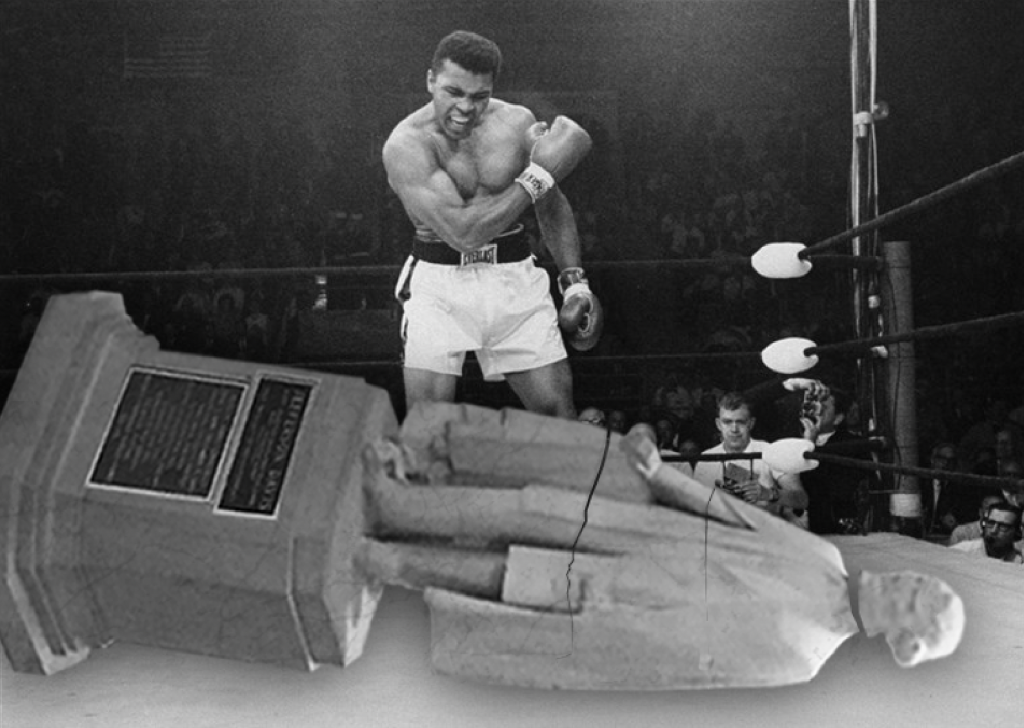
Please sign the petition below to remove the statue of Jefferson Davis currently in Kentucky’s Capitol Rotunda, and replace it with a tribute to Muhammad Ali, “the Louisville Lip” and “the Greatest of All Time.”
I just heard from the Ali family: It is the Champ’s belief that Islam prohibits three-dimensional representations of living Muslims. Accordingly, I have adjusted the petition to call for a two-dimensional representation of Ali (a portrait, picture or mural) in lieu of a statue.
UPDATE (Tuesday, December 2, 2014)
In this interview with WHAS-TV’s Joe Arnold, Governor Steve Beshear endorses the idea of honoring Muhammad Ali in the State Capitol (although he disagrees with removing Davis). Arnold explores the idea further on his weekly show, “The Powers that Be.”
Click here to check out WDRB-TV’s Lawrence Smith’s coverage of the story.
And here’s my op-ed in Ali’s hometown paper, the Louisville Courier-Journal.
UPDATE (Saturday, June 4, 2016)
In the wake of the 2015 Charlestown tragedy, in which a Confederate flag-waving murderer united the nation against racism, all of the most powerful Kentucky policymakers — U.S. Senator Mitch McConnell, Governor Matt Bevin, Senate President Robert Stivers and House Speaker Greg Stumbo — called for the removal of the Davis statue from the Rotunda. Today, as we commemorate last night’s passing of Muhammad Ali, there is no better moment to replace the symbol of Kentucky’s worst era with a tribute to The Greatest of All Time.
UPDATE (Wednesday, June 8, 2016):
Great piece by Lawrence Smith of WDRB-TV in Louisville on the petition drive to replace Jefferson Davis’ statue in the Capitol Rotunda with a tribute to Muhammad Ali.
UPDATE (Thursday, June 9, 2016):
Excellent piece on the petition drive by Jack Brammer that was featured on the front page of the Lexington Herald-Leader.
Highlight of the article:
Miller said he has received a few “angry comments” on his call to honor Ali.
“One of them encouraged me to kill myself,” he said. “You can quote me that I have decided not to take their advice.”
UPDATE (Friday, June 10, 2016)
The petition drives continues to show the Big Mo(hammed): check out these stories from WKYU-FM public radio in Bowling Green and WKYT-TV, Channel 27 in Lexington:
UPDATE (Saturday, June 11, 2016):
Still not convinced? Check out this excerpt from today’s New York Times:
By Krystal Ball, on Fri Apr 13, 2012 at 1:30 PM ET
When Republicans took over state legislatures and the US Congress in 2010, we were promised a war on unemployment. Instead we’ve gotten a war on the environment, women, minorities, unions and everything else that moves, organizes and votes Democratic.
The idealized “Schoolhouse Rock” version of our democratic process works something like this: Constituents concerned about a problem in the community contact their representative in the legislature, who recognizes the issue and decides to respond. The legislator works together with a skilled staff to draft legislation. The legislation is honed in committees where other members bring the perspective of their districts.
Finally, the entire body votes for the bill and it either succeeds or fails on its merits. We all know that this ideal has long been perverted by lobbyists and large donors who hold undue sway in our democracy. Less visible but even more pernicious is the impact of organizations like ALECand AUL who turn legislating into a wholesale, Costco-style activity.
Read the rest of… Krystal Ball: ALEC and AUL: Buying our democracy at wholesale
By John Y. Brown III, on Fri Apr 13, 2012 at 12:00 PM ET
Celebrity look alike?
Who are the celebrities you think you look most like? And which one do you really look most like?
Oh, I know. You’ve never thought about this because you aren’t that shallow. Baloney. Don’t worry, I haven’t either.
And that’s baloney too.
I’ll go first.
Being associated with a celebrity based on appearance must have some instinctive pull on us. Maybe it gives us a sense of validation that we are somehow important (or have the potential to be) bc we look like someone who is considered important and successful.
When I was a boy I had blondish curly hair. And lots of it.
The first celebrity I was told I looked like was Shirley Temple. A little girl. This displeased and distressed me to the point I took a pair of scissors and cut my own hair. It would be the last time I’d do anything like that again before the Flowbee was introduced some 25 years later.
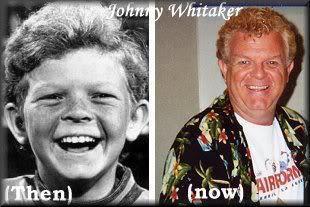
The Shirley Temple comments ended around ages 6 or 7. And a new celebrity comparison began. Jody –from Family Affair (as in Buffy and Jody), i.e. Johnny Whitaker. Jody was a quantum leap better than Shirley….And best of all he was a male! But if I could have chosen any celebrity in Hollywood, he would have been my first choice.
So I tried to improve on it. When I was 15 the movie Blue Lagoon came out. Two good looking teens, Christopher Atkins and Brooke Shields are stranded on a deserted island and forced to fall in love. Atkins had curly hair and was my age. I floated a the idea to several people that someone had suggested I looked like him. (The person who suggested I looked like him was me–and I suggest it to me.) Suffice it to say the idea never caught on.
No one –other than me–ever thought I looked like Christopher Atkins. Ever. Not even a little.
Chastened, a lowered my standards. I floated the idea a few years later around age 17 that someone (again me) told me I looked like Tommy from the sitcom Eight is Enough.
It didn’t catch on either. Mostly because no one I told could understand why I would want to look like Tommy –of all the celebrities out there.
That’s when I gave up on trying to find a celeb look alike to bolster my self -esteem. At least for the next 30 years.
I may float a rumor later this week that I look like a mature Jonah Hill (after the weight loss). It’s not that I want to look like Jonah Hill. It’s mostly my last ditch resistance before making peace with the fact that the only celeb I’ve ever seriously been told I look like is Johnny Whitaker (Jody).
Like so much in life, it’s not what I was hoping for. But could have been a lot worse. I need to simply accept this and be grateful it’s not Shirley Temple.
1. As the movie reviewers from In Living Color would say: “Hated it!”
2. This may be the first book review in history to quote Benjamin Netanyahu, Fredo Corleone, Emily Bronte, Three Dog Night, and Jerry McGuire.
An excerpt:
Within the aching, romantic heart of Peter Beinart lies an epic, tragic love story.
Beinart’s latest book, The Crisis of Zionism, begins as a tale of the author as a young boy, sitting at the knee of his immigrant grandmother, falling in love with her utopian vision of their ancestral homeland, a nation of liberal values and the moral pursuit of peace. You had me at “Shalom”!
But recently, upon receipt of a mysterious video — featuring a young boy mourning the arrest of his Palestinian father — our heroic narrator removes his devotion-inspired blinders, and his now-unjaundiced eyes reveal a long trail of illiberal betrayal by the wholly hole-y Holy Land.
But rather than retreat, our author sets out instead to reform his unfaithful love. With a self-image of Biblical proportions, Beinart likens himself to the Hebrew Prophets who decried the misuse of power the last time the Jews ran Israel.
Alas…this Jeremiah is a bullfrog.
Like many works in the kiss-and-tell genre, The Crisis of Zionism is driven by emotion rather than fact, and is so transparently one-sided that it reveals that the true betrayer is the author himself. Beinart is like Heathcliff, whose misinformed, misguided abandonment of his true love damns the couple to tragedy. Or perhaps he’s Fredo, whose thwarted ambition leads him on the path to perfidy, enabling and empowering his family’s enemies. You broke my heart, Peter. You broke my heart.
By Kristen Soltis, on Thu Apr 12, 2012 at 3:00 PM ET
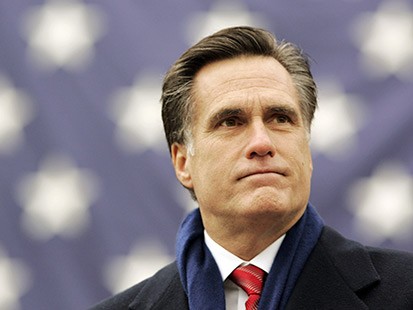
Having weathered the tense, topsy-turvy contest for the Republican presidential nomination, Mitt Romney now moves into the next chapter of the 2012 campaign. But how that next chapter reads is yet to be determined.
The departure of Rick Santorum from the race has sparked debate about how much Romney will need to “fire up the base” as he moves forward in order to turn out very conservative voters in November. Yet as voters grow increasingly frustrated with both parties, it is disaffected voters and disappointed independents who will be most decisive in this coming election.
The great news for Romney is that, no matter how you slice the electorate into target groups, the economy and jobs are the top issues on voters’ minds. This is not an election that will be decided on social or cultural issues. Despite Democrats’ efforts to turn fundamentally economic and fiscal issues into cultural issue wedges, the election will not hinge on issues like free contraception or funding for Planned Parenthood.
Read the rest of… Kristen Soltis: Does Romney Still Need to Court Conservatives?
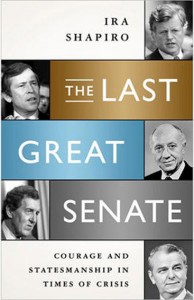
Ira Shapiro’s recent work on the late seventies, “The Last Great Senate”, has the gift of good timing. It hits bookstands during a time when its thesis–that Washington was occupied by political giants, moderates, and thoughtful deal-makers until far-right Republicans dragged it into the mud–is the conventional wisdom du jour. As a narrative, the book also reads well, which is no small accomplishment, given its dive into the nuts and bolts of policy battles that are only dimly recalled: Jimmy Carter’s conservation initiatives and his failed stimulus are not exactly the stuff of lore. As Shapiro reminds, there actually was an ample amount of substance and rigor in many of those debates, and the quality of the fight seems, in Shapiro’s telling, richer than our current sound-bite clashes.
Click on the book cover to order
To be sure, there is much that is admirable about this book from one of the most credentialed public policy lawyers in DC. It’s worth asking though, whether Shapiro’s underlying theory of senatorial decline and right-wing liability really holds up as a description of the last thirty odd years. Two threshold criticisms: first, the supposed dark ages after 1980 contain a lot more bipartisan accomplishment than Shapiro acknowledges. While his epilogue makes a nod to a series of eighties era achievements, including a refinancing of Social Security, a work-over of Title VII, tax reform, immigration reform, and the patent protection that enabled the generic drug market, it’s a run of success that Shapiro seems to dramatically understate and which is at odds with his premise. If Shapiro is right about the sources of dysfunction, a Republican lurch to the right and the surge of cut and slash ad wars sponsored by conservative cash, the eighties should have been one long pattern of gridlock. The fact that they weren’t gives Shapiro’s case fits that he doesn’t really address.
Read the rest of… Artur Davis: Seventies Night on Capitol Hill


 Blog this!