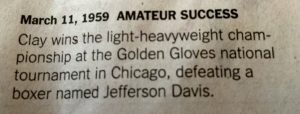
Please sign the petition below to remove the statue of Jefferson Davis currently in Kentucky’s Capitol Rotunda, and replace it with a tribute to Muhammad Ali, “the Louisville Lip” and “the Greatest of All Time.”
I just heard from the Ali family: It is the Champ’s belief that Islam prohibits three-dimensional representations of living Muslims. Accordingly, I have adjusted the petition to call for a two-dimensional representation of Ali (a portrait, picture or mural) in lieu of a statue.
UPDATE (Tuesday, December 2, 2014)
In this interview with WHAS-TV’s Joe Arnold, Governor Steve Beshear endorses the idea of honoring Muhammad Ali in the State Capitol (although he disagrees with removing Davis). Arnold explores the idea further on his weekly show, “The Powers that Be.”
Click here to check out WDRB-TV’s Lawrence Smith’s coverage of the story.
And here’s my op-ed in Ali’s hometown paper, the Louisville Courier-Journal.
UPDATE (Saturday, June 4, 2016)
In the wake of the 2015 Charlestown tragedy, in which a Confederate flag-waving murderer united the nation against racism, all of the most powerful Kentucky policymakers — U.S. Senator Mitch McConnell, Governor Matt Bevin, Senate President Robert Stivers and House Speaker Greg Stumbo — called for the removal of the Davis statue from the Rotunda. Today, as we commemorate last night’s passing of Muhammad Ali, there is no better moment to replace the symbol of Kentucky’s worst era with a tribute to The Greatest of All Time.
UPDATE (Wednesday, June 8, 2016):
Great piece by Lawrence Smith of WDRB-TV in Louisville on the petition drive to replace Jefferson Davis’ statue in the Capitol Rotunda with a tribute to Muhammad Ali.
UPDATE (Thursday, June 9, 2016):
Excellent piece on the petition drive by Jack Brammer that was featured on the front page of the Lexington Herald-Leader.
Highlight of the article:
Miller said he has received a few “angry comments” on his call to honor Ali.
“One of them encouraged me to kill myself,” he said. “You can quote me that I have decided not to take their advice.”
UPDATE (Friday, June 10, 2016)
The petition drives continues to show the Big Mo(hammed): check out these stories from WKYU-FM public radio in Bowling Green and WKYT-TV, Channel 27 in Lexington:
UPDATE (Saturday, June 11, 2016):
Still not convinced? Check out this excerpt from today’s New York Times:
By Jonathan Miller, on Wed Jun 27, 2012 at 1:30 PM ET
As Presbyterians prepare to convene in Pittsburgh for their biennial General Assembly, and plan to consider a resolution to divest from companies that do business with Israel, here’s a stark reminder of moral choice they are making.
As I discussed in my Huffington Post column yesterday, Hewlett-Packard — one of the companies proposed to be boycotted —
is charged with selling “hardware to the Israeli Navy that is used for its operational communications, logistics and planning including the ongoing naval blockade of the Gaza Strip.” Yet, as an official report of the notoriously anti-Israel-leaning United Nations declared in 2011, the blockade was manifestly legal, and it was instituted for the very purposes of upholding the peace. Wrote the Palmer Commission: “Israel faces a real threat to its security from militant groups in Gaza…The naval blockade was imposed as a legitimate security measure in order to prevent weapons from entering Gaza by sea and its implementation complied with the requirements of international law.”
Yesterday, came this report from the Washington Free Beacon:
As Gaza militants renew violent rocket attacks on Israeli cities, a Hamas national security minister told a delegation of graduating police officers in the Gaza Strip that they should help liberate Israeli cities, such as Jerusalem, from Jewish control, according to a recently released translation of his remarks.
“None of you should give up playing with all the tools of force and equipment, which will bring us closer to our aspirations: Jerusalem, the Al-Aqsa Mosque, Haifa, Akko, and Jaffa,” Hamas Minister Fathi Hammad declared during a Gaza police academy commencement ceremony on June 13, about a week before militants began firing hundreds of rockets into Southern Israel.
“The officers of the class graduating today will become the police chief of Jaffa, the police chief of Haifa, the police chief of Akko, the police chief of Lod, the police chief of Ramle, and of all other places,” said Hammad, an interior and national security minister said, according to a translation of his remarks by the Middle East Media Research Institute.
“Therefore, from this place, we declare to all those who usurped our lands that they must prepare to leave, because we have prepared for jihad,” said the Hamas official, which remains officially committed to the destruction of Israel. “You are going to leave, while we are summoned to battle. We are the owners of this land.”
Hammad’s remarks, which are routinely echoed by Hamas officials, provide context for the currently stalled peace negotiations between the Israelis and Palestinians.
I hope members of the General Assembly seriously consider whether the interests of peace are best serve by divesting from Israel, and taking the side of brutal thugs like Fathi Hammad who calls for Israel’s very destruction.
By John Y. Brown III, on Wed Jun 27, 2012 at 12:00 PM ET
“Abs”
No, not abs that I have now….or abs I’m comitting to have in the future.. I am at a point in my life where I will likely never talk about abs in the present or future tense ever again.
The best I can do is mention abs as an occurence in the past—something that existed years ago and, for a period of time, I was proud of. A reflection. A reminescence of something positive t can still recall and remind people about–form once upon a time, A sweet memory.
The column published this morning here at The Recovering Politician by The RP and his No Labels co-founder, Mark McKinnon, headlines the influential Real Cleafr Policy web site. See below:
Food and Drug Administration (FDA) recently warned consumers about a potentially dangerous counterfeit version of Adderall tablets being sold on the Internet – the tablets contained the painkillers tramadol and acetaminophen rather than the active ingredients of the authentic ADHD drug, Adderall. In addition, thousands of packages containing unapproved and counterfeit drug products sold to unsuspecting Americans on Internet sites continue to be seized by US Customs and Border Protection. The Web sites peddling these products place Americans’ health at risk, distributing products that can cause more harm than good.
The AWARXE consumer protection encourages consumers to make an informed choice when buying medications online by using resources provided by the National Association of Boards of Pharmacy® (NABP®). As part of its mission to protect the public’s health, NABP has reviewed, more than 9,800 Web sites selling prescription drugs. AWARxE alerts consumers that only 3%, or 328, of these sites appear to be in compliance with state and federal laws and NABP patient safety and pharmacy practice standards. The other 97% of these sites are considered rogue sites and are listed as Not Recommended on the AWARxE Web site, www.AWARErx.org.
Of the sites reviewed, those currently listed as Not Recommended are characterized as follows:
87% do not require a valid prescription
50% offer foreign or non-FDA-approved drugs
59% use an online questionnaire to evaluate patient health and medication needs, which can be very dangerous
24% are located outside of the United States and selling drugs illegally to patients in the US
Lives have been lost due to people buying medicines from sites that send dangerous drugs without medical oversight that may have been tampered with, expired, or even fake.
FDA regulations and federal and state laws help ensure a secure drug supply chain for products distributed within the US, such as those purchased by patients at the local community pharmacy. In fact, the US drug supply chain is one of the safest in the world. But what happens when consumers go outside of this safety net by purchasing drug products on the Internet that are shipped from locations around the world?
Read the rest of… Carmen Catizone: Americans Can Protect Themselves from Web Sites Selling Dangerous Counterfeit Drugs
By Jonathan Miller, on Wed Jun 27, 2012 at 8:30 AM ET
The RP and his fellow No Labels co-founder Mark McKinnon (George W. Bush’s campaign manager) offer the following thoughts on the presidential appointment process:
This is what a broken government looks like.
Over a year after the 2008 financial crisis, the Treasury Department still didn’t have an assistant secretary for financial markets. In the middle of fighting wars in Iraq and Afghanistan, there was no Secretary of the Army. And on 9/11, the Bush administration still didn’t have a full national security team in place.
These are the consequences of a broken presidential appointments process. In recent years, the Senate is taking more time to confirm more people, and the problem is especially glaring at the beginning of new administrations. The number of positions requiring Senate confirmation has grown from 280 to 1,400 over the past 50 years, while the average length of time for confirmation has grown from two-and-a-half months to more than 10.
The confirmation process has developed into an embarrassing charade, with highly qualified nominees often held up for petty or purely partisan reasons.
No matter who the next president is, we need a smarter, more efficient system to ensure he can staff his administration with the best people in a timely fashion. No Labels has a three-part solution.
1. Reduce the number of appointees subject to Senate confirmation: The Senate’s “Advice and Consent” on nominations is an important check on presidential power, but it’s not needed for every mid-level official and presidential commission. We should give new presidents more authority to fill less urgent positions and let the Senate focus on the most important nominees who deal with more pressing matters. Encouragingly, a bipartisan bill to do just that has already passed the Senate and awaits action in the House.
2. Identify a “slate that can’t wait” of critical nominees for expedited confirmation: Within a few days of the election, the president should be prepared to name a group of nominees for especially crucial positions, who would be subject to both speedier background checks and Senate review and confirmation.
3. Up or down vote on presidential appointments: All presidential nominations should be confirmed or rejected within 90 days of the nomination being received by the Senate. This time frame includes both committee and floor action. If a nominee’s name is not confirmed or rejected within 90 days, the nominee would be confirmed by default.
Our next president will have plenty of problems to deal with – and worrying about whether he can hire good people should not be one of them. It’s time to fix the presidential appointment process and fix it now.
By Patrick Derocher, on Tue Jun 26, 2012 at 3:00 PM ET
Until a health care decision is released Thursday, SCOTUS watchers will have to focus on the ruling in Arizona v. United States.
There was no health care ruling yesterday, but Constitutional scholars have plenty to talk about with Arizona’s win/loss on SB 1070. The Supreme Court struck down part of the highly controversial law, but invited further litigation to better establish the parameters of what enforcement is Constitutionally acceptable. Who “won” the decision is up for debate, but the Court has, of course, released the full decision for you to come to your own conclusions. [SCOTUS]
Tonight’s marquee primary races are both in New York, and one in particular promises to be exciting– New York’s 13th Congressional District. Democrat Charlie Rangel, who has represented the Upper Manhatan-based district and its predecessors since 1971 is fighting for his political life against State Senator Adriano Espaillat. Espaillat is challenging Rangel in today’s primary and may have a demographic advantage as a popular legislator of Dominican descent in an increasingly Hispanic district, but Rangel has a major advantage in his incumbency and endorsements. [POLITICO]
California’s budget problems and political dysfunction continue to have a negative impact on that state’s residents. Should a tax increase initiative fail in November, individual districts would be allowed to decrease the length of the school year by 15 days in each of the next two school years, down to 160 days. (Previous budget cuts already shortened the year from the traditional 180 days to 175.) This new school year would, of course, still be subject to collective bargaining. [Sacramento Bee]
State primaries are in a truly very sad state. Voters don’t understand the importance of primaries. Voter turnout in every State primary has always been horrible. Primaries defeat the principle of representative democracy. Primaries give incumbents a big advantage over challengers. Next Tuesday, New York, Colorado, Oklahoma and Utah have primaries. And, the beat goes on.
One reason for poor turnout is that voters are often ignorant of the importance of primaries. For any office that is safe for a particular party, whoever wins the primary office contest has, in effect, already won the office. The office contest in the November general election is virtually meaningless. In the District of Columbia, almost all of the elected officials are Democrats. The primary election literally determines the DC government. The November DC election is a waste of time and money. Unfortunately many voters are unaware of this, and, by not showing up for the primary, they simply have no say in the selection of the candidate(s) who will represent them.
A second reason for poor turnout is that voters don’t understand primaries and are intimidated by them. Each State can hold a primary election in numerous ways. And, each State has its own rules in the actual execution of its primary. For voters, this makes for a confusing mess. They don’t know what party primary they can vote in. They don’t know how many different ballots there will be. They don’t know what party ballot(s) they can request. They don’t know what will be on the ballot(s). They don’t know what party identification they need. They simply don’t know what is going to happen when they show up at the polls. Worst of all, they can’t even get answers to these questions in advance on the State’s election website. I challenge you to try!
In the case of next Tuesday, New York and Oklahoma will conduct ‘closed’ primaries. Voters may vote only if they are registered member of that party. Independent and non-partisan voters cannot participate. Colorado, however, will conduct a ‘semi-closed’ primary. Registered party members and unaffiliated voters can vote only in a party’s primary. Independents choose a party. But, Utah takes the prize. It will hold a ‘closed’ primary for registered Republicans but will hold ‘open’ primaries for Democrats and Constitution party members. Is it any wonder that voters are turned off by the whole business?
Read the rest of… Ron Kahlow: The Sad State of State Primaries
By Jonathan Miller, on Tue Jun 26, 2012 at 12:30 PM ET
Were you aware that this coming week, the General Assembly of the Presbyterian Church (USA) will be taking a critical vote to divest from companies that do business in Israel?
Many of my Presbyterian friends and family were not aware, and they strongly oppose such action.
Please read my piece in today’s Huffington Post, and if you are moved to take action, I urge you to do so before the weekend’s convention:
On June 30, the biennial General Assembly of the Presbyterian Church (USA) will consider the church’s divestment from three American companies because of their sales to Israel. This misguided, ineffectual proposal would have only one meaningful ramification — It would seriously deepen a growing chasm with one of the church’s strongest allies on nearly every issue of social justice: the Jewish people.
===
Although I am a devout Jew, I have always enjoyed a special kinship with the Presbyterian Church. My paternal cousins, though intermarriage, are active Presbyterians, and I have been proud to celebrate a lifetime of life cycle events at their church. As a child, when my small synagogue in Lexington, Kentucky could not field a basketball team, I played point guard for First Presbyterian; and as a requirement of my team membership, I attended church at least once a year. And with Presbyterian Church (USA)’s headquarters in nearby Louisville, I’ve had the opportunity to meet and work with several of its national leaders in my former roles as Kentucky’s State Treasurer and Chief Financial Officer.
I learned from these experiences about the wide spectrum of values shared by Jews and Presbyterians. First and foremost is a passion for social justice — whether our inspiration comes from the Hebrew Prophets or the Gospels of Jesus, one of our most sacred missions is to serve the poor, promote the rights of the disenfranchised, and to love our neighbors as ourselves. It’s no wonder that over the past several decades, Jews and Presbyterians have walked arm in arm in efforts to establish equal rights for women, African-Americans, and gays and lesbians; to battle callous government policies that exacerbate income inequality; and to promote peace throughout the world.
A serious cleavage in the interfaith relationship emerged, however, upon passage of a policy by the 2004 General Assembly of the Presbyterian Church (USA) for a “phased, selective” divestment of Israel. After strong protest by Jewish groups — as well as many Presbyterian parishioners — the 2006 General Assembly reversed course, calling for “corporate engagement” to promote peaceful solutions in the Middle East.
This February, however, citing the failure of corporate engagement to produce results, the church’s General Assembly Mission Council recommended that the church divest its stock from Caterpillar, Motorola Solutions, and Hewlett-Packard “until they have ceased profiting from non-peaceful activities in Israel-Palestine.” The church will consider this resolution at its 220th General Assembly meeting that begins June 30 in Pittsburgh.
Unfortunately, the church’s proposed actions have little grounding in reality. Caterpillar, for example, does not actually sell equipment to Israel; it sells tractors to the U.S. government which then transfers them to about 150 countries around the globe, including Israel. To address the church’s objectives, Caterpillar would have to refuse to sell bulldozers to its own government, a move that would level a devastating,, if not existential blow to the company, its shareholders, and its thousands of U.S. employees.
Meanwhile, Hewlett-Packard is charged with selling “hardware to the Israeli Navy that is used for its operational communications, logistics and planning including the ongoing naval blockade of the Gaza Strip.” Yet, as an official report of the notoriously anti-Israel-leaning United Nations declared in 2011, the blockade was manifestly legal and instituted for the very purposes of upholding the peace: “Israel faces a real threat to its security from militant groups in Gaza…The naval blockade was imposed as a legitimate security measure in order to prevent weapons from entering Gaza by sea and its implementation complied with the requirements of international law.”
By John Y. Brown III, on Tue Jun 26, 2012 at 12:00 PM ET
Right of Passage or reason for passing out?
We just received our first child’s first college tuition bill.
It’s a proud moment, to be sure. I smiled inwardly as I knelt down on the ground to steady myself and decided to stay down until the faint feeling and nausea subsided.
It’s a feeling I won’t ever forget. Mixed with great parental pride was the initial thought that passed through my head like a loud chugging locomotive that could be heard over a mile away, “We’re going to have to sell the house!”
Of course, I caught myself up, chuckled, and reminded myself of an age-old trick that always helped in situations like this, “Let it sink in before reacting” and then I knelt back down into a sitting position as the faint feeling and nausea came rushing back.
So, I waited several minutes. In fact about 30 minutes and decided to reflect calmly on this momentous occasion. My second–calmer and more reflective reaction–was we need to sell the house and I’m going to have to pick up a second job delivering pizzas for the next 4 years.



 Blog this!