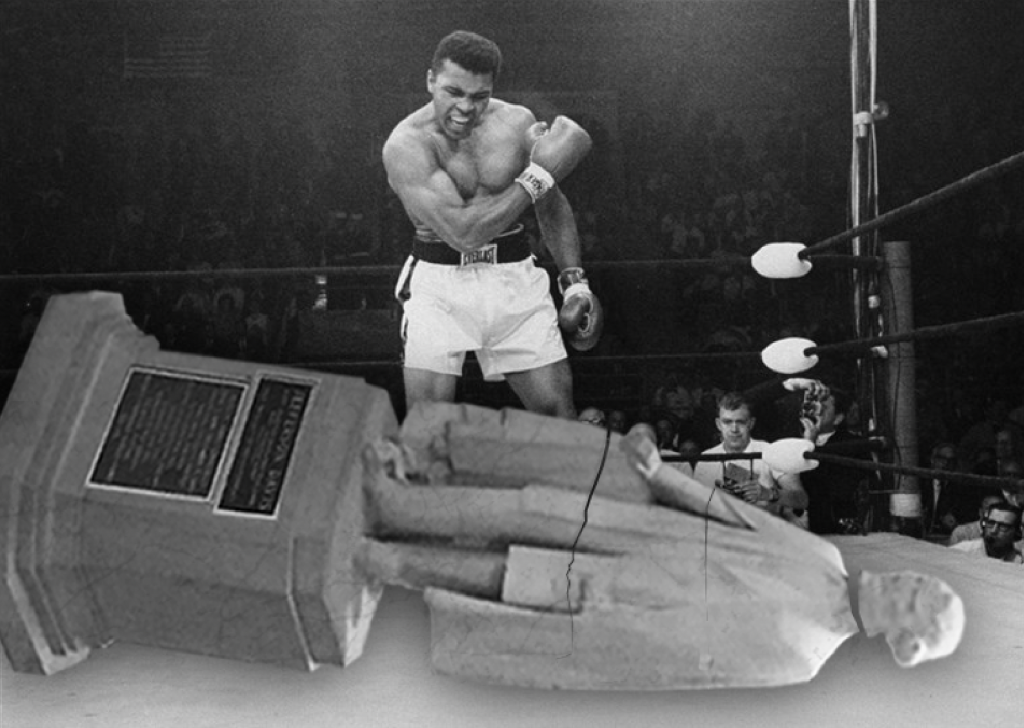
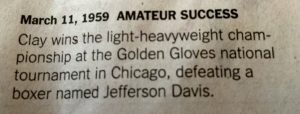
Please sign the petition below to remove the statue of Jefferson Davis currently in Kentucky’s Capitol Rotunda, and replace it with a tribute to Muhammad Ali, “the Louisville Lip” and “the Greatest of All Time.”
I just heard from the Ali family: It is the Champ’s belief that Islam prohibits three-dimensional representations of living Muslims. Accordingly, I have adjusted the petition to call for a two-dimensional representation of Ali (a portrait, picture or mural) in lieu of a statue.
UPDATE (Tuesday, December 2, 2014)
In this interview with WHAS-TV’s Joe Arnold, Governor Steve Beshear endorses the idea of honoring Muhammad Ali in the State Capitol (although he disagrees with removing Davis). Arnold explores the idea further on his weekly show, “The Powers that Be.”
Click here to check out WDRB-TV’s Lawrence Smith’s coverage of the story.
And here’s my op-ed in Ali’s hometown paper, the Louisville Courier-Journal.
UPDATE (Saturday, June 4, 2016)
In the wake of the 2015 Charlestown tragedy, in which a Confederate flag-waving murderer united the nation against racism, all of the most powerful Kentucky policymakers — U.S. Senator Mitch McConnell, Governor Matt Bevin, Senate President Robert Stivers and House Speaker Greg Stumbo — called for the removal of the Davis statue from the Rotunda. Today, as we commemorate last night’s passing of Muhammad Ali, there is no better moment to replace the symbol of Kentucky’s worst era with a tribute to The Greatest of All Time.
UPDATE (Wednesday, June 8, 2016):
Great piece by Lawrence Smith of WDRB-TV in Louisville on the petition drive to replace Jefferson Davis’ statue in the Capitol Rotunda with a tribute to Muhammad Ali.
UPDATE (Thursday, June 9, 2016):
Excellent piece on the petition drive by Jack Brammer that was featured on the front page of the Lexington Herald-Leader.
Highlight of the article:
Miller said he has received a few “angry comments” on his call to honor Ali.
“One of them encouraged me to kill myself,” he said. “You can quote me that I have decided not to take their advice.”
UPDATE (Friday, June 10, 2016)
The petition drives continues to show the Big Mo(hammed): check out these stories from WKYU-FM public radio in Bowling Green and WKYT-TV, Channel 27 in Lexington:
UPDATE (Saturday, June 11, 2016):
Still not convinced? Check out this excerpt from today’s New York Times:
For the most part, Bill Clinton’s reconstruction of the Democratic Party is a masterpiece that did not survive the consummate political artist’s time in power: balanced budgets seem like a relic of a bygone era; the pro-growth, business friendly wing of the Democratic Party has given way to Elizabeth Warren style populism; and modulated stances on social issues have been replaced with legal fights against Catholic hospitals, rhetorical battle cries about a “War on Women”, and a place in the party’s platform for a fifty state right of same sex marriage.
The exception, the one preserved centrist jewel from that era, had been (until last week) the 1996 reform of welfare. As a policy instrument, the conversion of welfare from an entitlement to an earned benefit conditioned on work, job training, or secondary level education like a GDE program rested on decades of data about the perils of dependency in poor communities. As a political instrument, coupling public assistance with a work requirement achieved a stunning result: a benefit program that had been deeply controversial, and racially polarizing, was re-crafted as a bipartisan amalgam of left-leaning altruism and right-leaning notions of personal responsibility.
As a result, one of the most contentious ideological disputes between seventies and eighties era conservatives and liberals all but disappeared as a flashpoint. It has been Social Security and Medicare–not welfare–that movement conservatives have sought to redesign in the past eight years, and the most provocative expenditure of public dollars in the last four years has been the transfer of nearly a trillion dollars to the banking and automobile industries rather than any form of public assistance.
Read the rest of… Artur Davis: Setting Welfare Back on Fire
By John Y. Brown III, on Thu Aug 16, 2012 at 12:00 PM ET
Pet peeve from NY visit.
I got irked a couple times listening to seemingly self-deprecating New Yorkers talk about how they were so self-absorbed or narcissistic—as was their spouse.
What bothered me wasn’t that fact but the way they seemed to be saying that sort of “sophisticated” problem happens only to busy city folk. And explains all the syllables and hard to spell word like narcissistic.
I wanted to say, “Ever heard the saying ‘That couple is like two tics and no dog?'”
Pause and then add “Back home we can out self-center and out-crazy you all any day of the week.” And smile smugly in a pleasant but slightly deranged manner.
But I held my tongue. It just didn’t seem as impressive a bragging point as it initially sounded in my head.
By Zack Adams, RP Staff, on Thu Aug 16, 2012 at 10:00 AM ET
The Politics of Tech
Wikileaks reveals US government spy network “TrapWire” and is subsequently smacked down by DDOS attacks. [io9]
How many times have you read all the way through a Terms of Service agreement before click “I accept” on the Internet? Probably very few. There is a new project on the way that would change things. [TechCrunch]
“Samsung: Whether or not we ripped off Apple’s tech, Apple stole it to begin with” — Provides video evidence of a tablet built by Mitsubishi to show that Apple’s patent on pinch-to-zoom technology should not be valid because it already existed for years before the first iPhone launched. [BGR]
German government officials are claiming that Facebook is maintaining a database of facial recognition and are demanding they erase it. [ars technica]
Scientists have invented particles that will keep you alive even if you can’t breathe. [Gizmodo]
The winners have been declared in Tuesday’s primary elections. On the heels of the results, a political analyst weighs in on how the results might have been different if the primary process was different.
Several states have blanket primaries or open primaries. Supporters say they could increase voter turnout and get the best two candidates to the general election regardless of the party. Opponents say there’s no proof of that.
Voters throughout the metro hit the polls for Tuesday night’s primary. Early Tuesday evening, Kansas City reported a disappointing turnout. Some say they’d like to say they would like to see the way primaries are held changed.
“Normally, these days there’s not one person that wants to vote straight ticket. It’s not the way it works anymore,” said analyst Jason Grill.
Grill’s answer is the blanket primary. Currently, in Missouri and Kansas, residents must vote on either the Republican or Democrat ballot containing only that party’s candidates. With a blanket primary, all candidates for each race would be on one ballot. People could vote for whomever they chose. Then the top two winners would advance to the general election. Even if they were of the same party.
“We’ve seen that primary elections have become so partisan with who gets elected,” Grill said. “Usually, the extremes of both parties get elected so you have extreme one, versus extreme two in the general election, and a lot of the general public more of the independent minded public doesn’t really feel a connection with each candidates.”
Both of the top two system isn’t without criticism. Opponents have been concerned about things like one party domination. Others say there’s simply no research proving these type of primaries bring out more voters.
Washington State, California and Louisiana have all used the Top 2 System for primaries. The U.S. Supreme Court ruled them constitutional in 2008.
By Bradford Queen, Managing Editor, on Wed Aug 15, 2012 at 12:30 PM ET
The Politics of Faith
The Romney-Ryan ticket is making religious history, at least in presidential politics, by becoming the first major party’s ticket to not include a Protestant Christian. [CNN]
Some wonder if the evangelical principles in both Romney’s and Ryan’s respective churches might put the two candidates at odds. [TIME]
As the NFL pre-season gets ramped up, Tim Tebow talked about how his faith comes before football. [Fox Sports]
A Catholic-run business in Colorado received an injunction against the Department of Health and Human Services mandate to provide insurance coverage for contraceptives. The Catholic owners are asking the President to respect their beliefs. [Catholic News Agency]
Prominent religious history author David Barton’s “The Jefferson Lies” has been pulled from bookstores after the publisher determined there were many unsupported claims or factual errors in the book. [CNN]
It’s tempting to wonder how candidate Barack Obama would have performed in 2008 if he had campaigned on President Barack Obama’s agenda in the first seven months of 2012. Imagine if the Illinois Senator had gone on record favoring a rewrite of federal regulations to mandate Catholic institutions to cover contraceptives in their insurance plans; if he had endorsed same-sex marriage; if he had pledged to dismantle the work requirement at the centerpiece of welfare reform; and if he claimed the executive authority to alter federal immigration laws on his own without waiting for congressional approval.
The likely result is that the base of his party would have been thrilled at such a thoroughgoing progressive vision, but that Obama would have hardened his image as a Kerry/Dukakis like cultural liberal with a tin ear for Middle America. The McCain campaign certainly would have had ammunition fresher than the obscure William Ayers to cast Obama as an ideological risk and, perhaps, a path to divert conservative independents and blue collar Hillary Clinton voters from the crevasses in the economy.
In the real universe, and not this parallel one of progressive fantasies, Obama campaigned as someone quite different from the liberal warrior Republicans would have relished running against. To the extent Obama ventured into cultural politics at all, it was with the measured nuance of a Clintonian moderate: tolerant of civil unions, but opposed to gay marriage on religious grounds; respectful of the public divide on reproductive rights, and virtual silence on an immigration proposal that had dominated congressional debate just two summers earlier. Obama even described the welfare reform that he had opposed as a rookie legislator as an unmitigated success and its work requirement as a “centerpiece of any social policy.”


 Blog this!