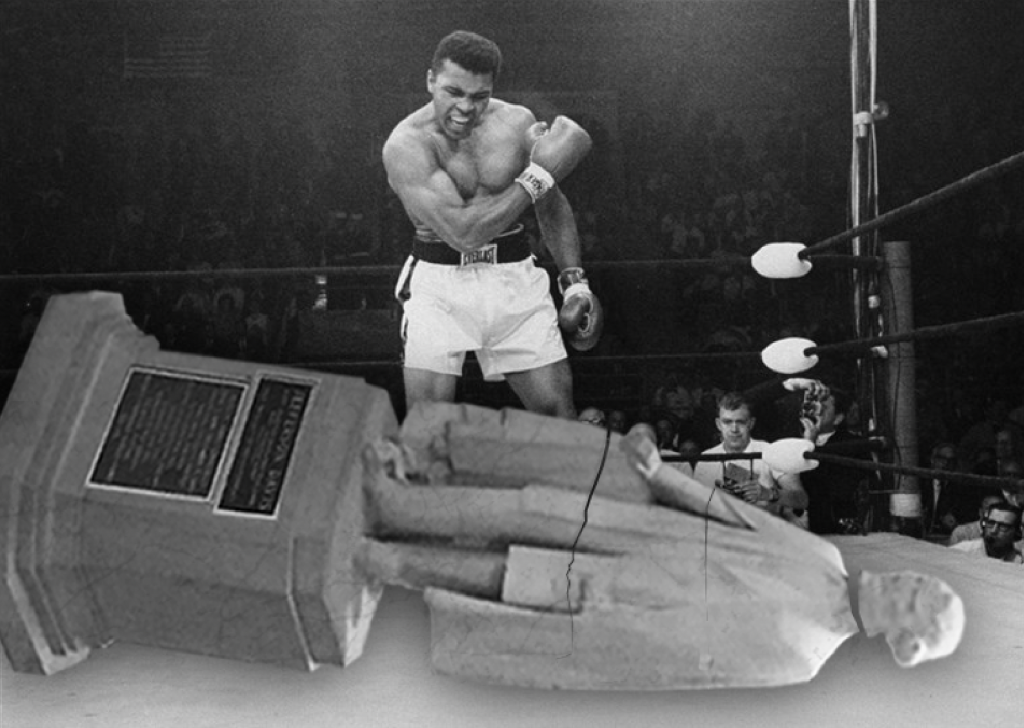
Please sign the petition below to remove the statue of Jefferson Davis currently in Kentucky’s Capitol Rotunda, and replace it with a tribute to Muhammad Ali, “the Louisville Lip” and “the Greatest of All Time.”
I just heard from the Ali family: It is the Champ’s belief that Islam prohibits three-dimensional representations of living Muslims. Accordingly, I have adjusted the petition to call for a two-dimensional representation of Ali (a portrait, picture or mural) in lieu of a statue.
UPDATE (Tuesday, December 2, 2014)
In this interview with WHAS-TV’s Joe Arnold, Governor Steve Beshear endorses the idea of honoring Muhammad Ali in the State Capitol (although he disagrees with removing Davis). Arnold explores the idea further on his weekly show, “The Powers that Be.”
Click here to check out WDRB-TV’s Lawrence Smith’s coverage of the story.
And here’s my op-ed in Ali’s hometown paper, the Louisville Courier-Journal.
UPDATE (Saturday, June 4, 2016)
In the wake of the 2015 Charlestown tragedy, in which a Confederate flag-waving murderer united the nation against racism, all of the most powerful Kentucky policymakers — U.S. Senator Mitch McConnell, Governor Matt Bevin, Senate President Robert Stivers and House Speaker Greg Stumbo — called for the removal of the Davis statue from the Rotunda. Today, as we commemorate last night’s passing of Muhammad Ali, there is no better moment to replace the symbol of Kentucky’s worst era with a tribute to The Greatest of All Time.
UPDATE (Wednesday, June 8, 2016):
Great piece by Lawrence Smith of WDRB-TV in Louisville on the petition drive to replace Jefferson Davis’ statue in the Capitol Rotunda with a tribute to Muhammad Ali.
UPDATE (Thursday, June 9, 2016):
Excellent piece on the petition drive by Jack Brammer that was featured on the front page of the Lexington Herald-Leader.
Highlight of the article:
Miller said he has received a few “angry comments” on his call to honor Ali.
“One of them encouraged me to kill myself,” he said. “You can quote me that I have decided not to take their advice.”
UPDATE (Friday, June 10, 2016)
The petition drives continues to show the Big Mo(hammed): check out these stories from WKYU-FM public radio in Bowling Green and WKYT-TV, Channel 27 in Lexington:
UPDATE (Saturday, June 11, 2016):
Still not convinced? Check out this excerpt from today’s New York Times:
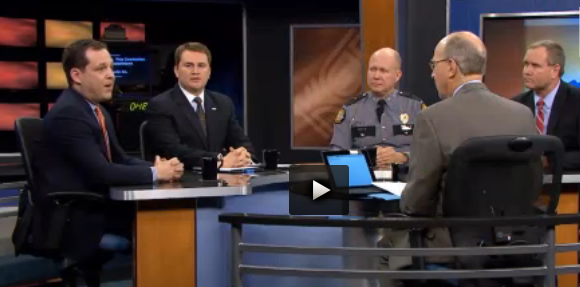
Last night, Kentucky Educational Television’s Kentucky Tonight program, hosted by Bill Goodman, featured a deeply substantive, and occasionally emotional, debate about the future of industrial hemp in the Bluegrass State. The combatants included The RP (Jonathan Miller), Kentucky Agriculture Commissioner James Comer, Kentucky State Police Commissioner Rodney Brewer, and Dan Smoot, vice president of Operation UNITE.
Mentioned in the debate were the following studies and legislative proposals.
By Jonathan Miller, on Mon Feb 4, 2013 at 7:30 PM ET
As The RP (Jonathan Miller) and Kentucky Agriculture Commissioner James Comer debate industrial hemp legalization with state law enforcement officials on Kentucky Tonight, join in the online debate on Twitter.
Your tweets will be posted LIVE below, and whenever possible, the panelists will respond to them, either on air, or afterwards online.
Some Guidelines:
Use the hashtag #KYTonight somewhere within your tweet, and it will be posted LIVE below
Refer to Jonathan Miller as @RecoveringPol, Commissioner Comer as @KYComer, and host Bill Goodman as @BillKET
Click the following links to read the reports referenced in the debate:
KET’s Kentucky Tonight program with host Bill Goodman will discuss industrial hemp this evening at 8:00 PM ET.
Scheduled guests are:
– Kentucky Agriculture Commissioner James Comer
– Kentucky State Police Commissioner Rodney Brewer
– Former Kentucky State Treasurer Jonathan Miller, founder of The Recovering Politician
– Dan Smoot, vice president of Operation UNITE
The program is live on KET and at www.ket.org/live at 8:00 pm ET.
Viewers with questions and comments may send e-mail to kytonight@ket.org or use the message form at www.ket.org/kytonight. All messages should include first and last name and town or county. The phone number for viewer calls during the program is 1-800-494-7605.
You can come back to this site at 8:00 PM and join a LIVE Twitter debate — all of your tweets that use #KYTonight will be published LIVE at The Recovering Politician.
Kentucky Tonight programs are archived online, made available via podcast, and rebroadcast on KET, KET KY, and radio. Archived programs, information about podcasts, and broadcast schedules are available at www.ket.org/kytonight.
For your reading prior to or after the show, click here for a 1998 report produced by the University of Kentucky on the “Economic Impact of Industrial Hemp in Kentucky.” As you read the report, keep in mind that farmers and scientists have developed dozens of new applications for the crop since the report was prepared 15 years ago. The key findings in the report include:
A market for industrial hemp exists in a number of specialty or niche markets in the United States, including specialty papers, animal bedding and foods and oils made from hemp.
Additional markets could emerge for industrial hemp in the areas of automobile parts, replacements for fiberglass, upholstery, and carpets. Using current yields, prices, and production technology from other areas that have grown hemp, Kentucky farmers could earn a profit of approximately $320 per acre of hemp planted for straw production only or straw and grain production, $220 for grain production only, and $600 for raising certified seed for planting by other industrial hemp growers. In the long run, it is estimated that Kentucky farmers could earn roughly $120 per acre when growing industrial hemp for straw alone or straw and grain, and $340 an acre from growing certified hemp seed.
Industrial hemp, when grown in rotation, may reduce weeds and raise yields for crops grown in following years. Several agronomic studies have found that industrial hemp was more effective than other crops at reducing selected weeds. One study found that industrial hemp raised yields by improving soil ventilation and water balance.
The economic impact if Kentucky again becomes the main source for certified industrial hemp seed in the United States is estimated at 69 full-time equivalent jobs and $1,300,000 in worker earnings. The total economic impact in Kentucky, assuming one industrial hemp processing facility locating in Kentucky and selling certified seed to other growers, would be 303 full-time equivalent jobs and $6,700,000 in worker earnings. If two processing facilities were established in Kentucky, industrial hemp would have an economic impact of 537 fulltime equivalent jobs and $12,100,000 in worker earnings. If one processing facility and one industrial hemp paper-pulp plant were established in Kentucky, industrial hemp would have an economic impact of 771 full-time equivalent jobs and $17,600,000 in worker earnings.
If just a fraction of the agricultural counties in Kentucky went into the industrial hemp business, thousands of jobs and sizable earnings would be created. If just one-fourth of Kentucky’s 90 agricultural counties went into industrial hemp business, approximately 17,348 jobs would be created and $396 million in worker earnings generated yearly.
These economic impact estimates reflect possible outcomes for Kentucky given a national industrial hemp industry that is focused in specialty niche activities that have been demonstrated to work in Europe. It is important to remember, however, that technologies are under development that may allow industrial hemp products to compete in bulk commodity markets. The economic impacts that would occur if these technologies were found to be commercially feasible would be substantially greater than those identified in this report.
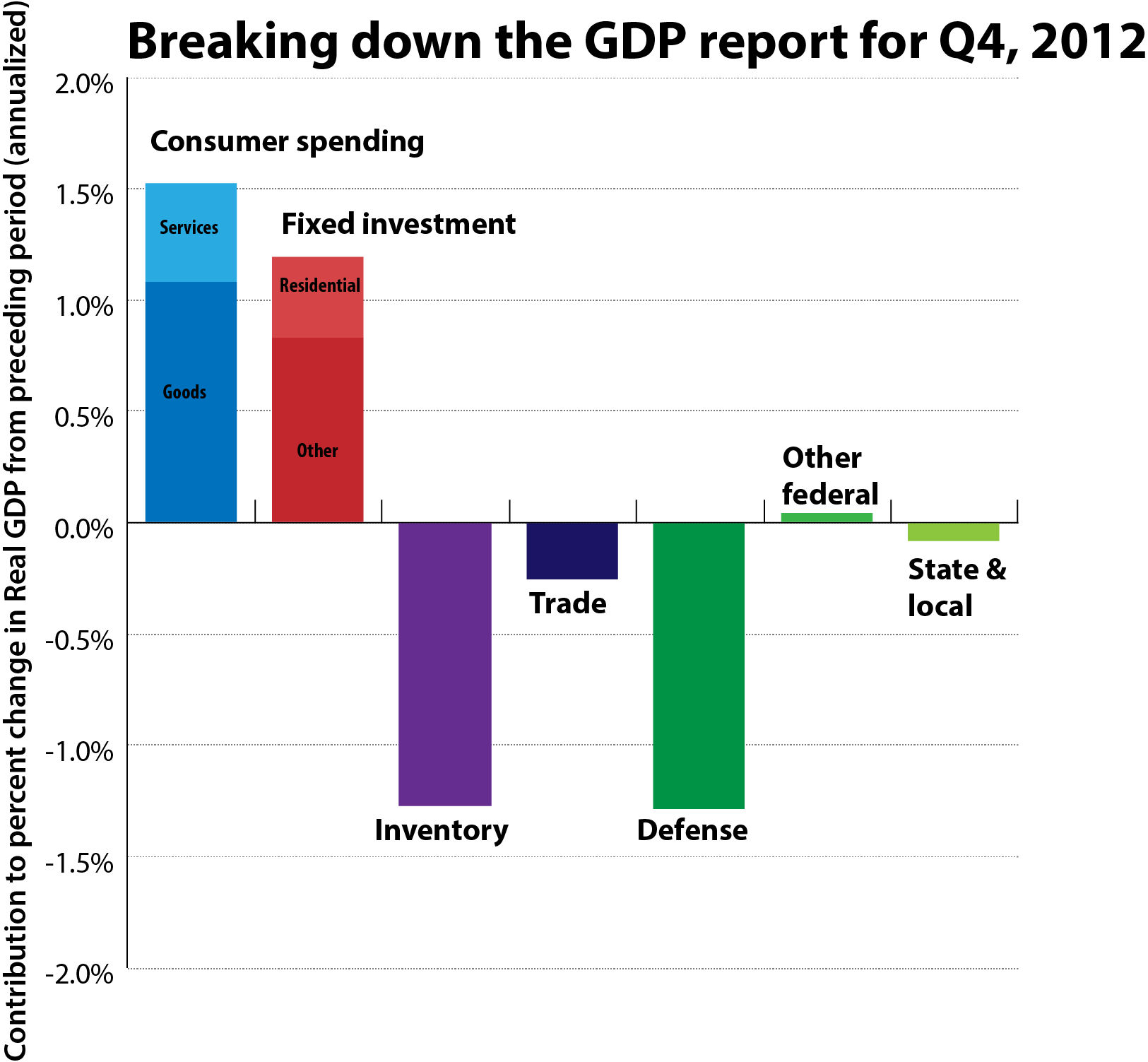
New GDP numbers were released last week. For the first time since the depths of the financial crisis in 2009, the economy actually shrank. And things were just starting to look pretty solid! What the heck happened? You know, I actually think the Gipper may have an answer here.
Yeah. Pretty much. Look deeper at the GDP numbers and it becomes clear that government really is the problem here. Consumer spending was up. Business spending on equipment was way up and housing investment was also way up. Sooo…. What gives?
Defense spending in particular was dramatically pared back in the last months of 2012. Businesses also depleted their inventories but that’s no big deal since consumer spending was up and they’ll have to restock at some point. The real story here is cuts in federal spending. This is what austerity looks like, my friends. At a time when our recovery is still on shaky legs, cuts in federal spending could easily send us right back into a recessionary tailspin. In fact, if federal spending had just remained even, we would have had over 1% growth. Not amazing but positive territory.
But you might say, this is probably a one-time deal right? After all, we had the whole fiscal cliff situation and they were probably preparing for the sequester cuts that were supposed to take effect in January.
That’s all true but it’s also not the whole story. Take a look at this chart. Since the beginning of 2009, the private sector has been in positive territory, consistently contributing to economic growth. Meanwhile the private sector has mostly been a drag with this final quarter being one of the most dramatic examples.
What’s more, we’ve just ended the payroll tax cut so middle-class folks will have less money in their pockets and may very well start spending less. We’ve also still got large sequester cuts on the horizon that could drive public spending down even further, and Republicans still seem to think it might be fun to use a government shutdown or debt ceiling crisis to force further cuts. You guys sure know how to show a girl a good time.
Look, there’s no question that over the long term, we’ve got to balance budgets and pay down our debts. But short term deficit hawkishness is hurting us badly. Our problem is not relief for storm victims or Federal money for family planning services, it’s a tax base that is too low to support rising health care costs and an aging population over the long term. Let’s deal with those problems over the long term. But for now, Congress, how about we just try to avoid shooting ourselves in the foot. I know blaming government for a lack of spending is not the type of blaming government that the GOP enjoys, but in lean times it’s the only type of blaming government we can afford. You know, what would really be great is some stimulus but I understand that’s probably too much to ask. For now, let’s just keep the government from reversing the private sector-led recovery that’s already underway.
By John Y. Brown III, on Mon Feb 4, 2013 at 12:00 PM ET
A kinder, gentler Breaking Bad?
I love this series but it can be over-the-top with fringe plot developments and crazy characters as the mild mannered former high school chemistry teacher, Walter White, becomes a successful meth dealer.
I was wondered the other night what it might look like if Breaking Bad had been written with a more mainstream and gentler, kinder theme. Maybe call it, “Veering incautiously” instead of the rogue sounding “Breaking Bad.” And instead of making Walter White an ever-hardening meth dealer, write a more mainstream method for handling his personal crisis. What if, for example, instead of cooking and selling meth, Walter instead became a celebrated shoe cobbler (selling custom made and hand crafted suede shoes that become very popular in some circles)?
Sure the series may have a different feel and tone, but would it also be more plausible? Would it widen potential audience appeal since more people can identify with shoe-makers than meth dealers?
Here’s a video clip giving us a peek of what this series might have looked like as Walter sells a pair of blue suede shoes to internationally known shoe fashion designer Tuco Salamanaca. (Just imagine shoes and not methamphetamine is being transacted in this scene.) Tuco is renown for his exacting taste and relentless drive for perfection in his shoe line. Despite being skeptical about Walter at first—and being obviously flustered that the shoes he tries on are too “tight” —Tuco is still won over by Walter’s attention to detail and skilled craftsmanship. In fact, so much so, Tuco buys them on the spot (even though they are an unusual “blue” shade) and suggests future purchases for his shoe line in pink and yellow.
But there is still the critical question, Would the series work as well with Walter as shoe cobbler —or is something lost.
Warning: Foul language even though we are pretending they are talking about shoe design.
But remember, the high end shoe market is a brutally competitive business. So this scene may not be too far off the mark. ; )
By Erica and Matt Chua, on Mon Feb 4, 2013 at 10:00 AM ET
How much does it cost to travel the world for a year? Between $26,821-36,534 for two people*. In 2012 we spent $26,821**. In 2011 we spent $36,534***.
As always, the devil is in the details, those asterisks that terrorize our lives…those evil symbols that advertisers have trained us to recognize as “it’s possible, but only for a hypothetical person that we’ve never actually met, who managed to work through our very convoluted systems that our programmers assured us wasn’t possible”. Our numbers though are real, it’s what we’ve actually spent, visiting countries as expensive as Japan and Australia, and as cheap as Vietnam and Sri Lanka. This is every dollar we’ve spent traveling hundreds of thousands of miles. The asterisks are because everyone travels differently, these differences are the details that determine how much it would actually cost you.
HOW WE TRAVEL
We travel to see the sights, meet the people, taste the foods and try new things. We keep a budget as a guide, not as a limiter. Our costs reflect the following decisions:
– The length of our trip has never been a goal, we aren’t trying to stretch our time abroad by staying places for extended periods or saving money.
– We travel overland whenever possible. Grueling at times, overland travel has given us the opportunity to see more of countries, savor the local foods and interact with locals the way they travel. How else would you experience this!?!
We met Amit by overland traveling in India. Later he showed us Israel, this “Amit” tour was one of our 2012 highlights.
– Hostels and Couchsurfing are home. We stay in dorms when private rooms cost substantially more. We only Couchsurf when we can connect with a host, not just to save money.
– We average a new city every four days. We set off with the goal of seeing whatever interested us in the world, having visited over 200 cities we learned that a lot of the world interested us. Moving costs money as shown by transportation (ground and air) being our largest area of spending.
– We didn’t visit Europe or North America. Our costs reflect a vast majority of time spent in the developing world, which is substantially cheaper than Europe, the USA or Canada. We set off with very few goals, but number one was to see the rapidly changing developing world, we have keep true to this mission.
These are the things that affect our spending, for everyone it is different. We’ve met people that are comfortable spending $20/day and people that couldn’t possibly be comfortable for less than $1000/day.
Read the rest of… Matt and Erica Chua: Cost to Travel the World
By John Y. Brown III, on Mon Feb 4, 2013 at 9:15 AM ET
From wardrobe malfunctions to Beyonce’s half-time show with more highlights than the first or second half, some are claiming the NFL is starting to use too much sex to sell football.
Starting?
Hmmm. I am old enough to recall this little Super Bowl commercial from the early 1970s.
It didn’t warp me or cause me to buy Noxema. Or to become a bigger Joe Namath fan.
It did to me becoming a Charlie’s Angels fan a few years later at age 13.
===
I have a confession to make.
You know how some people say that for many women going to the Kentucky Derby is all about the hats?
Well….I have a similar dirty little secret.
I watch the Super Bowl mostly for the commercials.
Then the football.
And then the hats.
===
My personal Super Bowl story.
It wasn’t way back when. Actually, it was year ago last January. The NFL had helped successfully pass anti-concussion legislation in over 30 states (mostly states with NFL teams) and now was going to the remaining states hoping to make a clean sweep on this important health issue for our student-athletes. Kentucky was selected because the timing seemed ripe.
Read the rest of… John Y. Brown, III: Super Bowl Wrap Up
KET’s February 4 Kentucky Tonight program with host Bill Goodman will discuss industrial hemp.
Scheduled guests are:
– Kentucky Agriculture Commissioner James Comer
– Kentucky State Police Commissioner Rodney Brewer
– Former Kentucky State Treasurer Jonathan Miller, founder of The Recovering Politician
– Dan Smoot, vice president of Operation UNITE
The program is live on KET and at www.ket.org/live at 8:00 pm ET.
Viewers with questions and comments may send e-mail to kytonight@ket.org or use the message form at www.ket.org/kytonight. Viewers may also submit questions and comments on Twitter @BillKET, #kytonight, or on KET’s Facebook page. All messages should include first and last name and town or county. The phone number for viewer calls during the program is 1-800-494-7605.
Kentucky Tonight programs are archived online, made available via podcast, and rebroadcast on KET, KET KY, and radio. Archived programs, information about podcasts, and broadcast schedules are available at www.ket.org/kytonight.
By Patrick Derocher, on Fri Feb 1, 2013 at 3:00 PM ET
Immigration seems to be doing some odd things to the conservative movement. Following this week’s reveal of a bipartisan reform outline in the Senate, public and press attention shifted quickly to Marco Rubio, the Florida Republican who is more than a little bit of a rock star in conservative circles. This plan represents the culmination of a major shift in Sen. Rubio’s position– when running for Senate just two years ago, he had dismissed the idea of granting much of anything in the way of citizenship or related rights to illegal immigrants. (Incidentally, while in the Florida House of Representatives, Rubio proposed a DREAM Act-esque plan that would have cut tuition for undocumented students.) Conservative media figures, among them Sean Hannity and Rush Limbaugh, responded positively, especially considered that the Senate plan involves a path to citizenship, which many on the right believe to be tantamount to amnesty (and we all know how Rush feels about that). So we can be forgiven for thinking that the conservative base may be falling in line with some form of comprehensive immigration.
Not so fast. After an interview with Rubio this past Tuesday (which was, by all accounts, a smashing success for the Senator), Rush felt compelled to post this clarification on his Web site (warning: full transcript ahead). Key quote: “nobody else has the guts to criticize Obama, and that’s what I was praising him for. I was not signaling that he converted me to amnesty.” And there’s the problem. For many on the right, including a large number of primary voters, anything approaching amnesty is heretical, as evidenced by major backlash in 2006-7 and continued unease with comprehensive reform. This, of course, runs right into the strong, almost fervent support Rubio has built up in conservative circles in recent years. It’s a tricky balancing act for the conservatives and the Republican Party, and no matter how it plays out, things will get interesting.
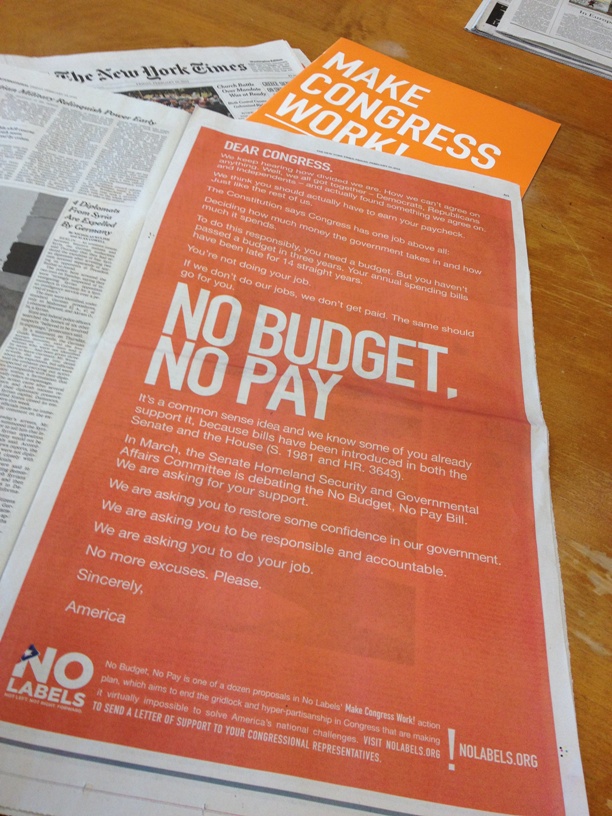
Yesterday, the United States Senate passed No Budget, No Pay in addition to a three-month extension of the debt ceiling.
“For more than a year and a half, I’ve fought for ‘No Budget, No Pay,’ as a common-sense approach to hold Members of Congress accountable for passing a budget. Despite the odds, this idea has gained strong bipartisan support in Congress. Thank you to Representative Jim Cooper for spearheading this effort in the House, and to No Labels supporters from all over the country who wrote to their Members of Congress in support of this idea. With their help, No Budget, No Pay gained the momentum necessary to pass both chambers,” said Senator Dean Heller (R-NV).
The original No Budget, No Pay bills were introduced by Senator Heller and Representative Jim Cooper (D-TN). With support from No Labels’ hundreds of thousands of supporters, No Budget, No Pay garnered more than 90 co-sponsors and a hearing in the Senate in the 112th Congress. Details of today’s Senate-passed version of No Budget, No Pay differ slightly from No Labels’ original proposal, but the underlying idea is the same: members of Congress shouldn’t be paid if they can’t pass a budget on time.
“No Budget, No Pay is a great example of the achievable and immediate reform that No Labels has been pushing since its inception,” said No Labels National Leader and Honorary Co-Chair Jon Huntsman. “Like the filibuster reform that just passed the Senate, No Budget, No Pay can help our government work better right now. Our country’s problems are urgent and we simply don’t have time to wait.”
“The passage of No Budget, No Pay by both chambers is unprecedented. Americans want Congress to be held accountable, and due to the fact that Senate leaders have indicated that they will pass a budget this year, it is clear that No Budget, No Pay has already had a behavioral effect. The No Labels grassroots supporters made this happen,” said No Labels co-founder and Brookings Institution Senior Fellow in Governance Studies,Bill Galston.


 Blog this!