Please sign the petition below to remove the statue of Jefferson Davis currently in Kentucky’s Capitol Rotunda, and replace it with a tribute to Muhammad Ali, “the Louisville Lip” and “the Greatest of All Time.”
I just heard from the Ali family: It is the Champ’s belief that Islam prohibits three-dimensional representations of living Muslims. Accordingly, I have adjusted the petition to call for a two-dimensional representation of Ali (a portrait, picture or mural) in lieu of a statue.
UPDATE (Tuesday, December 2, 2014)
In this interview with WHAS-TV’s Joe Arnold, Governor Steve Beshear endorses the idea of honoring Muhammad Ali in the State Capitol (although he disagrees with removing Davis). Arnold explores the idea further on his weekly show, “The Powers that Be.”
Click here to check out WDRB-TV’s Lawrence Smith’s coverage of the story.
And here’s my op-ed in Ali’s hometown paper, the Louisville Courier-Journal.
UPDATE (Saturday, June 4, 2016)
In the wake of the 2015 Charlestown tragedy, in which a Confederate flag-waving murderer united the nation against racism, all of the most powerful Kentucky policymakers — U.S. Senator Mitch McConnell, Governor Matt Bevin, Senate President Robert Stivers and House Speaker Greg Stumbo — called for the removal of the Davis statue from the Rotunda. Today, as we commemorate last night’s passing of Muhammad Ali, there is no better moment to replace the symbol of Kentucky’s worst era with a tribute to The Greatest of All Time.
UPDATE (Wednesday, June 8, 2016):
Great piece by Lawrence Smith of WDRB-TV in Louisville on the petition drive to replace Jefferson Davis’ statue in the Capitol Rotunda with a tribute to Muhammad Ali.
UPDATE (Thursday, June 9, 2016):
Excellent piece on the petition drive by Jack Brammer that was featured on the front page of the Lexington Herald-Leader.
Highlight of the article:
Miller said he has received a few “angry comments” on his call to honor Ali.
“One of them encouraged me to kill myself,” he said. “You can quote me that I have decided not to take their advice.”
UPDATE (Friday, June 10, 2016)
The petition drives continues to show the Big Mo(hammed): check out these stories from WKYU-FM public radio in Bowling Green and WKYT-TV, Channel 27 in Lexington:
UPDATE (Saturday, June 11, 2016):
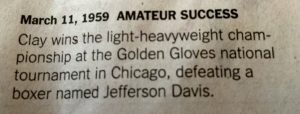
Still not convinced? Check out this excerpt from today’s New York Times:
By John Y. Brown III, on Mon Feb 25, 2013 at 12:00 PM ET
Getting an unpleasant message about yourself….
I heard some awfully wise advice at Sunday School last Sunday.
Our teacher said “Sarcasm is a sign of intelligence……without wisdom!”
His wife added the second part, and I think those are words to live by. So I try to be cautious and watch for sarcasm and crankiness and cut them off before they spread to the tip of my tongue.
But I am usually a little late to the scene. We need others to let us know when we are veering off course and have a tendency to dismiss unflattering feedback about ourselves. It seems to work itself out in ever escalating stages.
For example: When your family tells you that you are being grouchy and sarcastic, you can chew on it and disregard (several consecutive times) without consequence.
When a friend tells you that you are being grouchy and sarcastic, it gives you pause and reminds you to be more cheerful around them next time (or avoid them altogether for a while).
But when a person who is more of an acquaintance (hence objective observer) tells you that you are being grouchy and sarcastic…… Well, put it this way, it’s kind of like when you were a child and your parents told you that you needed to take a bath, but you didn’t. Then a friend suggested a bath, and you ignored them. But when someone who you barely knew suggested it was time “That boy took a bath,” well, you figured it was getting pretty close to the time to take a bath.
Or in this case, to stop being a sarcastic grouch and soften up a bit….at least until you are, as I heard someone once say, “Sweeter than a bumblebees behind.”
Or thereabouts, give or take. ; ) At a minimum, sarcasm is to the soul what poor hygiene is to the body.
And if bystanders notice, it’s time for me some lye soap. For the soul. ; )
By Erica and Matt Chua, on Mon Feb 25, 2013 at 10:00 AM ET
Sailing the Nile for three days sounds wonderful, doesn’t it? Sailboats conjure up feelings of freedom, relaxation and, let’s be honest, opulence. How often do you associate sailing with anything less than the high-life? My last multi-day sailing experience, yachting around the Galapagos, was exactly what sailing fantasies are made of. Sailing on a felucca for three days up the Nile though was not.
The idea of sailing from Aswan to Luxor as the ancient Egyptians did is romantic. Wanting to see the Nile, relax and enjoy a little more of Egypt’s scenery we signed up for the two night, three-day tour. Originally we had planned to do the five-day cruise, but people had told us that two nights was plenty, actually they told us one night was probably enough. Even with this advice we decided to spend a little extra time, hoping to see more of the Nile, little did we know that extra time didn’t equate to extra distance.
Getting on the boat around 1 PM we lazily drifted a couple hundred meters to what we presume was a police checkpoint. Waiting there for a few minutes, we were excited when the captain returned to start our voyage. After drifting downstream for another 20 minutes we stopped at a beach to “swim”. Only LOCAVORista took the opportunity to dive into the Nile while our two German shipmates and I read on the boat. After LOCAVORista finished her swim the captain continued playing in the water for another hour or so. When he finally returned we were excited to really get moving, maybe actually sail.
Read the rest of… Erica and Matt Chua: Sailing the Nile — Dream or Dull?
By John Y. Brown III, on Mon Feb 25, 2013 at 9:15 AM ET
The fall that launched a thousand applauses.
Jennifer Lawrence’s fall will become an Oscar trivia question and a perfectly defining moment for one of our greatest actresses.
What makes Jennifer Lawrence so appealing is her accessibility. What makes her so compelling is her naturalness. And what makes her acting so convincing is her authenticity.
No actress I can think of could fall as they ascend the steps to receive their Oscar without being embarrassed and lightly ridiculed. Because of the vanity quotient Hollywood demands.
But tonight we saw an exception. A lady who falls graciously and gracefully “up hill” –again. She fell….as we would fall (we relate) and she gets up for us naturally, authentically, and accessibly– and wasn’t acting at all. And brings this same transparency, energy and charisma to her acting roles.
Tomorrow I can even imagine a few young female fans practicing falling upstairs with the charming aplomb of their heroine.
The acting talent Jennifer Lawrence has isn’t something uniquely special or even uniquely extraordinary. It is, in my view, rather uniquely ordinary–and uniquely refreshing. It’s a realness and substantive lightness that is unaffected and vanity-free.
Here’s wishing her well and hoping she never loses the great gift that allows her to fall uphill. And that she keep doing so.
By Jonathan Miller, on Sat Feb 23, 2013 at 7:36 PM ET
Oh, no. First the Chinese. Now the Mexicans are attacking me. As you can see in the screenshot, UPI Espanol is calling me y “el ex director del partido, Jonathan Miller” which I am pretty sure is Spanish for a “former dictator who throws bad parties.”
By Patrick Derocher, on Fri Feb 22, 2013 at 3:00 PM ET
Wilbur has taken flight. Not only to both the U.S. Chamber of Commerce and AFL-CIO support some manner of comprehensive immigration reform, but they have found at least a modicum of common ground on the matter, releasing a statement of principles yesterday afternoon.
This is a good thing—if organizations as ideologically divergent as the Chamber and AFL-CIO can agree on significant reforms of the American immigration system, maybe Congress can do the same. Their statement rests on three basic principles: American workers should have the first opportunity to fill American jobs, businesses that cannot fill all positions with American workers should be able to hire foreign-born workers through a streamlined process, and we need an accurate and transparent system to identify and address labor shortages to enable hiring foreign workers when it is needed. To fulfill these requirements, the Chamber and AFL-CIO suggest creating federal agency that would track the status and needs of the American labor market.
Apart from the incongruity of the U.S. Chamber of Commerce calling for another organ of the federal government, there are some flaws with this plan. To be sure, the underlying goals of these principles, to protect both American- and foreign-born workers and optimize the labor market for them and their employers, are laudable. As, of course, is these organizations’ willingness to cross ideological boundaries and work together. From an economic and regulatory perspective, however, there are some problems.
In their statement, the Chamber and AFL-CIO call for a guest worker program, designed to respond to the needs of the labor market. In theory, this is a great idea—when they can, American business will hire American-born workers, and when they cannot, they will be able to hire foreign-born workers with a minimum of bureaucratic involvement. Therein lies the catch: the fact is, it is nearly impossible for a federal, top-down program to ascertain, let alone keep up with, the visa needs of a complicated labor market.
This sort of program has been tried before, most notably with the Bracero Program. A sort of predecessor to contemporary H-2A visas, the Bracero Program was a joint effort with the Mexican government between the 1940’s and 1960’s that brought agricultural and railroad workers into the United States to work for a set period of time before heading back to their homes (although a number stayed and received green cards). Even then, when the population of the United States was around half of its current level, federal regulations couldn’t keep up with demand levels in the labor market, and illegal immigration continued. Illegal immigration, as it turns out, almost perfectly meets labor market demands, and is really a complement to legal immigration under the current system. (This idea has been gaining currency and is not a new one.)
So, what of it? Just because a guest worker program as has been proposed is too cumbersome for a long-term solution does not mean we should abandon the notion altogether—allowing illegal immigration to continue as it does only contributes to degraded working conditions of both American- and foreign-born workers. This country can find a solution, and I will start exploring some of the specifics and (humbly) proposing some of my own ideas in the coming weeks.
By Garrett Renfro, RP Staff, on Fri Feb 22, 2013 at 1:30 PM ET
The Politics of Sequestration
Americans are bracing themselves for the impact of impending government spending cuts, also known as the sequester. The $85 Billion cuts are set to begin on March 1, barring congressional action to avert them. According to Linda Feldman in an article for The Christian Science Monitor, the old saying about fearing what you don’t understand is rather poignant. The article cites a poll which found that only 36 percent of voters actually know what the sequester is, another 38 percent said they knew but then picked the wrong answer. Though disappointing, this lack of clarity is understandable. Since this whole fiasco began we have seen a concerted effort on the part of power players in Washington to shift blame. Perhaps one of the more well-known if not effective strategies has been the roll-out of the phonetically awkward phrase “Obamaquester.” Feldman attempts to explain the origins of the sequester plan (The 2011 Budget Control Act) as well as determine which side of the aisle is to blame, spoiler alert… both sides. [CSM]
The “Average Joes” out there aren’t alone in their confusion. Conservative political commentator Byron York questions whether or not the GOP leadership can formulate a coherent stance on the sequester. York is admittedly perplexed by the Speaker of the House’s insistence that the sequester represents a threat to our national security but still seems to, at least tacitly, support them. [WE]
Though uniformed personnel are not subject to unpaid leave, the Defense Department officially notified 800,000 civilian employees of likely furloughs beginning March 1. The Pentagon is facing $46 Billion in budget cuts resulting from the sequester. With no solution in sight, Defense Secretary Leon Panetta was compelled by law to warn Congress of possible furloughs. [WP]
By John Y. Brown III, on Fri Feb 22, 2013 at 12:00 PM ET
Deep question. Even deeper than a Fortune Cookie fortune. Maybe.
If you were at a Chinese restaurant and your Fortune Cookie didn’t have a slip of paper in it revealing your “fortune,” would you complain to the manager and ask for a new cookie that has an actual “fortune” inside it?
Or say nothing and enjoy the cookie realizing your future probably has little to do with what’s inside a Fortune Cookie, and hence not feel cheated?
Or some other option….like refuse to eat the cookie while Googling on your iPhone about the meaning of receiving a barren Fortune Cookie?
I have a feeling your answer will say a lot about you in some weird “psychology test” way. I have nothing to back me up except a gut feeling.
And mild depression for being cheated out of my fortune with my last Fortune Cookie and a sense of defeatism for not saying anything about it–and worry that the cookie was trying to tell me something important about an impending terrible event that I am ignoring at my peril.
I don’t even want to know my real Fortune Cookie fortune now! ; )



 Blog this!