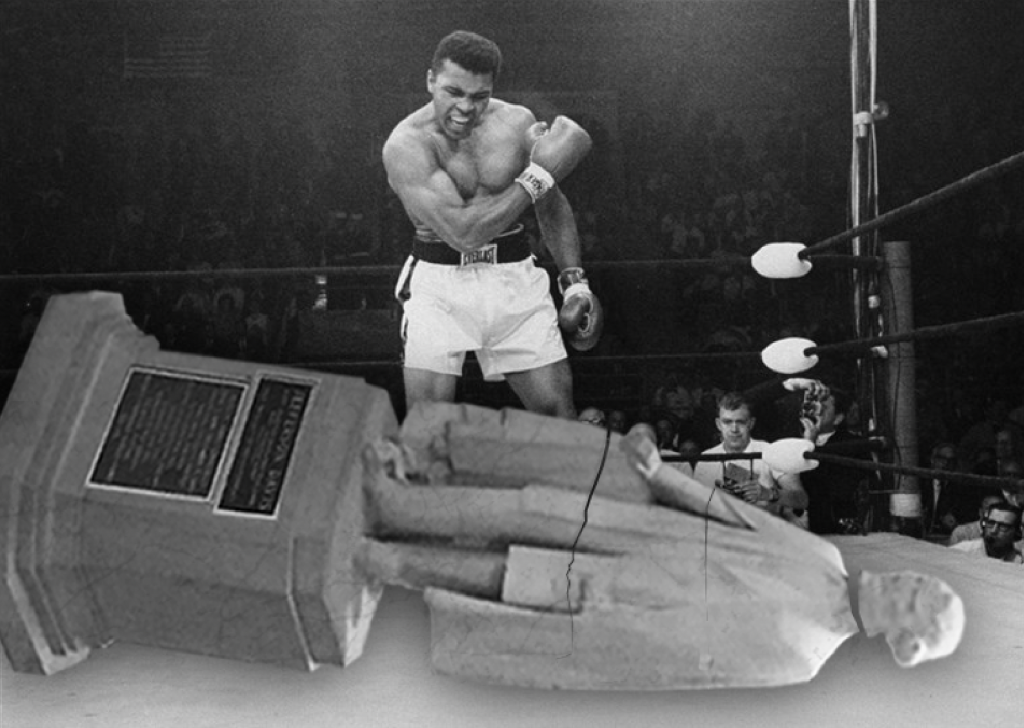
Please sign the petition below to remove the statue of Jefferson Davis currently in Kentucky’s Capitol Rotunda, and replace it with a tribute to Muhammad Ali, “the Louisville Lip” and “the Greatest of All Time.”
I just heard from the Ali family: It is the Champ’s belief that Islam prohibits three-dimensional representations of living Muslims. Accordingly, I have adjusted the petition to call for a two-dimensional representation of Ali (a portrait, picture or mural) in lieu of a statue.
UPDATE (Tuesday, December 2, 2014)
In this interview with WHAS-TV’s Joe Arnold, Governor Steve Beshear endorses the idea of honoring Muhammad Ali in the State Capitol (although he disagrees with removing Davis). Arnold explores the idea further on his weekly show, “The Powers that Be.”
Click here to check out WDRB-TV’s Lawrence Smith’s coverage of the story.
And here’s my op-ed in Ali’s hometown paper, the Louisville Courier-Journal.
UPDATE (Saturday, June 4, 2016)
In the wake of the 2015 Charlestown tragedy, in which a Confederate flag-waving murderer united the nation against racism, all of the most powerful Kentucky policymakers — U.S. Senator Mitch McConnell, Governor Matt Bevin, Senate President Robert Stivers and House Speaker Greg Stumbo — called for the removal of the Davis statue from the Rotunda. Today, as we commemorate last night’s passing of Muhammad Ali, there is no better moment to replace the symbol of Kentucky’s worst era with a tribute to The Greatest of All Time.
UPDATE (Wednesday, June 8, 2016):
Great piece by Lawrence Smith of WDRB-TV in Louisville on the petition drive to replace Jefferson Davis’ statue in the Capitol Rotunda with a tribute to Muhammad Ali.
UPDATE (Thursday, June 9, 2016):
Excellent piece on the petition drive by Jack Brammer that was featured on the front page of the Lexington Herald-Leader.
Highlight of the article:
Miller said he has received a few “angry comments” on his call to honor Ali.
“One of them encouraged me to kill myself,” he said. “You can quote me that I have decided not to take their advice.”
UPDATE (Friday, June 10, 2016)
The petition drives continues to show the Big Mo(hammed): check out these stories from WKYU-FM public radio in Bowling Green and WKYT-TV, Channel 27 in Lexington:
UPDATE (Saturday, June 11, 2016):
Still not convinced? Check out this excerpt from today’s New York Times:
By Jonathan Miller, on Wed Apr 24, 2013 at 8:30 AM ET
For what may be the first time ever, lawmakers from both sides of the aisle are sitting down together for a video town hall with No Labels.
I’m honored to moderate a conversation with Reps. Ami Bera, David Cicilline, Rodney Davis and Adam Kinzinger in a Google+ Hangout as they discuss how they’re working together in the No Labels Problem Solvers group. This video discussion is the only place where you can hear the facts on what is happening in Washington, not just the party talking points.
Will you join us TODAY at 5 p.m., eastern time, to watch the Problem Solvers talk No Labels?
These lawmakers are just four of the 61 Problem Solvers in Congress — but they can give you an inside look at what goes on in these meetings. This has never happened before — you won’t want to miss it. And they’d love to hear from you.
By Lauren Mayer, on Tue Apr 23, 2013 at 3:00 PM ET
Sure, California has lots of advantages – fabulous weather, beautiful scenery, and being on the cutting edge of everything from computer innovation to right-turn-on-red. But there are plenty of drawbacks, besides the obvious (cost-of-living and housing prices are insane, New Yorkers like my father-in-law refer to our home as ‘the land of fruits and nuts’). And one of the biggest problems here is political.
Granted, I’m grateful to live in a state where my kids aren’t taught creationism in science class, or where I don’t worry that a personhood amendment is going to make my birth control pills illegal. But when lunacy happens on the federal level, there’s often not much I can do. For example, many people were horrified by last week’s Senate vote, blocking watered-down background checks on gun purchases (that were supported by 80-90% of all voters – one of the rare occasions where WTF? is a totally appropriate reaction). All the left-leaning organizations tell us we’re supposed to contact our senators and representatives and give them hell. But what do I do when my legislators are all very liberal women? I mean, am I supposed to call Dianne Feinstein and complain that the assault weapons ban, which SHE sponsored, hasn’t gotten further? That’s like the old borscht belt joke about the Jewish mother at a Catskills resort, complaining that the food was “just awful, I couldn’t eat a bite, and besides, the portions were so small!”
And while I am grateful to California innovators for all the advances in computers and internet connectivity, now I can’t pretend to be from another state. I get emails saying “Let Senator so-and-so know you’re angry about the background checks vote” and when I call the number, something in the system figures out what my zip code is and redirects me to Barbara Boxer’s office voicemail. I mean, technology is great, but that feels a little creepy to me, especially when I was getting really good at imitating a southern accent.
So to all my friends in red states who envy us in more liberal parts of the country, at least you can make some noise, and possibly some difference, by contacting your legislators. And trust me, I know your pain, I grew up in Orange County, which I like to think of as the red state in the middle of California. I was one of two students in my entire high school trying to drum up support for McGovern . . . . . and before you whip out your calculators, yes, I’m old, but not THAT old, it was my freshman year and I was only 13 and I can’t lie about my age because my teenage sons are good at math and lousy at keeping secrets . . . . oh never mind, here’s a song about being blue in a blue state:
By Nick Paleologos, on Tue Apr 23, 2013 at 1:30 PM ET
Last week, the US Senate voted 54-46 to strengthen gun safety laws in America. It failed.
That’s right. 54%–a solid majority of the US Senate–voted in favor of universal background checks, and the bill still lost. Because the filibuster rule requires a 60% vote for anything to pass.
Which made me think about Elizabeth Warren.
You will recall that Ms. Warren carried her reform message together with everybody’s highest hopes into the halls of congress. Shortly after her election–I received an email from her. This is what she said:
“You know what I want to do. You know what I care about. But here’s the honest truth: Any senator can make a phone call to register an objection to a bill, then business comes to a screeching halt. On the first day of the new session in January, the Senate will have a unique opportunity to change the filibuster rule with a simple majority vote. I’ve joined Senator Jeff Merkle and four other senators to fight for this reform on day one. No more bringing the work of this country to a dead stop.”
The only problem is that on the first day of the session she fought for nothing of the sort.
Neither did Jeff Merkle, nor any other senator—Democrat or Republican. And by fight, I mean rise to their feet on the floor of the Senate and use the filibuster to change the filibuster. Bring that shameful institution to a screeching halt on behalf of majority rule.
Stop everything. Force a national conversation on why—in the “world’s greatest deliberative body”–a simple majority isn’t enough.
Why–after 20 kids got their heads blown off—doesn’t 54% of Senators voting in favor of gun safety legislation advance that bill to the next step? I’d like Ms. Warren, and Mr. Reid, and the Democratic majority in the United States Senate to explain to the parents of those twenty dead six year olds, why protecting the filibuster is so much more important than protecting our children?
Read the rest of… Nick Paleologos: Filibuster the Filibuster
By John Y. Brown III, on Tue Apr 23, 2013 at 12:00 PM ET
The other day I was interviewed about who I thought run in the 2015 Governor’s race. Here is an answer I fleshed out that didn’t get quoted but I re-read it and liked.
“As fun as it is to speculate about who will run for governor in 2015 and who will be the strongest candidates, it is more art than science and more about personal timing than politcal timing. At bottom, running for governor is an irrational decision. One morning you wake up and decide to run because you can’t not run. It is a leap of faith. One of the boldest leaps of faith a mortal can ever take who is also politically inclined. And especially in Kentucky. Where it is two parts political and one part horse race.
And the gambling metaphor is fitting. Running for governor is like walking up to a casino craps table and grabbing the dice. But before you throw the die, striping off all your clothes and crawling onto the table. And betting everything on yourself –physical, mental and emotional–on a single roll. Not because it is a wise or prudent thing to do. And not because you have nothing to lose or something to gain. It is deeper than that. There is something in the gubernatorial candidate’s DNA code that makes him or her feel they are betraying their genetic make-up if they don’t run. They run not because they worry of what others will say in their presence if they don’t run —but rather worry what they will whisper to themselves when no one else is around.
It is, in these candidate types, as if they were born with invisible wings. And like any animal blessed with wings, there will come a day when it is time to try to fly.
And that day, so to speak, is more about instinct and impulse that intellect and preparation. The day a gubernatorial candidate files to run for office is, in a very real sense, the day that particular political animal believes is the day he or she is finally ready to fly.
By Jonathan Miller, on Tue Apr 23, 2013 at 11:00 AM ET
For what may be the first time ever, lawmakers from both sides of the aisle are sitting down together for a video town hall with No Labels.
I’m honored to moderate a conversation with Reps. Ami Bera, David Cicilline, Rodney Davis and Adam Kinzinger in a Google+ Hangout as they discuss how they’re working together in the No Labels Problem Solvers group. This video discussion is the only place where you can hear the facts on what is happening in Washington, not just the party talking points.
Will you join us on Wednesday at 5 p.m., eastern time, to watch the Problem Solvers talk No Labels?
These lawmakers are just four of the 61 Problem Solvers in Congress — but they can give you an inside look at what goes on in these meetings. This has never happened before — you won’t want to miss it. And they’d love to hear from you.
By Artur Davis, on Tue Apr 23, 2013 at 10:00 AM ET
Give the New Republic’s Adam Winkler credit for laying some of the blame for the collapse of background checks on gun sales not just on NRA sophistry but on a poorly executed, badly timed, overly polarizing campaign by the Obama Administration. As Winkler points out, the over-reach of going after an assault weapon ban boomeranged badly, serving only to galvanize opposition and define even incremental regulations as a wedge to confiscate guns. And the virtues of a go-for-broke strategy, whatever they were, never compensated for the fact that no assault weapons ban had even a remote chance of passing the House.
I would add an additional point that goes much deeper than tactics and the debate over guns. To a degree that could not have been anticipated, and seems doubly odd for a reelected president, Barack Obama smothers his own initiatives. He has the capacity to lend eloquence to his own followers’ views, but no demonstrated ability to organize them behind any cause other than putting him in office. He moves literally no sector of the electorate that didn’t vote for him. His intervention in a legislative fight seems good primarily for preserving gridlock. Obama wins elections but through pathways that close quickly and elevate few specific policy aims: in 2008, a backlash against George Bush’s unpopularity and an airy promise of a post-racial society, and in 2012, a relentlessly negative siege against Mitt Romney. And the country that has elected Obama twice is still split to the core, more so today than when he was a senator signing book contracts. And the deepest splits are more around the country’s perception of Obama than around any singular issue.
None of this means, of course, that there are not a variety of other elements that contribute to the hyper-polarization of the past four years, from the internet’s inevitable pipeline for misinformation, to the continued weight of interest groups like the NRA, to a cable culture that dismisses any efforts by politicians to craft a middle ground as expediency. But it would take an element of willful denial to ignore the fact that Obama occupies the single most divisive space in American politics since Nixon, and that one of the costs is a presidency that is frustratingly weak at persuasion.
It is not too early to wonder if Obama a generation from now looks weirdly like, of all people, Margaret Thatcher: a highly effective campaigner whose victories spun off the unintended consequence of an entrenched cultural opposition, and whose “conviction politics” seem like a relic. Twenty plus years after Thatcherism formally ended, it has been supplanted by a run of center-leaning British prime ministers with a penchant for downplaying sharp ideological rifts. It is not hard to imagine that Obama’s successors won’t be similarly preoccupied with navigating away from the intense divisions of the Obama era.
Read the rest of… Artur Davis: Obama the Polarizer
By Nancy Slotnick, on Tue Apr 23, 2013 at 8:30 AM ET
It happens when you least expect it. That’s what they say anyway. But I was always expecting it. And it still happened for me. It didn’t happen how I expected it. I met my husband on the street. When I was single, I had opened a dating Café with the idea in mind that necessity is the mother of invention. I had imagined that the right guy would just walk through the doors one day. But it wasn’t happening. So I set out to look outside my Café and take matters into my own hands. I met my husband within 2 weeks of that. (you can read the whole story here)
But my story is not typical, I know. Many people swear by the “least expect it” story. Here’s one example from this week’s post on the Matchmaker Café fan page:
@Britta Alexander: It was for me! I finally gave up on finding the one, moved into a loft in Brooklyn, practiced my violin day and night, and my future husband was listening to me through the walls. Turns out he was the roommate on the other half of the shared loft. So there’s a strategy: just move around and live with complete strangers!
So I tried to analyze the common denominator of these seemingly contradictory philosophies and here’s what I conclude. It depends how you expect it. If you have too much negative attention on it (i.e. why isn’t happening?!? I have such bad luck with dating!! L) then it can’t happen. If you feel entitled to meeting someone but are not doing the work on yourself, it can’t happen. If you are so busy working that your Cablight is not on, (like I was) then it can’t happen.
On the other hand, if you are open and willing to make yourself vulnerable without putting expectations on how or when, then the universe will work hard to send it to you. If you become grounded in who you are and move towards the life that you want to have with a partner, it will happen faster. If you are really ready, you will just walk out your door and the One will be there. If you read Britta’s story carefully, you can see that she was willing to move somewhere new and live with complete strangers! That takes courage and confidence. And by practicing violin she was developing her core sense of herself. She was not shy about the world hearing her. And that is very powerful.
Read the rest of… Nancy Slotnick: When You Least Expect It


 Blog this!