|
|||
|
The RP is back at it — talking with Michael Kastneron his Wall Street Journal radio program, “The Daily Wrap.”
If you ask some on the right (as well as more than a few depressed Democrats), Obama is toast. The data to support their case are straightforward: no president (since the advent of modern survey research) has beenreelected with an approval rating below 48 percent. Obama’s numbers these days are below that threshold and are just south of Jimmy Carter’s at this point in his presidency. Furthermore, the highest unemployment rate that accompanied a president’s reelection is 7.2 percent, a far cry from today’s 9 percent. Republican voters are more excited. Young voters aren’t going to show upwhen their unemployment rate is through the roof. Not to mention, the new electoral college map handsRepublicans six freebie electors if they simply hold the states McCain won in 2008. Simple conclusion: the Obama reelection effort is doomed. Or is it?
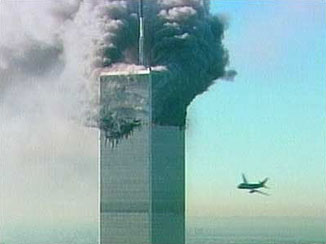
So which is it? Count me somewhere in the middle. Read the rest of… In those days before kids, I was fast asleep when the phone by my bed rang at about half past six in the morning. It was my father calling. Planes had flown into the World Trade Center. America was being attacked. I knocked on the door of my guest bedroom to awaken a visiting friend. Together, thousands of miles from New York and Washington, we experienced the day—the fall of one tower and then the other, the attack on the Pentagon, the confusion, the rumors, the terror—the way most Americans did: watching television in stunned silence. It’s not just that we all still remember where we were when we heard; it’s that at that very moment we knew we would always remember. But even as it was already clear on September 11, 2001 that the attacks were a turning point in American history, no one could have foreseen the direction of that pivot. The terrorists struck an ascendant America that had seen a period of unprecedented peace and prosperity. While so much was destroyed that day, our confidence was unshaken. Most Americans anticipated a long war in Afghanistan with many casualties, but were certain of victory. In the days after 9/11, according to a poll conducted by Harris Interactive, two-thirds of Americans said they had prayed and a similar number admitted to having wept. Eighty percent told someone they loved them as a result of the attack, and 60 percent kept in closer touch with relatives. Seventy percent had sung “God Bless America” and 63 percent sang the national anthem. But by September 27, 2001, 60 percent of Americans believed life had returned to normal. Looking back after ten years, we were clearly wrong. September 11 ushered in a sorry, sad, low decade. Ten years later, we are a nation that has been humbled abroad and felled at home. In a Time poll conducted this summer, only 6 percent of Americans now believe the country has fully recovered from the attacks. It is more than the tragedies of Iraq or the sorrows of economic stagnation that have beset America in the ten years since 2001. It is the widespread sense that we are no longer the young, brave nation that brushes off adversity and charges forward—the America that went from Sputnik to Apollo in 11 years and from “malaise” to “Morning in America” in five. It is the belief that we are a slower, older country—an America stuck in its ways, no longer able to tackle big challenges and make big changes. More than a hundred years ago, the transition into the Industrial Age saw the rise of the Progressives and a new approach to public action. But now America moves into an individualized economy while politicians still repeat the familiar arguments of a bygone era. The Great Depression brought about the New Deal and a transformation of government while the Great Recession has produced little more than tinkers to an ossified system. In the wake of Pearl Harbor, America mobilized its manpower and machinery to win a global war against fascism. We invaded North Africa and Normandy. Four years after the attack, Hitler lay dead and Tojo was in chains. The occupations and transitions to democracy of Germany and Japan began and would succeed. Ten years after 9/11, the case for victory is far more muddled—at best. In a nondescript house on a leafy street in a medium-sized city in Pakistan, Osama bin Laden—surrounded by porn and Pepsis—met his long overdue end on May 1. With the news, cheering crowds poured into Times Square and gathered in front of the White House. It had the feeling of a victory celebration, a national relief after a decade of frustration. But, in many ways, it was the Arab Spring—as much as a Navy SEAL’s bullet—that closed the chapter on bin Laden. And it is the impulse that led to that Arab Spring—for all its contradictions and uncertainty—that provides the best hope for a regeneration of an optimistic, forward-looking American spirit at home and around the world. Read the rest of… As loyal members of the RP Nation already know, the RP recently returned from a life-changing trip to Israel. Last week, he filed reports on Bibi Netanyahu, Why Israel Traded 1000 Prisoners for Gilad Shalit, Fun Facts from an Extraordinary Tour Guide, and Walking in Jesus’ Footsteps. (Click on the preceding topics to access the links). Today, The Huffington Post has published the RP’s most comprehensive and thought-provoking post yet: The Liberal Case for Israel. (And controversial — within the past hour, more than 150 people have commented — Join in on the fun!) In it, the RP introduces his readers to the 21st century Israel — one that is much-under-publicized — a country with a vibrant, open, tolerant, and yes, progressive culture. Israel’s record for promoting liberal values — on gay rights, economic equality, race, and immigration — matches or passes most Western democracies, including the U.S, and far, far exceeds its intolerant and illiberal neighbors. Here’s an excerpt:
Click here to read the RP’s full Huffington Post column, “The Liberal Case for Israel”
The RP was back at it yesterday afternoon on national television, discussing political dysfunction and promoting the work of the national movement he co-founded to promote bipartisan dialogue and action: No Labels. This time, he was joined on a CNN live broadcast by fellow contributing RP and fellow No Labels co-founder, Lisa Borders. TV critics unanimously declared that Lisa whupped up on the RP, even though they took the same side of the debate. Watch it for yourself and let us know what you think. And if you like what you hear about No Labels’ plans to “Make Congress Work,” click here to join No Labels:
In my first semester as a college freshman, I attended a campus event at which student organizations could promote themselves and happened upon the table for the UK College Democrats. Intrigued, I got to talking to several of their members and agreed to attend their first meeting, which, like any well-planned first semester meeting featured free pizza and soda. I became a regular at these meetings over the coming weeks and when a position opened up at the end of the semester for the chapter treasurer, I was nominated and unanimously elected to the position. I served as the treasurer for some three months before our president announced she would not be running. All heads in the room turned to me and I was once again nominated and unanimously elected president of the chapter, the youngest such president in chapter history. While I was president of the UK chapter, we volunteered for John Yarmuth’s winning 2006 congressional campaign as well as for the campaign of Ken Lucas in northern Kentucky’s 4th district. It was while working on the latter campaign that I first met a man who would come to play a pivotal role in my development as a professional political staffer. Read the rest of…
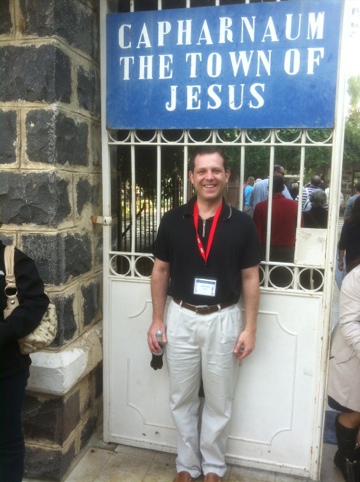
Today is dedicated to all of my Christian readers, except those of the Laettner variety. Israel is my Jewish homeland, but is very much the Holy Land for Christians as well — for a variety of reasons; but most significantly, as the place where Jesus spent his entire life. Accordingly, I want to share some pictures and stories from my ventures this morning along the Sea of Galilee, where Rabbi Jesus of Nazereth shared his profoundly influential message during the last few years of his life.
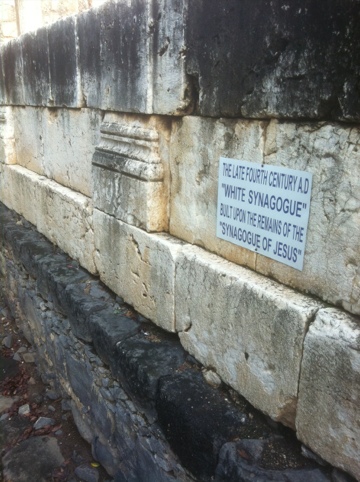
We began at Capernaum, home of Simon (Peter) and a synagogue in which Jesus shared his ministry. Check out the sign on the picture above. The white stone is from a 4th century facility built on top of the dark stone synagogue which dates from Jesus’ time. This landmark shows an extraordinary link between the archeological evidence and the scripture from the New Testament. And across the road lies the ancestral home of St. Peter, upon which different levels of churches have been built over the millennia. Read the rest of… What happens when your mission through Israel is guided by an internationally-respected expert on religion, history, and archeology? You get an extraordinary experience.
Let me share a few fun facts gleaned from the wisdom of Dr. Ian Stern (pictured at left), the Director at Archaeological Seminars Institute. First, Ian is sitting on a rock that was separated from the Second Temple when it was destroyed by the Romans in 70 C.E. The remaining part of the wall, known as the Western Wall, or Wailing Wall, is in the background. The stones in the foreground weigh somewhere between 6 and 8 tons. It took an incredible engineering feat to accomplish something so destructive. How ’bout those Romans? Heard of the Jewish holiday, Tisha b’Av, which commemorates the Temple’s destruction? Ian is sitting on it.
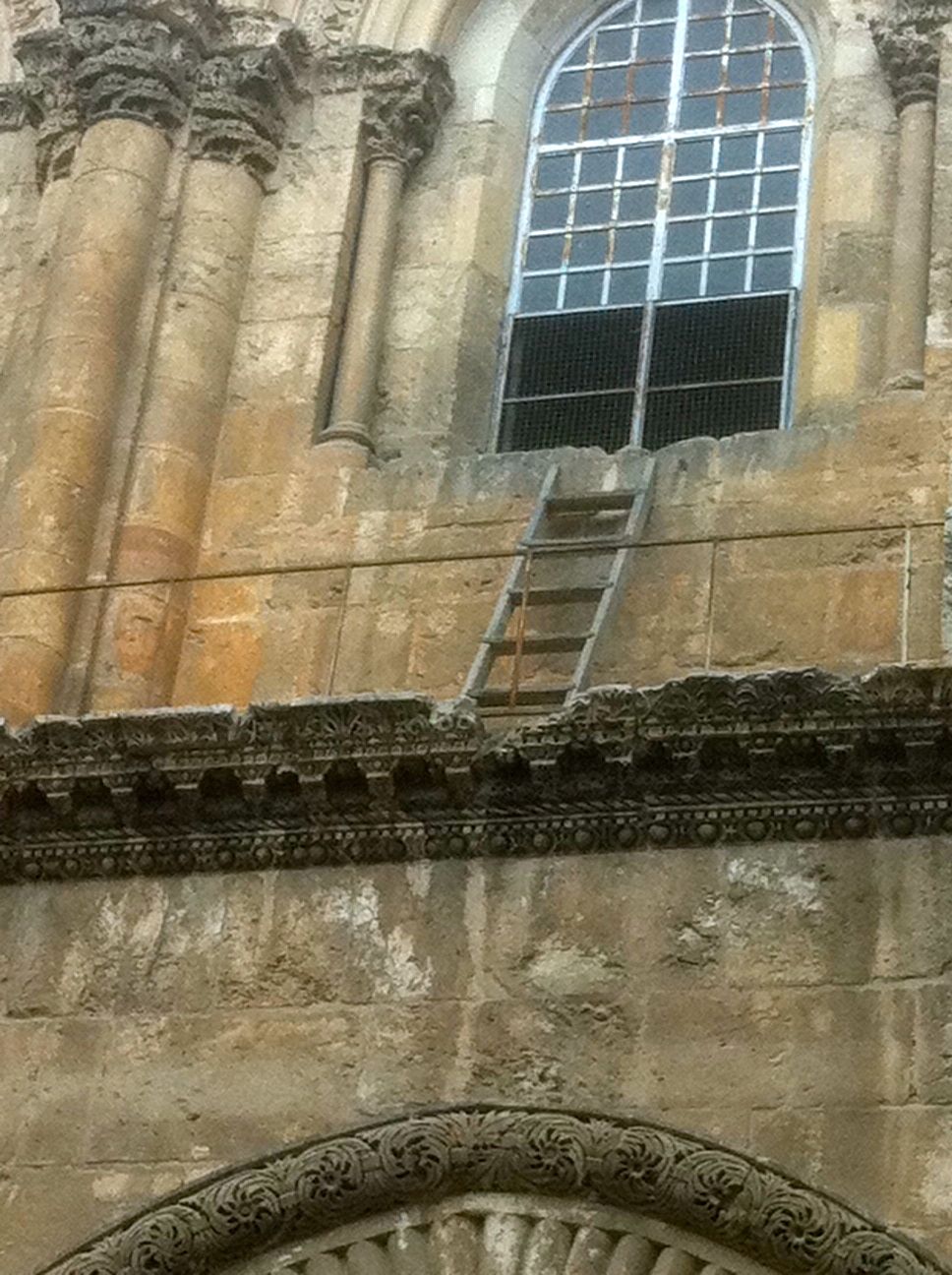
This is a closeup view from the courtyard of the Church of the Holy Sepulchre in Jerusalem, one of Christianity’s most significant holy sites — if not the single most significant — as it marks where Jesus was crucified, buried, and reborn. So back to the ladder…That modest, unassuming ladder has rested in that exact spot for more than a century. Why you ask? Well, it has become a symbol for the millennia-old battle between various Christian churches for the right to manage the church ground. One church owns the balcony; another the window. If the ladder were moved, it would disrupt centuries of careful negotiation. Ian tells us that the church is opened and closed every day by a Muslim family to avoid inter-Christian squabbles. Read the rest of… |


| ||
| Copyright © 2026 The Recovering Politician - All Rights Reserved | |||