Rather, my deep disappointment is directed toward the most famous Jonathan Miller.
For those of you who are under the age of 50 and have never tried to Google me, THE Jonathan Miller is “is a British theatre and opera director, actor, author, television presenter, humorist and sculptor,” best known for being a frequent guest in the early 1980s on The Dick Cavett Show.
That Jonathan Miller also recently committed an act of transparent anti-Semitism.
Miller co-signed a letter (along with three dozen other British actors, directors, and writers, including two-time Oscar winner Emma Thompson), asking Shakespeare’s Globe Theater in London to withdraw its invitation to an Israeli theater company “so that the festival is not complicit with human rights violations and the illegal colonisation of occupied land.”
A charge of anti-Semitism, of course, is quite severe, especially concerning a fellow Jonathan Miller. And I’m not one to consider every pronouncement against Israeli policy anti-Semitic or even anti-Zionist.
Furthermore, I strongly support a two-state solution in the Middle East that would require Israel to return most of the West Bank lands it captured in its defensive struggle for existential survival during 1967’s Six Day War. I believe that criticism of the occupation, and particularly of many of the Jewish settlements in these territories, can be — in the proper context — a profoundly Zionist statement.
But this is far from the proper context.
Read the rest of… Jonathan Miller: Jonathan Miller’s Anti-Semitic Act
By Jonathan Miller, on Wed Apr 4, 2012 at 7:00 AM ET
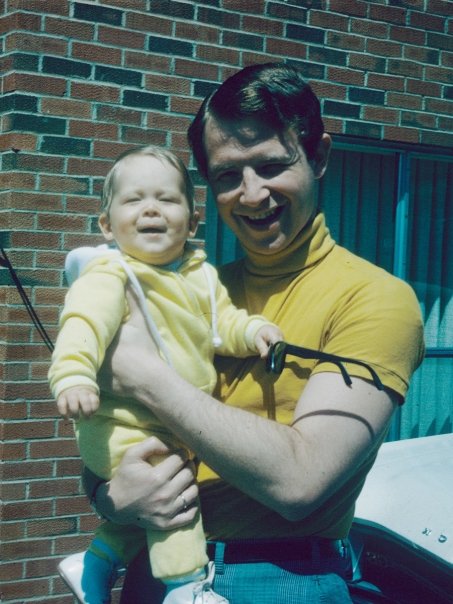
My dad and I circa 1968
On this day in which we remember the tragic assassination of Martin Luther King, Jr., we re-run this piece — in which the RP honored King, his father, and contributing RP Kathleen Kennedy Townsend’s father — that first appeared at The Recovering Politician on April 4, 2011.
Today — as on every April 4 — as the nation commemorates the anniversary of one of the worst days in our history; as some of us celebrate the anniversary of the greatest speech of the 20th Century; my mind is on my father. And my memory focuses on a winter day in the mid 1970s, sitting shotgun in his tiny, tinny, navy blue Pinto.
I can still remember my father’s smile that day.
He didn’t smile that often. His usual expression was somber, serious—squinting toward some imperceptible horizon. He was famously perpetually lost in thought: an all-consuming inner debate, an hourly wrestling match between intellect and emotion. When he did occasion a smile, it was almost always of the taut, pursed “Nice to see you” variety.
But on occasion, his lips would part wide, his green eyes would dance in an energetic mix of chutzpah and child-like glee. Usually, it was because of something my sister or I had said or done.
But this day, this was a smile of self-contented pride. Through the smoky haze of my breath floating in the cold, dense air, I could see my father beaming from the driver’s seat, pointing at the AM radio, whispering words of deep satisfaction with a slow and steady nod of his head and that unfamiliar wide-open smile: “That’s my line…Yep, I wrote that one too…They’re using all my best ones.”
He preempted my typically hyper-curious question-and-answer session with a way-out-of-character boast: The new mayor had asked him—my dad!—to help pen his first, inaugural address. And my hero had drafted all of the lines that the radio was replaying.
This was about the time when our father-son chats had drifted from the Reds and the Wildcats to politics and doing what was right. My dad was never going to run for office. Perhaps he knew that a liberal Jew couldn’t get elected dogcatcher in 1970s Kentucky. But I think it was more because he was less interested in the performance of politics than in its preparation. Just as Degas focused on his dancers before and after they went on stage—the stretching, the yawning, the meditation—my father loved to study, and better yet, help prepare, the ingredients of a masterful political oration: A fistful of prose; a pinch of poetry; a smidgen of hyperbole; a dollop of humor; a dash of grace. When properly mixed, such words could propel a campaign, lance an enemy, or best yet, inspire a public to wrest itself from apathetic lethargy and change the world.
Now, for the first time, I realized that my father was in the middle of the action. And I was so damn proud.
– – –
Click above to watch my eulogy for my father
My dad’s passion for words struck me most clearly when I prepared his eulogy. For the past two years of his illness, I’d finally become acquainted with the real Robert Miller, stripped down of the mythology, taken off my childhood pedestal. And I was able to love the real human being more genuinely than ever before. The eulogy would be my final payment in return for his decades of one-sided devotion: Using the craft he had lovingly and laboriously helped me develop, I would weave prose and poetry, the Bible and Shakespeare, anecdotes and memories, to honor my fallen hero. In his final weeks of consciousness, he turned down my offer to share the speech with him. I will never know whether that was due to his refusal to acknowledge the inevitable, or his final act of passing the torch: The student was now the author.
While the final draft reflected many varied influences, ranging from the Rabbis to the Boss (Springsteen), the words were my own. Except for one passage in which I quoted my father’s favorite memorial tribute: read by Senator Edward Kennedy at his brother, Robert’s funeral:
My brother need not be idealized, or enlarged in death beyond what he was in life, to be remembered simply as a good and decent man, who saw wrong and tried to right it, saw suffering and tried to heal it, saw war and tried to stop it.
Read the rest of… The RP: My Father, RFK, and the Greatest Speech of the 20th Century
By Jonathan Miller, on Tue Apr 3, 2012 at 1:00 PM ET
My friend Billy Reed — who happens to also be the dean of Kentucky’s sportswriters — wrote an incredible piece on Kentucky basketball last week for Si.com prior to the UK/UofL showdown. I share it with you here to demonstrate the kind of writing I aspire to — someday:
Outside my home here in Louisville, all hell is breaking loose. Insults and predictions are dropping like bombs. Rational people are fleeing bars and restaurants in search of sanctuary. Offices have become battlegrounds, families are being torn apart, and minor events such as weddings are being reorganized. I now know what Edward R. Murrow must have felt like when he was reporting about the siege of London during World War II.
In more than a half century of covering basketball in Kentucky, I thought I had just about seen it all. Heck, even though I was just a kid in 1955, I remember the flag over the state capital building in Frankfort being lowered to half-mast because Georgia Tech had ended the Kentucky Wildcats’ 129-game home winning streak (still the national record). That was my first clue that basketball wasn’t just a game in my native state.
Nevertheless, I wasn’t prepared for the madness that surrounds me this week. I guess I always knew that Kentucky and Louisville would someday meet in the Final Four. But I never dreamed that it would cause all serious work in the Commonwealth to grind to a virtual standstill. I never dreamed that Anthony Davis’ brow would get more radio and TV time than anything since Muhammad Ali fought Joe Frazier for the first time in 1971.
To put it into context, this is Super Bowl week in Kentucky. Even folks who only have a casual interest in hoops — yes, we do have some of those — are suddenly expressing opinions and making bets and generally acting like fools.
Naturally, the national media has been in town this week, trying to ferret out basketball crazies to interview. This makes me nervous because when they find somebody like the guy who has the UK logo in his glass eye, it doesn’t exactly reflect well on us. But we can’t deny the obvious. You may have heard about the two senior citizens in Georgetown, Ky., ages 69 and 72, who almost came to blows arguing about Louisville and Kentucky during their dialysis treatment.
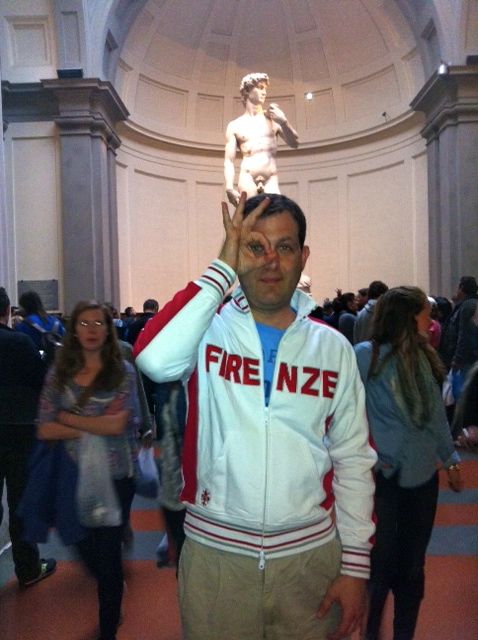
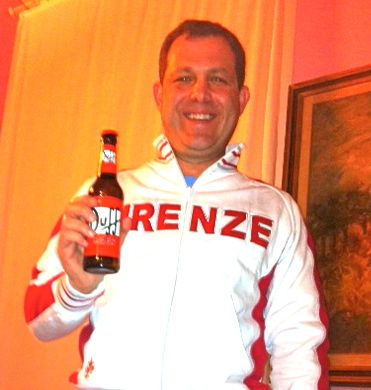
The RP was spotted in this picture scouting a new, young 17 foot center named David [NO LAST NAME] in Florence, Italy. Apparently by the RP’s hand gesture, David is proficient from behind the 3-point line — amazing for a young man of his size.
Shortly after this picture was taken, the RP was arrested for climbing on top of David and hanging a UK hat on his head.
The University of Kentucky Wildcats basketball team and the Big Blue Nation weren’t the only winners last night
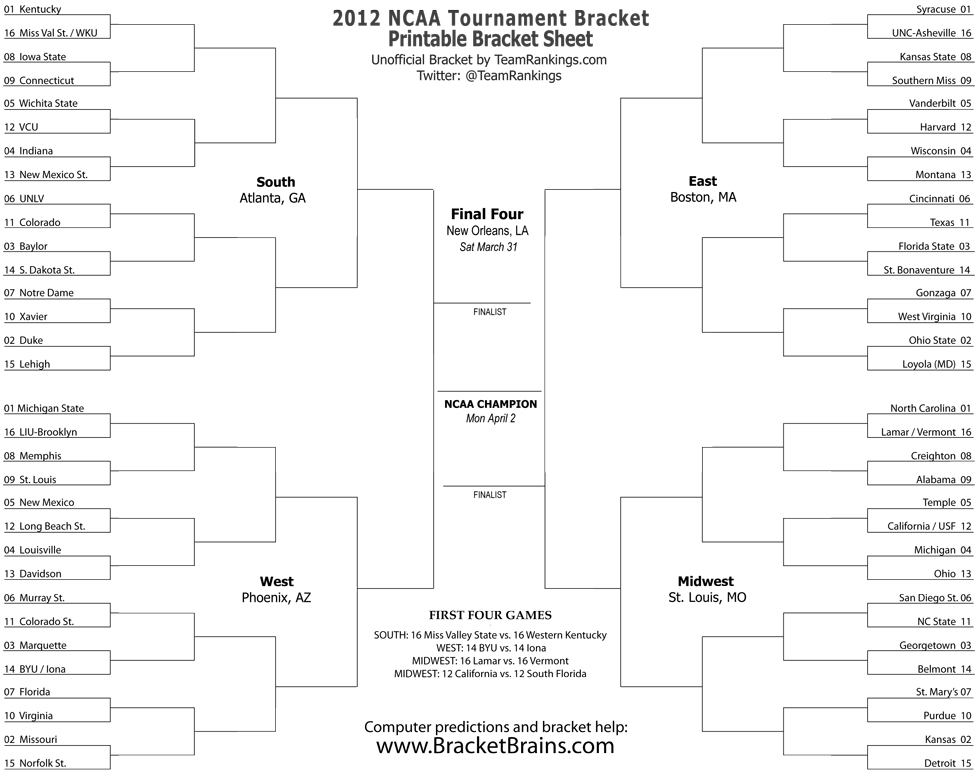
The First Annual No Labels/Recovering Politician NCAA bracket contest — “No Bracket No Pay” — is now crowning two champions.
The overcall winner — of the original 68-team bracket contest — was “Nate.” “Nate” please identify yourself to claim your prize. In second place was Butler University student Scooter Stein, whose mom happens to be Kathy Stein, the beloved State Senator from Lexington, Kentucky. The RP came from way back in the field of 77 to finish a respectable 7th.
Here's our goofball winner of the Second Chance tourney with his prize, an original bottle of "Duff" beer, available only in Italy, Argentina, and Springfield, the fictional home of Homer J. Simpson
And in the “second chance” bracket — featuring picks for the Sweet Sixteen forward, the winner was…The RP himself! By picking the winners of every single game in the Sweet 16 except for Louisville’s surprise wins, and then accurately predicting the 8 point margin of victory in the finals (the tiebreaker), the RP edged out Friend of RP John Johnson for the title. How fitting that the guy who started this site dedicated to second acts wins the second chance tourney.
Or is it part of the greater international Zionist conspiracy? You decide!
Congrats to all, and don’t forget to go to NoLabels.org, and make your voice heard about “No Budget, No Pay”
By Jonathan Miller, on Tue Apr 3, 2012 at 8:30 AM ET
(Photo by Jeff Gross/Getty Images)
What a night! Or should I say what a morning?
The girls and I woke up at 3AM here in Florence, Italy to watch our beloved University of Kentucky Wildcats capture their eighth NCAA national basketball championship.
Sheer euphoria.
I’ve tried for a few years to put into words what the Wildcats mean to me, as well as their profound impact on my home state. It really is more than a kids’ game — Kentucky basketball delivers sound public policy.
For my fellow members of the Big Blue Nation; for the uninitiated who don’t understand what the fuss is all about; and for the cynics who decry the professionalization of amateur sport, I offer my latest column for The Huffington Post: “Why Kentucky Basketball Matters.” Enjoy:
An uninformed visitor to my old Kentucky home this week might conclude that they’d mistakenly walked onto the compound of a Prozac-fueled utopian cult.
An odd but euphoric delirium had descended upon the hills, hollers and hamlets of the Bluegrass State. Men and women walking more upright, a bounce in their steps, a huge grin on their faces. You couldn’t meet a stranger: In grocery stores and city parks and shopping malls, neighbors who months before felt nothing in common were now greeting each other with warm words, high fives, and fist bumps.
Weeks from now, we’ll return to our regional camps, our partisan corners. But for now, we’re united; the sun’s shining just a bit brighter.
The Wildcats have once again won the national championship. Kentucky basketball matters.
By Jonathan Miller, on Mon Apr 2, 2012 at 9:46 AM ET
Greetings from my third favorite city in the world (behind Lexington & Jerusalem — sorry Vegas!): Florence, Italy.
The weather is perfect, the food extraordinary, the art sublime. Only trouble is that the RPettes and I are going to try to watch THE GAME at 3 AM while Mrs. RP sleeps.
At least everyone over here is part of the Big Blue Nation. I spotted the T-shirt to the left at Florence’s famous leather marketplace. Didn’t know Audrey Hepburn was a Cats fan, but apparently she anticipated Marquis Teague’s three-point form decades before he was born.
We are sincerely hoping that tonight Sylvester finally catches Tweety bird — What’s a Jayhawk anyway? — as Thomas Robinson discovers that Anthony Davis owns the paint on both sides of the court. He’s not in Kansas anymore!!
(I assume that joke’s being overused back home, but it’s getting big laughs here in Italy! Or maybe they are laughing because they have no idea what I’m saying.)
Anyhoo, our trip got diverted a bit thanks to Delta and a little rain, and we got to spend the afternoon yesterday in Amsterdam. Being a huge proponent of municipal infrastructure improvement, I decided to take a tour of the so-called “Red Light District.”
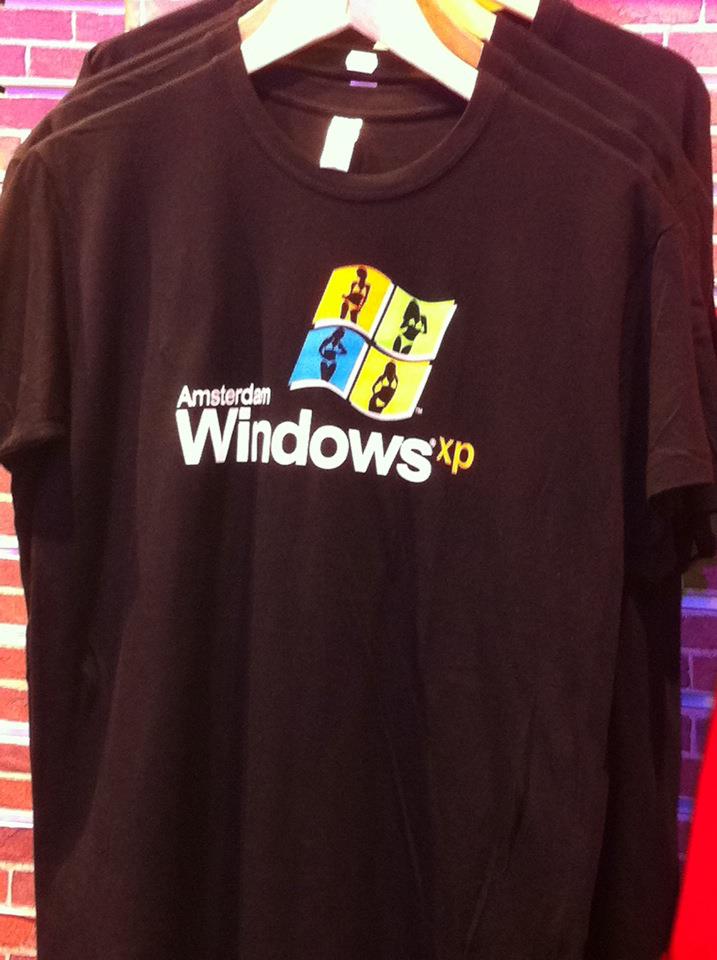
Well, it seems there was a little misunderstanding. Let me put it this way — I didn’t take any pictures. The T-shirt at right is the best PG-rated presentation of the scenery in the Red Light District.
To recover from the shock and awe, I decided to take a detour into a “coffee shop.” Turns out they didn’t serve coffee, and the place was hazy and smelled like a Jimmy Buffett concert. The good news is that after spending a few minutes in the place, all of my cares disappeared, and I became relaxed and happy; although for some strange reason I was (Terrence) Jones-ing for a bag of Cheetos.
Apparently, I’m very popular in Amsterdam as well. Whenever I introduced myself, people asked if I was the same Jonathan Miller who wrote an article in The Huffington Post advocating for the legalization of marijuana.
OK, back to my vacation…I promise to send another post(card) soon.
For centuries, Jews have looked at world events and/or world leaders and have wondered: Is it good for the Jews? So much so, it’s become a running joke within the tribe.
JTA, the leading international Jewish news agency, decided to test this question on the issue of the week: The NCAA’s Final Four,and specifically, the semifinal meeting of two longtime intrastate archrivals, the University of Kentucky Wildcats and the University of Louisville Cardinals.
Taking the side of all that is good and right and holy (the Wildcats) is the RP himself. On the dark, red side (the Cardinals) is the RP’s great friend, Marie Abrams, who serves on the board of the University of Louisville, and has been a local and national leader of Jewish organizations for decades, including serving as former national chair of the Jewish Council for Public Affairs.
Listen to the podcast here for the fireworks and fun:
By Jonathan Miller, on Thu Mar 29, 2012 at 3:00 PM ET
I’m awfully proud to read this story about my former colleagues:
From The New Republic:
EXCLUSIVE: Are State Treasurers Preparing a Novel Attack on Mega-Rich Campaign Donors?
Thanks to Citizens Unitedand other recent rulings, the nation’s ultra-wealthy have a lot more latitude than they did a few years ago when it comes to pouring money into the political system. And, according to the latest campaign filings, they aren’t skimping. During February, Ken Griffin, founder of the hedge fund Citadel, and Henry Kravis, co-founder of private equity giant KKR, each gave $100,000 to the super PAC supporting Mitt Romney, while American Crossroads, the group co-founded by Karl Rove, received $500,000 from the financial services firm S.W. Childs Management Corp.
But these are just the contributions that get disclosed. Groups such as Crossroads do not need to reveal who donates to their 501(c)(4) arms, which are supposed to focus their advocacy on “issues,” not elections. (In practice, of course, they often blur that distinction to the point of meaninglessness. Crossroads’s 501(c)(4) arm, for instance, has spent hundreds of thousands of dollars on two ads attacking Barack Obama over the Solyndra fiasco.) Because the donations are anonymous, no one knows how much money is flowing from Wall Street billionaires to these entities. But everyone assumes—and it’s a pretty safe guess—that it’s a lot.
Now, under the radar, a fledgling effort to force these donors out into the open is underway. And it’s being led by a rather unlikely group of crusaders: a handful of the nation’s state treasurers.
In most states, the duties of the treasurer include a role in the oversight of pension funds for state employees. These funds invest much of their money with the country’s biggest hedge funds and private equity firms. In fact, about 30 percent of the money invested with private equity is from public pensions. And so, it has occurred to some state treasurers that they might use these funds as leverage. The idea would be to say to firms: If you want to keep managing our billions, then we want you to be more transparent in your political giving. (While the stated intent is not to limit giving, presumably some money managers would be less inclined to write big checks if disclosure were required.) “They’re sending a message,” says Shelley Alpern of Trillium Asset Management, a “socially responsible” investment fund that pushes for transparency in political giving. “The pension funds have multiple billions of dollars to choose how they want to invest, and they can probably find hedge fund managers who aren’t involved in the political process the same way some of their current money managers are.”
So far, the loosely coordinated group of states considering this approach, according to several people familiar with the effort, includes California, Illinois, Massachusetts, North Carolina, and Rhode Island. Discussions appear to be most advanced in California, where the state’s two public pension funds have $53 billion invested with private equity and $5 billion with hedge funds. The tactic was a topic of discussion at a recent meeting of California pension officials in Los Angeles, and state staffers are now studying options for its implementation. “I support it,” California Treasurer Bill Lockyer, a Democrat, told me. “I’m among those concerned about the escalation of megabucks, private megabucks, in presidential and other campaigns. It’s alarming to see what’s happening.”
I want to personally thank Senator Joey Pendleton and Ag Commissioner Comer for continuing to fight the good fight in the attempt to legalize this amazing crop. We are picking up speed thanks to you guys taking the discussion to Frankfort on behalf of the 77% of Kentuckians who want to see this crop legalized. And thank you to all the volunteers and pioneers who have been the backbone of this political movement! Without you guys, this seminar would have never happened!
The seminar was amazing; it was the most gorgeous venue, and perfect setting, at the Red Mile Horsetrack on the outskirts of downtown Lexington. It was a beautiful day, borderline hot, and the atmosphere was electric. Guests of the seminar started rolling in just before 5 P.M. and continued to swarm the place until we had a crowd of at least 50 people. There were drinks served by the finest bar manager in Lexington, who is a farmer himself (and now thinking about hemp.) And when you stepped into the Round Barn, you felt like you went back in time about 100 years. There were antique carriages and a gorgeous three-story chandelier hanging over a hemp brake designed by Thomas Jefferson himself. It was the perfect setting to talk about a plant that’s just as much a part of Kentucky’s history as horses and horse racing.
Former Treasurer Miller, the wide-eyed liberal
Among our guests were several very key individuals in the hemp movement. Jonathan Miller, former KY State Treasurer and webmaster at therecoveringpolitician.com has been a vocal supporter of industrial hemp, and has even written an article for the Huffington Post supporting the cause. He did a wonderful job of being the emcee, as several other key individuals surprised us by showing up. Jonathan rolled with the change in plans, allowing us to seamlessly introduce several other speakers. State Senator Robin Webb, who signed on as a co sponsor to HB 100 back in 1998, came in and gave an impromptu speech, as did State Senator Damon Thayer, who is still on the fence about hemp, but is making great strides as he learns more about the crop.


 Fair readers, have no fear: This column is not a revelation of yours truly as a self-hating “self-hating Jew.”
 That Jonathan Miller also recently committed an act of transparent anti-Semitism.