By Jonathan Miller, on Mon Jul 9, 2012 at 12:15 PM ET
It’s instructive that my impossible run through the World Series of Poker tournament was a study in black and white:
An exhilarating roller coaster ride encompassing 40 hours of mind-thumping boredom.
A liberal former politician succeeding by playing with an über-conservative game plan.
A victory of steadfast patience, the absence of which has been my defining character flaw.
The long distance coaching of one of my better friends, whom I’ve only met twice in person.
A game legendary for its macho bravado that’s dominated by pasty-faced math geeks.
And the most striking contrast of all: I’ve lived a life of painstaking diligence — some might say monomaniacal zeal — toward building a career centered around moral values; and one of my life’s highlights — indeed one of its most truly spiritual moments — came playing a card game that I’d hardly practiced and that’s banned in my home state because of its purportedly immoral implications.
===
On Independence Day 2012, the 73rd anniversary of baseball legend Lou Gehrig’s famous statement that he was “the luckiest man on the face of the earth,” I began a journey that certainly contested the Iron Horse’s declaration. Indeed, it was pure serendipity that I was even playing in the tournament in the first place.
Months earlier, when we learned the schedule of my youngest daughter‘s summer in Israel program, my wife, who had a trip planned already to Mexico, suggested that after I dropped Abby off at JFK airport, I should make it a long weekend playing poker in Vegas. She knew how much I loved no limit Texas hold ’em — a game that both rewarded my high school math skills and stoked my innate competitive fires — and that I so rarely got chance to play since online poker was made illegal.
Read the rest of… The RP: My Impossible Run Through the World Series of Poker
Even assuming that at least some of the conservative sentiment is the desire to find comfort in defeat, and that some liberals are engaging in the intellectual version of being graceful winners, there is some core of truth here: upholding the mandate on commerce clause grounds would have linked the power to regulate a market with the power to compel participation in it. Justice Ginsburg’s concession that the power’s only limitation is practicality and political modesty is much less dangerous in a concurrence than a majority opinion.
But the fact that five votes coalesced around a weakening of the commerce clause is cold comfort when the fifth vote hinged on blowing the lid off of the tax and spend power. That taxing power, which looked until the day of the ruling like a straightforward ability to add an official levy to commercial activity, now looks ominously broader. As of now, it as limitless as the government’s imagination, as long as it not so high that it turns into a de facto penalty or a fine. Or, in Chief Justice Roberts phrasing, as long as it is “just a tax hike”, all is fair.
Read the rest of… Artur Davis: The Silver Lining is Dark
By Jonathan Miller, on Sat Jul 7, 2012 at 12:56 PM ET
It was a half hour past midnight, Vegas time. Of course, my body felt like it was 3:30 AM. This wasn’t way past my bedtime, it was approaching my time to get up.
Out of the field of 4260 in the World Series of Poker’s $1000 no limit hold’em tournament, there were 95 of us left. And I was the shortest stack of all. Only 16,000 chips. And the big blind was coming to me the next hand — that meant I’d have to post 6000 chips from my dwindling stack.
I was toast.
Despite my imminent elimination, despite the extraordinary fatigue of the late/early hour and having spent over 20 mind-numbing hours watching grown men (and a few women) play cards, I was beaming. Not only was I checking off my longtime bucket list moment of playing in the World Series of Poker; not only had I fulfilled the goal I set of playing to Day 2; not only had I passed my revised goal of making a little money; not only had I cracked the top 100 players left; I felt the unique zen of playing a perfect game — for me, of course — I had not make a single stupid decision; I hadn’t lost my cool and gone on “tilt”; I hadn’t lost my attention and failed to assess the circumstances correctly; I had done my best.
And now, as the Poker Gods had demanded, it was time to go home.
I looked down at my two cards and smiled. A Jack and a five. Known among in poker parlance as “Jackson Five,” it’s a pretty lousy starting hand. 99% of the time, I would have folded.
But I had no choice — if I folded now, I’d have such a small stack that I’d be leaving soon anyway. I went all-in. The player on the button called. He turned over an eight and a four.
Read the rest of… The RP at the World Series of Poker: How I Was Saved by the Jackson 5
By Jonathan Miller, on Fri Jul 6, 2012 at 12:15 PM ET
Today, at 1 PM PDT (4 PM EDT), Day 2 of the World Series of Poker $1000 non-limit Texas hold-em tourney begins, with the RP holding onto to 27,925 chips, placing him in 151st place among the 726 players still remaining from an original field of 4,620.
With a total prize pool of $1,566,000, the winner would receive more than $654,000. The RP’s immediate goal — being among the 468 survivors who win a cash prize. We should know that by Midnight PDT tonight. The final table will take place on Sunday afternoon.
Stay tuned to these pages, and if you are really a poker geek, you can head to this link to follow all of the action, including chip counts and commentary.
Good luck RP!
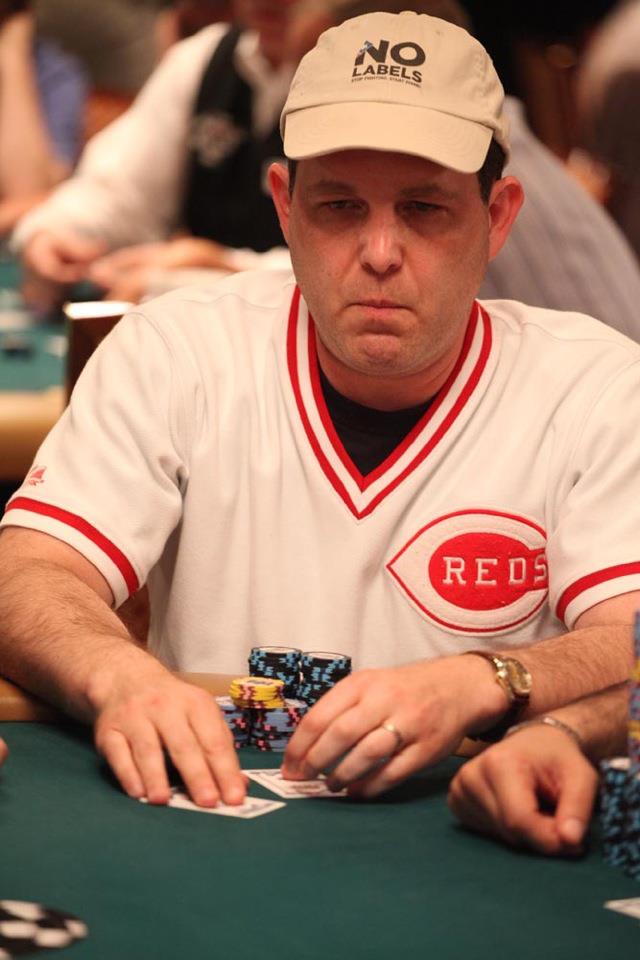
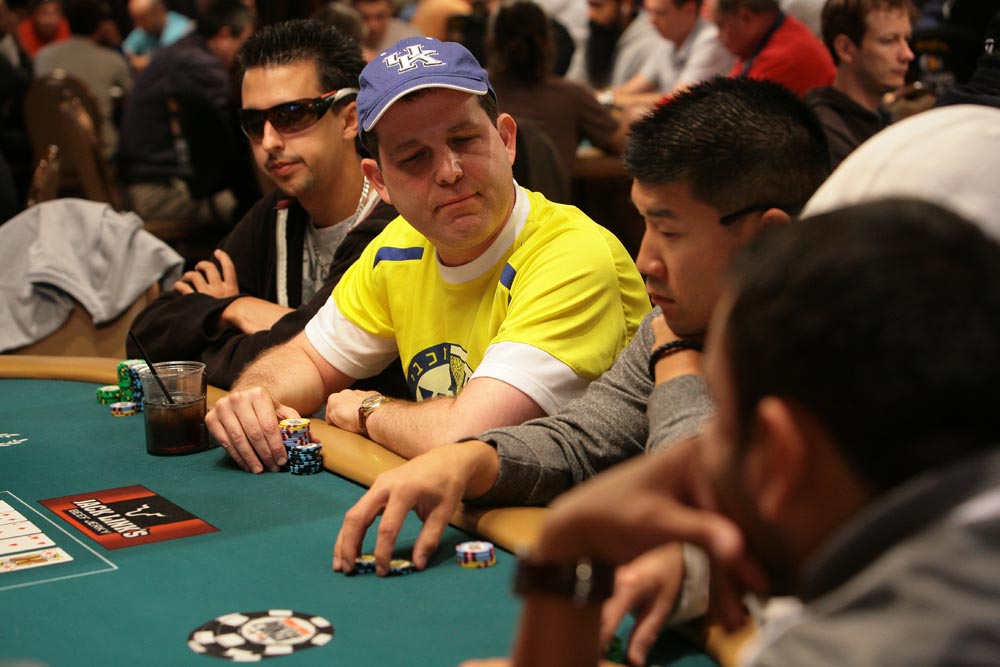
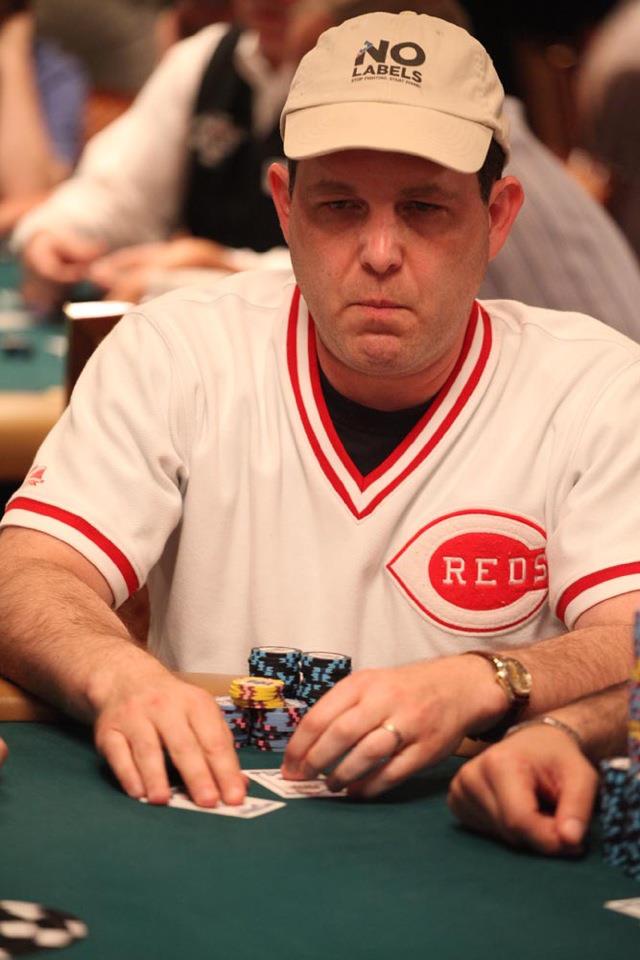
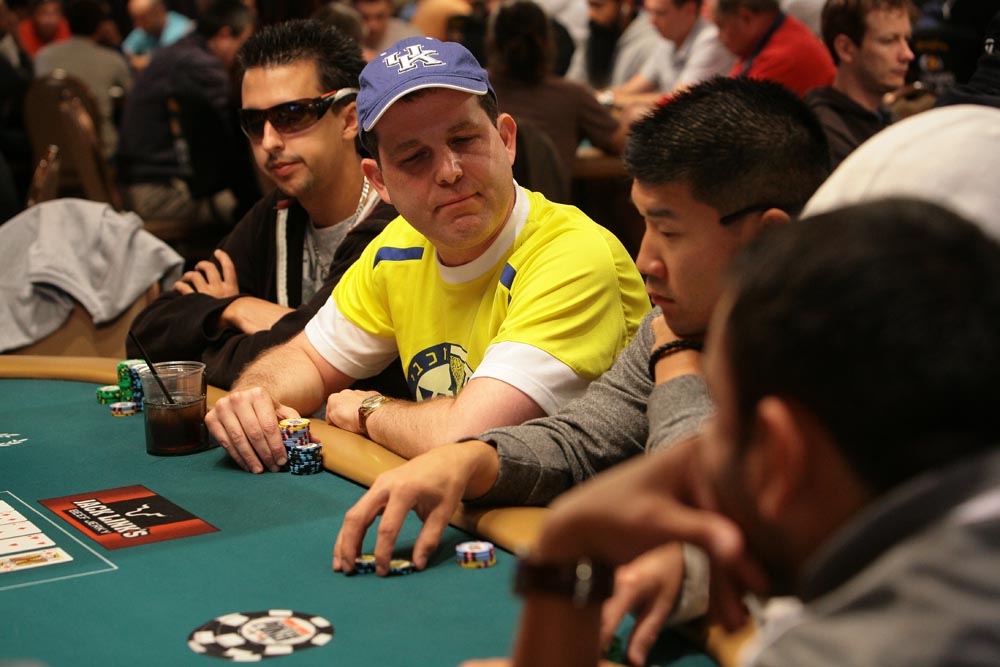
I hadn’t received my No Labels hat yet, so I was representing my two favorite basketball teams: Tel Aviv Maccabeans (shirt), and some semi-professional unit in the upper South (hat)
I’ve always dreamed of standing out in a crowd. Little known fact: The Lady Gaga song, “Poker Face” is NOT about me. The Carly Simon song, “You’re so Vain” is, however. At least I probably think so.
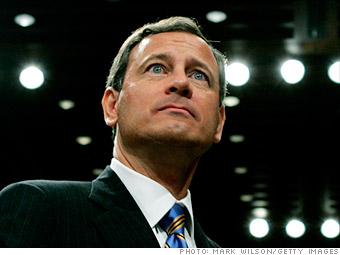
Whether Chief Justice John Roberts changed his mind, or is the latest example of Republican justices “evolving” on the bench, he has done the improbable: liberals are praising a Supreme Court that they had trashed as a player in a right-wing conspiracy. Old sins like Citizens United are washed away, as are President Obama’s spring musings about the dangers of an unelected court unaccountable to public opinion. The about-face is jarring even in a political atmosphere where the right result typically makes right.
I’ll offer two quick cautionary notes, though, on the politics,and on the arguably more significant trend signified by the outcome. First, a rebuttal to Democratic wishfulness that healthcare is now a politica lwinner for Barack Obama: the better evidence is that it will be a media inflated victory that is worth no votes. Just as Democrats miscalculated in 2010 by assuming that the passage of the healthcare law would prove that they could get things done, they are probably drawing th ewrong lesson today if they assume the Court’s rescue of a deeply unpopular law somehow validates the Obama term.
The notion that the Supreme Court’s imprimatur alters the electoral equation implies that the hostility to Obamacare among Independents and swing voters is related to their doubts about the law’s legitimacy. To the contrary, there is considerably more polling evidence that the political middle’s resistance to the Affordable Care Act is grounded in bread and butter realities: sticker shot at the cost; reflexive doubts that any fledgling federal bureaucracy will work the way it is supposed to; and a suspicion that for all the hoopla, the reform won’t lower their premiums or improve their coverage. The constitutional gripe never really permeated the congressiona ldebate, and it has become a rallying point only within the GOP’s Tea Party base and on the intellectual right: two places that are not exactly part of the persuadable voter universe, and two sectors that aren’t about to rethink thei ropinion based on a one vote escape act.
Good morning and welcome to a special edition of Prix Fixe Politics! At 11:30 PM Wednesday night, I hailed a cab to the second most important address in all of America – One First Street NE, Washington, DC. I arrived at the Supreme Court, not realizing how tense and dramatic the next twelve hours would get. I want you to relive Thursday with me – I hope it gives you a different perspective on this historic moment. With that, here is today’s special SCOTUS menu…
Appetizer: It was actually around 2:00 PM Wednesday that I first stopped by the Court to see if the mayhem had begun. No protestors, no supporters, no media in sight…and there were only 3 people in line at that point. It was less electric than an LA Clippers game in the 90’s and 00’s. The third woman in line was kind enough to inform me that the Court reserves about 60 spots for the general public on oral argument and opinion days. While she wouldn’t hold a place for me, she gave me her phone number and suggested I call her later in the evening to gauge the crowd. Sure enough, when I called her at 11:30 PM, she let me know the line had grown to roughly 40. So, in khakis and a button-down, with only a half-full bottle of water, I took a cab to the Court and got in line. If you didn’t recognize the building behind us, you could easily have mistaken the group for college freshmen on move-in day. The average age was 25 or 26 at most. They brought foam egg crates and yoga mats to sleep on, blankets and sleeping bags to sleep under. Some wore sandals and shorts, others wore suits and suspenders. Justice truly knows no dress code. There were over-eager undergraduates and case-citing law students, with some Masters in Public Health candidates sprinkled in. And even though all sides of the aisle were represented and the Capitol Building shone illuminated across the street, there wasn’t one political argument all night.
Main Course: By the time 5:00 AM rolled around, I learned that a lone Crystal Geyser water bottle does not make for a good pillow. People were stirring and the media circus was arriving. While the mood was still surprisingly relaxed at that time, 8:00 AM was another story. The Court security lined us up single-file and handed out a numbered gold card to each person. I got #36, and could breathe a quick sigh of relief that I’d make it into the courtroom. The guards moved us along 10 at a time, left, right, left, right. Walking up the first few stairs and heading to the side of the Court, I got a different feeling than I do when I enter the Capitol or White House. For me, at least, I didn’t feel the same sense of patriotism, but more of a feeling of permeating purpose. Finally moving toward and into the Court reminded me how monumental a moment this could be in the course of defining the parameters of American government, determining the next President, and shaping the political conversation for years to come. And when you pass CNN’s Jeffrey Toobin in the hall of the Supreme Court, you know there’s no better place to be if law and policy is your bag.
As we lined up once again and prepare to head upstairs, a rosy Michelle Bachmann appeared out of nowhere to join the front of the line. She hadn’t looked that cheerful since she won the Ames straw poll last August. Eventually, after we make our way upstairs and check cell-phones and bags in a locker room, I am led to a seat directly behind Bachmann. She’s not the only congressional Republican on hand: Reps. Tom Price and Catch McMorris-Rogers are a few rows ahead. Senators Hatch and Barrasso found good seats in the middle, too. Paul Clement, attorney for the National Federation of Independent Businesses, was already seated in the back section when Donald Verrilli and others from the Solicitor General’s Office arrived to take their seats only a few rows from the bench.
Read the rest of… Zac Byer: EXCLUSIVE Report from Inside the Supreme Court on Obamacare Decision Day
“Congress’s use of the Taxing Clause to encourage buying something is . . . not new. Tax incentives already promote, for example, purchasing homes and professional educations. See 26 U. S. C. §§163(h), 25A. Sustaining the mandate as a tax depends only on whether Congress has properly exercised its taxing power to encourage purchasing health insurance, not whether it can. Upholding the individual mandate under the Taxing Clause thus does not recognize any new federal power. It determines that Congress has used an existing one.” –Chief Justice John Roberts
The Supreme Court earlier today upheld “Obamacare.” The majority opinion, drafted by Chief Justice Roberts, essentially recognized that taxation to influence consumer behavior in this country is nothing new. Republican leadership is already vowing to kill it. I’m curious to know what provisions of insurance reform they will kill first . .
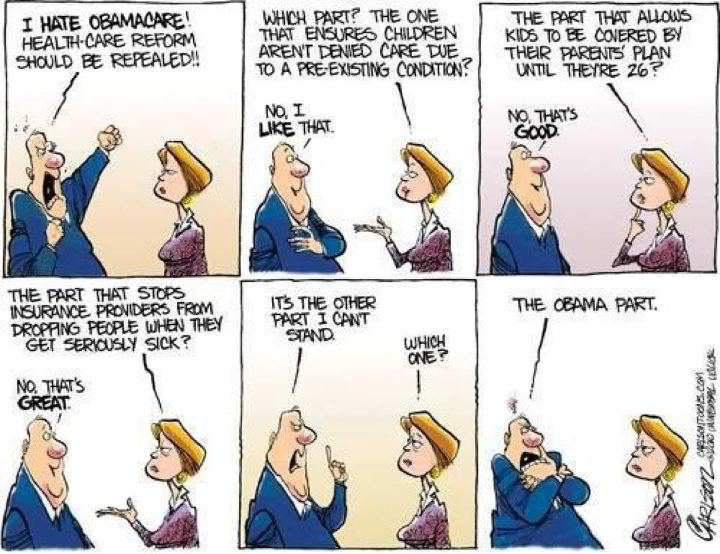
The first provisions include barring insurers from discriminating against children with pre-existing conditions, allowing parents to opt to keep their own children covered on their plans until they turn 26, and fixing the Medicare reimbursement gap (the “doughnut hole”) that costs seniors several hundred dollars each year. Will the GOP fight to continue medical discrimination against children? Will they kill legislation to reimburse seniors? Will they stop parents from keeping their children covered until age 26?
The law has also required states to create high-risk pools that cover individuals denied private insurance due to pre-existing conditions. Will they now ask the adult with multiple sclerosis to give up that coverage?
Moving forward, health insurance reform will establish insurance exchanges and purchasing cooperatives where insurers that currently enjoy monopolies over entire regions will face competition from other private insurers. Will the GOP kill private sector competition in favor of retaining insurance monopolies? Will they prevent small business and the self-employed from entering into purchasing cooperatives so they can enjoy the discounted coverage that results from economies of scale?
The GOP laments the effects of Obamacare (modeled after RomneyCare) on the economy, especially small business. But the only small businesses impacted by healthcare legislation are those that employ over 50 people. About 96% of all small businesses do not employ over 50 people, and so will not be effected. As for those that do employ over 50 people, most of them already provide healthcare. They will now be getting tax credits to make their coverage of employees far more affordable. Will they take these small business tax credits away?
So in the coming days, I look forward to hearing from GOP leadership, specifically, whose health care will you be killing?
No full meal yet, but wanted to send regards from the line in front of the Supreme Court.
I’m #42 in line to get in and hear the opinions read in the morning — as you know, the healthcare decisions are expected.
First 60 are reserved for public…so I lucked out.
But, I am so ill-prepared. One water bottle, and the same button down and khakis I wore since Tuesday morning and through a red-eye flight. Everyone has sleeping bags and pillows, foam egg crates and blankets. And 95% of us are under 25 years old!