By Jonathan Miller, on Thu Jan 12, 2012 at 12:30 PM ET 
Do you remember last year’s State of the Union address?
I’m not asking about the speech itself. I’m referring to the fact that members of Congress abandoned their usual, and frankly juvenile, practice of sitting with their own precious cliques – Republicans on one side, Democrats on the other.
They crossed the aisle to demonstrate unified support for Rep. Gabrielle Giffords (D-AZ) who had been shot just a few days previously. It was a wonderful gesture. But the next day, things were back to hyper-partisan business as usual.
As you know, bipartisan seating is reform #10 of our Make Congress Work! action plan. It’s the reform that gets a “Duh” response from anyone who hears about it. As in, “Of course, they should sit together. It makes perfect sense.” Unfortunately, the fact that an idea makes sense doesn’t make it any more likely for Congress to act on it.
By John Y. Brown III, on Mon Jan 9, 2012 at 4:00 PM ET  John Y.’s Closing Argument John Y.’s Closing Argument
[John Y.’s Provocation; The RP’s Rebuttal #1; Ron Granieri’s Rebuttal #2; Rod Jetton’s Rebuttal #3; Krystal Ball’s Rebuttal #4; John Y.’s First Defense; Rod Jetton’s Response #1; Jeff Smith’s Rebuttal #5; John Y.’s Second Defense; Ron Granieri’s Response #1; John Y.’s Third Defense; Artur Davis’ Rebuttal #6; Jeff Smith’s Response #1; Rod Jetton’s Response #2; Jason Atkinson’s Rebuttal #7]
Final counter, counter, counter rebuttal.
 I’ve enjoyed mixing it up and teasing it out—for fun and with friends. I’ve enjoyed mixing it up and teasing it out—for fun and with friends.
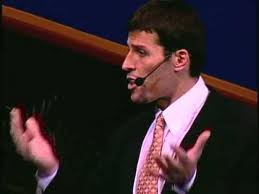
We’re all tired and need a wrap on this. Look, all I’m saying is that I won’t be surprised if Mitt Romney shows up at the next NH debate with a headset mic a la Anthony Robbins.
He can pull it off, look great, impress listeners. Heck, I’ll even buy his CD set. He’ll score points for fashion and suave, but lose votes—again.
Or, as Krystal Ball so succinctly put it, instead of convincing voters “he’s perfect” to be their next president, Mitt will seem “too good to be true.” A subtle but important distinction for recovering politicians.
So, no, Mitt probably doesn’t need to punch out Rick Santorum Tony Soprano style (even if he wants to). But he darn sure better muss his hair and stay away from headset mics as America focuses in to finally decides if Mitt is real enough — and not too good enough — to be president.
Remember, we voters can sometimes steal a page from Goldilocks, as we all look for the presidential candidate that is neither too big nor too small, neither too hot nor too cold. But just right. And just right for the times we face.
By Jason Atkinson, on Mon Jan 9, 2012 at 3:30 PM ET  Jason Atkinson: Rebuttal #7 Jason Atkinson: Rebuttal #7
[John Y.’s Provocation; The RP’s Rebuttal #1; Ron Granieri’s Rebuttal #2; Rod Jetton’s Rebuttal #3; Krystal Ball’s Rebuttal #4; John Y.’s First Defense; Rod Jetton’s Response #1; Jeff Smith’s Rebuttal #5; John Y.’s Second Defense; Ron Granieri’s Response #1; John Y.’s Third Defense; Artur Davis’ Rebuttal #6; Jeff Smith’s Response #1; Rod Jetton’s Response #2]
Some people just deserve good things in life. Ya, we know Mitt’s daddy owns the car dealership and got a Corvette for his 16th birthday, but after all, he looks like the quarterback. He is not like the rest of the kids in shop class, English, debate or pep-band. He is just a little better. He doesn’t have to one-up, he was born up.
In 1920, Warren Harding looked like Presidential timber too and campaigned on the thriller banner of “normalcy.” Some people just “got it go’n on.” Not like the rest of us who have had to pull our selves up the hard way, make hard calls, and pay the personal price for our political decisions. Mitt has always had someone else pay, or someone else’s money to pay. Mitt Harding has the look and was smart enough to choose the right parents. People want to have their picture taken with him, but don’t really want to talk to him, akin to taking picture at a car show.
So back to Harding: He looked like President, so let’s run him for President. The key to that borrowed historical back room quote is “who” is part of “let’s?” History showed us who with Teapot Dome.
Read the rest of…
The RPs Debate Presidential Leadership: Jason Atkinson Rebuts
By Rod Jetton, on Mon Jan 9, 2012 at 3:00 PM ET  Rod Jetton’s Second Response Rod Jetton’s Second Response
[John Y.’s Provocation; The RP’s Rebuttal #1; Ron Granieri’s Rebuttal #2; Rod Jetton’s Rebuttal #3; Krystal Ball’s Rebuttal #4; John Y.’s First Defense; Rod Jetton’s Response #1; Jeff Smith’s Rebuttal #5; John Y.’s Second Defense; Ron Granieri’s Response #1; John Y.’s Third Defense; Artur Davis’ Rebuttal #6]; Jeff Smith’s Response #1]
Jeff is so right about the difference between presidential races and state races. It is much easier for one candidate to have the resources to buy those down-ticket races.
While we have been asking about how a candidate is perceived by disinterested voters, I do think we should remember that the opposing campaign also has a chance to impact those perceptions. A good media buy with cutting ads can hurt a candidate. What the Bill Clinton camp did to Bob Dole in 1996 is a good example.
By Jeff Smith, on Mon Jan 9, 2012 at 2:30 PM ET  Jeff Smith‘s First Response Jeff Smith‘s First Response
[John Y.’s Provocation; The RP’s Rebuttal #1; Ron Granieri’s Rebuttal #2; Rod Jetton’s Rebuttal #3; Krystal Ball’s Rebuttal #4; John Y.’s First Defense; Rod Jetton’s Response #1; Jeff Smith’s Rebuttal #5; John Y.’s Second Defense; Ron Granieri’s Response #1; John Y.’s Third Defense; Artur Davis’ Rebuttal #6]
I think we should delineate between presidential elections and most other types — gubernatorial, House, Senate, etc. Presidential campaigns are exceptional. The candidates (especially in years like this when there are 38 debates) face a lot of scrutiny; they are inspected closely by the media, party activists, and to some extent rank-and-file voters (at least in the early states).
This, however, is not the case in most races. As long as candidates for House can raise $1-2M and candidates for US Senate or Governor can raise $5-10M, they can communicate effectively and thoroughly via TV ads. So I think that in those races the most important things are money, name ID, and surface likeability – as opposed to substantive ideas that can be put into action. This is because candidates with money are able to circumvent the press and the scrutiny of said ideas, and can saturate the airwaves with ads penned by others in which they mouth 30-60 seconds of reassuring bromides.
By Artur Davis, on Mon Jan 9, 2012 at 2:00 PM ET  Rebuttal #6: Artur Davis Rebuttal #6: Artur Davis
[John Y.’s Provocation; The RP’s Rebuttal #1; Ron Granieri’s Rebuttal #2; Rod Jetton’s Rebuttal #3; Krystal Ball’s Rebuttal #4; John Y.’s First Defense; Rod Jetton’s Response #1; Jeff Smith’s Rebuttal #5; John Y.’s Second Defense; Ron Granieri’s Response #1; John Y.’s Third Defense]
I’m a Johnny-come-lately to what sounds like an incredible conversation, so I will wade in very selectively, with these random observations:
- I like Jeff’s observations if only because they are the best explanation for why a decidedly average looking guy like me didn’t go further! More seriously, I think we will forever remain on the lookout for an explanation of what makes winners in politics. If it were all looks and charm, Kennedy crushes Nixon, instead of beating him by a vote per precinct; I’ve seen the charming losers–I vividly recall from my candidate recruitment days at the DCCC, a Nebraska guy whose looks had female staffers rearranging their schedules to meet him; the voters were less enraptured than the staffers and the online world; he lost by about 20 points — and I’ve seen the winners whose charisma would’t carry them past the corner next to the punch bowl in most other settings.
- My best guess is that for all our jaded reasons not to believe it, issues do matter, but sometimes only in the most reductionist sense–“does the guy or lady believe in people like me?”;”is this person going to deliver on the one or two things I really value?” I deliberately don’t use the word trust, by the way, because I think the trust quotient is so low in politics today that relying on it proves too little. I also don’t mean to endorse the very test I describe — part of leadership is sometimes deciding to deliver not on the one thing you care about, but the one thing that really will work better. Sometimes, “believing in people like me” means leading too narrowly, and shortchanging the broader good for one faction.
Read the rest of…
The RPs Debate Presidential Leadership: Artur Davis Rebuts
By John Y. Brown III, on Mon Jan 9, 2012 at 1:30 PM ET John Y.’s Third Defense
[John Y.’s Provocation; The RP’s Rebuttal #1; Ron Granieri’s Rebuttal #2; Rod Jetton’s Rebuttal #3; Krystal Ball’s Rebuttal #4; John Y.’s First Defense; Rod Jetton’s Response #1; Jeff Smith’s Rebuttal #5; John Y.’s Second Defense; Ron Granieri’s Response #1]
Great point, Ron, but let me play the contrarian’s contrarian on looks and politics and point out that although I brought up the issue and am trying to make the case that we need to think more deliberately and deeply about the candidates than we do, I still seem to vote for the better looking ones myself.
I guess what I’m trying to say is that it’s important to be deep when discussing presidential politics, but don’t underestimate the shallow. Not because of shallow voters.
Read the rest of…
The RPs Debate Presidential Leadership: John Y. Defends
By Ronald J. Granieri, on Mon Jan 9, 2012 at 1:00 PM ET  Ron Granieri’s First Response Ron Granieri’s First Response
[John Y.’s Provocation; The RP’s Rebuttal #1; Ron Granieri’s Rebuttal #2; Rod Jetton’s Rebuttal #3; Krystal Ball’s Rebuttal #4; John Y.’s First Defense; Rod Jetton’s Response #1; Jeff Smith’s Rebuttal #5; John Y.’s Second Defense]
John Y. is right to bring up the power of TV, but I have to play the contrarian idealist for just one more moment.
Everyone loves to make the argument that surface appearance is what matters most in politics, especially when their candidate loses. It is yet another way to assume that the people who vote differently than you are too shallow and superficial to understand the depth and brilliance of your own positions.
It is a dangerous fallacy, though, because it can lead strategists to believe that winning elections ONLY involves the manipulation of images and to forget the significance of the actual political ideas and positions behind them.
Of course it helps to be pleasant and nice looking in most cases. But if sex appeal was all you needed for electoral success, then Sarah Palin would be President, and the RP would be governor of Kentucky. [ED’s note: Aw shucks!] Ask Rick Perry (or, if you want a coherent answer, don’t): it matters what candidates say when they open their pretty mouths.
By John Y. Brown III, on Mon Jan 9, 2012 at 12:30 PM ET John Y.‘s Second Defense
[John Y.’s Provocation; The RP’s Rebuttal #1; Ron Granieri’s Rebuttal #2; Rod Jetton’s Rebuttal #3; Krystal Ball’s Rebuttal #4; John Y.’s First Defense; Rod Jetton’s Response #1; Jeff Smith’s Rebuttal #5]
Jeff’s post reminds me of the famous story about the Nixon –Kennedy debates.
On TV Nixon, who had refused pancake make-up, had his infamous 5 o’clock shadow and sweated profusely. Kennedy, by contrast, was cool, calm, and collected—and at his Kennedy-esque best.
Learn to help create beauty with a beauty school diploma.
Those voters watching on television believed Kennedy won by a 3-1 margin. Those listening on radio believed Nixon won by a 3-1 margin.
Which opens up an entire new line of discussion: How has TV has changed the message and the messengers—we get for political candidates today?
Abe Lincoln would have withdrawn from Iowa months before Michelle Bachmann had to. And if Mitt Romney had showed up to debate with Lincoln and Stephen Douglass a while back, he would’ve have been laughed off stage and beaten up as a dandy. But that’s another thread altogether.
Read the rest of…
The RPs Debate Presidential Leadership: John Y. Defends
By Jeff Smith, on Mon Jan 9, 2012 at 12:00 PM ET Rebuttal #5: Jeff Smith
[John Y.’s Provocation; The RP’s Rebuttal #1; Ron Granieri’s Rebuttal #2; Rod Jetton’s Rebuttal #3; Krystal Ball’s Rebuttal #4; John Y.’s First Defense; Rod Jetton’s Response #1]
Love reading everyone’s posts…especially Rod’s, because unlike most of you, I can hear the accent and it makes me feel as if i’m back home in Missour-ah.
It’s really hard to top the insightful analysis you all provided. So I’ll just say this, at the risk of offending: Most campaigns can largely be reduced to sex appeal.
Oh sure, there are a few voters who read a candidate’s seven white papers, and the opponent’s seven white papers, and decide that they agree with Candidate A on four and Candidate B on three, and so they’re gonna vote for Candidate A.
But those voters are regrettably rare. The majority are like Rod’s harem and vote on appearance. This is why I find it so mystifying that the RP ever got elected dogcatcher. [ED’s Note: HEY?!?!]
Campaigns are largely about likeability and, implicitly, sexuality. I hired attractive, appealing college kids in part to lure other kids to volunteer. I flirted with women in senior centers. Did I hone my policy chops? Sure, but unfortunately, I probably winked at ten times more guys in the Pridefest parade than I gave policy answers to. Sorry, I’m 5’5″; I had to WORK it, baby.
Read the rest of…
The RPs Debate Presidential Leadership: Jeff Smith Rebuts
|
The Recovering Politician Bookstore
|