By Kathleen Kennedy Townsend, on Mon Apr 2, 2012 at 8:30 AM ET 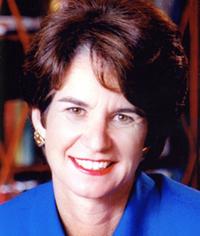 On St. Patrick’s Day I had the pleasure of speaking to about 350 Catholics who gathered together to attend a conference put on by New Ways Ministry, which is an effort to support the LGBT community in the Catholic Church. The women and men I spoke to included nuns and priests, children who had come out and parents who wanted to be supportive. Two female priests gave me special blessing and I left the meeting inspired by the devotion of those who attended. On St. Patrick’s Day I had the pleasure of speaking to about 350 Catholics who gathered together to attend a conference put on by New Ways Ministry, which is an effort to support the LGBT community in the Catholic Church. The women and men I spoke to included nuns and priests, children who had come out and parents who wanted to be supportive. Two female priests gave me special blessing and I left the meeting inspired by the devotion of those who attended.
New Ways Ministry has a critical mission, since changing the Church will help those who suffer from ill treatment not only here in the United States but around the world, where the Church has so much clout. The Church has millions of members in Africa and South America, where being gay or lesbian can lead to a death sentence.
Worse, the Church’s own teaching encourages bigotry and harm. Just last year, my father’s memorial, the Robert F. Kennedy Center for Justice and Human Rights, gave its human rights award to Frank Mugisha, a gay activist in Uganda whose good friend had just been brutally killed in his own home. American missionaries have encouraged the discrimination Mugisha suffers. Refuting their religious arguments is critical, and so is making a moral and religious case for gays. What we need is a transformation of hearts and minds, not merely a change of laws.
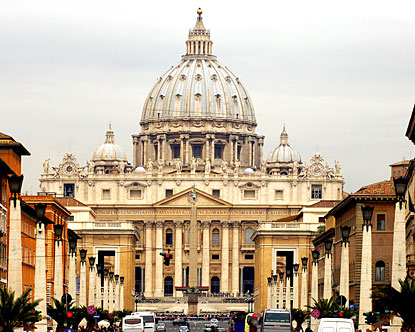
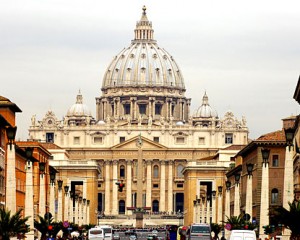 The Catholic Church’s attitude towards homosexuality is at odds with its tradition of tolerance and understanding. The actual practice of the Church is true to this tradition. What other institution separates men and women and encourages them to live together in monasteries and convents where they can develop deep relationships with those who share their kind of love? The Catholic Church’s attitude towards homosexuality is at odds with its tradition of tolerance and understanding. The actual practice of the Church is true to this tradition. What other institution separates men and women and encourages them to live together in monasteries and convents where they can develop deep relationships with those who share their kind of love?
The fight for the dignity of the LGBT community is a fight for the soul of today’s Church. Some conservatives see the hierarchy’s current, traditional teaching on sex as the Church’s defining position. They don’t really like to talk about, or even be reminded of, the Church’s teachings on immigration, or protection of the environment, or the greed that produces financial meltdowns, all of which they would find distastefully liberal.
Read the rest of…
Kathleen Kennedy Townsend: The Case for Gay Acceptance in the Catholic Church
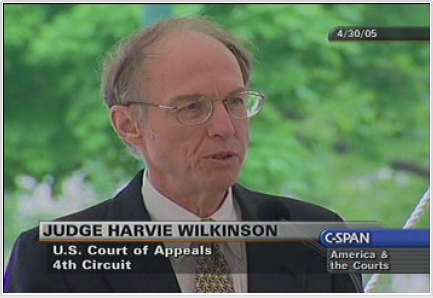
By Artur Davis, on Thu Mar 29, 2012 at 8:30 AM ET  Judge Harvie Wilkinson of the Fourth Circuit Court of Appeals could easily have been Justice Harvie Wilkinson of the Supreme Court. He was short-listed for vacancies in both 2005 and 2007, and his brand of conservative jurisprudence and judicial restraint bears more than a passing resemblance to John Roberts. Judge Harvie Wilkinson of the Fourth Circuit Court of Appeals could easily have been Justice Harvie Wilkinson of the Supreme Court. He was short-listed for vacancies in both 2005 and 2007, and his brand of conservative jurisprudence and judicial restraint bears more than a passing resemblance to John Roberts.
His essay last week in the New York Times is a thoughtful, elegant scolding of both liberals and conservatives who are bent on using the Constitution as the last resort when politics takes too long.
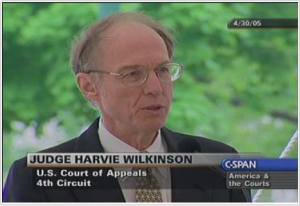 As Wilkinson notes, both the left and right have spent an inordinate amount of time on their own versions of judicial activism—liberals famously so in the context of abortion but increasingly in the context of same sex marriage as well. Liberals favor a robust vision of constitutional privacy over the shifting, ambivalent state of public opinion on both issues. Conservatives, meanwhile, are a week away from urging the court to overturn the Affordable Care Act’s mandate that individuals buy health insurance or risk a fine. If they win, it would be the first time since the thirties that the Court invalidated a major domestic statute. As Wilkinson notes, both the left and right have spent an inordinate amount of time on their own versions of judicial activism—liberals famously so in the context of abortion but increasingly in the context of same sex marriage as well. Liberals favor a robust vision of constitutional privacy over the shifting, ambivalent state of public opinion on both issues. Conservatives, meanwhile, are a week away from urging the court to overturn the Affordable Care Act’s mandate that individuals buy health insurance or risk a fine. If they win, it would be the first time since the thirties that the Court invalidated a major domestic statute.
Read the rest of…
Artur Davis: A Moderate’s Constitution
By Artur Davis, on Tue Mar 27, 2012 at 8:30 AM ET I’m half admiring and half-critical of Rule and Ruin, Geoffrey Kabaservice’s exploration of the decline of moderates as a political force in the Republican Party. On the admiring side, he dusts off an important, and mostly forgotten, phase in the turbulent sixties, when centrist Republicans simultaneously rescued civil rights legislation and fashioned a critique of bureaucratic liberalism that has held up well over the last four decades. Not only is it a vivid account of the era’s characters, it’s a valiant reminder that the unrestrained growth of both government and the safety net can be criticized for reasons that don’t contain a racist or hard-hearted foundation.
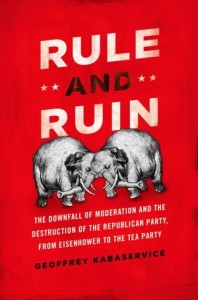 Click on book jacket to review On the critical side, an elegant narrative that is balanced and reserved in its political assessments for about 300 pages turns rushed and simplistic in its last hundred pages. Kabaservice on the post-Nixon era buys and re-sells the stock line that Reagan Republicans pulled the GOP away from its moorings to a right-wing fantasy-land, and that intemperate ideologues have refashioned the party in a way that has steadily erased any moderates or even thoughtful conservatives. It’s hardly wrong to fault the philosophical intolerance that does exist on the Right, but Kabaservice’s frustration with it leads him to minimize other large factors: first, the book has too little to say about the numerous centrifugal forces in American life that have pulled both the left and right away from the middle, including the surge of grassroots, cause based fundraising; the aggregation of special interests on both sides; and the explosion of a cable culture that profits off polarization. Any one of these developments is a book-length project, and the limited attention Kabaservice gives them puts too much weight on the machinations of politicians and kingmakers at the expense of forces much bigger than they were.
Read the rest of…
Artur Davis: Where Have All the Moderates Gone?
By Zac Byer, on Fri Mar 23, 2012 at 3:00 PM ET
 Good morning, and welcome to another offering of Prix Fixe Politics! I hope your brackets aren’t yet busted, and that you’ve enjoyed our first few weeks of spring. In the meantime, here is today’s meal…
Appetizer: I thought we could step away from politics for one meal and try something interactive. Here are five qualities of life that, frankly, all sound ideal. However, only one takes top billing with men, while one takes the top spot with women:
-More Choices
-More Time
-Fewer Hassles
-No Worries
-More Money
How well do you know American men and women? If you’d like, reply to this e-mail and send me your guesses — one for each gender. I’ll keep track of how everyone does, and in the next e-mail I’ll announce which two choices are truly what Americans want most in 2012. For one of the winners which I’ll select at random, a drink’s on me next time I’m in your city.
Read the rest of…
Zac Byer: Prix Fixe Politics — the GOP Primary Redux
By Artur Davis, on Thu Mar 22, 2012 at 8:30 AM ET Jamelle Bouie’s piece in the American Prospect on the glass ceiling for African American candidates is worth reading: it’s an interesting, and generally incisive, reminder that not a single African American has come within hailing distance of being elected to the Senate or governor (except the narrowly reelected incumbent, Deval Patrick) since Barack Obama’s election.
Bouie avoids the usual rhetorical trope about racism and white backlash and pays appropriate attention to the constraints posed by representing liberal, partisan districts that provide a limited donor base. It’s also to his credit that he focuses on institutional factors over vague claims that the system has simply failed to produce enough compelling black candidates.
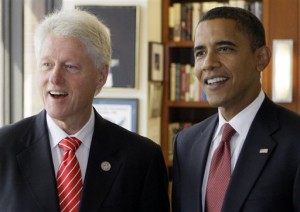 Bouie’s one major omission, though, is a failure to dig more deeply into the failure of credible black Democratic contenders to command significant support within their own party in recent races: it’s a vexing truth for liberals and Democrats and is at odds with one of the central narratives in politics today, that it is liberals who are advancing the ambitions of ethnic minorities and conservative Republicans who are thwarting them through schemes like voter ID. Bouie’s one major omission, though, is a failure to dig more deeply into the failure of credible black Democratic contenders to command significant support within their own party in recent races: it’s a vexing truth for liberals and Democrats and is at odds with one of the central narratives in politics today, that it is liberals who are advancing the ambitions of ethnic minorities and conservative Republicans who are thwarting them through schemes like voter ID.
Read the rest of…
Artur Davis: Do White Democrats Have a Race Problem?
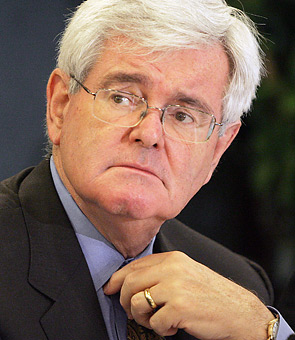
By Jonathan Miller, on Fri Mar 16, 2012 at 8:30 AM ET  Newt Gingrich shouldn’t drop out of the presidential race as long as he feels that he has something to say and to contribute, and he has the desire and fire in his belly to go through the process. Newt Gingrich shouldn’t drop out of the presidential race as long as he feels that he has something to say and to contribute, and he has the desire and fire in his belly to go through the process.
The GOP establishment hasn’t helped Gingrich in his race, and its calls for him to sacrifice for party unity are likely to fall on deaf ears. The amount of pressure these Republicans can put on Gingrich is marginal, since they are neither endorsing nor funding him.
Also, the idea that somehow Newt will lose his dignity if he stays in the race beyond his natural shelf-life…is, well, a bit absurd given who Newt Gingrich is and how he comports himself.
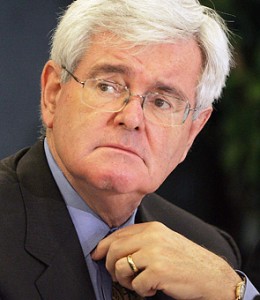 The argument that somehow Santorum would dominate Romney without Gingrich in the race is also misplaced, for several reasons. Firstly, I am deeply suspicious of the underlying rationale of this argument. The argument that somehow Santorum would dominate Romney without Gingrich in the race is also misplaced, for several reasons. Firstly, I am deeply suspicious of the underlying rationale of this argument.
It’s the same argument that suggests that Ralph Nader was responsible for Al Gore’s loss in 2000 and not Gore’s anemic campaigning that brought the race to the margin of error. This same argument falls flat with Santorum. Santorum is gaining ground, strength, and momentum from the way he is running his campaign.
Facts on the ground may conspire to make Newt largely irrelevant, as voters line up behind either Santorum or Romney. However, if Santorum loses to Romney, it’s his own fault. Not Newt Gingrich’s.
Read the rest of…
Krystal Ball: Only Newt Gingrich Decides When He Gets Out
By RP Staff, on Thu Mar 15, 2012 at 1:30 PM ET  The RP and Academy Award nominee Willem Dafoe appeared yesterday on Wall Street Journal’s Daily Wrap with Michael Castner. The RP and Academy Award nominee Willem Dafoe appeared yesterday on Wall Street Journal’s Daily Wrap with Michael Castner.
They were on to discuss their upcoming film Platoon 2: Electric Boogaloo.
  OK, not really. OK, not really.
Willem Dafoe was on to discuss some new movie of his about the end of the world.
And The RP talked about a different kind of apocalypse — the collapse of the American democracy, and what No Labels is doing about it. The RP reported on yesterday’s historic hearings on their “No Budget, No Pay” legislation.
It is worth a listen. Click here to hear the podcast.
By Jonathan Miller, on Thu Mar 15, 2012 at 10:00 AM ET
Just two more hours to enter an opportunity of a lifetime. Or at least a good time for all.
 Yesterday, “No Budget, No Pay” legislation — sponsored by Sen. Dean Heller (R-NV) and Cong. Jim Cooper (D-TN) — received its first hearing by the Senate Homeland Security and Government Affairs Committee, chaired by Sen. Joe Lieberman (I-CT). The landmark bill, sponsored by No Labels, would deny Congressmen pay if they fail to pass a budget and spending bills on time. (Read all about it here, and Click here for more information on how you can get involved.) Yesterday, “No Budget, No Pay” legislation — sponsored by Sen. Dean Heller (R-NV) and Cong. Jim Cooper (D-TN) — received its first hearing by the Senate Homeland Security and Government Affairs Committee, chaired by Sen. Joe Lieberman (I-CT). The landmark bill, sponsored by No Labels, would deny Congressmen pay if they fail to pass a budget and spending bills on time. (Read all about it here, and Click here for more information on how you can get involved.)
Now today, March Madness erupts — the first full round of the NCAA Men’s Basketball tournament begins play across the country.
To celebrate the convergence of these two monumental events, we at The Recovering Politician and No Labels are sponsoring our first NCAA basketball March Madness bracket challenge.
 No Bracket? No Pay! We are calling it…wait for it… “No Bracket, No Pay“. The RP Nation and No Labels activists across the country are invited to submit a completed NCAA bracket — for free — and the winning brackets (and perhaps some losers as well) will receive BIG CASH PRIZES.
(OK, full disclosure: The “BIG CASH PRIZES” don’t actually involve “cash.” But we will come up with some fun stuff to give away.)
Entering the tournament is simple and easy. Just click here and follow the directions. And you don’t need to be a roundball expert to play — in most office pools, it’s the clueless hoops-a-phobe that usually wins.
The deadline for entry is TODAY (!!!) at 12pm (Noon!!!) EDT.
And remember, you can’t win if you don’t play — No Bracket, No Pay.
Click here to join the fun today (or at least before today at Noon EDT.)
By RP Staff, on Wed Mar 14, 2012 at 1:30 PM ET The RP was back on Wall Street Journal radio last night talking up No Labels’ “No Budget, No Pay” proposal.
Click here to listen in.
By Jason Atkinson, on Tue Mar 13, 2012 at 3:30 PM ET Our own contributing RP, Jason Atkinson, has decided to take a sabbatical from politics, announcing they he would not run for a second term. Here’s the story from The Oregonian:
Steve Duin: Jason Atkinson’s choice not to run again means Oregon Legislature suffers an untimely loss
Published: Saturday, March 10, 2012, 10:00 AM
Why is Jason Atkinson involved in Oregon politics?For years now, the Central Point Republican has been close to the Ramirez family, the patriarch of which slipped across the border with Mexico in the ’70s, gained amnesty during the Reagan administration and raised eight children in Medford.
After Cesar Ramirez, the youngest of those children, graduated fromSouthern Oregon University in June, he told Atkinson he planned to take two years off to raise money for law school.
No way, Atkinson said: You can’t afford to take a break; we need to find you a scholarship. Three weeks ago, he invited Ramirez to the Capitol, showed him around Willamette University’s College of Law, then introduced him to a fellow Willamette Law grad, Paul De Muniz, chief justice of the Oregon Supreme Court.
Mightily impressed, De Muniz handed Ramirez his business card and said, “Let me know when you apply.”
When Ramirez later asked his tour guide how he could ever thank him, Atkinson said, “Show the chief justice’s card to your father. He’s going to have a proud smile on his face, holding that card. Memorize that look. And work as hard as you can getting through law school, remembering that look.”
Why is Atkinson exiting Oregon politics?
“We don’t do that in Oregon politics anymore,” he said. “In Oregon politics, that kid would be considered a Hispanic kid who is a drain on the system. That’s the pettiness of politics right now. It’s completely devoid of humanity.”
When Atkinson announced last week that he would not seek re-election in November, the state Senate lost one of its more thoughtful, balanced and idealistic personalities.”Twenty years ago, he would have been considered an idiosyncratic conservative,” said Jack Roberts, the former labor commissioner. “In a healthy party, that kind of conservatism, which carries some independence of thought, would be valued. Now, it doesn’t seem to be.”
Money is a significant factor in Atkinson’s sabbatical. He needs a better-paying job. “I’ll come back,” he notes, “when I can afford to come back.”
But Atkinson is increasingly unnerved, he said, by the anger in the public arena and the colleagues who pander to it.
When Atkinson decried the January 2011 shooting of Rep. Gabrielle Giffords, D-Ariz., arguing that we must abandon “the idea that I am right and you are evil,” he received so many threats that a sheriff’s deputy spent several weeks parked outside his Jackson County home.
When he finished speaking last week at a woman’s retirement party in his district, Atkinson said he was “attacked by three angry people. One guy comes up to me and says, ‘Why are you taking my freedom?’ The other two guys are angry that I’m too fish friendly.
“I’m thinking, ‘Hey, if you’re gonna beat me up, beat me up on Monday, will ya?’ It’s getting angrier and it’s getting more petty. I’ve lost my taste for the pettiness of politics.”
Atkinson — who reached the Legislature in 1999 — is the rare political figure who celebrates the Tea Party and a 100-percent rating with the Oregon League of Conservation Voters.
Huge chunks of his library are devoted to Theodore Roosevelt and fly-fishing. He knows the best book on C.E.S. Wood and regularly exchanged letters with the late Mark Hatfield on Herbert Hoover, the only U.S. president to live in Oregon.
Five generations of Atkinson’s family have waded the Klamath River. And every Wednesday during legislative sessions at the Capitol he leads a college seminar on politics and history for Senate floor staff and interns.
That weekly gathering, the Floyd McMullen Fire Brigade, is named after the 23-year-old firefighter — and Willamette Law student — who died when the Capitol went down in flames in 1935.
The decision to put that career on pause has been draining, Atkinson admits. But he needs some financial security, more time with his 9-year-old son, Perry — who was born three months premature and has already survived a romp with thyroid cancer — and a reason to believe there’s still nobility in public service.
Until the riptide turns, the last is a daunting proposition. Should he need a little extra encouragement, Atkinson could do far worse than to check in with a freshly energized Southern Oregon grad who is still working his way toward law school.
“Mr. Atkinson always told me to follow my dreams,” Cesar Ramirez said, “and if challenges come, to not be afraid to face them.”
|
The Recovering Politician Bookstore
|


 The Catholic Church’s attitude towards homosexuality is at odds with its tradition of tolerance and understanding. The actual practice of the Church is true to this tradition. What other institution separates men and women and encourages them to live together in monasteries and convents where they can develop deep relationships with those who share their kind of love?