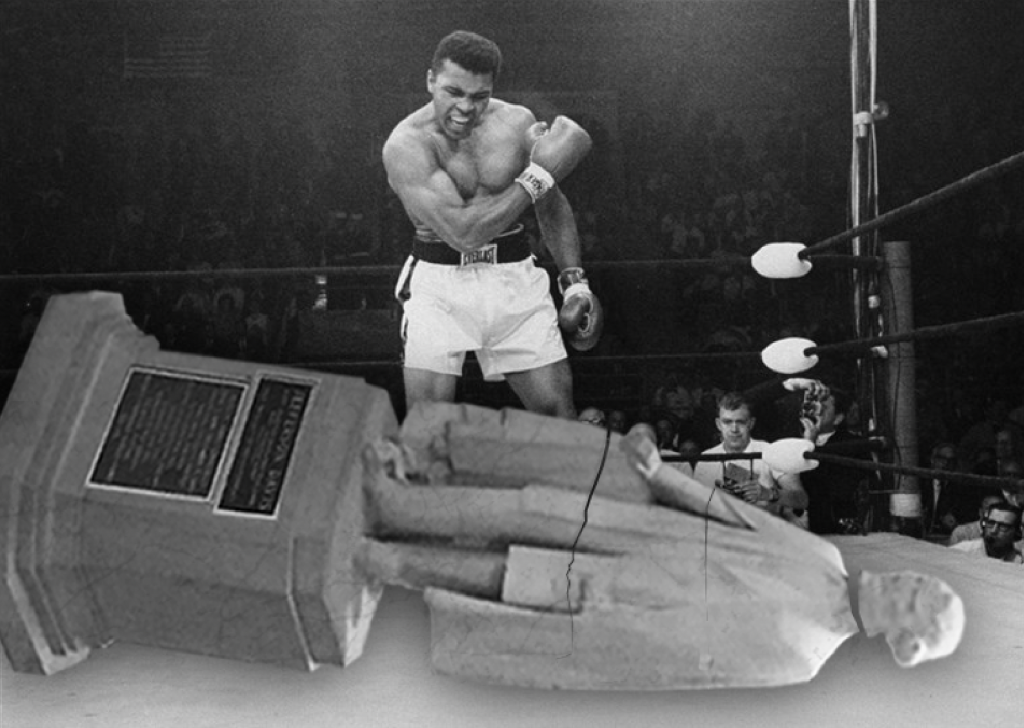
Please sign the petition below to remove the statue of Jefferson Davis currently in Kentucky’s Capitol Rotunda, and replace it with a tribute to Muhammad Ali, “the Louisville Lip” and “the Greatest of All Time.”
I just heard from the Ali family: It is the Champ’s belief that Islam prohibits three-dimensional representations of living Muslims. Accordingly, I have adjusted the petition to call for a two-dimensional representation of Ali (a portrait, picture or mural) in lieu of a statue.
UPDATE (Tuesday, December 2, 2014)
In this interview with WHAS-TV’s Joe Arnold, Governor Steve Beshear endorses the idea of honoring Muhammad Ali in the State Capitol (although he disagrees with removing Davis). Arnold explores the idea further on his weekly show, “The Powers that Be.”
Click here to check out WDRB-TV’s Lawrence Smith’s coverage of the story.
And here’s my op-ed in Ali’s hometown paper, the Louisville Courier-Journal.
UPDATE (Saturday, June 4, 2016)
In the wake of the 2015 Charlestown tragedy, in which a Confederate flag-waving murderer united the nation against racism, all of the most powerful Kentucky policymakers — U.S. Senator Mitch McConnell, Governor Matt Bevin, Senate President Robert Stivers and House Speaker Greg Stumbo — called for the removal of the Davis statue from the Rotunda. Today, as we commemorate last night’s passing of Muhammad Ali, there is no better moment to replace the symbol of Kentucky’s worst era with a tribute to The Greatest of All Time.
UPDATE (Wednesday, June 8, 2016):
Great piece by Lawrence Smith of WDRB-TV in Louisville on the petition drive to replace Jefferson Davis’ statue in the Capitol Rotunda with a tribute to Muhammad Ali.
UPDATE (Thursday, June 9, 2016):
Excellent piece on the petition drive by Jack Brammer that was featured on the front page of the Lexington Herald-Leader.
Highlight of the article:
Miller said he has received a few “angry comments” on his call to honor Ali.
“One of them encouraged me to kill myself,” he said. “You can quote me that I have decided not to take their advice.”
UPDATE (Friday, June 10, 2016)
The petition drives continues to show the Big Mo(hammed): check out these stories from WKYU-FM public radio in Bowling Green and WKYT-TV, Channel 27 in Lexington:
UPDATE (Saturday, June 11, 2016):
Still not convinced? Check out this excerpt from today’s New York Times:
By Jonathan Miller, on Tue Jul 1, 2014 at 5:18 PM ET
After two hours, I’ve built up my stack from 4500 to 5950. No special hands, just grinding out small victories. My best move was folding an ace queen when I was convinced my opponent had an ace king. I was right!
Biggest news: I met Trishelle from Real World Las Vegas
Most embarrassing news: I recognized Trishelle from Real World Las Vegas and introduced myself to her.
Growing up I always admired Michael Jordan. In my opinion, he is the best basketball player of all time. At the time he was playing professional basketball, I never imagined him making mistakes. But recently, I came across a quote where he said, “I’ve missed more than 9,000 shots in my career. I’ve lost almost 300 games. Twenty-six ties, I’ve been trusted to take the game winning shot and missed. I’ve failed over and over and over again in my life. And that is why I succeed.”
Air Jordan couldn’t have said it better. Even the greatest fail in some aspects of their career or business along their way to success.
Although MJ’s sentiment is spot on, here are three mistakes to avoid when building your business.
1. Assuming Growing Big Fast Is Best
Many people believe that quickly growing their company with numbers and employees is always a great thing and will make them more successful. But this isn’t always the case. Many times people learn this the hard way and fail fast after thinking that having a lot of people in-house would make them more profitable and successful. They fail financially and have smaller profits because of all the other costs involved.
As a small business owner, it often makes more sense to build strategic partnerships and mutually beneficial relationships. This allows you to keep your overhead costs lower and not have the stress of numerous employees as you begin to grow your profits. You won’t have to worry about everything else. Working with other businesses that might be bigger or offer more back-end support allows you to do what you do best, while at the same time utilizing the strengths of the other partner companies. Growing your business with key partners is often way more profitable than growing fast within.
2. Never Saying the Word “No”
As a small business owner and entrepreneur, it’s always tough to say or use the word “no.” As you begin your business, you want to be everywhere and be everything to potential clients. It’s very hard not to do this when you start out. If your business is somewhat successful, even at an early stage, you will be asked many times to coffees, lunches and events. At some point you have to say no to some people, free services and advice or meetings in order to continue to move forward with your business. On the flip side of the coin: you must say no to potential clients or projects you don’t want to really work on.
I understand as a small business it’s sometimes hard to say no to a decent paycheck and short-term reward, but if you don’t, you will regret it. Saying no to projects or clients your heart isn’t into, or your mind isn’t truly focused on, will allow you to work on those opportunities you really enjoy. This will allow you to leverage your strengths more. You will produce a much better product and your work will be stronger. Walking away from something in the short term will help you build the portfolio you want over the long term.
3. Planning Too Much
Small business owners often want to plan out every little thing, from the top to the bottom. We want to control everything and make sure it’s exactly what we had in our original plan. As a result, we find ourselves spending all our time planning out the future instead of being mindful of the present.
Why do these small business plans fail? They fail because too much time is spent on process and plan and not on execution. The Harvard Business School says 90 percent of well-formulated strategies fail due to poor execution. Fortune Magazine says 70 percent of CEO failures come not as a result of poor strategy, but from poor execution. As small business owners, it’s always good to remember to iterate and to not ever hesitate. Execution trumps devising another elaborate, time-consuming process or plan every time.
Life is a journey, not a destination. Mistakes are going to happen along the way. Always remember: if you don’t experience mistakes you will never learn what success can be. Don’t dwell on your business failures; instead, learn from your mistakes, be resilient and persevere.
A version of this article originally appeared in The Huffington Post.
@JasonGrill is the founder of JGrill Media where he consults on media relations, public affairs and strategies and government relations. Under same umbrella, he works in the media as a local and national writer/contributor, radio host and television analyst/commentator. He is the co-founder of Sock 101.
By David Goldberg, on Tue Jul 1, 2014 at 1:30 PM ET
Hemingway had it mostly right: “When people talk, listen completely. Most people never listen.”
I’d actually take it a step further: most people never ask.
To be an effective leader, it’s crucial to develop a culture where employees feel consistently heard, and that their feedback is having an impact on the organization. A simple way to do this is to just start asking.
Think about it: how often do you ask your significant other, child, family members and friends, “How are you doing?” It’s probably more than once a year. Curiously, we don’t follow the same construct in the workplace. We usually only ask employees once a year.
Most companies typically do this through an annual employee survey, or worse, water cooler discussions at executive meetings where conjecture and subjective opinions are offered on how people are “feeling.” Multiple studies have proven that this type of infrequent, ad hoc means by which most solicit feedback from their workforce has an extremely negative impact on employee engagement. It’s probably why, in its 2013 State of the Global Workplace report, Gallup found only 13% of employees worldwide are engaged at work – a ridiculously low number.
Last year, we surveyed HR leaders in Silicon Valley to find out how they were keeping their employees happy, healthy and heard. Five key themes emerged:
Money does matter
Hands-on approach is key
Employees want a voice
Employees must feel valued
Environment must be comfortable and positive
What’s interesting about the results is that 4 out of the 5 themes are centered on nurturing and building culture. This tells us that to really help employees thrive, listen to them. And, not just once a year. Culture isn’t an accident. It takes constant nurturing and work. One way to measure the health of your culture is through a series of employee engagement surveys.
At SurveyMonkey, we still do our annual employee survey. But we do it to identify a few key topics to explore deeper throughout the year. Then every three months, we solicit specific topic feedback and share the results with the team. For example, health benefits were an area that employees identified in the annual survey that they’d like improved. We followed up that annual survey with a specific benefits survey to all employees, and adjusted our offerings accordingly. The employees are part of the decision, feel heard, and we all feel a little bit wiser in the process. This ongoing survey dialogue allows your team leaders the ability to quickly identify issues and celebrate wins in real-time, not just once a year.
One parting word of wisdom. Don’t ask about things you’re not willing to change. Ignoring feedback is a sure way to disillusion a workforce. So, if you can’t change something, don’t ask. What you can change, involve employees. It will help build a healthy, thriving culture where everyone feels engaged and assured that their feedback has meaningful impact. So be wise. Stop talking. Ask and listen.
The author is the Founder and CEO of Survey Monkey
By Jonathan Miller, on Tue Jul 1, 2014 at 12:00 PM ET
Definition: “I am sooo over that (or him or her).”
Something people say when they are still obsessed about some event or person and aren’t really over it (or him or her), but don’t want others to suspect they are still completely obsessed and have been seeing a therapist twice a week for nearly a year-and-a-half to work through the issue and have made little progress.
==
Story of my life.
At airport and huffing and puffing carrying two stuffed bags, one on each shoulder, and neither with wheels.
How do other people know about these much simpler and better options?
I know they exist. I just can’t imagine myself every being particularly orderly and organized. But when I get back into this position I always regret not being. For about 15 minutes.
By Erica and Matt Chua, on Tue Jul 1, 2014 at 8:30 AM ET
Before we had even unpacked our bags in our sixth floor room in Can Tho there was a knock at the door. Upon opening the door in came a short, fiery Vietnamese woman that we could tell wasn’t going to take “no” for an answer before we could even figure out what she was selling. She squatted down and started pulling out photos, maps, a notebook and testimonials from previous customers. She jumped right into her sales pitch for her boat tours on the Mekong Delta for “good price.” Her English was some of the best we had heard in Vietnam and she was talking a mile a minute while writing down pricing in her notebook to show us. $20 for a half day private tour and $40 for a full day private tour down the Mekong Delta. Before we even had time to respond to anything she had presented she was shoving testimonials written in every language at us, clearly proud of all her happy customers.
Her aggressive sales pitch and excellent English landed us on a small boat at 5:30 am the next morning in the Mekong Delta. Breakfast was included, coffee too, as well as a driver and English speaking guide. Our guide was an affable older gentleman who had fought in the South Vietnamese Military alongside the Americans in the Vietnam War, which is where he picked up his English. They were a great pair for giving us a glimpse into life on the Delta and for getting plastic bags out of the motor so that the tour could continue.
The first stop was Cai Rung floating market, the largest in the Mekong Delta. Most of the trading, selling and buying happens between 6-8 am, so we were right on time. Next we headed to a small rice paper making operation, which also seemed to be raising pigs and pythons. With all the rice noodles we had been eating we didn’t know how they were made, so this stop was of particular interest as they made rice paper that was then made into noodles.
We continued down the Delta observing how people lived along the rivers and watching as new bridges were being built and barge traffic made it’s way towards Saigon. Much of the Mekong Delta looks the same, but we were kept entertained as our driver made us bouquets of flowers, grasshoppers and jewelry out of coconut palm leaves. Our guide also made us some pineapple lollipops and attempted to teach us Vietnamese.
Read the rest of… Erica and Matt Chua: Ms. Ha’s School of Marketing
By W. Carlton Weddington, on Tue Jul 1, 2014 at 8:15 AM ET
Our newest contributing RP, former Ohio State Representative Carlton Weddington, is currently serving a three-year sentence at the Allen Correctional Institution in Lima, Ohio for charges of bribery, election falsification and filing a false financial disclosure statement.
It is still early yet, but I feel like I can survive at least two years without any major problems or issues. Arguably my biggest challenge to date is that some of the inmates being held in Protective Control (PC) just don’t give a fuck.
This is business as usual for the career inmates, and they are the ones that make the time hard to do. We will see what happens.
The politics of PC is dramatic and intense — inmates continually jockeying for positions of power. Extortion, gambling, drinking, smoking and sexual favors are the strategic norms used without thought or question. On a daily basis, I witness the constant chatter and sidebar conversations that take place about the next play, hustle or shot to be taken. It is an ultra-surreal, action-packed story of mini-tragedies within themselves.
Guys are anxious to find compatible cellmates since they have begun to implement a more “strict” tier system. A few have already asked to cell with me without even asking me, but going directly to the case manager or unit manager. Luckily, both managers are sharing with me who is asking and showing me some respect because of my status and former position as a state legislator. The bold ones just ask me directly; some are cool, but that doesn’t mean I want to cell with them.
I remember one inmate saying: “Yo man, I put in a kite to cell witchu cause I know you ain’t gawn be no trouble.”
I was quick to say: “I don’t think I am going to have a cellmate, but thanks anyway.”
I am having a hard time grasping the fact that many of the inmates are living double lives on the low. Other inmates call them ‘homo thugs.”
I was shocked when I heard a gang member openly tell one of his horrifying tales: “Yo, I fucked his boy, he ain’t shit! …” was all I can really remember, but that was all I needed to know. Not only was he a gang hit man, but he spoke of his assaults on another inmate as a badge of honor. Big, bad and ready to “fuck or fight”!
For whatever reason, this mentality is a prison norm, with many of these same men having girlfriends, wives, and children on the street. I’m lobbying hard to stay in a cell by myself until I can figure this shit out and get my bearings together.
Unfortunately, a majority of the inmates in this unit are serving long sentences, and quite a few have life — some have even returned for their 3rd, 4th and 5th times. The mentalities of these men are unbelievable and distorted; their reality is clouded from the lack of outside contact and communication. The world is constantly changing and evolving without them; these men who are stuck in a warped, retarding environment that threatens to further sicken their ill hearts and minds through violence and other vices. Even though I am considered a “short timer” with a foreseeable outdate — back to reality of the chaos of the outside world unscathed, jaded and abused — I still must walk a fine line.
An inmate from my city calls me “lil Barack o’Drama.” He would say, “You ain’t no politician no more, you’s a criminal.” It didn’t bother me as much as when another inmate said, “Nigga, you think you betta than us but you in here wit us now!”
It was true that I had a college degree, wrote legislation that impacted 11.9 million people in the State of Ohio, and traveled the world; but the perception that I thought I was better than them was hard for me to handle. I considered myself the staunch advocate for the underdog, less fortunate, and minorities, even amid the inmates being housed in the facility.
To keep safe of any ill feelings someone might have of me, I would tell inmates who asked what I did for a living: “I was a low level analyst.” It worked for awhile, until word got around that I was more than I claimed to be. My name appeared on the letterhead of a response letter from the Correctional Institution Inspection Committee that several inmates had received — not to mention that it was stapled to the information boards in all the housing blocks. I immediately asked that it be removed and updated.
Read the rest of… A Caged Pol Sings — Former State Rep. Carlton Weddington Reports from Behind Bars on Sex, Violence and Survival
Globally-recognized personal trainer Josh Bowen will this week be providing intensive physical workout routines for The RP as he prepares to compete in the World Series of Poker.
By Jonathan Miller, on Mon Jun 30, 2014 at 10:00 AM ET
From Betsy Power of the Toronto Star:
Jonathan Miller
Hi, I’m Rob. And I’m a recovering politician.
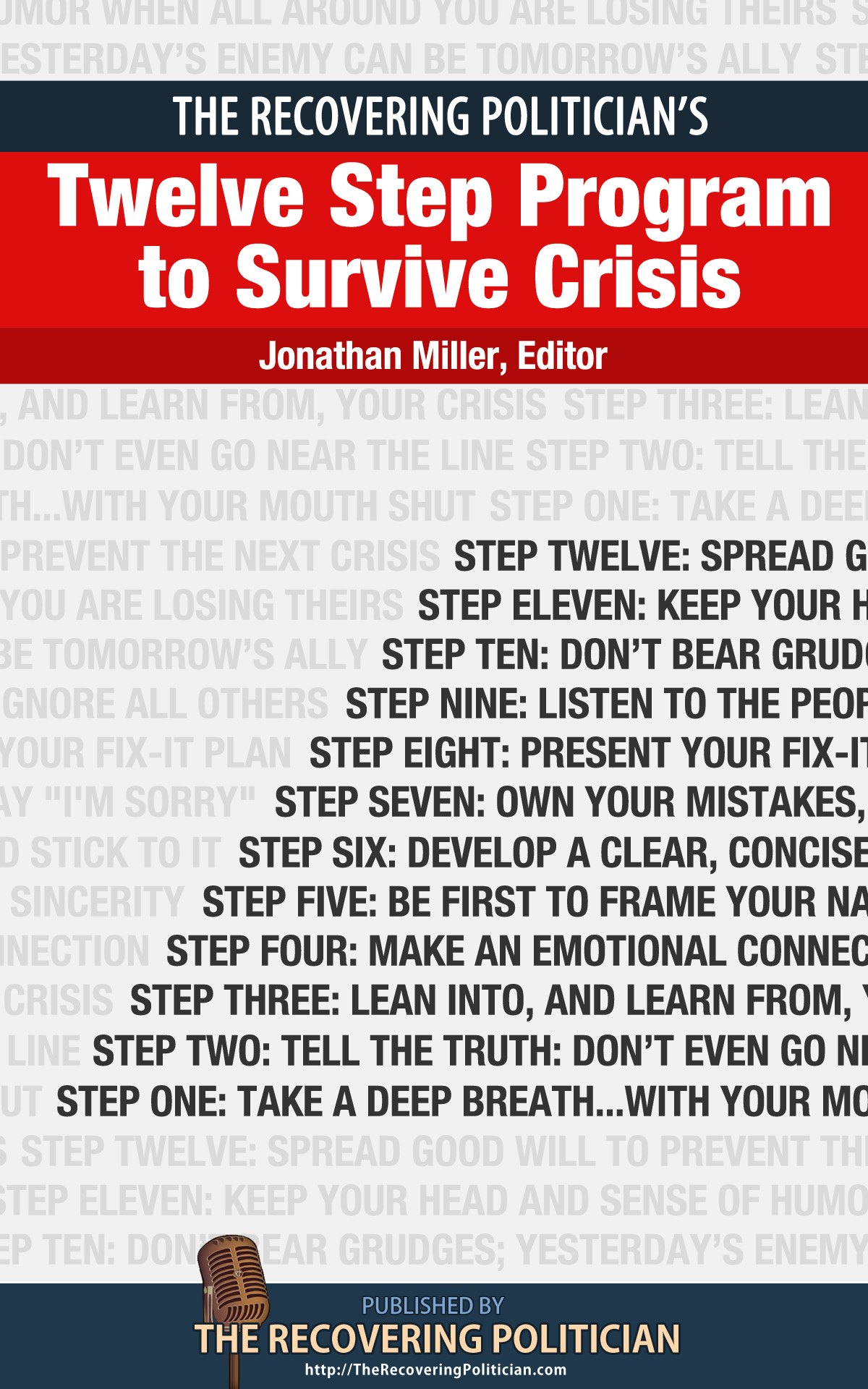
When Toronto’s world famous mayor leaves rehab and returns to city hall and the campaign trail Monday, Rob Ford might want to get his hands on The Recovering Politician’s Twelve Step Program to Survive Crisis, a 2013 book edited by Jonathan Miller, a former state treasurer of Kentucky. (His editor’s note opens with that take on the well-known Alcoholics Anonymous’ salutation.)
The book includes contributions from a dozen former American politicians sharing their “war stories” and advice on how to survive and transcend a crisis.
The steps include: Tell the truth. Own your mistakes, take responsibility and sincerely say “I’m sorry.” Make an emotional connection. Be first to frame your narrative in your own voice, with facts and sincerity. Present your fix-it plan.
North Americans, generally speaking, like to give public figures a second chance, Miller says, citing former U.S. president Bill Clinton, “the ultimate survivor,” and Marion Barry, the ex-Washington, D.C., mayor whom the New York Post calls the “original Rob Ford.”
Some comeback attempts don’t work out. Former New York governor Eliot Spitzer’s campaign for comptroller last year acknowledged his hooker scandal with an ad that said he’d “failed, big time,” and then he did. Former congressman Anthony Weiner scuttled his political re-entry by getting caught in a second sexting scandal.
Miller says that in his memory, no other scandal-scarred politician has sought re-election with the kind of “comprehensive baggage” Ford has accumulated.
“You’ve had people who suffered from addiction, others accused of hanging with criminal elements, and ethical impropriety. It’s just unprecedented to think of anybody with all of these accusations,” said Miller, a crisis management attorney and founder oftherecoveringpolitician.com.
The mayor and Councillor Doug Ford, his older brother and campaign manager, have promised the 45-year-old Rob Ford will be a “new man” after spending the last two months in a Muskoka rehab centre where he received treatment for alcoholism.
Ford went to the facility April 30 after audio recordings of him making racist remarks surfaced as well as another video allegedly showing him smoking crack cocaine, which was viewed by a Star reporter.
Ford’s actions in the coming days will be critical if he has a chance of persuading voters to re-elect him mayor on Oct. 27, Miller said.
His advice to Ford? Address the public and answer any and all questions — similar to New Jersey Gov. Chris Christie’s two-hour news conference after a bridge closing scandal.
“He (Ford) really needs to have a full, free, honest and sincere admission of wrongdoing and to say, ‘Here are the ways I am going to change my behaviour so you’ll never see this happen again.’ ”
Ford has scheduled a city hall news conference at 3:30 p.m. Monday, but he will not take any questions. That’s a mistake, said Miller, who is married to a Mississauga native and has spent a lot of time in Canada.
“Letting his critics come in and take every single question and answer it honestly and sincerely . . . that is the way to survive something like this.”
Miller would also advise Ford to speak to youths about the perils of drug and alcohol abuse, and donate money to addiction treatment facilities.
The key will be his sincerity, “and whether people really believe that what he is doing is sincere or rather just a cover for trying to find political redemption.”
But after months of defiance, name calling and angry denials about substance abuse and a string of embarrassing and outrageous behaviour, Ford will face a doubtful public. Emailing a photo of himself in a swimming pool and proclaiming rehab is “amazing” might play well with his hardcore base but it will do little to sway skeptics.
Down at city hall, for instance, Ford has invited councillors to join him in his office Monday afternoon for an “informal meeting.” None contacted by the Star planned to attend. Some wished him luck and hoped rehab had done him some good.
“I don’t make time to meet with bigots, sexists or homophobes,” Councillor Josh Matlow said, referring to some of the comments Ford has made in his drunken stupors…
Jeff Smith
Former Missouri senator Jeff Smith, a Recovering Politician contributor and another co-author of Scandal and Resurgence, said there’s a “reservoir of goodwill” for Ford, the same way there was for Barry, the former Washington mayor.
While both shared the ignominy of being caught on videotape smoking crack, the two men are popular with a similar constituency: people suspicious of government and media, and who view these politicians “as sort of persecuted underdogs,” Smith said.
“If Ford is able to channel peoples’ sympathies in a way that Marion Barry, I don’t think it’s inconceivable that he could be re-elected, but he can’t come back and have another episode, then it’s over,” Smith said.
Just last week, Barry, who is on a book tour promoting his memoir, Mayor for Life, denied he ever smoked crack in a hotel room when he was mayor in 1990. After going to jail, he was re-elected as mayor in 1994 and later won a seat on council that he still occupies.
Voters also respond to personal scandals differently than they do financial transgressions or those involving abuses of power,” Smith noted. In recent American history, financial scandals are more damaging.
“If it’s sex, a lot of voters are like, ‘what does that have to do with me, that’s between him and his wife and his God.’ If it’s public money, voters are like, ‘that’s my tax money,’ so it’s a different reaction.”
Smith was once a rising star in the Democratic Party and subject of the critically acclaimed documentary Can Mr. Smith Get to Washington Anymore? His political career ended after he pleaded guilty to election-related fraud and went to prison in 2010 — punishment even his political enemies believed was wildly excessive.
Now a politics professor, Smith said Ford will have to craft his message aimed at the “fence sitters,” and not direct his message to the people “who identify with the sort of grievance-based politics that fuelled his rise.”


 Blog this!

 is the founder of