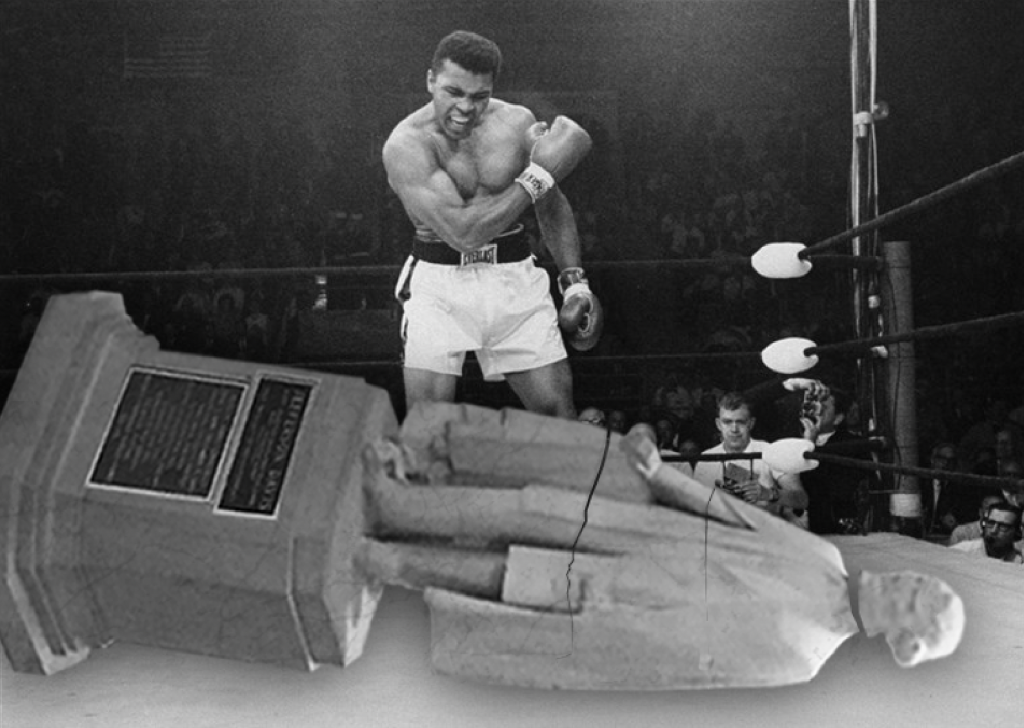
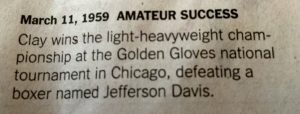
Please sign the petition below to remove the statue of Jefferson Davis currently in Kentucky’s Capitol Rotunda, and replace it with a tribute to Muhammad Ali, “the Louisville Lip” and “the Greatest of All Time.”
I just heard from the Ali family: It is the Champ’s belief that Islam prohibits three-dimensional representations of living Muslims. Accordingly, I have adjusted the petition to call for a two-dimensional representation of Ali (a portrait, picture or mural) in lieu of a statue.
UPDATE (Tuesday, December 2, 2014)
In this interview with WHAS-TV’s Joe Arnold, Governor Steve Beshear endorses the idea of honoring Muhammad Ali in the State Capitol (although he disagrees with removing Davis). Arnold explores the idea further on his weekly show, “The Powers that Be.”
Click here to check out WDRB-TV’s Lawrence Smith’s coverage of the story.
And here’s my op-ed in Ali’s hometown paper, the Louisville Courier-Journal.
UPDATE (Saturday, June 4, 2016)
In the wake of the 2015 Charlestown tragedy, in which a Confederate flag-waving murderer united the nation against racism, all of the most powerful Kentucky policymakers — U.S. Senator Mitch McConnell, Governor Matt Bevin, Senate President Robert Stivers and House Speaker Greg Stumbo — called for the removal of the Davis statue from the Rotunda. Today, as we commemorate last night’s passing of Muhammad Ali, there is no better moment to replace the symbol of Kentucky’s worst era with a tribute to The Greatest of All Time.
UPDATE (Wednesday, June 8, 2016):
Great piece by Lawrence Smith of WDRB-TV in Louisville on the petition drive to replace Jefferson Davis’ statue in the Capitol Rotunda with a tribute to Muhammad Ali.
UPDATE (Thursday, June 9, 2016):
Excellent piece on the petition drive by Jack Brammer that was featured on the front page of the Lexington Herald-Leader.
Highlight of the article:
Miller said he has received a few “angry comments” on his call to honor Ali.
“One of them encouraged me to kill myself,” he said. “You can quote me that I have decided not to take their advice.”
UPDATE (Friday, June 10, 2016)
The petition drives continues to show the Big Mo(hammed): check out these stories from WKYU-FM public radio in Bowling Green and WKYT-TV, Channel 27 in Lexington:
UPDATE (Saturday, June 11, 2016):
Still not convinced? Check out this excerpt from today’s New York Times:
By Erica and Matt Chua, on Tue Jul 8, 2014 at 8:30 AM ET
There are few situations more overwhelming than finding yourself in one of India’s largest cities. The sensory assault soon crescendos into an all out war on your senses with the cacophony of noises and smells fighting for your attention. The problem is these aren’t pleasant sounds and smells, constant honking, yelling along with the stench of garbage urine and body odor. So, what can I say to convince you that visiting any of these cities would be an enjoyable experience. Well, along with staggering statistics these cities also boast some of the best dining, sights and experiences India has to offer.
Chowpatty Beach in Mumbai
MUMBAI 20.5 million
Mumbai has something for everyone with the world’s most prolific movie industry, one of Asia’s largest slums, the most expensive residence ever built and more artists and servants than L.A. India’s most modern metropolis is a 24 hour party or the best place to find a good book and a proper cup of coffee- you decide. We’ve talked to travelers that couldn’t get out of there fast enough, but we could have stayed and eaten the cupcakes at Theobroma forever. It’s a city where dreams are born and dreamers dwell, so come and get inspired!
When to Go: October to February
Don’t Miss: Chowpatty Beach (FREE), Malabar Hill (FREE, a round trip cab ride from Colaba is about $4) , Bollywood (If you’re an extra they pay you!), Restaurants of Colaba (a nice dinner for two $20-$100 without wine), Dharavi slum (tour through Reality Tours is $10 per person), Dhobi Ghat laundry area (FREE, a round trip cab ride from Colaba is about $4)
Humayun’s Tomb in Delhi
DELHI 17 million
Read the rest of… Erica and Matt Chua: India’s Big City Life
Last month I had the pleasure of reconnecting with many classmates at the same reunion that Jonathan Miller enjoyed. I went to a panel discussion about health care reform. As a physician who is interested in health policy, I was eager to hear what the panelists had to say. My former classmates were now health services researchers, physicians, and health policy experts. Other audience members were now health insurance executives, policy makers, and health care users with diverse political affiliations. It didn’t take long before I felt as if I had mistakenly walked into a foreign language film without English subtitles. While Canadians may spell and pronounce words differently, understanding American English is usually not a hardship. The language used in public discourse on the Affordable Care Act, however, simply does not resonate with Canadians.
While I have lived in the US, I have never practiced medicine there, nor have I ever been a consistent user of US health care services (unless you count sporadic interactions with the University Health Service in college– but let’s not). I have spent over 20 years as a health care provider and a lifetime as a health care user in Canada. I am not a comparative expert on US vs. Canadian health care models. I have simply experienced the Canadian system both as a physician and a patient/ advocate.
There are three key components of the Canadian universal health care system that are integral to its success and might illustrate the true differences between citizens of both countries (aside from the Canadian propensity to be polite and apologetic). The first is the way in which Canadians view their right to health care. It is an expectation but not one that is felt to necessarily be an immediate one. Canadians are very patient people (unless they are watching an NHL playoff game on TV and the cable goes out). I think it is similar to garbage collection. I pay taxes to the city of Toronto and in return I get my garbage collected on a regular basis. While I might want the garbage collectors to come every day, instead I have to wait patiently to have it removed according to the schedule.
What if there is a chemical spill or a major hazard that would require removal of toxic waste urgently? There is a way to initiate an emergency system to get that garbage removed. Access to health care is seen in much the same way.
Another component of Canadian Medicare that supports its success is the belief of most Canadians that every citizen has the right to access the system. While there may be geographic variations with respect to the services that are offered, those differences are not unique to this country. It is similar to public primary and secondary education. This belief is part of the fabric of the country.
The last characteristic of Canadian Medicare might sound odd. I actually believe that we have less government and third-party intervention in the doctor-patient relationship in Canada when compared to the US. While government involvement in instituting Obamacare has met with resistance from insurance companies and individuals on many levels because of the fear of losing free choice, the recent Supreme Court Hobby Lobby decision suggests that there is a long road ahead. As a physician, I see patients and bill the province’s Ministry of Health, who then pays me for the services that I have provided. Neither the patient nor the physician has to get approval from a third party for the care that is needed. The role of health insurance companies is for extended benefits only, such as dental and psychological services, medical device costs, medication costs, and use of private hospital rooms. While there are government controls on overall costs and resource allocation, there are certainly no government or third parties interfering with moral decision-making for the patient.
Canada has usually been a little behind the times when compared to the US. In a reference to the ‘80s fashions worn by Robin Sparkles in 1994 in an episode of How I Met Your Mother, Cobie Smulders’ character says, “The ‘80s didn’t come to Canada ‘til like ’93.” While that may be the case for access to stores like Target (which finally opened in Canada in 2013), access to health care in Canada is the exception. While uninsured rates for those without health insurance are followed closely south of the border, and are thankfully dropping, they are negligible in Canada and have been for 50 years.
In 2004, the Canadian Broadcasting Corporation (CBC) launched a TV series called The Greatest Canadian. It was a reality show/documentary, of sorts, that encouraged viewers across the nation to nominate the greatest Canadian. The winner was not Mike Myers, Wayne Gretzky, Alexander Graham Bell, William Shatner or Jim Carrey. It was Tommy Douglas, the politician who is rightfully considered the father of universal health care in Canada. This year, the federal government ran an on-line survey asking Canadians which of the country’s accomplishments “make you most proud to be a Canadian?” The answer, not surprisingly, was Medicare. So this Canada Day (yes, July 1 is a real holiday here with beer and fireworks and everything), I will pick up a bottle of Molson Canadian and toast Mr.Douglas.
By John Y. Brown III, on Mon Jul 7, 2014 at 12:00 PM ET
Kudos to Laura Ungar of the Courier-Journal for her clear-eyed, bold and much needed investigative piece on Suboxone. It isn’t critical as much as asks (and attempts to answer) sobering questions after the much heralded anti-addiction drug has now had time to demonstrate if it has been as effective as it’s early champions heralded it would be.
Four years ago, I agreed to disagree with several doctors –in a discussion that turned contentious at times– that Suboxone, alone, was all many addicts needed to overcome their drug addiction.
The doctors, well-meaning but short sighted, in my view, insisted on the above position and dismissed my skepticism because I wasn’t a trained medical expert.
That is a tough position to be in if you are trying to convince someone of your opinion who is a “trained medical expert.” So I backed away without backing down entirely.
I don’t have medical training and they each did. They knew and cited studies and treatment outcome data. All I had is that in my experience people, including doctors, who felt supremely confident in themselves in successfully treating the deeply mysterious and heart wrenching disease of addiction, eventually had their over-confidence displaced by humility.
I wish that weren’t the case and that there were a kind of “magic pill” to fix an addiction to other kinds of “magic pills.” But it’s not that easy. As I said then, and still believe, some medications may serve the equivalent role of “water wings” to someone trying to beat addiction–help them float while they are trying to learn to swim. But water wings, by themselves, are only a tool, and a limited one at that. Especially if you are trying to learn to swim and they are the only thing between you and drowning.
It’s time for me to come clean. In today’s social media crazed world it will come out sooner or later anyway. I have one high school varsity letter and it’s for bowling. Yes, you heard right, bowling. And it wasn’t ten-pin, but candlepin bowling. Anyone who grew up in New England, with parents like mine who looked for ways to get the kids out of their hair on rainy Saturdays, knows exactly what I’m talking about. Candlepin bowling rocks.
For those of you who aren’t from New England, candlepin bowling is a unique version of the sport invented in 1880 in Worcester, Massachusetts by a local bowling alley owner, Justin White. Candlepin bowling is clearly evidence of New England as a regional innovation hot-spot. For the most part candlepin never caught on outside of New England and the Canadian Maritime provinces. In the region candlepin bowling enjoyed a cult following including its own local television shows. I remember Candlepins for Cash, which was a Saturday morning staple and may well have been the first reality television show.
The first noticeable difference from the more popular ten-pin variety of bowling is the small size of the balls. Don’t look for holes for your fingers because there aren’t any. The ball is 4 ½ ” in diameter weighing only 1.13 kg. It fits in the palm of your hand and can literally be thrown rather than rolled down the alley at the pins. I have seen many errant candlepin balls launched across lanes. Personal injury insurance is a must. Back in the day I owned a set of balls (spare me the cajones jokes) and yes of course the required bowling ball bag. The balls were a pearly white with wonderful lime green marble swirls throughout. Come to think of it I wonder where they went. Most likely my wife sold them at a garage sale when I wasn’t paying attention.
Another difference in candlepin bowling is the size of the skinny pins (15 ¾ ” by 3″) which are harder to knock down so you get three tries in every frame versus the two attempts you get in ten-pin. My favorite difference in candlepin bowling is that the deadwood between shots isn’t cleared. In other words pins that are knocked down are left as they lie to either impede or aid the subsequent shot in each frame. You haven’t lived until clearing a 7-10 split which would be all but impossible without the help of well-placed deadwood. I love this aspect of the sport and in this way candlepin bowling is like the innovation process and life. There is always deadwood to deal with. It is how you deal with and leverage the deadwood in your life that defines you.
Innovation is a better way to deliver value. It isn’t an innovation until value is delivered to an end-user in the real world. Innovators must figure out how to deal with deadwood. This ability often marks the difference between an innovator and a non-innovator. It isn’t the lack of ideas or technology that gets in the way it is stubborn humans and institutions that slow down or block experimenting with and scaling a better way. Most give up when deadwood is either blocking the way forward or it seems insurmountable and not worth the personal effort or risk. Innovators don’t give up and are never deterred. They incessantly find ways to go around or through deadwood. The most creative innovators find ways to leverage deadwood. They actually put it to use in exploring new and better ways to deliver value and solve problems. Innovators co-opt or repurpose people and capabilities to enable the innovation process. What looks like deadwood to most is just part of the solution for an innovator.
This is the secret of how innovators confidently attempt 7-10 splits when no one believes a proposed innovation is even possible. Innovators see ways to recombine capabilities in order to tackle the seemingly impossible. They are relentless in trying new permutations until some new combination works. Innovators have learned to leverage deadwood to find new ways to create, deliver, and capture value. This innovation junkie is proud of his bowling varsity letter. Bring on the deadwood.
By John Y. Brown III, on Sun Jul 6, 2014 at 12:00 PM ET
Sunday morning.
Eight thirty in the A.M.
A blonde dame, my wife Rebecca, was in the other room.
She was trouble but knew what she wanted –even if she didn’t know why. I was attracted to trouble, especially trouble named Rebecca. I didn’t know what I wanted—but at least I knew why (thanks to a good therapist who cost me some serious cabbage).
We each had a cup of Joe –mine with sugar and cream; hers with Splenda and skim milk.
Like I said, it was Sunday.
And Sundays can be boring.
So I tried to fancy it up with film noir dialogue. Dialogue that was edgy hut as plain and as cheap as a two day old vanilla scone from a coffee shop you’ve never heard of –and will never go back to (after eating the two day old vanilla scone).
I didn’t create this problem of facing long Sundays with no plans. But I was going to have to solve it.
It’s what I do.
I don’t know why it’s what I do. But I do know why I don’t know why. (See above about having a good therapist.)
It wasn’t the beginning of a beautiful friendship. It was the middle of a beautiful marriage. That line may not be as catchy as the one from Casablanca, but it’s more than Bogie and Ingrid Bergman ever had. And it’s in color, see?
Maybe the middle of beautiful marriages isn’t supposed to make you think of film noir—of dark alleyways, danger and surprise lurking, guns with fingers twitching and bad dialogue around ever corner. I guess they are more like a relaxing Sunday morning. But still with a cup of Joe. And preferably fresh scones, from the coffee shop you know always go to.
Globally-recognized personal trainer Josh Bowen will this week be providing intensive physical workout routines for The RP as he prepares to compete in the World Series of Poker.
When business leaders talk about the ‘race for talent,’ you naturally want to know more about where the contestants in that race are going to come from, and exactly how they are training for the race. The answer, at least in the US, has for a very long time belonged to the higher education sector.
But there’s a significant disconnect here. Come June (graduation season) and then again come September (tuition check writing season), you can pick up any major newspaper and get even odds on finding an article or editorial that asks if a college education is worth the time and cost. If the race for talent were quite so intense, would anyone wonder about the value of college?
Today it’s absolutely fair to wonder. College education is one of the largest expenditures and investments that most people make in the course of their lives, with the possible exception of their primary real estate. These days, of course, a decent college education can cost a lot more than a decent apartment in most cities. And don’t forget the four (or more) years of opportunity cost, when the student is being a student and not something else that could earn him or her a salary.
And yet for a long time, at least in the United States, ‘is college worth it’ wasn’t even a question, or at least not a question you would pose in polite conversation. The economics of higher education seemed definitive: the more schooling you had, the more the labor market valued you and the more money you made over the course of your life (the only exception to that rule being non-professional PhD degrees). For most of the post-World War II period (and it’s still true today) a college degree was one of the best guarantees against unemployment during labor market downturns. And all of this, without even mentioning the inherent value of learning and socialization that happens during those four ‘wonderful’ years. Even electrical engineering students take a philosophy or art history course now and again, and human beings are indeed much more than simply labor market inputs. College was supposed to make them better at both.
Read the rest of… Matt Ranen: LABOR MARKETS, HIGHER EDUCATION, AND THE RACE FOR TALENT
By John Y. Brown III, on Fri Jul 4, 2014 at 12:00 PM ET
The image that I think best signifies Independence Day for our country isn’t bright colors waving gloriously in the wind or even extravagent fireworks exploding across the sky.
I think the most fitting image is a small but determined flickering flame that burns quietly through the day and night in each of us. That spark. That inclination. That dedication. That incontrovertible belief at our core that each of us is endowed by our Creator with cerain unalienable rights, that among these are life, liberty and the pursuit of happiness.
The spark that ignited a revolution to free ourselves, not the world, so that we might enjoy the fruits of living freely, if we could remember how to preserve it for ourselves.
Independence Day, for me anyway, is about honoring and fanning that giant little flame in each of us that animates our daily lives and defines the country we are blessed to call home.
By Jonathan Miller, on Fri Jul 4, 2014 at 10:00 AM ET
As millions of Americans celebrate our nation’s birthday with parades, grill-outs and firecrackers, I will be stuck in a cavernous, over-air-conditioned, non-descript warehouse, leaning over cushioned tables with several hundred other exhausted, bleary-eyed (mostly) men.
And having the time of my life.
Yes, in a few hours, we will begin Day 2 of the World Series of Poker’s “Little One for One Drop” tournament, and I’m still in the hunt. (Read more about the tournament and the incredible charity it supports in my Daily Beast report from last year’s event.)
Precisely, with over 14,000 chips, I’m in 529th place out of the 887 remaining players who have so far survived 10 hours through a field of more than 4400 poker-star wannabes. (Is it fitting that I built my political career around the creation of a 529 pre-paid tuition plan in Kentucky? Naahhhh.)
I am really lucky to be here, and that’s not just some Gehrig-like humility. A little over an hour into the event, I made the stupidest, most regrettable move that I have ever attempted in my three years of World Series events. I was dealt an Ace-10, and the flop revealed a 10, 8 and 6. The betting got intense, and a talky, charismatic Californian at the other end of the table with a larger stack than mine ultimately made a very large bet. I impulsively went all-in, having the top pair on the board (10s) and the biggest kicker (an Ace).
However, with all of the betting, I should have realized that I did not have the best hand. In retrospect, it was very possible that the Californian had flopped trips (three of a kind). Indeed, when he called me and turned over his cards, he held an 8-6, therefore having two pairs.
I was in serious danger of leaving the tournament VERY early. I thought I had 6 “outs” — there were 3 Aces and 3 tens left in the deck that could possibly save me. When the turn (fourth card) revealed a 4. I had one chance left. Finally, came the river. Praying in vain for an Ace or a 10, instead another 4 appeared. I got up thinking my tournament ended with a stupid mistake.
Then, the player to my right quickly informed me that I had just won. I was now the holder of two pair — tens and fours, and my two pair was larger than the Californians. I had doubled up through my stupid luck.
The poker miracle served also as a wake-up call. I became a lot more focused on my conservative/aggressive game (playing only the top hands and playing them with boldness) and played perhaps my best poker ever. I was up to over 20,000 chips, and was poised to jump to 26,000 until I got rivered in an all-in against a short stack. (He had only two cards that could save him from elimination, and one of them showed up.) Still, while the loss took me down to 14,000, I’m still very much in the game, starting today in a slightly below average stack position.
So, now it’s time for your help. Yesterday, I wore my lucky outfit — my Cincinnati Reds Joe Morgan jersey and No Labels ball cap. I’m wondering if I should wear it again (with different undergarments, of course!) — or if I should switch up to my Anthony Davis UK jersey or my Jeremy Lin Harvard jersey. Please provide your counsel in the comments below.
Meanwhile, if you need to get away from Fourth of July festivities, you can follow the action here at the WSOP Web site, starting at 4PM EDT/1 PM PDT.


 Blog this!