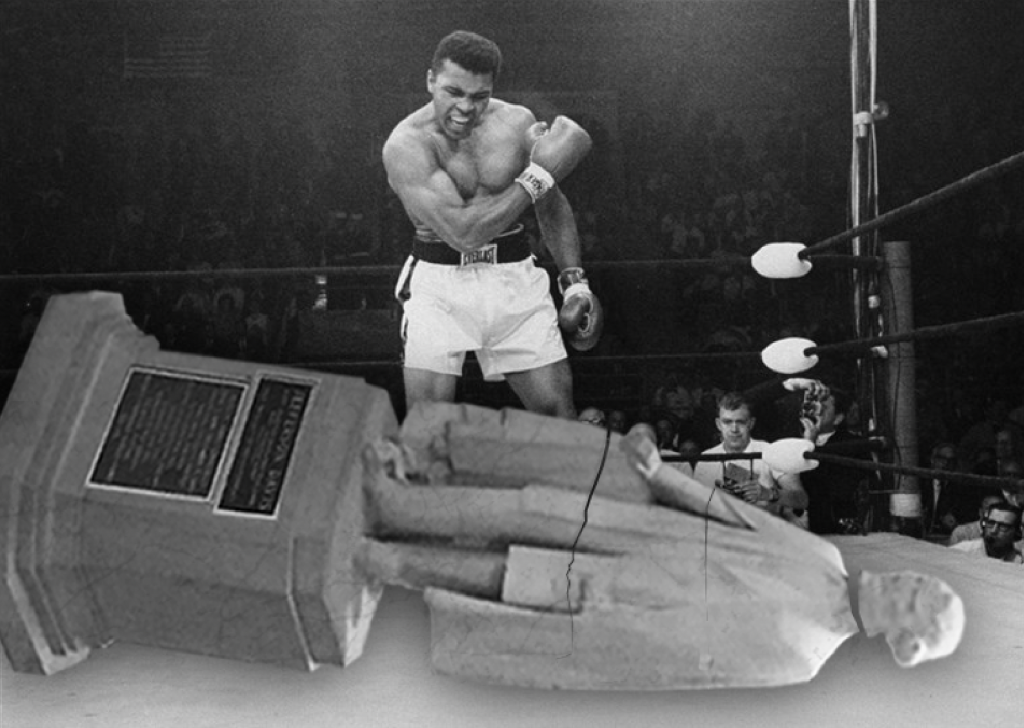
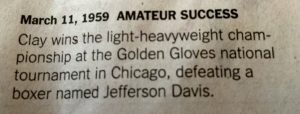
Please sign the petition below to remove the statue of Jefferson Davis currently in Kentucky’s Capitol Rotunda, and replace it with a tribute to Muhammad Ali, “the Louisville Lip” and “the Greatest of All Time.”
I just heard from the Ali family: It is the Champ’s belief that Islam prohibits three-dimensional representations of living Muslims. Accordingly, I have adjusted the petition to call for a two-dimensional representation of Ali (a portrait, picture or mural) in lieu of a statue.
UPDATE (Tuesday, December 2, 2014)
In this interview with WHAS-TV’s Joe Arnold, Governor Steve Beshear endorses the idea of honoring Muhammad Ali in the State Capitol (although he disagrees with removing Davis). Arnold explores the idea further on his weekly show, “The Powers that Be.”
Click here to check out WDRB-TV’s Lawrence Smith’s coverage of the story.
And here’s my op-ed in Ali’s hometown paper, the Louisville Courier-Journal.
UPDATE (Saturday, June 4, 2016)
In the wake of the 2015 Charlestown tragedy, in which a Confederate flag-waving murderer united the nation against racism, all of the most powerful Kentucky policymakers — U.S. Senator Mitch McConnell, Governor Matt Bevin, Senate President Robert Stivers and House Speaker Greg Stumbo — called for the removal of the Davis statue from the Rotunda. Today, as we commemorate last night’s passing of Muhammad Ali, there is no better moment to replace the symbol of Kentucky’s worst era with a tribute to The Greatest of All Time.
UPDATE (Wednesday, June 8, 2016):
Great piece by Lawrence Smith of WDRB-TV in Louisville on the petition drive to replace Jefferson Davis’ statue in the Capitol Rotunda with a tribute to Muhammad Ali.
UPDATE (Thursday, June 9, 2016):
Excellent piece on the petition drive by Jack Brammer that was featured on the front page of the Lexington Herald-Leader.
Highlight of the article:
Miller said he has received a few “angry comments” on his call to honor Ali.
“One of them encouraged me to kill myself,” he said. “You can quote me that I have decided not to take their advice.”
UPDATE (Friday, June 10, 2016)
The petition drives continues to show the Big Mo(hammed): check out these stories from WKYU-FM public radio in Bowling Green and WKYT-TV, Channel 27 in Lexington:
UPDATE (Saturday, June 11, 2016):
Still not convinced? Check out this excerpt from today’s New York Times:
By Stephanie Doctrow, RP Staff, on Wed Jul 6, 2011 at 4:00 PM ET
A new U.S. Army program helps soldiers improve their mental health after coming back from the combat zone. [Washington Post]
Here’s a kind of recovery that you don’t see every day: scientists digging mammoth and mastodon bones out of the ground. [NY Times]
Celebrity chef Anthony Bourdain talks overcoming bankruptcy and living on the edge (sample quote: “I had no self-control. I denied myself nothing. I had no moral compass.”. [Newsweek]
Got 12 minutes to kill? Spend it with the beautiful stop motion short film “Zero.” It will make you contemplate the world and how you can make it better. [Huffington Post]
Maybe this isn’t related to recovery, but it’s seriously cool. Graphic design and public relations firms analyze the current 2012 Republican presidential nominees’ campaign logos. [CNN]
By Zack Adams, RP Staff, on Wed Jul 6, 2011 at 3:00 PM ET
The Politics of Laughter
Did you ever play the telephone game when you were a kid? It’s the one where you whisper a message to someone, send it around the room and see what it turns into. Well, this website has a similar tool that uses Google Translate to translate your message into over 20 different languages. [Translation Telephone]
Who ever created this advertisement probably was not an engineer. [picture]
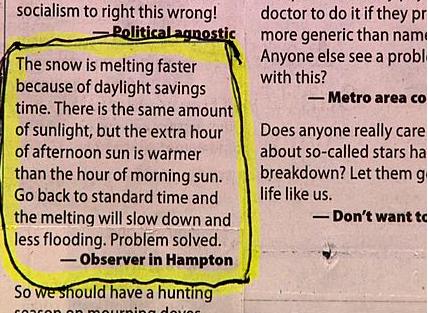
Yeah, I’m not sure things work the way you think they do, Observer in Hampton. [newspaper]
By Will Allison, on Wed Jul 6, 2011 at 10:30 AM ET
Hello there! My name is Will Allison, and Jonathan has quite generously offered to let me blog at RP. I thought I’d use my inaugural piece to fill readers in on who I am, and where I am coming from.
You might be wondering…who? Well, first and foremost, I am a proud native son of Louisville, KY. I grew up in the Highlands, in a family that passionately mixed politics with the arts. My father was a civil rights attorney, my mother an actress and acting teacher. If we weren’t at Actor’s Theatre, we were at a rally at Memorial Hall. One of my earliest memories is watching my mother perform in a one-woman show, portraying the South African anti-apartheid activist Ruth First. I guess you could say that experience was emblematic of my parents’ activism, and the values they taught their children.
Both of my sisters entered the arts, so as I became a teenager, I tried to take a different path, focusing on writing rather than politics or the theatre. However, I was quickly drawn back to the stage, attending the Youth Performing Arts School and falling in love all over again with Euripides and Stephen Sondheim alike. Assured I would become the next Ralph Fiennes, I journeyed far after high school from Louisville to Boston to continue my acting training. I had some great moments with Pinter, Brecht, Kaufman, Shakespeare and others. Assured I would become the next Philip Seymour Hoffman, I journeyed (not so) far after college from Boston to New York, to take the world by storm.
Well, that didn’t pan out so much. So, I turned back to the other family business.
Jane Hoffman
In the spring of 2002, I joined Democrat Jane Hoffman’s campaign for Lieutenant Governor of NY State as a junior staffer. It’s worth pointing out that joining any Democrat’s campaign for anything in the spring of 2002 was a risky proposition at best. The city was still reeling from the terrorist attacks of September 11, 2001. George W. Bush had poll numbers in the stratosphere. Locally, Republican Rudy Giuliani had gone from disgraced philanderer and failed Senate candidate to “America’s Mayor”. And Gov. George Pataki was cruising to re-election for a third term with more money than any opponent could compete with. All three men were wielding 9/11 as a deadly political weapon, and doing it brilliantly (if cynically).
But Jane was a compelling presence on the stump, a dedicated Consumer Affairs Commissioner, and a highly telegenic figure. As the summer campaign wore on, we felt we had at least an outsider’s shot of upsetting the establishment candidates in the race. That feeling ended the day Jane announced she had become very ill with a rare eye disease, and the campaign would have to end. A campaign without a victory is by its very nature a sad place to be, but I can’t recall a sadder way to end a campaign than that.
Read the rest of… Will Allison: Let’s Begin the Conversation
By Jonathan Miller, on Wed Jul 6, 2011 at 8:30 AM ET
Two weeks ago, I shared with readers of The Recovering Politiciana disturbing interview in which Kentucky GOP bigwig Larry Forgy stated his bizarre and pernicious theory that Jews such as George Soros, Barbra Streisand and Steve Spielberg would be pumping in significant loads of cash to support their co-religionist, Jerry Abramson, in his bid for Lieutenant Governor.
The RP Nation responded with outrage — dozens of your comments and emails unanimously denounced Forgy’s slur.
As far as the Kentucky mainstream media…well…the response was much more muted. It took two weeks for one of the state’s leading newspapers to issue a condemnation, and it did not even address the most offensive remarks. The other editorial page — from the very paper that broke the story — has been atypically silent.
I share my own views about the media response — as well as my belief that it is incumbent on all of us to denounce intolerance whenever it rears its ugly head — in my column this week in The Huffington Post:
My bet is that is that it was a conscious decision [by the media] to deprive oxygen to the flames of anti-Semitism. I suppose they believe that ignoring the issue and refusing to publish the more outrageous accusations will prevent them from being repeated and then accepted in areas of the state where latent anti-Semitism could be transformed into something much worse. Hopefully if this is the case, the rest of the media, as well as the state Republican party, will get the message and send Forgy off to permanent pasture.
But if the 20th Century taught us anything about the proper response to anti-Semitism, it is that we must confront it whenever it raises its ugly head. As I argued in this column two weeks ago, we no longer need to be afraid that this sort of anti-Semitism would be welcomed in this country, even in the rural, conservative Bible Belt. Indeed, by exposing and then denouncing language such as Forgy’s, we help reinforce the message now emanating from rural, evangelical churches — to love their Jewish neighbors.
By Robert Kahne, RP Staff, on Wed Jul 6, 2011 at 3:30 AM ET
The Politics of Basketball
I write about basketball in this space every other week. I do this because I enjoy basketball a lot–and I am extremely distraught at the prospect of not being able to enjoy my favorite sport being playing professionally over the next year.
If you haven’t heard, the NBA officially went into a lockout last week. The Association joined the National Football League in such a move, meaning that two out of the United State’s four big sports are now not actively operating. The NFL lockout is pretty easy to explain: there is a huge pie, and the owners don’t want to share it. The NFL lockout will end as soon as the owners realize that losing the good will they have built since the advent of fantasy football would be an incredibly bad idea.
The NBA lockout is a little bit more complicated. On paper, some NBA franchises are losing money. Many NBA owners also own NHL franchises, and remember the 2004-2005 hockey lockout (which eliminated an entire season) as something that bred a more profitable, more fun league. Lots of basketball players who also aren’t very good (relatively speaking) earn way too much money. This all potentially points to a work stoppage which could eliminate a significant chunk of next season. Michael Wilbon sure thinks so.
Though at first glance owners of NBA franchises seem to have many good points about the problems facing the league, many of their points don’t hold up under scrutiny. Matthew Yglesias, a blogger for the left-leaning blog Think Progress, has actually compiled some very interesting and informative posts about the NBA which lead readers to believe that the problems of NBA owners aren’t as big as they would make you believe. Chief among his points are that NBA owners have all increased their utility by owning an NBA team, and that the reason for financial difficulty does not rest with the players. For his justification, read his posts. Seriously, they are good.
Then, Deadspin uncovered some financial documents about the New Jersey Nets which really drove the point home that the NBA probably isn’t actually losing money. It involves a ridiculous concept called the “Roster depreciation allowance.” Again, this post is amazing for explaining how brazen NBA owners actually are and you really ought to read the whole thing.
However, despite whether or not NBA teams are losing money or not, and whether or not owners are suffering or not, they state that they are (and on paper they certainly are). But, the reason that they are is entirely the fault of the owners themselves. In 2004, when the Memphis Grizzlies offered a mediocre Brian Cardinal $37 million for six years, or when the Pistons offered the incredibly mediocre tandem of Charlie Villanueva and Ben Gordon $35 million and $55 million respectively, what were these men supposed to do? Not take the money? When businesses make bad decisions, we all know what happens–that business loses money. This isn’t necessarily a bad thing as much as it is an opportunity–an opportunity to get new leadership and make better decisions. The NBA ought to operate on that principle–just like the rest of America does.
But it doesn’t. Owners (who aren’t actually losing money) state that they are losing money because they make bad decisions, and then blame the players for their contracts which management offered to them. And this is the reason why basketball might be canceled next year. I hope not, but this is nothing but a big barrel of frustration.
By Zack Adams, RP Staff, on Tue Jul 5, 2011 at 3:00 PM ET
The Politics of Tech
It’s now official that Google has launched its newest social networking venture: Google+. The makers of the world’s most popular search engine have sputtered a few times while trying to dive into the social networking market. However, this looks to be a very promising idea. Google already has more users than than Facebook, so why send people to some new service or website? This time they aren’t. Google+ will be integrated into the service that billions already use: Google search. [The Official Google Blog]
Here is an artist’s representation of the organizational structures of some of the largest tech organizations in the world. [comic]
Did you know the cable box under your TV more than likely uses more power than your refrigerator? It totally does. [MSN]
More from the world of Google! Several weeks ago I told you to keep an eye on Google attempting to make driverless cars legal in the state of Nevada. That has now become a reality. Assembly bill no. 511 has passed! [inhabitat]
By Sandra Moon, RP Staff, on Tue Jul 5, 2011 at 1:30 PM ET
The Politics of Faith
Fourth of July Spirituality: One church leader suggests six spiritual practices for this holiday. The goals of these practices are to affirm and celebrate this day of our nation’s birth, while imagining the “impossible possibility” of justice, planetary health, and Shalom for the larger world. [Patheos.com]
For many Americans, this holiday weekend involved cookouts and picnics with copious amounts of food. This article challenges us to eat mindfully as a spiritual experience to “Give[e] us a deep appreciation of all that went into the meal’s creation as well a deep understanding of the relationship between the food on our table, our own health and our planet’s health.” [Huffington Post]
Freedom of religious belief is one of the core values of the U.S. On this day celebrating our nation’s birth, however, some claim that they feel alienated and face accusations of being anti-American because of their lack of belief in God. [CNN Belief Blog]
With the Pope’s first tweet, the Vatican embraces social media. [BBC News]
By John Y. Brown III, on Tue Jul 5, 2011 at 12:30 PM ET
Two years ago I took the family to Los Angeles, CA for the first time—and for my second time in 25 years (since my sophomore year at USC).
We arrived at night and the family was hungry. I promised a nice dinner –but first we had to go by my favorite old haunt, Tommy’s Burger. I promised “Not to ruin my dinner” and to just buy a burger “to look at” (for old time’s sake) and maybe to “take just one bite.”
Oh….the stories we tell ourselves.
My family knew exactly what would happen…and each gave their version of the play-by-play the next day. At Fatburger! (My second favorite haunt):
UPDATE: A few of you have been having trouble accessing the video above. Here is another link.
By Stephanie Doctrow, RP Staff, on Tue Jul 5, 2011 at 12:00 PM ET
Looking for some good summer reading? Twenty three acclaimed writers share their picks. [Time]
Here are five strange moments from Glenn Beck’s last show. New York magazine puts it best: aren’t there strange moments on every episode? [NY Mag]
What is Google +? The world is about to find out. [Poynter Institute]
Here’s an excellent case in media ethics. Read this story about what Princess Diana would be like if she were alive today, and draw your own conclusions. [Newsweek]
The media was happy to pounce on Dominique Strauss-Kahn when his scandal first came out, and now media coverage is finally starting to taper off. [Washington Post]
By Robert Kahne, RP Staff, on Tue Jul 5, 2011 at 10:00 AM ET
The Politics of Film
I see a lot of movies. More than most people I know. Every few weeks, I write in this space about all the movies I’ve seen, and whether or not I would recommend that you go see them also. Here is my rundown for the past few weeks:
Midnight in Paris: I have recommended that several people go see this film. It was nice, but I disagree with the people who have given it huge rave reviews. Woody Allen quit acting in his own movies a few years ago, and has resorted to using Woody Allen stand-ins in all of his films to date, and Owen Wilson doesn’t fit the mold very well. In my opinion, he is too attractive, and doesn’t come across as intelligent enough. However, the magic-realism interplay of the film was fantastic and the cameos are very enjoyable, but I had a hard time connecting with many of the characters. However, if you are looking for a film to see this weekend, this is the best thing playing at the multi-plex.
The Green Lantern: I love comic books. When comic book movies became a huge fad, I was thrilled. However, the genre has lost a lot of luster over the past few years, and this film showcases exactly what is wrong with comic book films in general. In essence, comic books are soap operas, which are totally dependent on putting well-developed characters into situations. Films, on the other hand, are a blank slate and require character development, plot, and resolution to be delivered in two hours. The Green Lanterns is the most soap-opera-esque of all comic books. This film isn’t good. It scraps the basis of the comic book, which ….es off Green Lantern fans, and the replaces the story with something terrible, which makes everyone else mad. There is a place for comic book films in the future, but they should be fan service, and try not to be cultural revolutions. Hopefully this film kills off the $10 million marketing campaigns for comic book films.
The Tree of Life: Terrence Malick is a genius. This film elevates how we talk about film. This film has drawn a lot of comparisons to poetry, but I disagree with that. This film is a wholly different medium of film than the narrative films which populate theaters. For what this film is–a non-linear narrative full of contemplation and imagery–it is fantastic. In my opinion, it is a homily on the book of Job, and it was very moving for me as a person of faith. The film’s most incredible aspect is its ability to move emotions using the elements of film, including jump cuts, voice-over, sound/music overplaying visuals, etc. The film is purely auteur, and all the problems of this film arise from that. Some elements are so dense and some visuals so obtuse that they are impenetrable–but these are common problems in auteur films, and are fairly minimized. These problems are much bigger in any Goddard or Fellini film, for example. Without a doubt, this is the best film of 2011 to date. In reality, it’s not close. I’ll be shocked if it doesn’t win Best Picture. In my opinion, I haven’t seen a better film since 2009.
Cars 2: This film has been reviewed poorly, and I went into this film thinking that it probably suffered from baring the Pixar brand. Expectations are very high for that studio, and I thought it would be “not good for Pixar, but still good.” I was dead wrong. Pixar films in the past have been able to move people emotionally based on their characters and their plots. There are several moments in every Pixar film where anyone–man or woman, child or adult–is either holding back tears or weeping openly. This film has none of those moments, and really doesn’t even try to develop them. Every bit of the film reeks as though it is cashing in on the Cars name–even the short film preceding the film, which was entitled (and I’m not kidding about this) Toy Story: Hawaiian Vacation. The first Cars, which was to date the worst Pixar film, is easily 10 times better that this film. There is no commentary or psychological evaluation in this film, and it lack any semblance of heart. It’s just not good, and it’s far below expectations for Pixar films.


 Blog this!